Bảo vệ Dữ liệu Lưu trữ bằng Mật mã học
Đã giới thiệu| English | Ý nghĩa |
|---|---|
| cryptography/krɪpˈtɒɡrəfi/ | Mã hóa học |
| plaintext/ˈpleɪntekst/ | Dữ liệu rõ |
| key/kiː/ | Khóa mã hóa |
| ciphertext/ˈsaɪfətekst/ | Dữ liệu mã hóa |
| keyspace/ˈkiːspeɪs/ | Không gian khóa |
| symmetric encryption/sɪˈmetrɪk enˈkrɪpʃn/ | Mã hóa đối xứng |
| AES/ˌeɪ iː ˈes/ | Tiêu chuẩn mã hóa nâng cao |
| block cipher/blɒk ˈsaɪfə/ | Mã khối |
Encryption basics
- Cryptography 密码学 hides information.
- Encryption combines plaintext 明文 with a key 密钥 to make ciphertext 密文.
- The keyspace 密钥空间 is the number of possible keys — an n-bit key has $2^n$.
Symmetric encryption
- Symmetric encryption 对称加密 uses the same key to encrypt and decrypt.
- The standard is AES 高级加密标准, a block cipher 分组密码.
- Both sides need the same secret key — sharing it safely is the challenge.
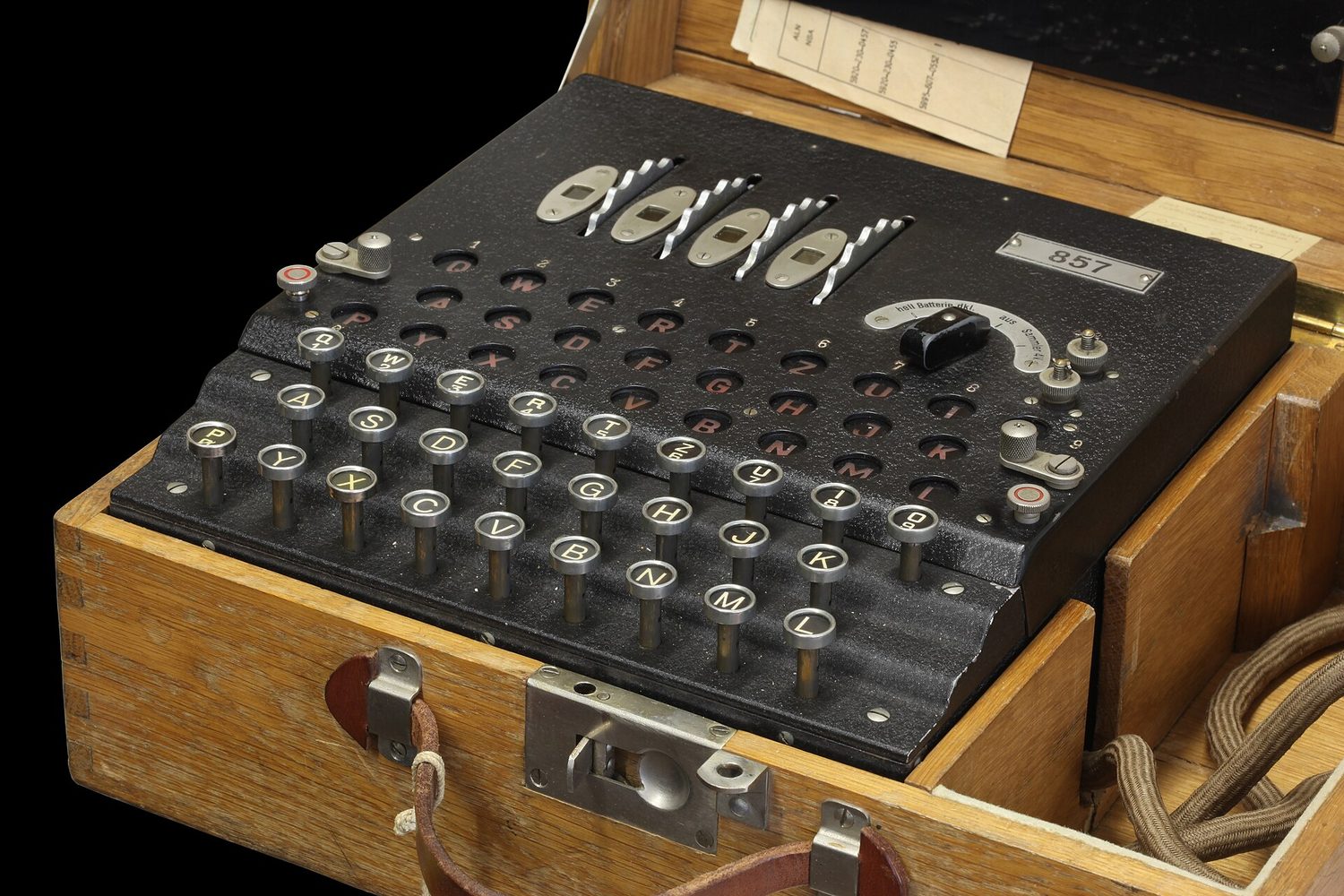
The Enigma machine scrambled messages with rotors— an early, breakable example of encryption
Mã hóa đối xứng sử dụng...
Độ khó 1/5 · 100 xu + một phần thưởng nhỏ cho lần hoàn thành đầu tiên trong ngày
Đối xứng = một khóa chung.
Tiêu chuẩn mã hóa khối đối xứng hiện đại là...
Độ khó 1/5 · 100 xu + một phần thưởng nhỏ cho lần hoàn thành đầu tiên trong ngày
AES là tiêu chuẩn đối xứng.
Kết quả bị xáo trộn của thuật toán mã hóa được gọi là ____.
Độ khó 1/5 · 100 xu + một phần thưởng nhỏ cho lần hoàn thành đầu tiên trong ngày
Mã hóa biến văn bản rõ thành văn bản mã hóa.
Bigger keys, more security
- A larger keyspace takes an adversary longer to guess.
- Longer keys are more secure but slower.
- AES works on 128-bit blocks and secures Wi-Fi, browsing, and files.
Symmetric encryption is fast and strong, but it has one hard problem: both sides must already share the same secret key. Sending that key over an insecure channel would expose it — which is exactly what asymmetric cryptography solves next.
Mã hóa bằng cách dịch chuyển các chữ cái
Mã hóa kết hợp văn bản rõ với một khóa. Ở đây khóa là số lượng dịch chuyển; chỉ người biết nó mới giải mã được.
Không gian khóa lớn hơn làm cho khóa mã hóa khó đoán hơn.
Độ khó 1/5 · 100 xu + một phần thưởng nhỏ cho lần hoàn thành đầu tiên trong ngày
Nhiều khóa có thể = nhiều thời gian đoán.
Một khóa 4-bit có bao nhiêu khóa có thể? (2^4)
Độ khó 2/5 · 140 xu + một phần thưởng nhỏ cho lần hoàn thành đầu tiên trong ngày
$2^4 = 16$ khóa có thể.
A simple Caesar cipher shifts each letter by a fixed key. With key = 3, CAT becomes FDW. Only someone who knows the shift (the key) can turn FDW back into CAT. Real algorithms like AES use far larger keyspaces, but the idea is the same.
Cryptography turns plaintext into ciphertext using a key. A bigger keyspace ($2^n$ for an n-bit key) is harder to break. Symmetric encryption (e.g. AES) uses one shared key — fast and strong, but the shared key must be exchanged safely.