Kết Nối Nhiều Biểu Diễn Khác Nhau Của Giới Hạn
Đã giới thiệu| English | Ý nghĩa |
|---|---|
| graph/ɡræf/ | đồ thị |
| table/ˈteɪbl/ | bảng |
| formula/ˈfɔːmjʊlə/ | công thức |
| representations/ˌreprɪˈzenteɪʃnz/ | biểu diễn |
One limit, four disguises
- A single limit can appear as a graph, a table, a formula, or a sentence in words.
- $\displaystyle\lim_{x\to2}f(x)=3$ is the same fact whether you see a curve heading to $3$, a table closing in on $3$, an algebra result of $3$, or "$f$ approaches $3$ near $2$."
- Fluency means moving between these four representations 表示 without losing the meaning.
- The exam mixes them on purpose — so practice the translation both ways.
Đồ thị, bảng, công thức và lời văn là bốn ____ của cùng một giới hạn.
Độ khó 1/5 · 100 xu + một phần thưởng nhỏ cho lần hoàn thành đầu tiên trong ngày
Tất cả chúng phải kể lại một câu chuyện nhất quán.
Graph ⇄ words
- From a graph 图像: trace both sides toward $c$ and read the shared height.
- Into words: "the left and right limits agree at $3$, so the limit is $3$" — even if the plotted point sits elsewhere.
- A jump on the graph becomes "the one-sided limits differ, so the limit does not exist."
- Practice describing a graph's behavior in one precise sentence.
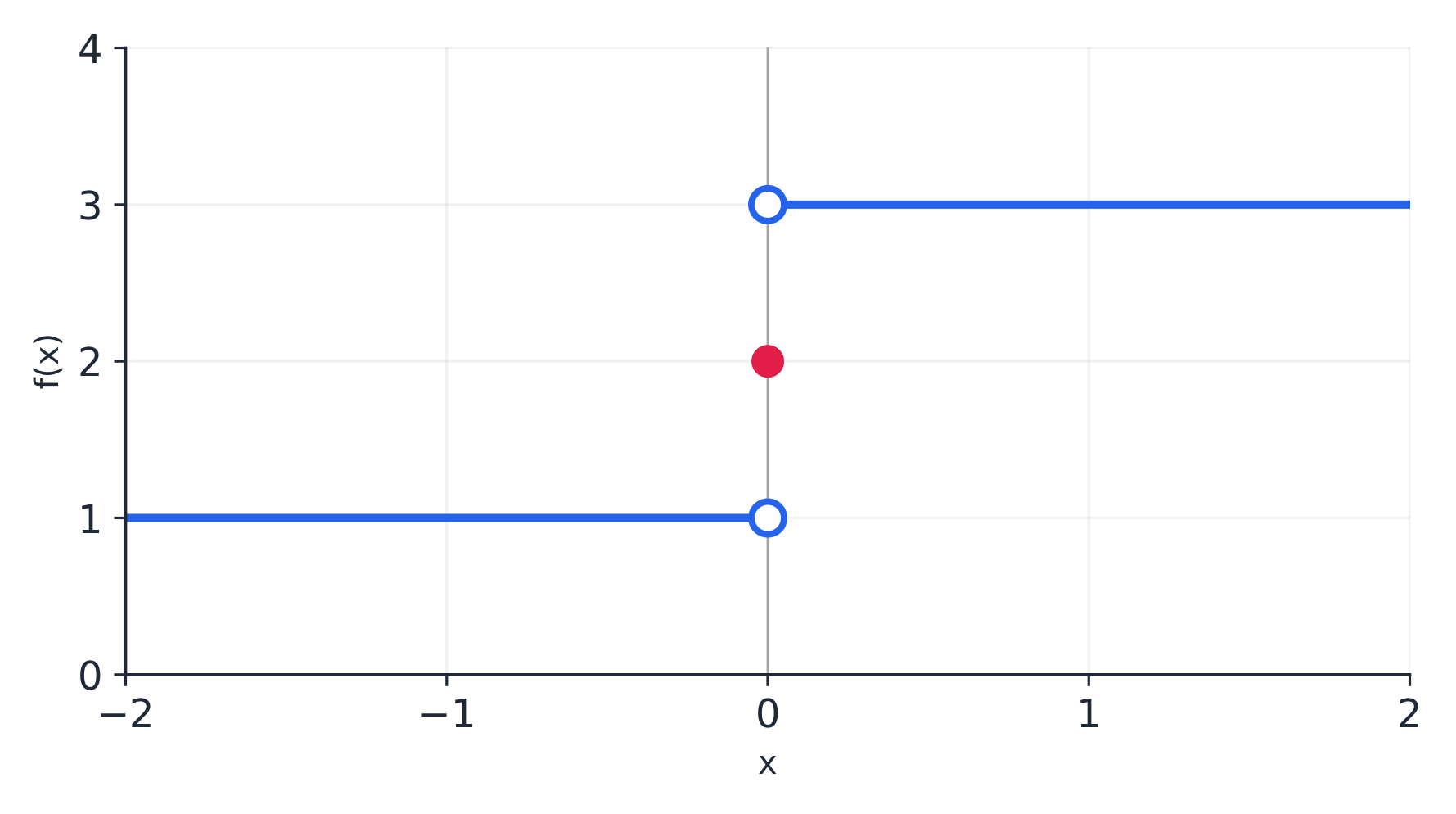
One-sided limits disagree: from the left f approaches 1 and from the right 3 so the limit at 0 does not exist
Biểu diễn đồ thị
y = ax² + bx + c
Đường cong này cũng có thể được giao cho bạn dưới dạng bảng hoặc công thức — hãy đọc hành vi của nó gần một điểm và mô tả bằng lời.
Đồ thị cho thấy đường cong tiến tới độ cao $3$ từ cả hai phía của $x=2$, với chấm đặc tại $(2,7)$. Câu nào phù hợp?
Độ khó 1/5 · 100 xu + một phần thưởng nhỏ cho lần hoàn thành đầu tiên trong ngày
Cách tiếp cận của đường cong cho ra giới hạn $3$; chấm đặc cho ra giá trị riêng biệt $f(2)=7$.
Table ⇄ formula
- From a table 表格: watch the outputs converge; that shared number is your numerical estimate.
- Confirm it with the formula by factoring or substituting — algebra turns the estimate into certainty.
- If the table and the algebra agree, you have strong, cross-checked evidence.
- If they disagree, recheck your inputs — a table can be fooled, algebra usually cannot.
Bảng cho $f(1.99)=4.98$, $f(2.01)=5.02$. Báo cáo ước lượng số học của $\lim_{x\to2}f(x)$.
Độ khó 2/5 · 140 xu + một phần thưởng nhỏ cho lần hoàn thành đầu tiên trong ngày
Cả hai phía đều hội tụ về $5$.
Let representations check each other
- The real skill: use one representation to confirm a limit found from another.
- Found $L$ by algebra? Sketch the graph or build a quick table to sanity-check.
- Read $L$ off a graph? Verify with substitution if a formula is available.
- Choose the most informative representation for the question — sometimes a picture is instant, sometimes algebra is exact.
Một thói quen tốt là xác nhận giới hạn đại số bằng bảng giá trị nhanh hoặc đồ thị.
Độ khó 1/5 · 100 xu + một phần thưởng nhỏ cho lần hoàn thành đầu tiên trong ngày
So sánh chéo giữa các biểu diễn giúp phát hiện lỗi.
Biểu diễn nào cho ra giá trị chính xác của giới hạn (không chỉ ước lượng)?
Độ khó 1/5 · 100 xu + một phần thưởng nhỏ cho lần hoàn thành đầu tiên trong ngày
Đại số mang lại sự chắc chắn; bảng và đồ thị chỉ đưa ra ước lượng hoặc minh họa.
Nếu đại số nói giới hạn là $4$ nhưng đồ thị rõ ràng tiến tới $2$, bạn nên làm gì?
Độ khó 2/5 · 140 xu + một phần thưởng nhỏ cho lần hoàn thành đầu tiên trong ngày
Sự mâu thuẫn có nghĩa là có lỗi — hãy tìm ra. Lấy trung bình hay chọn cái dễ là hoàn toàn không hợp lệ.
The four representations must tell a consistent story. If your algebra says the limit is $4$ but the graph clearly heads to $2$, one of them is wrong — most often a sign slip in the algebra or misreading the graph's open vs. filled dot. Don't ignore the clash; find the error.
Confirm $\displaystyle\lim_{x\to1}\dfrac{x^2+4x-5}{x-1}$ using two representations.
- Analytical: factor $\dfrac{(x-1)(x+5)}{x-1}=x+5$, so the limit is $1+5=6$.
- Numerical: $f(0.99)=5.99$, $f(1.01)=6.01$ — the table closes in on $6$ from both sides.
- The formula gives certainty and the table confirms it: consistent story, answer $6$.
A limit lives in four representations — graph, table, formula, words — and they must agree. Translate fluently between them, and use one to confirm another: algebra for certainty, a graph or table for a fast sanity-check. A disagreement means an error to hunt down.