Xác Định Giới Hạn Bằng Biến Đổi Đại Số
Đã giới thiệu| English | Ý nghĩa |
|---|---|
| equivalent/ɪˈkwɪvələnt/ | tương đương |
| factoring/ˈfæktərɪŋ/ | phân tích nhân tử |
| conjugate/ˈkɒndʒuːɡeɪt/ | biểu thức liên hợp |
$\tfrac00$ is a locked door — algebra is the key
- Direct substitution just gave you $\dfrac00$. Do not give up — rewrite the function first.
- The trick: find an equivalent 等价 expression that agrees with the original everywhere except the troublesome point.
- Since a limit ignores the single point $x=c$, the rewritten function has the same limit.
- Three tools do almost all the work: factor, rationalize, and combine fractions.
Biến đổi đại số thay thế hàm số ban đầu bằng một hàm số ____ phù hợp ở mọi nơi trừ điểm đã loại bỏ.
Độ khó 1/5 · 100 xu + một phần thưởng nhỏ cho lần hoàn thành đầu tiên trong ngày
Cùng các giá trị ngoài lỗ hổng nghĩa là cùng giới hạn.
Tool 1 — factor and cancel
- A $\tfrac00$ in a rational function means $(x-c)$ divides both top and bottom.
- Use factoring 因式分解 on each, cancel the common $(x-c)$, then substitute.
- $\displaystyle\lim_{x\to 3}\frac{x^2-9}{x-3}=\lim_{x\to 3}\frac{(x-3)(x+3)}{x-3}=\lim_{x\to 3}(x+3)=6$.
- The cancelled form is identical to the original for every $x\neq 3$ — exactly where the limit lives.
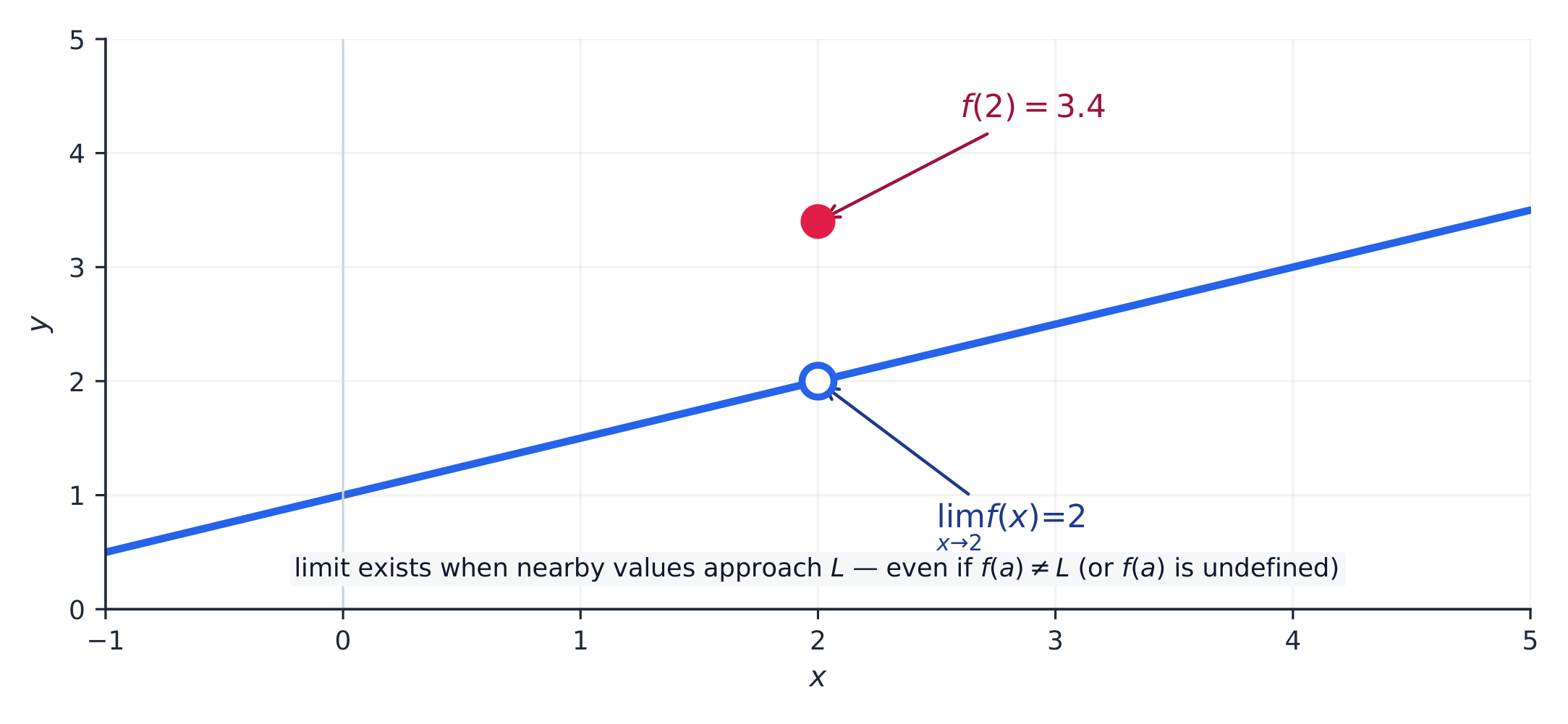
The limit at x = 2 is the height the graph approaches, even though f(2) is defined elsewhere
Đường cong trơn tru ngoại trừ tại lỗ hổng
y = x + 3 (từ việc rút gọn (x−3))
Sau khi phân tích và rút gọn, đồ thị trở thành đường cong thông thường với một điểm bị thiếu duy nhất — giới hạn đọc được từ khoảng trống đó.
Tính $\displaystyle\lim_{x\to 4}\dfrac{x^2-16}{x-4}$.
Độ khó 2/5 · 140 xu + một phần thưởng nhỏ cho lần hoàn thành đầu tiên trong ngày
Phân tích: $\frac{(x-4)(x+4)}{x-4}=x+4\to 8$.
Tool 2 — rationalize the root
- When a square root causes the $\tfrac00$, multiply top and bottom by the conjugate 共轭式.
- This clears the root and exposes a cancellable factor.
- $\displaystyle\lim_{x\to 0}\frac{\sqrt{x+4}-2}{x}=\lim_{x\to 0}\frac{(\sqrt{x+4}-2)(\sqrt{x+4}+2)}{x(\sqrt{x+4}+2)}=\lim_{x\to 0}\frac{x}{x(\sqrt{x+4}+2)}=\frac14$.
Giới hạn $\displaystyle\lim_{x\to 0}\dfrac{\sqrt{x+9}-3}{x}$ được xử lý tốt nhất bằng cách...
Độ khó 1/5 · 100 xu + một phần thưởng nhỏ cho lần hoàn thành đầu tiên trong ngày
Căn thức gây ra $\tfrac00$ đòi hỏi lượng liên hợp; ở đây giới hạn là $\tfrac16$.
Tính $\displaystyle\lim_{x\to 0}\dfrac{\sqrt{x+4}-2}{x}$.
Độ khó 2/5 · 140 xu + một phần thưởng nhỏ cho lần hoàn thành đầu tiên trong ngày
Trục căn thức để đưa về $\frac{1}{\sqrt{x+4}+2}\to\frac{1}{4}$.
Tool 3 — combine the fractions
- A difference of fractions like $\dfrac{1}{x+2}-\dfrac12$ over $x$ hides a factor once you use a common denominator.
- Combine into a single fraction, simplify, and the $(x-c)$ cancels.
- After any of these moves, finish with direct substitution — the door is now unlocked.
- Whichever tool you use, you are producing an equivalent function that lets substitution succeed.
Chọn tất cả các công cụ đại số có thể giải quyết giới hạn $\tfrac00$.
Độ khó 2/5 · 140 xu + một phần thưởng nhỏ cho lần hoàn thành đầu tiên trong ngày
Ba phương pháp đầu tiên là phép viết lại hợp lệ; làm tròn không phải là kỹ thuật hợp lệ.
Cancelling $(x-c)$ changes the function at exactly one point: the rewritten expression is defined at $c$ while the original has a hole there. That is fine for the limit (which never looks at $x=c$), but do not claim the two functions are identical — they differ at the removed point.
Sau khi rút $(x-3)$, hàm số đơn giản hóa hoàn toàn giống với hàm gốc tại mọi điểm bao gồm cả $x=3$.
Độ khó 1/5 · 100 xu + một phần thưởng nhỏ cho lần hoàn thành đầu tiên trong ngày
Chúng đồng nhất ở mọi nơi trừ $x=3$, nơi hàm gốc có một lỗ hổng. Giới hạn không bị ảnh hưởng, nhưng hai hàm số khác nhau tại đó.
Find $\displaystyle\lim_{x\to -1}\frac{x^2-1}{x^2+3x+2}$.
- Substitution gives $\tfrac00$ — factor both.
- $\dfrac{(x-1)(x+1)}{(x+1)(x+2)}=\dfrac{x-1}{x+2}$ for $x\neq -1$.
- Substitute: $\dfrac{-1-1}{-1+2}=\dfrac{-2}{1}=-2$.
When substitution gives $\tfrac00$, rewrite the function into an equivalent form that agrees everywhere except at $c$: factor and cancel, rationalize with a conjugate, or combine fractions. Then substitute. The rewrite has the same limit because a limit ignores the single removed point.