Lumped parameters: five subjects, one equation
แนะนำใหม่| English | ความหมาย |
|---|---|
| control/kənˈtrəʊl/ | Making a system's output follow a desired value, usually by measuring it and correcting the input. |
| lumped parameters | Idealised elements, such as a mass, a spring or a damper, that each represent one property of a real system. |
| transfer function | The Laplace transform of a linear system's output divided by that of its input, with zero initial conditions. |
| time constant/taɪm ˈkɒnstənt/ | The characteristic time for an exponential process to change by a factor of e; in decay, the quantity falls to one over e of its starting value. |
| state-space form | A model written as first-order equations, dx/dt = Ax + Bu, for the system's state variables. |
| Linearisation/ˌlɪnɪəraɪˈzeɪʃn/ | Replacing a nonlinear equation by its tangent at an operating point, valid for small departures from that point. |
Masses, circuits and tanks of water
- A control designer meets masses on springs, circuits, motors and tanks of hot water. With lumped parameters they become one subject: each effect sits in one ideal element.
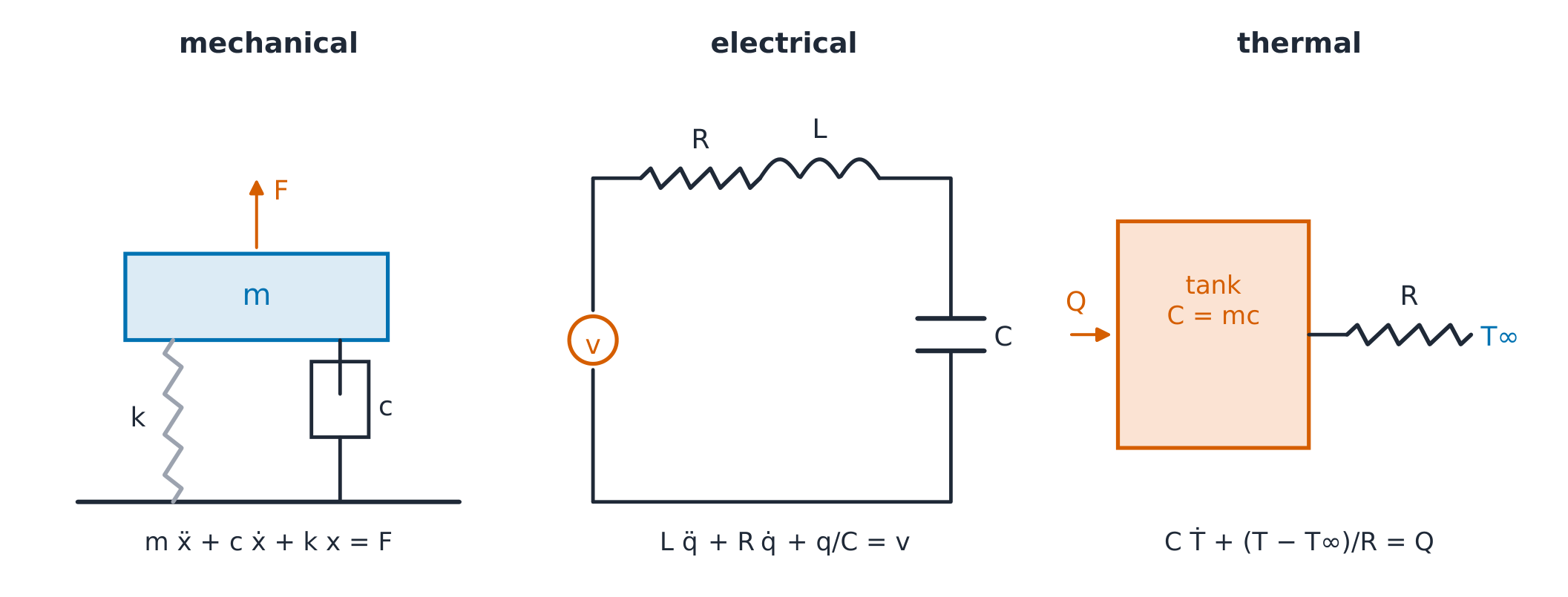
- Each domain has an effort (force, voltage, temperature) and a flow (velocity, current, heat flow). Elements store energy in two ways and dissipate it in one.
From equation to transfer function
- Laplace with zero initial conditions turns $m\ddot x + c\dot x + kx = F$ into $G(s) = X/F = 1/(ms^2 + cs + k)$: the transfer function.
- The heated tank, $C\dot T + (T - T_\infty)/R = Q$, gives $R/(RCs + 1)$: a first-order lag with time constant $\tau = RC$.
Store or dissipate?
Sort each element by what it does with energy.
The loop's reservoir
- 200 L of water: $C = 200 \times 4180 = \mathbf{836}$ kJ/K. It loses heat through $UA = 100$ W/K, so $R = \mathbf{0.01}$ K/W.
- $\tau = RC = \mathbf{8360}$ s, 2.3 hours. 1 kW eventually raises it $QR = \mathbf{10}$ K: 63% after 2.3 h, 95% after 7 h.
- Assumptions: well mixed, constant $UA$, no heat stored in the wall.
Thermal capacitance of 200 kg of water, c = 4180 (kJ/K)?
ความยาก 2/5 · 140 เหรียญ + บอนัสน้อยๆ เมื่อทำสำเร็จครั้งแรกในวันนี้
m c.
Time constant with R = 0.01 K/W (s)?
ความยาก 2/5 · 140 เหรียญ + บอนัสน้อยๆ เมื่อทำสำเร็จครั้งแรกในวันนี้
R C.
Final temperature rise for 1 kW (K)?
ความยาก 2/5 · 140 เหรียญ + บอนัสน้อยๆ เมื่อทำสำเร็จครั้งแรกในวันนี้
Q R.
After one time constant a first-order lag reaches:
ความยาก 1/5 · 100 เหรียญ + บอนัสน้อยๆ เมื่อทำสำเร็จครั้งแรกในวันนี้
1 - e^-1.
The pump mount in state space
- The state-space form $\dot{\mathbf x} = \mathbf A\mathbf x + \mathbf Bu$ with $x_1 = x$, $x_2 = \dot x$: $\mathbf A$ has rows $(0, 1)$ and $(-2500, -7.58)$.
- Its eigenvalues are $-3.79 \pm 49.86j$: the same decay rate and frequency as the tap test. One form now holds the mount and the motor.
Entry A21 = -k/m for 300 kN/m and 120 kg?
ความยาก 2/5 · 140 เหรียญ + บอนัสน้อยๆ เมื่อทำสำเร็จครั้งแรกในวันนี้
-300 000 over 120.
Linearise before you transform
- A tank draining through an orifice obeys $A\dot h = Q_{in} - k\sqrt h$: the square root rules out Laplace. Linearisation 线性化 replaces it by its tangent at the operating point, $k\sqrt h \approx k\sqrt{h_0} + \delta h/R$ with $R = 2\sqrt{h_0}/k$.
- For a 0.5 m² tank holding 1 m while passing 2 L/s, $k = 0.002$, $R = \mathbf{1000}$ s/m² and $\tau = AR = \mathbf{500}$ s. The model holds for small departures from 1 m only.
Orifice tank $A\dot h = Q_{in} - k\sqrt h$ with $k = 0.002$ at $h_0 = 1$ m and $A = 0.5$ m²: time constant of the linearised model (s)?
ความยาก 2/5 · 140 เหรียญ + บอนัสน้อยๆ เมื่อทำสำเร็จครั้งแรกในวันนี้
$R = 2\sqrt{h_0}/k = 1000$ s/m²; $\tau = AR = 500$ s.
The mount matrix with rows $(0, 1)$ และ $(-2500, -7.58)$ has $\omega_n = 50$ rad/s and $\zeta \approx 0.076$.
ความยาก 1/5 · 100 เหรียญ + บอนัสน้อยๆ เมื่อทำสำเร็จครั้งแรกในวันนี้
The second row is $(-\omega_n^2, -2\zeta\omega_n)$: $\omega_n = \sqrt{2500} = 50$, $\zeta = 7.58/100 = 0.076$.
Worked example: one hour of heating
- Switch the 1 kW heater on the 200 L reservoir for one hour. A first-order lag rises as $\Delta T = QR(1 - e^{-t/\tau})$.
- $t/\tau = 3600/8360 = 0.431$, so $\Delta T = 10(1 - 0.650) = \mathbf{3.50}$ K, only 35% of the final 10 K. Switched off, it decays with the same 2.3 h time constant.
Reservoir $\tau = 8360$ s, final rise 10 K for 1 kW: rise after one hour (two decimals, K)?
ความยาก 2/5 · 140 เหรียญ + บอนัสน้อยๆ เมื่อทำสำเร็จครั้งแรกในวันนี้
$10(1 - e^{-3600/8360}) = 10(1 - 0.650) = 3.50$ K.
Three modelling slips
- A lump without its assumption. A tank has one temperature only if it is mixed.
- Laplace on a nonlinear model. Linearise first.
- Non-zero initial conditions in $G(s)$. The transfer function assumes zero.
A transfer function can be taken of a nonlinear model as it stands.
ความยาก 1/5 · 100 เหรียญ + บอนัสน้อยๆ เมื่อทำสำเร็จครั้งแรกในวันนี้
Linearise about an operating point first.
Recap
- $G(s)$ = output over input, zero initial conditions.
- Tank: $R/(RCs + 1)$, $\tau = 8360$ s, final rise 10 K for 1 kW.
- Mount: eigenvalues of $\mathbf A$ are $-3.79 \pm 49.86j$.