Heat exchangers: LMTD to size, NTU to rate
แนะนำใหม่| English | ความหมาย |
|---|---|
| plate heat exchanger | A heat exchanger made of thin corrugated plates with the two fluids flowing in alternate gaps. |
| overall heat transfer coefficient | The coefficient U that combines all the resistances between two fluids, so that Q = UAΔT. |
| log mean temperature difference | The correct average temperature difference for a heat exchanger, found from the end differences. |
| counterflow | A heat-exchanger arrangement in which the two fluids flow in opposite directions. |
| parallel flow | A heat-exchanger arrangement in which the two fluids flow in the same direction. |
| effectiveness–NTU method | A heat-exchanger method that finds the heat duty from the number of transfer units when outlet temperatures are unknown. |
| effectiveness/ɪˈfektɪvnəs/ | The actual heat transfer in a heat exchanger divided by the largest possible heat transfer. |
| fouling resistance | The extra thermal resistance from deposits that build up on heat-exchanger surfaces in service. |
Too small overheats, too large wastes
- The loop is cooled by a plate heat exchanger. Size it too small and the pump motor overheats; too large and money is wasted.
- The duty is $Q = UA\,\Delta T_{lm}$, with the overall heat transfer coefficient $U$ and the log mean temperature difference $\Delta T_{lm} = (\Delta T_1 - \Delta T_2)/\ln(\Delta T_1/\Delta T_2)$.
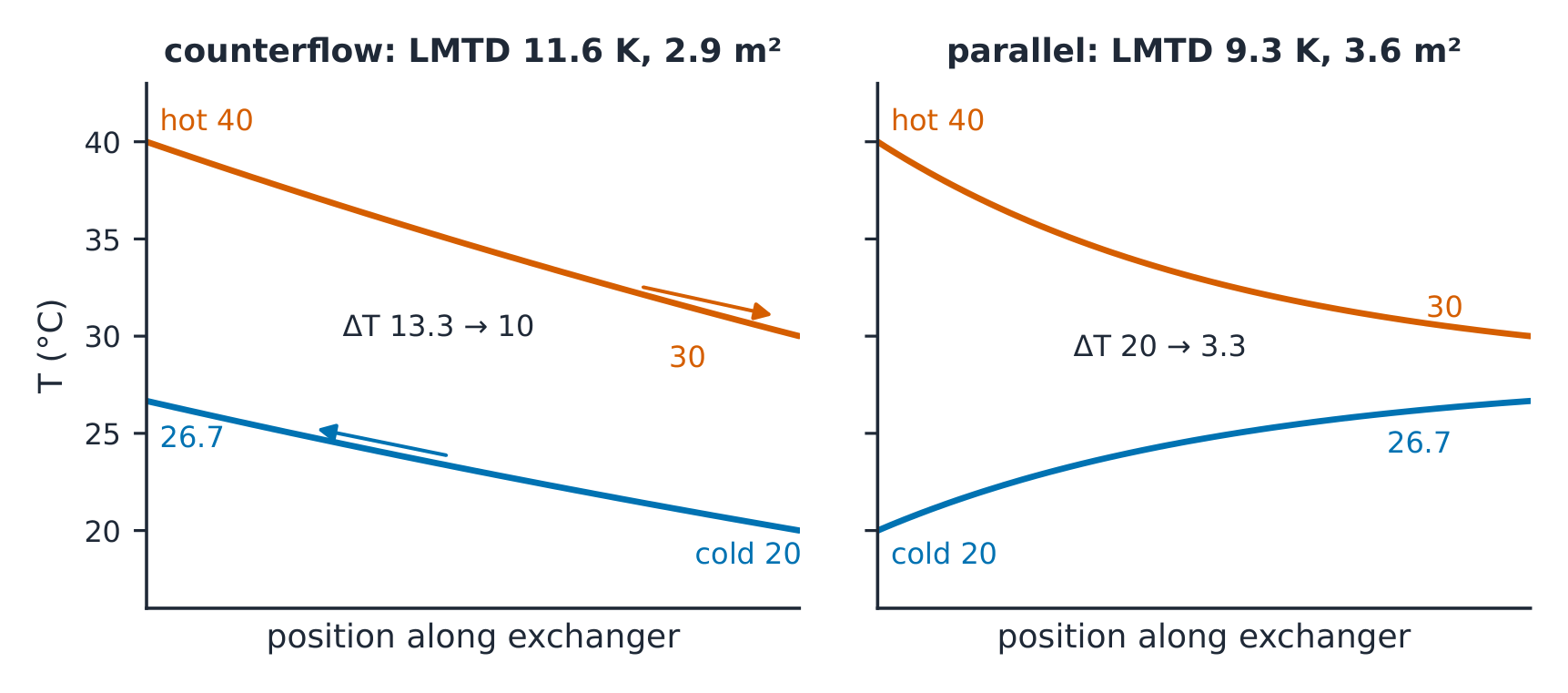
For the same duty, counterflow needs:
ความยาก 1/5 · 100 เหรียญ + บอนัสน้อยๆ เมื่อทำสำเร็จครั้งแรกในวันนี้
It keeps the streams closer in temperature along the length.
Sizing by LMTD
- Loop water 2.0 kg/s cooled from 40 to 30 °C: $Q = \mathbf{83.6}$ kW. Plant water 3.0 kg/s enters at 20 °C and leaves at 26.7 °C.
- Counterflow ends are 13.3 and 10 K, so $\Delta T_{lm} = \mathbf{11.6}$ K; with $U = 2500$, $A = \mathbf{2.89}$ m².
- Parallel flow (ends 20 and 3.3 K) gives 9.3 K and 3.59 m², 25% more.
Duty cooling 2.0 kg/s of water from 40 to 30 degrees C, c = 4180 (one decimal, kW)?
ความยาก 2/5 · 140 เหรียญ + บอนัสน้อยๆ เมื่อทำสำเร็จครั้งแรกในวันนี้
m c delta T.
LMTD for end differences of 13.3 and 10 K (one decimal, K)?
ความยาก 2/5 · 140 เหรียญ + บอนัสน้อยๆ เมื่อทำสำเร็จครั้งแรกในวันนี้
(13.3 - 10) over ln(1.33).
Area with U = 2500 W/m2K (two decimals, m2)?
ความยาก 2/5 · 140 เหรียญ + บอนัสน้อยๆ เมื่อทำสำเร็จครั้งแรกในวันนี้
Q over U times LMTD.
The effectiveness–NTU method
- When outlets are unknown, rate by effectiveness: $\varepsilon = Q/Q_{max}$, with $Q_{max} = C_{min}(T_{h,i} - T_{c,i})$.
- With $NTU = UA/C_{min}$ and $C_r = C_{min}/C_{max}$, counterflow gives $\varepsilon = (1 - e^{-NTU(1 - C_r)})/(1 - C_re^{-NTU(1 - C_r)})$.
LMTD or NTU?
Choose the method for each exchanger question.
Q_max uses the larger heat-capacity rate.
ความยาก 1/5 · 100 เหรียญ + บอนัสน้อยๆ เมื่อทำสำเร็จครั้งแรกในวันนี้
It uses C_min.
A year of scale
- A 3.0 m² unit, clean: $NTU = 0.897$, $\varepsilon = 0.511$, $Q = \mathbf{85.5}$ kW, which meets the duty.
- Fouling resistance $R_f = 0.0002$ m²K/W drops $U$ to 1667: $\varepsilon = 0.398$ and $Q = \mathbf{66.6}$ kW, short. Sizing on the fouled $U$ needs 4.33 m².
U after fouling R_f = 0.0002 added to 1/2500 (W/m2K, whole number)?
ความยาก 2/5 · 140 เหรียญ + บอนัสน้อยๆ เมื่อทำสำเร็จครั้งแรกในวันนี้
One over 0.0006.
The ceiling of each arrangement
- Make the exchanger endlessly large ($NTU \to \infty$). Counterflow approaches $\varepsilon = 1$: the cold stream can leave as hot as the hot one entered.
- Parallel flow stalls at $\varepsilon = 1/(1 + C_r) = 1/(1 + 0.667) = \mathbf{0.60}$: both streams meet at one mixed temperature. No amount of area beats that.
Parallel flow with $C_r = 0.667$: the highest possible effectiveness (two decimals)?
ความยาก 2/5 · 140 เหรียญ + บอนัสน้อยๆ เมื่อทำสำเร็จครั้งแรกในวันนี้
$1/(1 + 0.667) = 0.60$.
Given enough area, a parallel-flow exchanger can match counterflow.
ความยาก 1/5 · 100 เหรียญ + บอนัสน้อยๆ เมื่อทำสำเร็จครั้งแรกในวันนี้
Parallel flow tends to $\varepsilon = 1/(1 + C_r)$, 0.60 here; counterflow tends to 1.
Worked example: outlets from effectiveness
- The clean 3.0 m² unit transfers $Q = 85.5$ kW. The loop water leaves at $40 - 85\,500/8360 = \mathbf{29.8}$ °C, just under its 30 °C target.
- The plant water leaves at $20 + 85\,500/12\,540 = 26.8$ °C. Effectiveness–NTU rates an existing unit directly, without guessing outlets first.
Clean unit, $Q = 85.5$ kW, hot side $C = 8360$ W/K entering at 40 °C: hot outlet (one decimal, °C)?
ความยาก 2/5 · 140 เหรียญ + บอนัสน้อยๆ เมื่อทำสำเร็จครั้งแรกในวันนี้
$40 - 85\,500/8360 = 29.8$ °C.
Three exchanger slips
- Arithmetic mean instead of LMTD. It overstates the driving difference.
- Sizing on clean $U$. The unit falls short after a year.
- Swapping $C_{min}$ and $C_{max}$. $Q_{max}$ uses the smaller one.
Recap
- $Q = UA\Delta T_{lm}$: 83.6 kW needs 2.89 m² in counterflow.
- $\varepsilon = Q/C_{min}\Delta T_{max}$ from $NTU$ and $C_r$.
- Size on fouled $U$: 4.33 m².