Load paths and safety factors: every link in the chain
แนะนำใหม่| English | ความหมาย |
|---|---|
| load path | The route a force takes through a structure from where it is applied to where it is supported. |
| factor of safety | The ratio of a part's strength to the stress it actually carries. |
The link nobody checked
- Most machine failures happen at a link nobody checked: a key, a weld, a bolt. Tracing the load path from source to ground lists every link that needs a calculation.
- For the pump drive: motor torque, gear mesh, shaft, bearings, housing, flange bolts, base frame, floor. Each arrow is an interface, and each interface can fail.
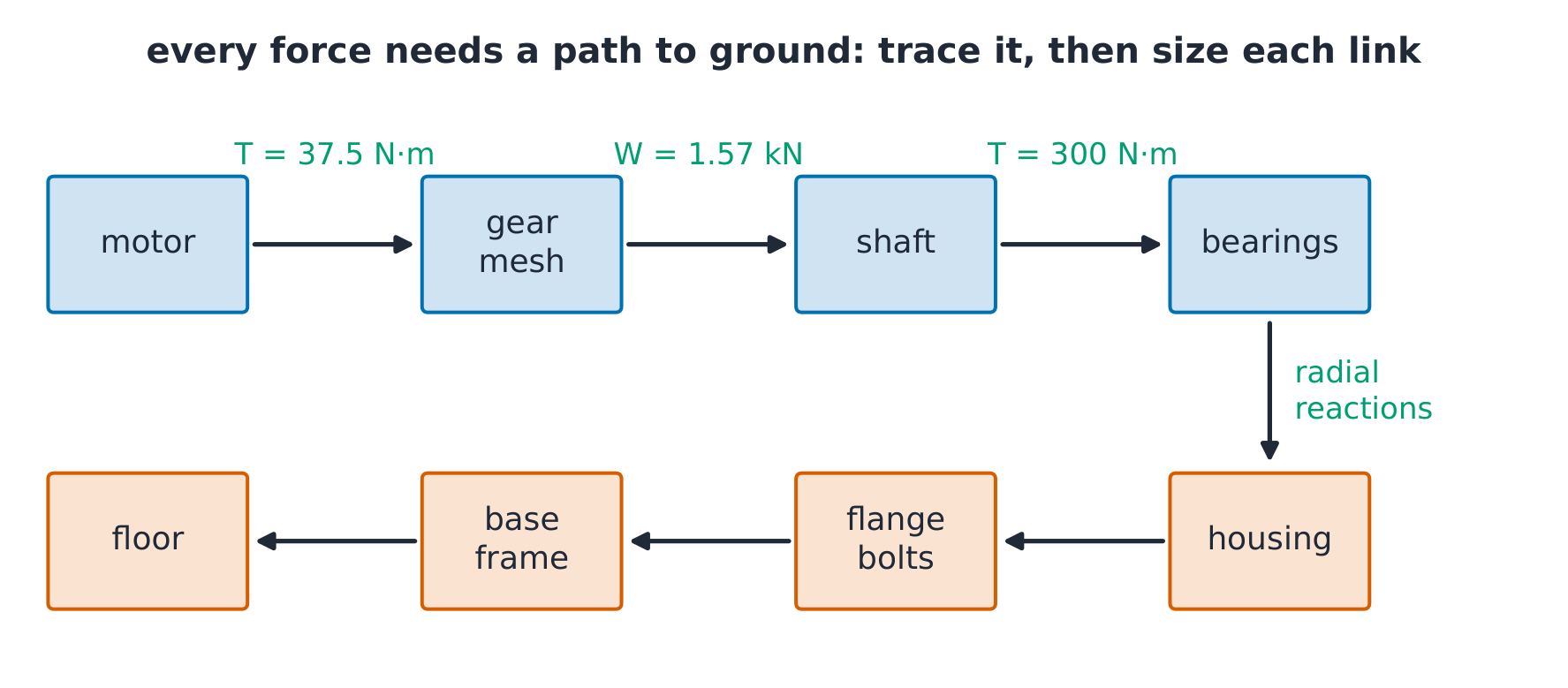
A load path ends at the part you are designing.
ความยาก 1/5 · 100 เหรียญ + บอนัสน้อยๆ เมื่อทำสำเร็จครั้งแรกในวันนี้
It runs all the way to the ground.
A factor of safety you can explain
- The factor of safety is $n = \text{strength}/\text{stress}$. Build it from named uncertainties: load 20% high, material 15% weak, model 10% optimistic.
- They multiply: $n = 1.2 \times 1.15 \times 1.1 = \mathbf{1.52}$. A single "use 2" hides what it covers.
Which link, which check?
Match each link of the drive to the check it needs.
Safety factor from 1.2 x 1.15 x 1.1 (two decimals)?
ความยาก 2/5 · 140 เหรียญ + บอนัสน้อยๆ เมื่อทำสำเร็จครั้งแรกในวันนี้
Multiply the named factors.
A duty cycle becomes one load
- The bearing side load is 2 kN for 60% of the time, 3 kN for 30% and 5 kN for 10%.
- Ball-bearing life goes as $1/P^3$, so take the cube mean: $P_{eq} = (0.6 \times 8 + 0.3 \times 27 + 0.1 \times 125)^{1/3} = \mathbf{2.94}$ kN.
- The plain average is only 2.6 kN: the rare 5 kN peaks do most of the damage.
Cube-mean of 2 kN (60%), 3 kN (30%), 5 kN (10%) (two decimals, kN)?
ความยาก 2/5 · 140 เหรียญ + บอนัสน้อยๆ เมื่อทำสำเร็จครั้งแรกในวันนี้
Cube root of 25.4.
The cube-mean load is above the plain average because:
ความยาก 1/5 · 100 เหรียญ + บอนัสน้อยๆ เมื่อทำสำเร็จครั้งแรกในวันนี้
Life falls with the cube of the load.
Forces along the path
- The motor gives $T = 300/8 = \mathbf{37.5}$ N·m at the 51 mm pinion, so the tooth force is $W_t = 2T/d = \mathbf{1471}$ N and $W_r = W_t\tan20° = \mathbf{535}$ N.
- The total, 1565 N, is reacted by the bearings: 1.02 kN and 0.55 kN for a gear 70 mm from one bearing on a 200 mm span.
Pinion torque with 300 N m at the output and an 8:1 ratio (one decimal, N m)?
ความยาก 2/5 · 140 เหรียญ + บอนัสน้อยๆ เมื่อทำสำเร็จครั้งแรกในวันนี้
300 over 8.
Tangential tooth force at a 51 mm pitch diameter (N, whole number)?
ความยาก 2/5 · 140 เหรียญ + บอนัสน้อยๆ เมื่อทำสำเร็จครั้งแรกในวันนี้
2T over d.
Radial force at a 20 degree pressure angle (N, whole number)?
ความยาก 2/5 · 140 เหรียญ + บอนัสน้อยๆ เมื่อทำสำเร็จครั้งแรกในวันนี้
W_t tan 20.
Torque multiplies, speed divides
- Power is conserved along the path, less losses: $P = T\omega$. The pinion's 37.5 N·m at 1440 rpm and the output's 300 N·m at 180 rpm both carry $\mathbf{5.65}$ kW.
- So each link after the gear sees eight times the torque. The output key, not the motor key, is the one that needs checking.
37.5 N·m at 1440 rpm: power (two decimals, kW)?
ความยาก 2/5 · 140 เหรียญ + บอนัสน้อยๆ เมื่อทำสำเร็จครั้งแรกในวันนี้
$37.5 \times 1440 \times 2\pi/60 = 5655$ W.
Worked example: the key on the output shaft
- 300 N·m on the 30 mm shaft pushes the key sideways with $F = 2T/d = 20$ kN. An 8 × 7 mm key, 40 mm long, shears over $8 \times 40$ mm²: $\tau = \mathbf{62.5}$ MPa.
- It crushes against half its height, $40 \times 3.5$ mm²: $\sigma = \mathbf{142.9}$ MPa. Key steel at 350 MPa yield and $n = 1.52$ allows 132.9 in shear and 230 in crushing: it passes both.
300 N·m on a 30 mm shaft through an 8 mm wide, 40 mm long key: shear stress (one decimal, MPa)?
ความยาก 2/5 · 140 เหรียญ + บอนัสน้อยๆ เมื่อทำสำเร็จครั้งแรกในวันนี้
$F = 2 \times 300/0.030 = 20$ kN; $20\,000/(8 \times 40) = 62.5$ MPa.
Same key, 7 mm tall, bearing on half its height: crushing stress (one decimal, MPa)?
ความยาก 2/5 · 140 เหรียญ + บอนัสน้อยๆ เมื่อทำสำเร็จครั้งแรกในวันนี้
$20\,000/(40 \times 3.5) = 142.9$ MPa.
Three load-path slips
- The shaft checked, the key and bolts forgotten. Every link needs its own check.
- The average load in a non-linear life law. Use the cube mean for ball bearings.
- A safety factor chosen before the uncertainties are listed. Name them first.
Recap
- Trace the path and size every link.
- $n = n_L n_S n_M = 1.52$ from named uncertainties.
- Cube-mean duty load 2.94 kN; mesh forces 1471 N tangential and 535 N radial.