Axial loading: stress, strain and held-cold rods
แนะนำใหม่| English | ความหมาย |
|---|---|
| normal stress | The force component perpendicular to a section per unit area, with a uniform average equal to axial force divided by area. |
| strain/streɪn/ | The fractional change in a dimension, such as extension divided by original length. |
| Poisson's ratio | The negative ratio of transverse strain to axial strain under uniaxial loading in the elastic regime. |
Pull on it
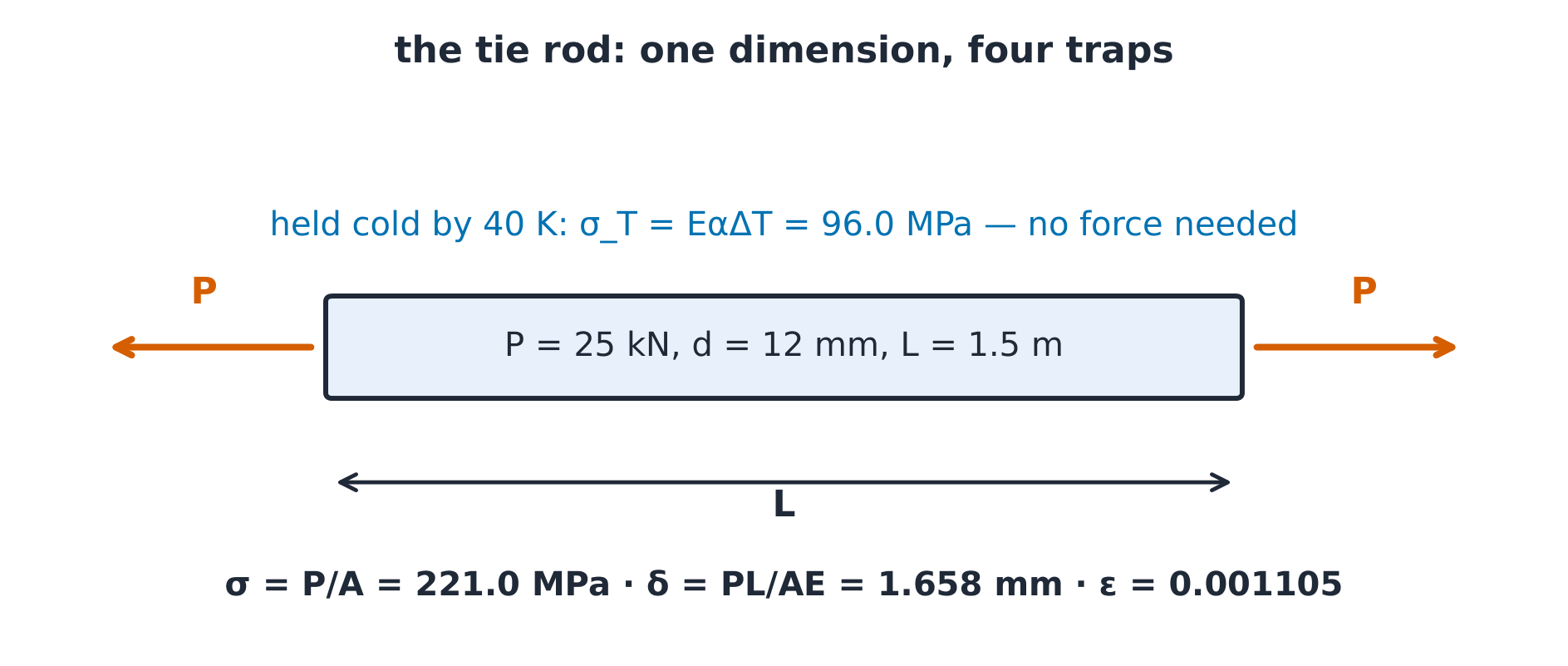
- The running case is the bracket's tie rod: $d = 12\ \mathrm{mm}$ steel, $L = 1.5\ \mathrm{m}$, carrying $P = 25\ \mathrm{kN}$ tension. Normal stress 正应力 is $\sigma = P/A$ and strain 应变 is $\varepsilon = \delta/L$; Hooke's law $\sigma = E\varepsilon$ ties them with $E = 200\ \mathrm{GPa}$.
- With $A = 1.131 \times 10^{-4}\ \mathrm{m^2}$: $\sigma = \mathbf{221.0}$ MPa - safely under the $250\ \mathrm{MPa}$ yield - and the rod stretches $\delta = PL/AE = \mathbf{1.658}$ mm.
Stress, strain, or constraint?
Route each request to the one-dimensional rule that answers it.
Tie rod d = 12 mm carrying P = 25 kN: normal stress (one decimal, MPa)?
ความยาก 2/5 · 140 เหรียญ + บอนัสน้อยๆ เมื่อทำสำเร็จครั้งแรกในวันนี้
P over pi r squared.
Same rod, L = 1.5 m, E = 200 GPa: elongation (three decimals, mm)?
ความยาก 2/5 · 140 เหรียญ + บอนัสน้อยๆ เมื่อทำสำเร็จครั้งแรกในวันนี้
PL over AE.
The axial strain (six decimals)?
ความยาก 2/5 · 140 เหรียญ + บอนัสน้อยๆ เมื่อทำสำเร็จครั้งแรกในวันนี้
sigma over E.
The squeeze beside the pull
- Poisson's ratio 泊松比 $\nu = 0.30$: pull axially and the sides cinch, $\varepsilon_{lat} = -\nu\varepsilon$. At $\varepsilon = 0.001105$ the lateral strain is $\mathbf{0.000332}$, so the 12 mm diameter thins by $\mathbf{3.98}\ \mu\mathrm{m}$ - small, but it is why press fits loosen under tension.
Lateral strain with nu = 0.30 (six decimals, magnitude)?
ความยาก 2/5 · 140 เหรียญ + บอนัสน้อยๆ เมื่อทำสำเร็จครั้งแรกในวันนี้
nu times epsilon.
Diameter change of the 12 mm rod (two decimals, micrometres, magnitude)?
ความยาก 2/5 · 140 เหรียญ + บอนัสน้อยๆ เมื่อทำสำเร็จครั้งแรกในวันนี้
d times lateral strain.
A rod in tension gets thinner.
ความยาก 1/5 · 100 เหรียญ + บอนัสน้อยๆ เมื่อทำสำเร็จครั้งแรกในวันนี้
Poisson lateral strain is negative in tension.
Held cold
- Fit the same rod between rigid walls and cool it $40\ \mathrm{K}$ ($\alpha = 12 \times 10^{-6}/\mathrm{K}$): it cannot contract, so $\sigma_T = E\alpha\Delta T = \mathbf{96.0}$ MPa tension - a load with no external force anywhere. That is the signature of a statically indeterminate problem: the constraint, not the load, sets the stress.
Held between rigid walls and cooled 40 K (alpha = 12e-6/K): stress (one decimal, MPa)?
ความยาก 2/5 · 140 เหรียญ + บอนัสน้อยๆ เมื่อทำสำเร็จครั้งแรกในวันนี้
E alpha delta-T.
An unrestrained steel rod heated by 40 K carries:
ความยาก 1/5 · 100 เหรียญ + บอนัสน้อยๆ เมื่อทำสำเร็จครั้งแรกในวันนี้
Free expansion produces deformation only; constraint produces stress.
Three axial slips
- Nominal diameter where the thread root governs. The weakest area sizes the rod.
- Thermal strain without constraint. Free expansion produces no stress at all.
- Sign of the lateral strain. Tension thins; compression fattens.
Recap
- $\sigma = P/A = 221.0$ MPa; $\delta = PL/AE = 1.658$ mm; $\varepsilon = 0.001105$.
- $\varepsilon_{lat} = -0.30\,\varepsilon$ thins the rod by 3.98 µm.
- Held cold: $\sigma_T = E\alpha\Delta T = 96.0$ MPa with no force applied.