Frequency: Miller, cascode, cascade
แนะนำใหม่| English | ความหมาย |
|---|---|
| coupling capacitor | ตัวเก็บประจุคู่ |
| Miller capacitance | ความจุของมิลเลอร์ |
| dominant pole | ขั้วหลัก |
| cascode | cascode |
Every amplifier is a band-pass
- An audio amplifier loses the deepest bass and the highest treble, however good it is. Something removes both ends of the spectrum.
- At low frequencies the coupling capacitors block; at high frequencies tiny internal capacitances short the signal. This lesson finds both corners.
The low corner: coupling capacitors
- A coupling capacitor 耦合电容 passes the signal but blocks DC between stages. With the resistance $R_{eq}$ it sees, it forms a high-pass corner $f_{L} = \dfrac{1}{2\pi R_{eq}C}$.
- Find $R_{eq}$ with the sources zeroed. For the earlier CE stage, the input capacitor sees $R_{B} \parallel r_{\pi} = 10.2\,\text{k} \parallel 2.6\,\text{k} = 2.08\,\text{k}\Omega$.
Match each cause to the end of the band it limits.
ความยาก 2/5 · 140 เหรียญ + บอนัสน้อยๆ เมื่อทำสำเร็จครั้งแรกในวันนี้
Series capacitors block slow signals; shunt capacitors short fast ones. Together they make every amplifier a band-pass.
Worked example: f_L
- A 10 µF coupling capacitor on 2.08 kΩ: $f_{L} = \dfrac{1}{2\pi \times 2080 \times 10 \times 10^{-6}} = 7.7\,\text{Hz}$, well below the audio band.
- The resistances are in parallel, not in series. Adding them would give 12.8 kΩ and a corner 6 times too low.
A 1 µF coupling capacitor sees 10 kΩ. What is f_L, in Hz?
ความยาก 2/5 · 140 เหรียญ + บอนัสน้อยๆ เมื่อทำสำเร็จครั้งแรกในวันนี้
$\dfrac{1}{2\pi \times 10^{4} \times 10^{-6}} = 15.9$ Hz.
The Miller effect
- A small capacitance $C$ from the output of an inverting stage (gain $-A$) back to its input carries $C(1 + A)$ times the input's rate of change. The input sees a Miller capacitance 米勒电容 $C_{M} = C(1 + A)$ to ground.
- With $C = 5\,\text{pF}$ and $A = 80$: $C_{M} = 5 \times 81 = 405\,\text{pF}$. A tiny capacitor becomes a large one.
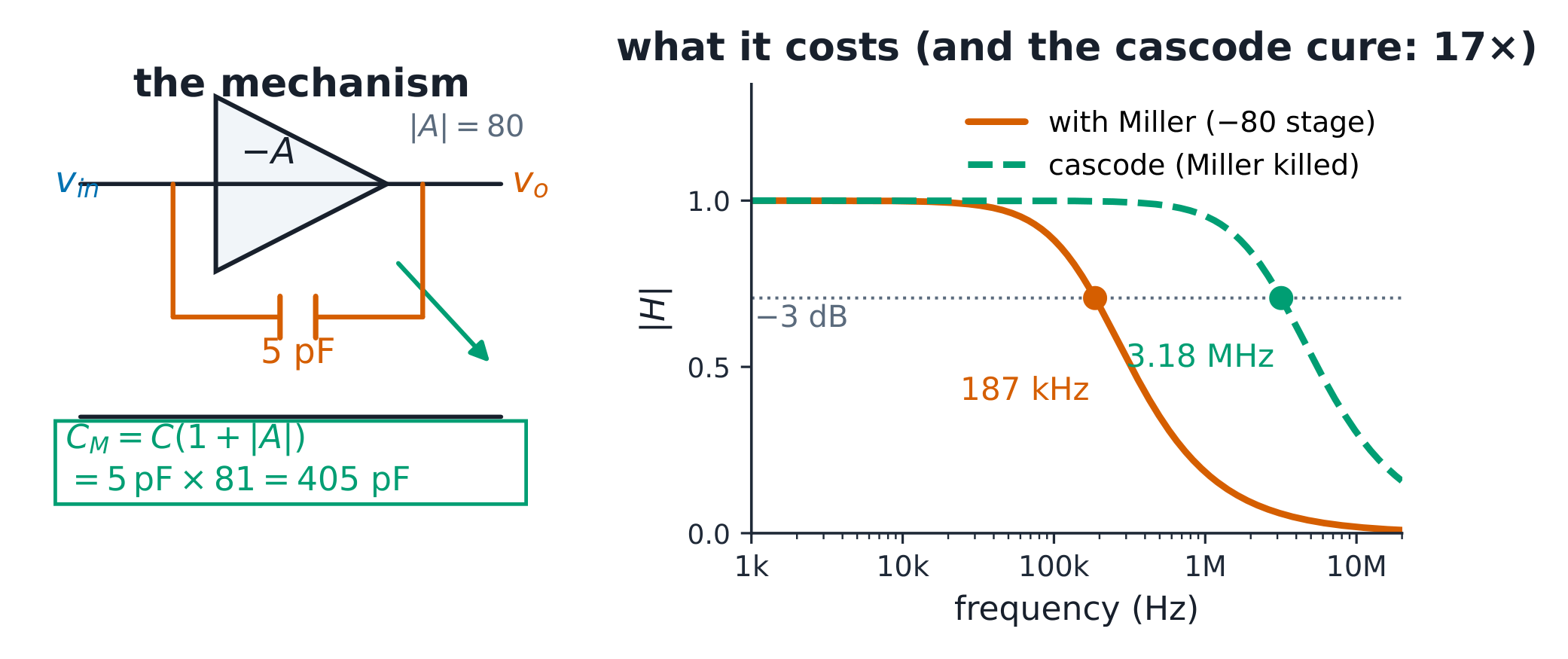
A 5 pF capacitor across a stage of gain −80 makes the input see
ความยาก 1/5 · 100 เหรียญ + บอนัสน้อยๆ เมื่อทำสำเร็จครั้งแรกในวันนี้
$C_{M} = C(1 + |A|) = 5 \times 81 = 405$ pF. The capacitor has the input at one end and an amplified, inverted copy at the other.
Worked example: f_H
- 405 pF plus 20 pF of stray capacitance on a 2 kΩ node: the dominant pole 主极点 is at $f_{H} = \dfrac{1}{2\pi \times 2000 \times 425 \times 10^{-12}} = 187\,\text{kHz}$.
- So the stage passes 7.7 Hz to 187 kHz at a gain of −80.
With 405 pF of Miller capacitance plus 20 pF stray on a 2 kΩ node, f_H is about
ความยาก 1/5 · 100 เหรียญ + บอนัสน้อยๆ เมื่อทำสำเร็จครั้งแรกในวันนี้
$f_{H} = \dfrac{1}{2\pi \times 2\,\text{k} \times 425\,\text{p}} = 187$ kHz. A cascode removes the Miller term: 25 pF alone gives 3.18 MHz.
The cascode cure
- A cascode 共射共基 stacks a second transistor on the first and holds its collector almost still. With no voltage swing across the 5 pF, there is no Miller multiplication.
- Only the 25 pF remains: $f_{H} = \dfrac{1}{2\pi \times 2000 \times 25 \times 10^{-12}} = 3.18\,\text{MHz}$, 17 times wider.
A cascode widens the bandwidth because it holds the first transistor's collector nearly still.
ความยาก 1/5 · 100 เหรียญ + บอนัสน้อยๆ เมื่อทำสำเร็จครั้งแรกในวันนี้
With almost no voltage swing across the feedback capacitance, it carries almost no current, so the Miller multiplication disappears.
Cascading stages narrows the band
- Two identical stages, each 3 dB down at 187 kHz, are 6 dB down there together. The overall −3 dB corner moves lower.
- For $n$ identical single-pole stages the corner shrinks by $\sqrt{2^{1/n} - 1}$: for two stages, $187 \times 0.644 = 120\,\text{kHz}$.
Two identical 187 kHz stages cascaded have an overall −3 dB corner at
ความยาก 1/5 · 100 เหรียญ + บอนัสน้อยๆ เมื่อทำสำเร็จครั้งแรกในวันนี้
Each stage is −3 dB at its corner, so the pair is −6 dB there. The overall −3 dB point is at $187 \times \sqrt{\sqrt{2} - 1} = 120$ kHz.
Three identical single-pole stages each have a 300 kHz corner. What is the overall −3 dB corner, in kHz?
ความยาก 2/5 · 140 เหรียญ + บอนัสน้อยๆ เมื่อทำสำเร็จครั้งแรกในวันนี้
$300 \times \sqrt{2^{1/3} - 1} = 300 \times 0.510 = 153$ kHz.
Three common slips
- Adding resistances for $R_{eq}$. With sources zeroed, the coupling capacitor usually sees resistances in parallel.
- Forgetting the Miller factor. A few picofarads across a high-gain stage can set the whole bandwidth.
- Quoting one stage's corner for the system. Cascaded stages narrow the band.
Recap
- Low corner: $f_{L} = \dfrac{1}{2\pi R_{eq}C}$ with sources zeroed.
- High corner: Miller multiplies feedback capacitance by $1 + A$; a cascode removes it.
- $n$ identical stages shrink the corner by $\sqrt{2^{1/n} - 1}$.