Your learning plan · Continue · Review →
Matching information — locate the requested evidence
แนะนำใหม่ตำแหน่งที่บันทึกของคุณจะคงอยู่ในเบราว์เซอร์นี้ การต่อจากตำแหน่งไม่ได้ทำให้บทเรียนเสร็จสิ้นหรือตอบคำถาม
The right topic can still be the wrong evidence
- Outcome: locate a specific reason, example, comparison, condition or qualification across paragraphs, then explain why that location answers the request. Start with Reading orientation and the matching overview if these task names are new. A paragraph about a bowl does not necessarily explain why someone moved it.
- Matching information asks where this detail or relationship occurs. Matching headings asks for a paragraph’s main contribution; matching features connects information to options such as people or objects. In this focused unit, choose a paragraph letter. This is original local practice, not a full Reading paper or a band prediction.
Worked reason: connect an observation to an action
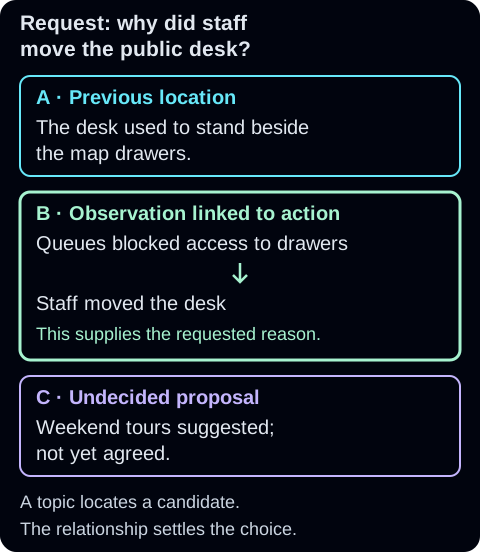
- Original passage: A. “The reading room keeps old maps in shallow drawers. A public desk used to stand beside those drawers.” B. “Queues at the public desk blocked access to the drawers, so staff moved the desk to the entrance.” C. “A visitor group has suggested weekend tours of the room. The archive has not yet decided whether to offer them.” Request: a reason for relocating a service point. Answer: B. Blocked access explains the move.
- A names the desk and maps but does not explain relocation; C reports a proposal for another service. Scan for useful anchors, then read the sentence relationship. The desk did not move merely because the word desk appears nearby. A keyword is an address label, not a witness statement.

Worked example: find an instance, not just the general topic
- Original passage: A. “The repair group welcomes residents’ help with equipment.” B. “Its equipment catalogue lists tools by size and stores their instruction sheets online.” C. “After a storm damaged the room’s lights, a resident lent portable lamps so the next repair session could go ahead.” Request: an example of a resident supplying equipment for a particular need. Answer: C. The lamps and interrupted lighting supply the instance and purpose.
- A gives a general invitation, not an actual contribution. B describes records, not a resident’s help. An example may use different words from the request; locate the event that meets it. Do not choose the paragraph with the most repetitions of equipment.
Worked comparison: keep both sides of the relationship
- Original passage: A. “The clay model shows tool marks more clearly than the cast, while the cast preserves the thin outer rim more faithfully.” B. “The cast was made in a workshop beside the gallery. Its label records the casting date.” C. “A guide demonstrates the tools used to shape the clay model during school visits.” Request: a comparison of two representations’ strengths. Answer: A. It states a different strength for each.
- B mentions the cast and C mentions the model, but neither compares their strengths. A true fact about one object is insufficient when the request needs a relationship between two. Name that relationship in your own words before choosing the location.
Guided practice: use a cue, then read beyond it
- The next ten mini-passages include a reading cue. Identify the demand first: reason, example, comparison, condition, change of view or limit. Use names and concrete terms to locate candidate sentences, then check who did what, when and under which condition.
- These tasks do not assume answers follow paragraph order. Some paragraphs in a task may be unused. Reuse a paragraph only when that task’s instructions permit it; do not import the no-reuse rule from matching headings. A second occurrence of a topic word is a second place to check, not a second answer by default.
Original mini-passage:
A. The archive’s new map covers can be folded for posting. They carry a printed reminder to return the borrowed map on time.
B. The archive stores its oldest maps flat because folding would weaken their already brittle edges. A shallow drawer supports each sheet when staff move it.
C. Visitors may photograph maps at a desk near the entrance. Staff record which map was used but do not charge for photography.
Which paragraph contains a reason for a storage arrangement? Choose A, B or C.
Reading cue: Look for the requested reason, not the first mention of maps.
Difficulty 1/5 · 100 coins + a small bonus on first completion today
Paragraph B. The fragile edges explain why the old maps lie flat. Foldable covers concern a different object; the visitor desk describes access, not the reason for storage.
Original mini-passage:
A. The eastern window overlooks the courtyard. The team chose that room because both windows were easy to reach.
B. The proposed building design includes screens on several windows. No design decision has yet been made about their material.
C. During one trial, the team fitted a screen to the western window. Afternoon readings fell there but stayed similar at the eastern window, which had no screen.
Which paragraph contains a comparison between a changed site and an unchanged site? Choose A, B or C.
Reading cue: A comparison needs both sides and their relationship.
Difficulty 1/5 · 100 coins + a small bonus on first completion today
Paragraph C. The trial compares screened west with unscreened east. Choosing a room and proposing future screens do not supply that before/contrast evidence.
Original mini-passage:
A. The guide offers tactile labels; for example, the raised outline beside the engine model lets visitors feel the shape of its flywheel.
B. The engine’s paper label gives its date and original owner. A large-print copy of that information is available at the desk.
C. A volunteer suggested adding more engine models next year. The museum has not yet agreed a budget for them.
Which paragraph contains a concrete example of information supplied through touch? Choose A, B or C.
Reading cue: Distinguish a general access feature from the example requested.
Difficulty 1/5 · 100 coins + a small bonus on first completion today
Paragraph A. The raised flywheel outline is an example of tactile information. Large print is visual; a proposal for models is neither an implemented label nor a touch example.
Original mini-passage:
A. The main street has several shops that sell gardening supplies. Survey volunteers meet outside one of these shops before starting work.
B. A public chart lists the new shop total. The chart uses blue bars for the town centre and green bars for the outer districts.
C. The previous survey covered only the main street. The new survey includes side streets too, so its larger shop total cannot by itself show that shops have recently opened.
Which paragraph contains a warning about comparing counts collected over different areas? Choose A, B or C.
Reading cue: Ask whether the measured groups stayed the same.
Difficulty 1/5 · 100 coins + a small bonus on first completion today
Paragraph C. The coverage changed, making the totals non-equivalent. Meeting locations and chart colours mention surveys or totals without explaining this comparison problem.
Original mini-passage:
A. An introductory talk about workshop safety runs on Monday. It is open to visitors who do not plan to use any tools.
B. The evening workshop remains open to beginners, provided they bring the required eye protection. Borrowed tools are available at each bench.
C. A photograph outside the workshop shows an experienced maker at a bench. The display gives the year in which the workshop opened.
Which paragraph contains a condition attached to taking part in a practical activity? Choose A, B or C.
Reading cue: Keep the condition attached to the correct activity.
Difficulty 1/5 · 100 coins + a small bonus on first completion today
Paragraph B. Eye protection is a stated condition for the practical workshop. The separate talk has a different audience; the photograph is background, not an entry condition.
Original mini-passage:
A. A letter describes the garden as treeless. However, an inventory written in the same year lists six mature apple trees, so the historian treats the letter’s description cautiously.
B. The garden’s present apple trees were planted ten years ago. Their labels name the varieties rather than the people who planted them.
C. The historian stored copies of the letters in date order. An index helps readers search for references to the garden.
Which paragraph contains evidence used to question an earlier description? Choose A, B or C.
Reading cue: Check the dates of the claim and the counter-evidence.
Difficulty 1/5 · 100 coins + a small bonus on first completion today
Paragraph A. The contemporary inventory conflicts with the letter. Present trees cannot establish what stood there in that earlier year; the filing method does not test the claim.
Original mini-passage:
A. A student copied the sign’s wording for a class project. The copy is displayed beside a photograph of the entrance.
B. The curator first recommended replacing the faded sign. After a student found its original painted backing, she instead asked a conservator whether the existing sign could be repaired.
C. The conservator has repaired several objects from the collection. The museum publishes photographs of that earlier work online.
Which paragraph contains a change in a person’s recommendation? Choose A, B or C.
Reading cue: Follow one person’s view through time.
Difficulty 1/5 · 100 coins + a small bonus on first completion today
Paragraph B. The curator moves from replacement to possible repair after a discovery. A student copy and the conservator’s past work do not themselves state that changed recommendation.
Original mini-passage:
A. The study counted birds on four mornings, but each visit occurred in dry weather. Its author says the results cannot establish how birds use the site during rain.
B. Rainwater drains from the site through a shallow channel. A volunteer clears leaves from the channel each autumn.
C. The study’s bird photographs appear beside a map of the site. The map marks the four observation positions.
Which paragraph contains a limitation on what a study can establish? Choose A, B or C.
Reading cue: A limitation may be an unobserved condition, not a broken method.
Difficulty 1/5 · 100 coins + a small bonus on first completion today
Paragraph A. Dry-weather observations leave rainy use untested. A drainage description mentions rain but is not a limitation of the bird study; mapped positions do not fill that missing condition.
Original mini-passage:
A. The seats come in three shapes. A display beside the repair desk lets riders compare the available sizes.
B. The specialist collects referred bicycles on Fridays. Owners receive a message when a collection time has been arranged.
C. The repair team checks the frame before removing the seat. If the frame is cracked, they stop the job and refer the bicycle to a specialist.
Which paragraph contains a check that can prevent a later stage from proceeding? Choose A, B or C.
Reading cue: Find the decision point, not simply a later event.
Difficulty 1/5 · 100 coins + a small bonus on first completion today
Paragraph C. The frame check can stop seat removal and trigger referral. Seat choice describes alternatives; Friday collection happens after referral rather than preventing a repair stage.
Original mini-passage:
A. The team uses the software on scanned pages from a local newspaper. Each scan is stored beside its page number.
B. The new software makes faint lettering easier to see, although it cannot reconstruct letters missing from a torn page. Researchers still mark those gaps as unreadable.
C. A donor paid for the page scanner. The donation also funded a public demonstration of the new software.
Which paragraph contains a benefit qualified by an explicit remaining limit? Choose A, B or C.
Reading cue: Read past the positive claim for its qualification.
Difficulty 1/5 · 100 coins + a small bonus on first completion today
Paragraph B. Improved visibility is qualified by inability to recover absent letters. Storage details and funding mention the same tools without supplying that benefit–limit relationship.
Independent evidence: twenty new mini-passages
- Each of the next twenty questions has a different original mini-passage and no reading cue. Choose before checking. Feedback explains the requested relation and why the nearby paragraphs do not provide it. Do not convert a proposed action into an agreed one, a present condition into historical evidence or a limited observation into a universal claim.
- This is short focused practice. Longer passages and a full Reading paper add navigation and time demands that these mini-passages do not measure. Use several sessions if useful; on return, choose the saved position deliberately. A previously seen answer letter is not evidence for a new passage.
Original mini-passage:
A. The garden sells spare pots near its gate. This year the sales table moved under cover to protect the labels from rain.
B. A volunteer photographed every trial pot before planting. The photographs record colours and shapes for the garden’s display board.
C. The trial garden used fewer pots this year, but each pot was twice as wide. Staff caution that a lower pot count does not demonstrate a reduction in planted area.
Which paragraph contains a reason that a smaller count need not indicate a smaller total area? Choose A, B or C.
Difficulty 1/5 · 100 coins + a small bonus on first completion today
Paragraph C. The wider pots make count alone an unreliable area comparison. Sales arrangements and photographs describe pots but do not explain that counting limitation.
Original mini-passage:
A. Visitors may borrow the portable magnifier for use inside the gallery only. It must be returned to the same desk before they leave the building.
B. The gallery’s collection includes an old magnifying glass with a brass handle. It remains in a locked display case.
C. An online page shows enlarged photographs of small objects. Visitors can save these photographs to consult after their visit.
Which paragraph contains a restriction on where a borrowed object may be used? Choose A, B or C.
Difficulty 1/5 · 100 coins + a small bonus on first completion today
Paragraph A. The portable magnifier is restricted to the gallery. The historic object is a display, while saved photographs can be viewed later; neither states this loan restriction.
Original mini-passage:
A. The demonstrations attract many local makers. Several bring tools and examples of finished work for visitors to inspect.
B. The early timetable put demonstrations beside quiet study sessions. Complaints about noise led the organiser to move demonstrations to a separate afternoon slot.
C. Quiet study sessions have a desk-booking form. The form asks whether readers need a seat near a power socket.
Which paragraph contains a scheduling change made in response to a problem? Choose A, B or C.
Difficulty 1/5 · 100 coins + a small bonus on first completion today
Paragraph B. Noise complaints cause the demonstrations to move. The makers describe participation, and desk bookings describe study access rather than the scheduling response.
Original mini-passage:
A. The footbridge has a broad handrail and a non-slip surface. Its lights are switched on automatically after sunset.
B. The report records that a new footbridge shortened the walk between two stops from fifteen minutes to six. It does not claim that bus journeys themselves became quicker.
C. The bus company has printed the bridge on its route map. The map still shows the same scheduled departure times as before.
Which paragraph contains a distinction between a quicker connection and a main journey not shown to be quicker? Choose A, B or C.
Difficulty 1/5 · 100 coins + a small bonus on first completion today
Paragraph B. The report explicitly separates shorter walking access from faster bus travel. Bridge design and a printed map do not state that precise distinction; unchanged timetables alone would not measure journey speed.
Original mini-passage:
A. The window was replaced during roof repairs. Workers used cloth covers to protect the display cases while they fitted the new frame.
B. A weaving demonstration takes place in the room each spring. Visitors can compare the new cloth with photographs of older pieces.
C. The cloth was stored away from the window because earlier samples had faded in direct sunlight. A label records the storage date and the condition of the fibres.
Which paragraph contains an earlier observation used to justify a protective measure? Choose A, B or C.
Difficulty 1/5 · 100 coins + a small bonus on first completion today
Paragraph C. Observed fading motivates storage away from light. Cloth used during building work and a demonstration do not provide the evidence behind that preservation decision.
Original mini-passage:
A. The committee has discussed extending opening hours, but it has approved only a trial of Sunday mornings. Evening opening remains a suggestion.
B. The centre’s current evening classes cover drawing and printing. Participants enter through a side door while the main hall is closed.
C. A visitor survey asked about preferred opening times. Respondents could mark mornings, afternoons, evenings or more than one period.
Which paragraph contains a distinction between an agreed trial and a proposal still awaiting approval? Choose A, B or C.
Difficulty 1/5 · 100 coins + a small bonus on first completion today
Paragraph A. Only Sunday mornings are approved; evening opening remains proposed. Existing classes and survey choices mention evenings without establishing approval for the suggested public hours.
Original mini-passage:
A. The shrub beds beside the visitor centre contain several native plants. Their labels include drawings of common insects.
B. A later school group repeated the open-ground survey. The group’s teacher explained how to label each collecting tray.
C. In the coastal sample, insects were trapped on open ground and under shrubs. The two locations produced similar counts but different species, showing why the total alone missed a difference.
Which paragraph contains a difference hidden by similar overall numbers? Choose A, B or C.
Difficulty 1/5 · 100 coins + a small bonus on first completion today
Paragraph C. Similar counts conceal different species. Plant labels and a school procedure concern insects but do not make that composition-versus-total comparison.
Original mini-passage:
A. The manual notes are stored in a bound book. Its cover lists the dates on which each researcher worked at the site.
B. The device logs temperature every minute, while the manual notes record only the highest reading each day. Researchers keep both because the frequent log reveals brief peaks that a daily maximum does not locate in time.
C. The device’s battery was replaced before the summer trial. Spare batteries are stored in a labelled box at the station.
Which paragraph contains why one record reveals timing that another does not? Choose A, B or C.
Difficulty 1/5 · 100 coins + a small bonus on first completion today
Paragraph B. Minute-by-minute readings locate brief peaks; a daily maximum does not give their timing. Cover dates concern staffing, and battery storage is maintenance rather than a comparison of records.
Original mini-passage:
A. The exhibition’s largest model is a replica. Its accompanying label says the original was too fragile to travel, so the replica allows its shape to be shown without moving it.
B. A photograph shows staff carrying the replica into the hall. The photograph was taken before the visitors’ entrance opened.
C. The original maker used wood and thin wire. A catalogue entry gives the names of both materials and the year of construction.
Which paragraph contains a reason for displaying a substitute instead of an original? Choose A, B or C.
Difficulty 1/5 · 100 coins + a small bonus on first completion today
Paragraph A. Fragility explains why the original stays put and a replica is displayed. Transporting the replica and naming original materials do not themselves state that reason.
Original mini-passage:
A. The light covering was stored beside the measuring equipment. Its box carried the supplier’s address and the delivery date.
B. At one test site, the surface stayed cooler under a light covering than under a dark covering made from the same material. The team held thickness constant to compare the coverings fairly.
C. The team plans another test using thicker material. The new test has not yet been run.
Which paragraph contains a variable held the same during a comparison? Choose A, B or C.
Difficulty 1/5 · 100 coins + a small bonus on first completion today
Paragraph B. Thickness is explicitly held constant in the completed test. Storage details do not control the comparison, and a proposed thicker-material test is not an already completed one.
Original mini-passage:
A. The path leads past a display about early wheelchairs. The display includes a photograph of the old museum entrance.
B. Workers repaired the stone steps last winter. A notice thanks the volunteers who cleared materials after the job.
C. A museum guide says the path is suitable for wheelchairs except during work on the temporary ramp. Visitors can ask the desk whether that work is in progress before setting out.
Which paragraph contains an exception to a general statement about access? Choose A, B or C.
Difficulty 1/5 · 100 coins + a small bonus on first completion today
Paragraph C. Ramp work qualifies the guide’s suitability statement. A display about wheelchairs and completed step repairs share access-related words but do not state the current exception.
Original mini-passage:
A. The village archive invites residents to add names to unidentified group photographs. One resident recognised her grandfather by the distinctive badge on his jacket and supplied a dated family letter to support the identification.
B. The archive stores badges separately from photographs. Each badge has a small number linking it to its donation record.
C. The next public workshop will show residents how to scan letters. Participants are asked to bring a page they have permission to copy.
Which paragraph contains an example of a public contribution supported by another source? Choose A, B or C.
Difficulty 1/5 · 100 coins + a small bonus on first completion today
Paragraph A. The resident’s identification is supported by a family letter. Badge storage and a future scanning class do not give an actual supported naming contribution.
Original mini-passage:
A. The first acoustic survey counted only sounds louder than the road traffic. The team now uses a quieter early-morning period so softer calls can be detected as well.
B. Road traffic near the survey area is busiest at lunchtime. A council notice gives the dates of planned road resurfacing.
C. The survey recordings are saved with the date and microphone number. A copy is kept on a separate drive.
Which paragraph contains a method changed to include evidence previously missed? Choose A, B or C.
Difficulty 1/5 · 100 coins + a small bonus on first completion today
Paragraph A. A quieter survey period permits softer calls that the earlier method missed. Traffic schedules and file storage describe context or administration, not this change in sampling.
Original mini-passage:
A. The replacement belt arrived in a box bearing the engine’s model number. Staff checked the number before signing for the delivery.
B. The engine display includes a diagram of the belt’s route. A volunteer explains the diagram to school groups each Thursday.
C. When the old engine was demonstrated, the belt slipped after ten minutes. The engineer stopped it to prevent damage and postponed further demonstrations until the belt could be replaced.
Which paragraph contains a fault that interrupted an activity for a stated safety reason? Choose A, B or C.
Difficulty 1/5 · 100 coins + a small bonus on first completion today
Paragraph C. The slipping belt causes the demonstration to stop to avoid damage. Checking a delivery and explaining a diagram do not describe the interruption or its reason.
Original mini-passage:
A. The building’s present owner stores furniture in its eastern room. A sign outside gives the owner’s business hours.
B. The first draft called the building a warehouse. After finding a register of passengers and ticket prices, the researcher revised the description to a waiting hall, while leaving its precise opening date unresolved.
C. The register was photographed during a visit to the town archive. The researcher noted the archive’s catalogue number for future reference.
Which paragraph contains a revised interpretation with an unanswered detail? Choose A, B or C.
Difficulty 1/5 · 100 coins + a small bonus on first completion today
Paragraph B. The register motivates a different account of the building, with the opening date still unknown. Present storage and recording a catalogue number do not state that interpretation and qualification.
Original mini-passage:
A. School groups visit the orchard in autumn. Their worksheets ask them to compare leaves from three apple varieties.
B. A gardener planted young trees along the orchard’s western boundary. These trees will provide shelter when they are larger.
C. The orchard offers branches to local schools only after the trees have been checked for disease. The check protects the receiving gardens as well as the orchard.
Which paragraph contains a condition intended to protect both a supplier and a recipient? Choose A, B or C.
Difficulty 1/5 · 100 coins + a small bonus on first completion today
Paragraph C. Disease checking is required before branches go to schools and protects both sites. School visits and future shelter are separate activities, not that transfer condition.
Original mini-passage:
A. The board shows the route as a straight line for easy reading. A smaller map beside it gives the bends and distances more accurately, so walkers should use that map to estimate travel distance.
B. The straight-line board was repainted before the walking festival. Its lettering uses the same colour as the festival’s printed programme.
C. A group of walkers suggested adding a bench near the board. The landowner has not yet decided whether to provide one.
Which paragraph contains a warning about using a simplified representation for measurement? Choose A, B or C.
Difficulty 1/5 · 100 coins + a small bonus on first completion today
Paragraph A. The straight line serves readability rather than accurate distance, which the smaller map supplies. Paint colours and a bench proposal do not explain that measurement limit.
Original mini-passage:
A. The interview sheets have the same title at the top. Staff print a new bundle when the pile beside the entrance runs low.
B. Two teams used the same interview questions, but one interviewed only weekday visitors while the other included weekends. The report identifies this difference before comparing their findings.
C. Weekend visitors can join a guided walk after the interview. The walk starts beside the information desk.
Which paragraph contains a sampling difference that matters when comparing findings? Choose A, B or C.
Difficulty 1/5 · 100 coins + a small bonus on first completion today
Paragraph B. Weekday-only versus weekday-and-weekend samples differ despite identical questions. Printing and an optional walk do not identify the difference between the two research groups.
Original mini-passage:
A. The water meter was fitted beside a covered drain. Its small display can be read without opening the meter box.
B. The trial’s final report says water use fell in three measured weeks. It withholds a claim about annual savings because there are no winter readings.
C. An information sheet explains how to report a leaking tap. It asks users to include the building and room number.
Which paragraph contains a reason for limiting the time span of a conclusion? Choose A, B or C.
Difficulty 1/5 · 100 coins + a small bonus on first completion today
Paragraph B. Missing winter readings prevent an annual claim from a short observation period. Meter placement and leak reporting are practical details rather than a limit on that conclusion.
Original mini-passage:
A. The current leaflet includes a high-contrast map following a reader’s complaint that the old pale lines were difficult to distinguish. The editor kept the route itself unchanged.
B. The route passes a shop selling maps and guidebooks. The shop is closed on Monday mornings.
C. The leaflet also gives a telephone number for guided tours. Visitors who need a printed large-type version can request one from that office.
Which paragraph contains a change to presentation made after a specific user problem? Choose A, B or C.
Difficulty 1/5 · 100 coins + a small bonus on first completion today
Paragraph A. The reader’s difficulty prompts higher contrast while the route remains the same. A map shop and large-type request describe related services but not the stated cause-and-change relationship.
Transfer: one paragraph can answer two different requests
- The oral-history passage has four questions sharing three paragraphs. You may use any paragraph more than once in this task. Work from each request rather than assigning every paragraph once. The complete passage repeats for later review, but it remains one passage, not four independent texts.
- After answering, compare the evidence relationships. One paragraph can explain both an improvement and its remaining limitation; two questions need not ask for the same sentence. Do not assume that a correct answer to one question determines the rest by elimination.
Original passage — the town’s oral-history project
A. The project began with interviews about the old market. Contributors gave permission for an edited public recording, but some asked to keep their full interviews private. The archive stored those full files separately from the public collection.
B. Staff found that the public clips were hard to follow without background. They added short introductions naming the place and period. These helped listeners, but the introductions could not settle conflicting memories, so disagreements remained identified in the notes.
C. A school initially planned to use only the clips in a local-history display. After visiting the archive, pupils added copies of dated photographs so visitors could compare memories with another kind of evidence. The display does not claim that every memory has been independently verified.
For these four questions, you may use any paragraph more than once. Each question repeats the complete passage for later review; this is one shared passage, not four separate texts.
Which paragraph contains an improvement that leaves a problem unresolved?
Difficulty 1/5 · 100 coins + a small bonus on first completion today
B pairs helpful introductions with unresolved conflicting memories. A concerns consent and C broadens display evidence; neither gives this particular improvement and limit.
Original passage — the town’s oral-history project
A. The project began with interviews about the old market. Contributors gave permission for an edited public recording, but some asked to keep their full interviews private. The archive stored those full files separately from the public collection.
B. Staff found that the public clips were hard to follow without background. They added short introductions naming the place and period. These helped listeners, but the introductions could not settle conflicting memories, so disagreements remained identified in the notes.
C. A school initially planned to use only the clips in a local-history display. After visiting the archive, pupils added copies of dated photographs so visitors could compare memories with another kind of evidence. The display does not claim that every memory has been independently verified.
For these four questions, you may use any paragraph more than once. Each question repeats the complete passage for later review; this is one shared passage, not four separate texts.
Which paragraph contains a plan changed after a visit?
Difficulty 1/5 · 100 coins + a small bonus on first completion today
C changes the school display from clips alone to clips plus photographs after an archive visit. B adds introductions for a different reason; A sets out storage permissions.
Original passage — the town’s oral-history project
A. The project began with interviews about the old market. Contributors gave permission for an edited public recording, but some asked to keep their full interviews private. The archive stored those full files separately from the public collection.
B. Staff found that the public clips were hard to follow without background. They added short introductions naming the place and period. These helped listeners, but the introductions could not settle conflicting memories, so disagreements remained identified in the notes.
C. A school initially planned to use only the clips in a local-history display. After visiting the archive, pupils added copies of dated photographs so visitors could compare memories with another kind of evidence. The display does not claim that every memory has been independently verified.
For these four questions, you may use any paragraph more than once. Each question repeats the complete passage for later review; this is one shared passage, not four separate texts.
Which paragraph contains a reason some material is withheld from public access?
Difficulty 1/5 · 100 coins + a small bonus on first completion today
A records contributors’ requests for privacy and separate storage of the full files. Do not infer that every interview is public from the existence of edited public clips.
Original passage — the town’s oral-history project
A. The project began with interviews about the old market. Contributors gave permission for an edited public recording, but some asked to keep their full interviews private. The archive stored those full files separately from the public collection.
B. Staff found that the public clips were hard to follow without background. They added short introductions naming the place and period. These helped listeners, but the introductions could not settle conflicting memories, so disagreements remained identified in the notes.
C. A school initially planned to use only the clips in a local-history display. After visiting the archive, pupils added copies of dated photographs so visitors could compare memories with another kind of evidence. The display does not claim that every memory has been independently verified.
For these four questions, you may use any paragraph more than once. Each question repeats the complete passage for later review; this is one shared passage, not four separate texts.
Which paragraph contains information added to help an audience understand context?
Difficulty 1/5 · 100 coins + a small bonus on first completion today
B adds introductions specifying place and period to help listeners. It is reused legitimately because the directions permit paragraph reuse; it contains both this detail and the limit asked about earlier.
Explain and repair a keyword-only choice
- In the private writing task, name the paragraph and explain the observation linked to the action. Then explain why a shared object name does not meet the request. Compare the model only after drafting, and revise one missing link or unsupported claim.
- Several explanations can fit; identical model wording is unnecessary. The draft stays in this page, so copy it before leaving. The checklist records reflection rather than automatic correctness, proficiency or an IELTS score.
Original mini-passage:
A. The museum’s pottery display contains a cracked bowl. Its caption identifies where it was found and the estimated period of manufacture.
B. Staff moved the bowl away from a window after repeated sunlight readings showed that the old position received direct light for several hours each day. They chose a new place with less direct light.
C. A visitor requested a larger photograph of the bowl for a class project. The museum supplied one with permission to reproduce it in the class display.
A reader chooses A for “a reason for changing where an object is displayed” because it mentions the bowl. Write the correct paragraph letter and two sentences explaining the evidence and why the reader’s reason is insufficient. Draft before comparing the model, then revise one link. Your draft stays in this page; copy it before leaving.
Evidence and question demand matter more than identical model wording. Recording this checklist is self-review, not automatic correctness or an IELTS score.
Later review: locate a fresh limit and a fresh correction
- After a break, try the two new mini-passages without reopening the worked cases. Give a sentence-level reason for each paragraph choice. If you were wrong, identify whether you followed a keyword, missed a qualification or attached evidence to the wrong time or action.
- Continue with inference and supported conclusions to test how far evidence allows a claim, or completion and short answers to practise selecting the required words. Locating evidence and entering a permitted answer are connected skills with different checks.
New original mini-passage:
A. The pond survey recorded depth at its centre each week. A drawing shows where the measuring pole was placed.
B. The new report compares the centre readings with edge readings collected in the same weeks. It warns that centre depth alone does not describe the whole pond.
C. A notice asks visitors to keep dogs away from the pond edge. A low fence marks the protected area.
Which paragraph contains a limitation of using measurements from only one location?
Difficulty 1/5 · 100 coins + a small bonus on first completion today
B says why central depth cannot stand for the whole pond and supplies a spatial comparison. A records method and C concerns visitor behaviour, not that measurement limit.
New original mini-passage:
A. The first catalogue called a painted panel original. A later invoice showed it was a replacement ordered after a fire, so the entry was corrected.
B. The invoice is kept in a folder with receipts for roof repairs. Researchers can consult copies at the reading desk.
C. The replacement panel hangs above a model of the building. Its label names the painter and gives the year of the fire.
Which paragraph contains evidence that caused a published identification to be corrected?
Difficulty 1/5 · 100 coins + a small bonus on first completion today
A connects an invoice to correction of the original/replacement description. B stores the invoice and C describes the present display; neither narrates that evidence-led correction.
Keep the task directions beside the method
- Recap: identify the requested relationship, search for candidate locations, read the surrounding sentence, then check scope and instructions. Matching information concerns specific details rather than a paragraph’s whole main idea. A paragraph letter is a location; the sentence relationship is the reason for choosing it.
- Source checked on 19 October 2026: official IELTS Reading task guidance. All passages, examples, questions and the evidence map here are originally authored teaching. Independent subject/language review and learner trials remain pending; a completed local task does not establish an official test result.