Alcohol oxidation and spectral identification
แนะนำใหม่| English | ความหมาย |
|---|---|
| distillation/dɪstɪˈleɪʃn/ | การกลั่น |
| aldehyde/ˈældɪhaɪd/ | อัลดีไฮด์ |
| reflux/ˈriːflʌks/ | การ回流 (回流) |
| ketone/ˈketəʊn/ | คีโตน |
| anhydrous/ænˈhaɪdrəs/ | ไม่มีน้ำ |
How can one alcohol give two different products?
- Primary propan-1-ol can give propanal or propanoic acid with acidified dichromate. Product removal changes how far oxidation proceeds.
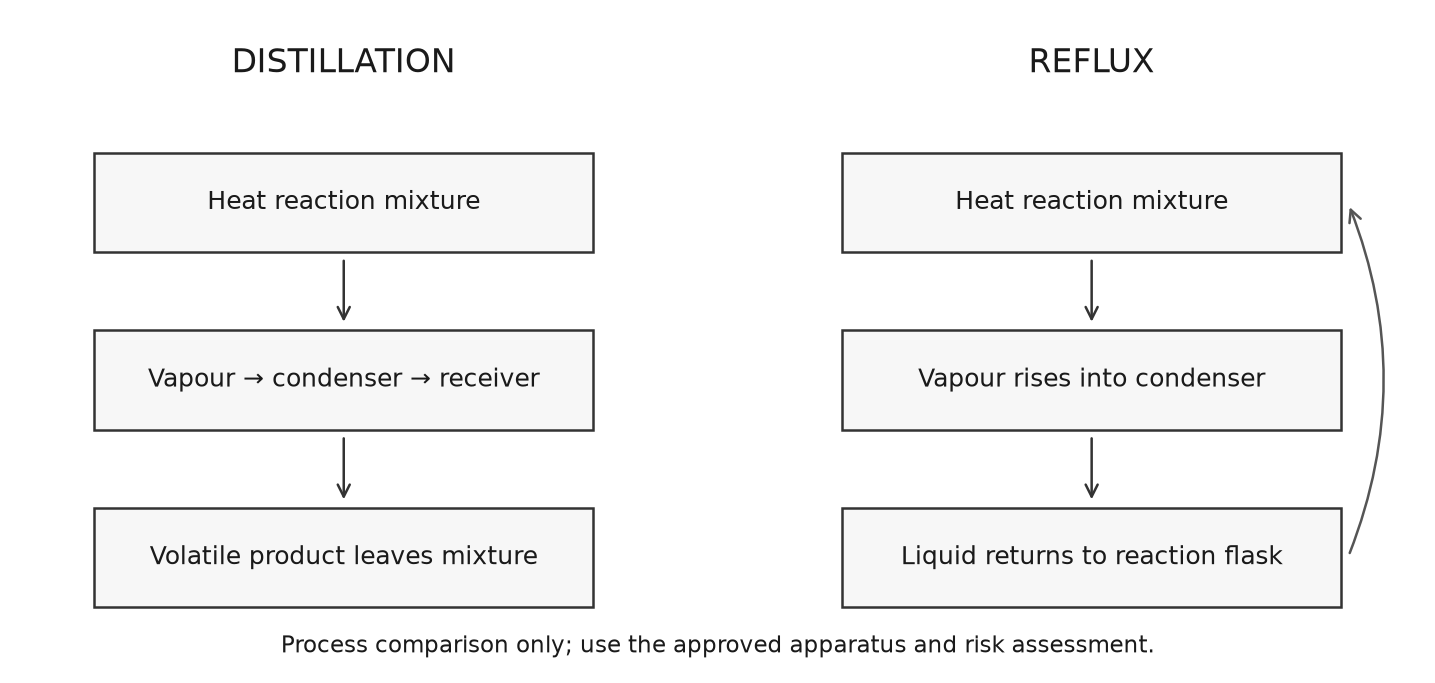
- Choose distillation 蒸馏 for aldehyde 醛 or reflux 回流 with excess oxidant for acid.
Which conditions favour propanal from propan-1-ol?
ความยาก 1/5 · 100 เหรียญ + โบนัสเล็กน้อยในการทำครั้งแรกวันนี้
Removing aldehyde limits further oxidation. Reflux with excess oxidant favours acid; phosphoric acid favours dehydration.
Use the alcohol structure
- Primary alcohols can oxidise to aldehydes and acids; secondary alcohols to ketones 酮. Tertiary alcohols resist these stated conditions.
- For propan-2-ol: CH₃CH(OH)CH₃ + [O] → CH₃COCH₃ + H₂O. Dichromate changes orange to green.
Propan-2-ol oxidises to propanone with the stated acidified dichromate conditions.
ความยาก 1/5 · 100 เหรียญ + โบนัสเล็กน้อยในการทำครั้งแรกวันนี้
It is secondary, so oxidation gives a ketone.
Explain purification rather than naming it
- Distillation removes volatile material; reflux returns condensed vapour to the reaction mixture.
- Solvent extraction separates immiscible layers. A suitable anhydrous 无水的 salt removes residual water before final distillation.
Propan-1-ol + [O] → propanal + H₂O; propan-1-ol + 2[O] → propanoic acid + H₂O. Distil the aldehyde as it forms or use excess oxidant under reflux for acid.
Name the heating technique that returns condensed vapour to the reaction flask.
ความยาก 1/5 · 100 เหรียญ + โบนัสเล็กน้อยในการทำครั้งแรกวันนี้
Reflux allows prolonged heating while limiting loss of volatile reactants/products.
Combine mass and IR evidence
- A molecular-ion m/z gives molecular mass for a singly charged ion; the largest peak need not be the molecular ion.
- Use provided IR data to identify possible C=O, O–H, N–H, C=C, C–H and C–X groups. A peak alone rarely identifies one structure.
Calculate Mr for C₃H₆O. Use C = 12, H = 1, O = 16.
ความยาก 2/5 · 140 เหรียญ + โบนัสเล็กน้อยในการทำครั้งแรกวันนี้
Mr = 3×12 + 6×1 + 16 = 58. Both propanal and propanone have this value, so mass alone does not distinguish them.
Reject a competing structure
- C₃H₆O with C=O and a positive warm Fehling’s test fits propanal. Propanone has the same formula and carbonyl but fails that test.
- An acid gives CO₂ with carbonate and has a very broad O–H absorption as well as C=O. Record independent evidence and its limits.
“Every carbonyl absorption proves an aldehyde” is false. Ketones and carboxylic acids also have C=O; combine other evidence.
Use formula, spectra, chemical tests and reaction conditions together; distinguish purity evidence from structural proof.
Write from an Mr of 72
- Calculate the relative molecular mass of C4H8O. Use carbon 12, hydrogen 1 and oxygen 16.
- A carbonyl absorption does not by itself prove an aldehyde.
Which two observations support a carboxylic acid?
ความยาก 2/5 · 140 เหรียญ + โบนัสเล็กน้อยในการทำครั้งแรกวันนี้
The acid chemical test and two functional-group absorptions support the proposal together.
What is the relative molecular mass of C4H8O, and why does a carbonyl absorption not prove that the compound is an aldehyde?
Add the relative atomic masses for every atom in the formula. The spectrum identifies a bond, not the whole functional group, until other evidence is added.
What is the relative molecular mass?
ความยาก 1/5 · 100 เหรียญ + โบนัสเล็กน้อยในการทำครั้งแรกวันนี้
48 plus 8 plus 16 is 72. Other options — 58 (the lesson example's result for C3H6O); 16 (the relative atomic mass of oxygen).