Enthalpy: define the reaction, then follow the energy
หลักสูตร
English
Topic 6 (spec pp.32-33). Enthalpy changes - formation, combustion, neutralisation, reaction; exothermic and endothermic profiles with activation energy; calorimetry experiments with heat-capacity calculations (q = mc-delta-T) and their errors; Hess cycles from formation and combustion data; mean bond enthalpies and their limitations for benzene-like delocalised systems; the definitions and signs of the standard states convention.
ทุกอะตอมและโมเลกุลมีแรงลอนดอน ซึ่งเกิดจากไดโพลชั่วขณะ inducing ไดโพลในอนุภาคใกล้เคียง อิเล็กตรอนมากขึ้นและเมฆอิเล็กตรอนที่ย้ายตัวได้ง่ายมักทำให้แรงเหล่านี้แข็งแกร่งขึ้น แรงดึงดูดไดโพลถาวร-ไดโพลถาวรยังเกิดขึ้นระหว่างโมเลกุลขั้ว พันธะไฮโดรเจน คือแรงดึงดูดระหว่าง H ที่จับกับ N, O หรือ F กับอิเล็กตรอนคู่โดดเดี่ยวบน N, O หรือ F ของโมเลกุลอื่น พันธะโคเวเลนต์ O–H ภายในเอทานอลเองไม่ใช่พันธะไฮโดรเจน
Explain boiling by the attractions between molecules, not by breaking every covalent bond. Longer alkane chains usually have more electrons and stronger London forces, so boiling temperatures rise. For isomeric alkanes, branching makes molecules more compact and reduces effective contact, so boiling temperature usually falls. An alcohol has a higher boiling temperature than a similar-size alkane because additional hydrogen bonding requires more energy to overcome. From HCl to HBr to HI, larger electron clouds strengthen London forces; HF is unusually high because it hydrogen-bonds.
Water has unusually high melting and boiling temperatures for its molecular size. Ice contains an open hydrogen-bonded arrangement. On melting, some of this arrangement collapses, bringing molecules closer; liquid water is denser than ice near the melting point. It is incorrect to explain floating ice by saying its molecules become larger.
Solubility depends on the balance between attractions broken and attractions formed. Water hydrates ions: the partially negative oxygen faces cations and partially positive hydrogens face anions. Small alcohols mix well with water because their O–H groups hydrogen-bond; a growing non-polar carbon chain reduces this advantage. Many halogenoalkanes have polar C–X bonds yet dissolve poorly in water: they cannot replace the water–water hydrogen-bond network effectively. A non-aqueous solvent with similar intermolecular attractions can be more suitable. “Polar dissolves polar” is a useful starting comparison, not a universal rule.
Topic 8 (spec pp.35-37). Oxidation numbers and their arithmetic; half-equations and full redox equations; Group 2 trends - reactivity with water, hydroxide solubility, sulfate solubility, thermal stability of nitrates and carbonates explained by polarising power; Group 7 trends - boiling points, oxidising strength, displacement reactions; halide-ion reactions with silver nitrate and with concentrated sulfuric acid (including the HI/H2S redox pattern for iodide); disproportionation as seen in chlorine water and chlorate decomposition; flame tests and the thermal decomposition of Group 1 nitrates; identifying ions by precipitation tests.
Small cations with high charge density strongly polarise large anions. Lithium and the smaller Group 2 cations therefore make their carbonates and nitrates less thermally stable. Stability increases down each group as cation size increases. Most Group 1 carbonates resist ordinary laboratory heating; Li₂CO₃ decomposes to Li₂O + CO₂. Group 2 carbonates give MO + CO₂. Group 1 nitrates except lithium give nitrite + oxygen, $2\mathrm{MNO_3}\rightarrow2\mathrm{MNO_2}+\mathrm{O_2}$. Lithium and Group 2 nitrates give oxide, brown NO₂ and oxygen; e.g. $2\mathrm{Mg(NO_3)_2}\rightarrow2\mathrm{MgO}+4\mathrm{NO_2}+\mathrm{O_2}$. Compare equal amounts under controlled heating; do not confuse a faster gas-production rate with a directly measured decomposition temperature. NO₂ is toxic and acidic; use approved ventilation. CO₂ turns limewater milky; oxygen relights a glowing splint.
สีจากเปลวไฟเกิดขึ้นเมื่ออิเล็กตรอนที่ถูกกระตุ้นตกลงสู่ระดับพลังงานต่ำกว่าและปล่อยโฟตอนที่มีพลังงานเฉพาะ Li เป็นสีแดงเข้ม Na สีเหลือง K สีม่วงอ่อน Ca สีแดงอิฐ Sr สีแดงเข้ม Ba สีเขียวแอปเปิล; Mg ไม่มีสีการทดสอบเปลวไฟเฉพาะ Clearing ลวดด้วยกรดไฮโดรคลอริกและความร้อนจนไม่มีสีเหลืออยู่ตามวิธีที่ได้รับการอนุมัติ ใช้ตัวอย่างแยกกันและรักษาบริเวณเปลวไฟและวิธีการโหลดให้สม่ำเสมอ; หลีกเลี่ยงการปนเปื้อนโซเดียม การเผาไหม้แมกนีเซียมสีขาวไม่ใช่สีเปลวไฟวินิจฉัยของไอออนแมกนีเซียม
สำรวจ
Two electrons per copper ion, at either cathode
Reducing 0.050 mol Cu²⁺ to copper requires 0.100 mol electrons. Track copper and electron amounts, then compare cathode signs while keeping reduction and the 2:1 ratio unchanged.
Topic 8 (spec pp.35-37). Oxidation numbers and their arithmetic; half-equations and full redox equations; Group 2 trends - reactivity with water, hydroxide solubility, sulfate solubility, thermal stability of nitrates and carbonates explained by polarising power; Group 7 trends - boiling points, oxidising strength, displacement reactions; halide-ion reactions with silver nitrate and with concentrated sulfuric acid (including the HI/H2S redox pattern for iodide); disproportionation as seen in chlorine water and chlorate decomposition; flame tests and the thermal decomposition of Group 1 nitrates; identifying ions by precipitation tests.
For core practicals 3 and 4, rinse the burette with its titrant and the pipette with the solution it will transfer; rinse the conical flask with deionised water. Remove the filling funnel, ensure the jet is filled, read the meniscus at eye level and record final minus initial readings. Swirl and add drops near the endpoint over a white tile. Use a rough titre to locate the endpoint, then obtain concordant accurate titres. Do not average the rough titre with accurate ones. Methyl orange is yellow in alkali and red in acid; phenolphthalein is pink in alkali and colourless in acid. Select an indicator whose colour change lies in the sharp endpoint region.
Mass concentration is $cM$ in g dm⁻³. If each burette reading has uncertainty ±0.05 cm³, the maximum uncertainty in a titre is ±0.10 cm³; here $100(0.10/24.60)=0.41\%$. Add relevant percentage uncertainties for a product/quotient as a maximum estimate. A larger appropriate titre lowers relative reading uncertainty. Repeating an endpoint does not correct a wrongly prepared standard.
สำรวจ
Readings, mole ratio and the original concentration
$V_{titre}=V_f-V_i,\quad n=cV$
Use both burette readings and the equation ratio. Added water dilutes the flask sample but leaves its solute amount unchanged.
Topic 8 (spec pp.35-37). Oxidation numbers and their arithmetic; half-equations and full redox equations; Group 2 trends - reactivity with water, hydroxide solubility, sulfate solubility, thermal stability of nitrates and carbonates explained by polarising power; Group 7 trends - boiling points, oxidising strength, displacement reactions; halide-ion reactions with silver nitrate and with concentrated sulfuric acid (including the HI/H2S redox pattern for iodide); disproportionation as seen in chlorine water and chlorate decomposition; flame tests and the thermal decomposition of Group 1 nitrates; identifying ions by precipitation tests.
แหล่งที่มา: หลักสูตร Cambridge International
Chlorine is a pale green gas, bromine a red-brown liquid and iodine a grey-black solid at room temperature; iodine vapour is purple. Down Cl₂, Br₂, I₂, larger electron clouds strengthen London forces, raising melting and boiling temperatures. Electronegativity decreases as increasing radius and shielding weaken attraction for a shared bonding electron pair. Oxidising power also decreases: attraction for an incoming electron becomes weaker. Distinguish the bonding-pair definition from electron gain in redox; the electron-gain argument also differs from Group 1 electron loss.
Chlorine displaces bromide and iodide; bromine displaces iodide; iodine displaces neither. For example, $\mathrm{Cl_2+2Br^-\rightarrow2Cl^-+Br_2}$. Bromide loses electrons and is the reducing agent. In water, chlorine is pale green, bromine orange/brown and iodine brown; in the stated inert non-polar organic solvent, chlorine is pale yellow-green, bromine orange and iodine violet. State the solvent when using colour as evidence. Predict fluorine to be a stronger oxidant and astatine a weaker oxidant from the trend; do not invent a safe school test for either.
In disproportionation, the same element in one species is both oxidised and reduced. Chlorine with water gives $\mathrm{Cl_2+H_2O\rightleftharpoons HCl+HClO}$: Cl goes from 0 to −1 and +1. Chlorine water disinfects because chlorine-containing oxidants destroy microorganisms. Balance the benefit against toxicity and harmful by-products rather than claiming it is risk-free.
With concentrated H₂SO₄, solid chloride salts undergo acid–base reaction to release HCl; chloride is not a sufficiently strong reducing agent to reduce the acid under these conditions. Bromide first gives HBr, which can reduce sulfur from +6 to +4 in SO₂ while forming Br₂: $2\mathrm{HBr}+\mathrm{H_2SO_4}\rightarrow\mathrm{Br_2}+\mathrm{SO_2}+2\mathrm{H_2O}$. Iodide is a stronger reducing agent and can give sulfur and H₂S as well as SO₂, with iodine formed. The sulfur routes include $2\mathrm{HI}+\mathrm{H_2SO_4}\rightarrow\mathrm{I_2}+\mathrm{SO_2}+2\mathrm{H_2O}$ and $6\mathrm{HI}+\mathrm{H_2SO_4}\rightarrow3\mathrm{I_2}+\mathrm{S}+4\mathrm{H_2O}$. For H₂S: $8\mathrm{HI}+\mathrm{H_2SO_4}\rightarrow4\mathrm{I_2}+\mathrm{H_2S}+4\mathrm{H_2O}$. These are hazardous supervised demonstrations, not instructions for independent gas generation. Hydrogen halides dissolve in water to form acids and react with ammonia to form ammonium halides: $\mathrm{HX+NH_3\rightarrow NH_4X}$.
Reaction needs collisions with sufficient energy to overcome the activation energy and a suitable orientation. Greater concentration, gas pressure or exposed solid surface increases collision frequency. Higher temperature increases collision frequency and, more importantly, the fraction with energy at least $E_a$.
On a Maxwell–Boltzmann– energy distribution, temperature increase makes the peak lower and shifts it to higher energy; the area stays the same for the same number of molecules. The high-energy area beyond $E_a$ increases. A catalyst provides another pathway with lower activation energy. At the same temperature it does not change the distribution, but moves the energy threshold left so more collisions can react. A catalysed reaction profile may have two peaks separated by an intermediate; neither the reactant/product levels nor $\Delta H$ changes.
For a fixed visible endpoint, $1/t$ is a comparative rate measure in s⁻¹, provided each trial reaches the same extent of reaction. It is not automatically a rate in mol dm⁻³ s⁻¹. On a gas-volume–time graph, average rate is $\Delta V/\Delta t$; instantaneous rate is a tangent gradient. If a tangent passes through (10 s, 12 cm³) and (50 s, 36 cm³), its gradient is $(36-12)/(50-10)=0.60$ cm³ s⁻¹. Use points on the tangent, not two nearby curve points. A faster reaction need not make more final product if the limiting amount is unchanged.
Dynamic equilibrium requires a closed system. Forward and reverse reactions continue at equal rates; concentrations remain constant but need not be equal. Increasing a reactant concentration shifts equilibrium toward its consumption. Increasing pressure favours the side with fewer gas moles; if gas coefficients are equal, there is no composition shift. Increasing temperature favours the endothermic direction. A catalyst speeds both directions and reaches the same equilibrium sooner.
A nucleophile donates an electron pair to form a covalent bond. The polar C–X bond has a partially positive carbon. A curly arrow starts at a lone pair or bond, not at a positive charge. Heterolytic breaking gives both bond electrons to one atom, producing ions. A mechanism shows electron movement, not just an overall equation.
จำแนกแอลกอฮอล์ตามคาร์บอนที่เชื่อมกับ OH ไม่ใช่โดยการนับจำนวน OH ทั้งหมด Primary propan-1-ol ออกซิไดซ์ด้วยโพแทสเซียมไดโครเมต(VI) ในกรดซัลฟิวริกเจือจาง Distil aldehyde as it forms to limit further oxidation: $\mathrm{CH_3CH_2CH_2OH+[O]\rightarrow CH_3CH_2CHO+H_2O}$. Heat under reflux with excess oxidant to make the acid: $\mathrm{CH_3CH_2CH_2OH+2[O]\rightarrow CH_3CH_2COOH+H_2O}$. Secondary propan-2-ol ให้ propanone: $\mathrm{CH_3CH(OH)CH_3+[O]\rightarrow CH_3COCH_3+H_2O}$. Tertiary alcohols ทนต่อการออกซิไดซ์ภายใต้เงื่อนไขเหล่านี้เพราะคาร์บอนที่มี OH ขาด H สีส้มไดโครเมตเปลี่ยนเป็นเขียวเมื่อถูกรีดิวซ์
Alcohol combustion produces CO₂ and H₂O when oxygen is sufficient. PCl₅ converts an alcohol to a chloroalkane, producing POCl₃ and HCl fumes: $\mathrm{ROH+PCl_5\rightarrow RCl+POCl_3+HCl}$. The fumes support an OH-group test but are not unique proof of an alcohol. KBr with 50% concentrated sulfuric acid supplies HBr for conversion to a bromoalkane; red phosphorus and iodine supply a reagent for an iodoalkane. Heating with concentrated phosphoric acid eliminates water to make an alkene. Distinguish dehydration from oxidation and substitution; state conditions on the arrow.
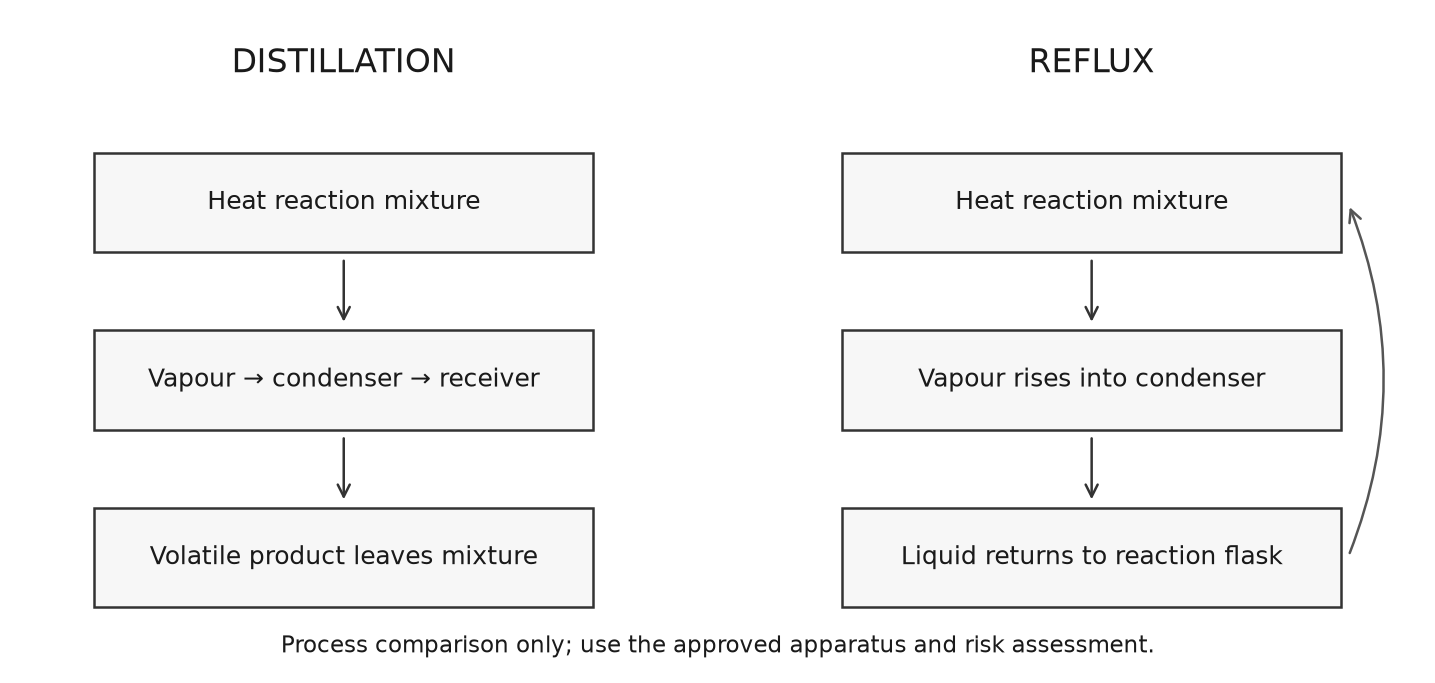
Reflux heats the mixture while a condenser returns vapour; distillation collects vapour after condensation and separates by volatility. Water enters the condenser at the bottom and leaves at the top. Solvent extraction partitions a product between immiscible layers. Use a suitable anhydrous drying agent to remove residual water, then decant/filter it before final distillation. A narrow boiling range near a reference value supports purity but is not conclusive identification; pressure and thermometer position affect the measurement.
Peak ของ molecular-ion ใน mass spectrum ให้มวลโมเลกุลสำหรับไอออนประจุหนึ่ง อาจไม่ใช่ peak ที่ใหญ่ที่สุด Fragment ions ช่วยเสนอโครงสร้าง: การสูญเสีย CH₃ สอดคล้องกับ 15 หน่วยมวล แต่ fragment เดียวมักพิสูจน์ isomer ได้ยาก แยก peak ของไอโซโทปออกจาก fragments ใน IR spectrum เปรียบเทียบตำแหน่งการดูดกลืนกับ ข้อมูล ที่ให้มา: C=O, O–H, N–H, C=C, C–H และ C–X สามารถระบุ functional groups ที่เป็นไปได้ O–H ของแอลกอฮอล์กว้าง; O–H ของกรดกว้างมากและปรากฏร่วมกับ C=O ทั้ง aldehyde และ ketone มี C=O ดังนั้นรวม IR กับสูตร mass spectrum และการทดสอบเคมี เข้าด้วยกัน การขาด absorption ที่คาดหวังอย่างชัดเจนสามารถตัดสมมติฐานได้ ขึ้นอยู่กับคุณภาพของสเปกตรัม Core practical 8 รวมการทดสอบไอออนและการทดสอบอินทรีย์โดยใช้ aliquot แยกสะอาดและบันทึกลำดับหลักฐาน
Two isomeric alkanes have the same electron count. Explain why their boiling temperatures can differ without invoking hydrogen bonding.
An unknown salt gives a white solid with BaCl₂ after acidification and a gas turning red litmus blue with warm NaOH. Identify both ions and give two ionic equations.
การเพิ่มอุณหภูมิเพิ่มอัตราแต่ลดผลผลิต equilibrium What does this imply about forward enthalpy, and why does a catalyst not solve the yield change directly?
A primary bromide gives a three-carbon nitrile. Identify the bromide, its reagent/conditions, and the product of subsequent substitution using aqueous KOH on the original bromide.