Interference
| English | Chinese | Pinyin |
|---|---|---|
| interference | 干涉 | gān shè |
| coherent | 相干 | xiāng gān |
| constructive | 相长 | xiāng zhǎng |
| destructive | 相消 | xiāng xiāo |
| fringe | 条纹 | tiáo wén |
| path difference | 路程差 | lù chéng chà |
| antiphase | 反相 | fǎn xiāng |
| double slit | 双缝 | shuāng fèng |
Two stones in a pond
- Drop two stones together and the ripples cross, making a steady criss-cross pattern.
- Some places churn; others stay almost still.
- This is interference 干涉 — superposition from two sources.
What interference is
- Two coherent 相干 waves overlap to give a fixed pattern.
- Bright (constructive 相长) where they add; dark (destructive 相消) where they cancel.

Two-source interference in a ripple tank: circular waves overlap to give lines of cancellation
Interference
y = y₁ + y₂
In phase → constructive (bright/loud); antiphase → destructive (dark/quiet).
Coherence
- Two sources are coherent if they keep a constant phase difference (same frequency).
- Two separate lamps are not coherent — their phases jump randomly, so any pattern flickers away.

The colours on a soap bubble come from interference of light
Two coherent sources have:
Coherence means a constant phase difference (and so the same frequency) — needed for a steady pattern.
Two separate lamps make a steady, visible interference pattern.
No — their phase difference changes randomly, so any pattern flickers too fast to see.
Path difference 路程差
- Constructive: path difference $= n\lambda$ (a whole number of wavelengths) — the waves arrive in phase.
- Destructive: path difference $= \left(n + \tfrac{1}{2}\right)\lambda$ — the waves arrive in antiphase 反相.

Two coherent sources give lines of maximum displacement where crests meet crests
Constructive interference happens when the path difference is:
$\Delta x = n\lambda$ → crests arrive together → they add. $(n+\tfrac{1}{2})\lambda$ gives cancellation.
Destructive interference happens when the path difference is a whole number plus a ____ of a wavelength.
$\Delta x = \left(n + \tfrac{1}{2}\right)\lambda$ — a crest meets a trough, so they cancel.
Explaining the pattern in exam words
- Four marks, four sentences. 1. The two slits act as coherent sources (constant phase difference), because the same wave reaches both.
- 2. The waves from the two slits overlap and superpose.
- 3. Where the path difference is a whole number of wavelengths the waves arrive in phase → constructive interference → a bright fringe.
- 4. Where it is an odd number of half-wavelengths they arrive in antiphase → destructive → a dark fringe.
Put the steps of the explanation of a double-slit pattern in order.
Coherence first, then superposition, then the two path-difference conditions — each is a separate mark.
Young's double slit 双缝
- One source lights two slits, so they act as coherent sources.
- Fringe 条纹 spacing $x = \dfrac{\lambda D}{a}$ ($a$ = slit gap, $D$ = distance to screen).
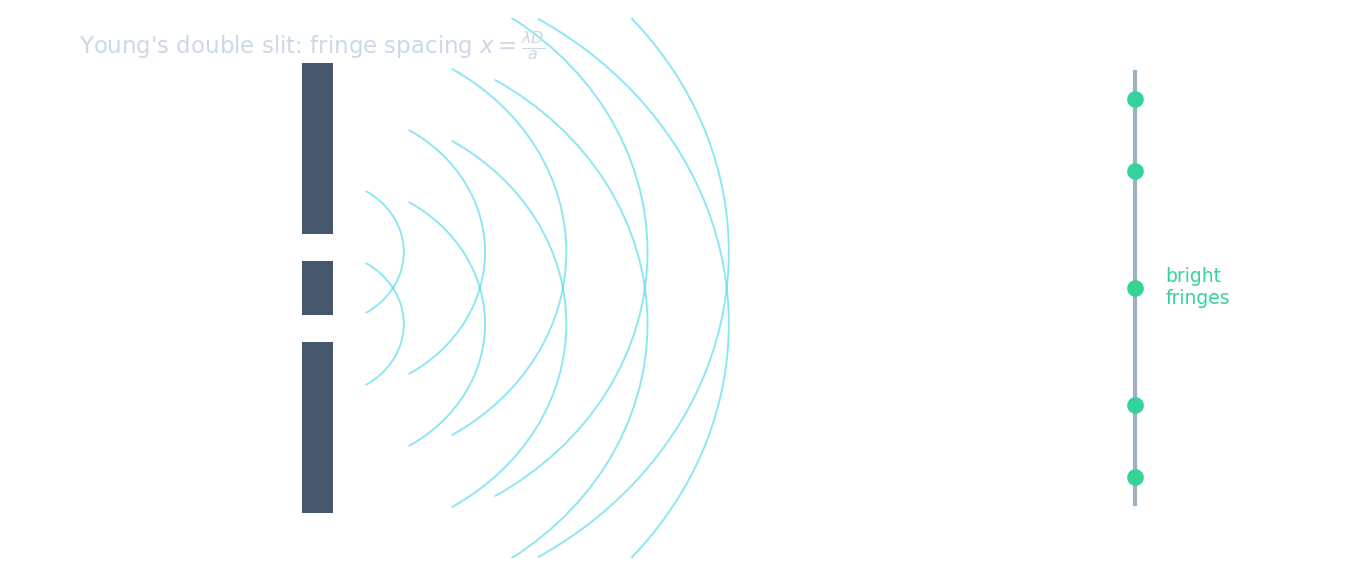
Light of wavelength $600\ \text{nm}$ passes through slits $1.0\ \text{mm}$ apart onto a screen $2.0\ \text{m}$ away. Find the fringe spacing, in mm.
$x = \dfrac{\lambda D}{a} = \dfrac{600 \times 10^{-9} \times 2.0}{1.0 \times 10^{-3}} = 1.2 \times 10^{-3}\ \text{m} = 1.2\ \text{mm}$.
Changing the fringe spacing
- From $x = \dfrac{\lambda D}{a}$: closer fringes need bigger $a$, smaller $D$, or shorter $\lambda$.
- Bluer light gives tighter fringes than red.
Select all the changes that make the fringes closer together.
From $x = \dfrac{\lambda D}{a}$: smaller $x$ needs a bigger $a$, a smaller $D$, or a shorter $\lambda$.
Worked example: from fringes to a frequency
A laser lights a double slit of separation $0.16\ \text{mm}$; the screen is $1.2\ \text{m}$ away. The distance from the centre of the first dark fringe to the centre of the ninth is $3.2\ \text{cm}$. Find the wavelength and the frequency of the light.
- Count the gaps: first to ninth is eight spacings, so $x = \dfrac{3.2}{8} = 0.40\ \text{cm} = 4.0 \times 10^{-3}\ \text{m}$.
- Wavelength: $\lambda = \dfrac{xa}{D} = \dfrac{(4.0 \times 10^{-3})(0.16 \times 10^{-3})}{1.2} = 5.3 \times 10^{-7}\ \text{m}$ — green light.
- Frequency: $f = \dfrac{c}{\lambda} = \dfrac{3.00 \times 10^{8}}{5.3 \times 10^{-7}} = 5.6 \times 10^{14}\ \text{Hz}$.
- Check: dark fringes are spaced the same as bright ones, so either kind gives $x$. Dividing by nine instead of eight is the usual slip.
In a double-slit pattern the centres of the first and sixth dark fringes are $2.0\ \text{cm}$ apart. What is the fringe spacing, in mm?
First to sixth is five spacings: $x = \dfrac{2.0\ \text{cm}}{5} = 0.40\ \text{cm} = 4\ \text{mm}$.
Worked example: two microwave sources
Two microwave transmitters emit in phase. A detector moved along a line finds the first minimum from the centre at a point where the two path lengths differ by $4.5\ \text{cm}$.
- First minimum: path difference $= \tfrac{1}{2}\lambda$, so $\lambda = 9.0\ \text{cm}$.
- Frequency: $f = \dfrac{c}{\lambda} = \dfrac{3.00 \times 10^{8}}{0.090} = 3.3 \times 10^{9}\ \text{Hz}$.
- Next maximum out from the centre: path difference $= \lambda = 9.0\ \text{cm}$.
- Check: the pattern is symmetrical about the centre line, so every point has a twin on the other side with the same intensity — that is the point an exam asks you to mark.
Coherent means a constant phase difference — not "in phase" and not merely "the same frequency". Two independent lamps of the same colour share a frequency but are not coherent, so no steady pattern forms. And fringe spacing is between adjacent fringes: the first-to-ninth distance is eight spacings, not nine.
You've got it
- interference needs coherent sources (constant phase difference)
- constructive: $\Delta x = n\lambda$ (in phase); destructive: $\Delta x = \left(n+\tfrac{1}{2}\right)\lambda$ (antiphase)
- double-slit fringe spacing $x = \dfrac{\lambda D}{a}$; count the gaps between fringes, not the fringes