Diffraction
| English | Chinese | Pinyin |
|---|---|---|
| gap | 缝 | fèng |
| diffraction | 衍射 | yǎn shè |
| obstacle | 障碍物 | zhàng ài wù |
| wavelength | 波长 | bō cháng |
| ripple tank | 水波槽 | shuǐ bō cáo |
| single slit | 单缝 | dān fèng |
| diffraction grating | 衍射光栅 | yǎn shè guāng shān |
Heard but not seen
- You can hear someone around a corner — but you can't see them.
- Both sound and light reach the gap 缝, yet only sound bends around it.
- The difference is diffraction 衍射.
What diffraction is
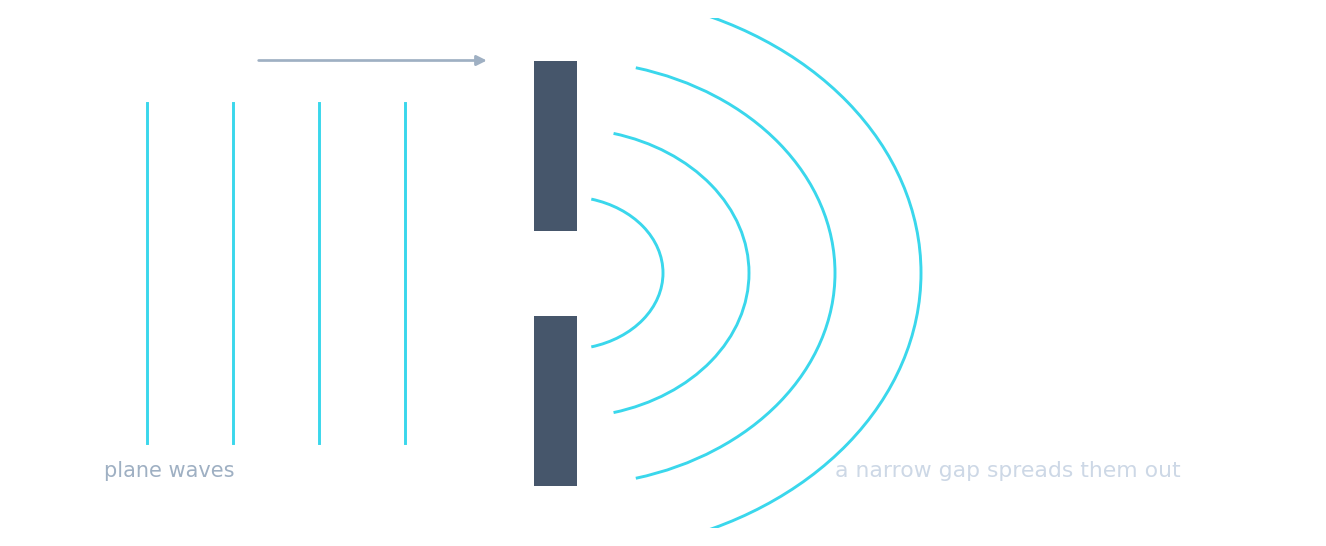
- Diffraction is the spreading of a wave as it passes through a gap or around the edge of an obstacle 障碍物.
- All waves do it — water, sound, light, microwaves. The speed, wavelength and frequency do not change; only the direction spreads.
Waves adding and cancelling
Two overlapping waves add where they are in phase and cancel where out of phase — change the phase to see the result. This is what makes diffraction patterns.
Diffraction is the ____ of a wave as it passes through a gap.
Diffraction is the spreading (bending) of a wave at a gap or obstacle.
All waves can diffract.
Yes — water, sound, light and microwaves all spread at a gap or edge.
How much it spreads
- Gap much wider than $\lambda$ → the wave passes nearly straight through.
- Gap about the size of $\lambda$ → it fans out strongly.

Diffraction in a ripple tank 水波槽 — a wide gap (a) spreads the waves little, a narrow gap (b) much more
A wave spreads out the most when the gap is:
When the gap ≈ the wavelength, the wave fans out strongly; a much wider gap lets it pass nearly straight.
Making the gap narrower makes the waves spread out ____.
A narrower gap (closer to one wavelength) gives stronger diffraction.
Match each gap to how much the wave spreads out beyond it.
Diffraction is greatest when the gap and the wavelength are about the same size, and fades as the gap gets much larger than the wavelength.
Why you hear but don't see
- Speech has $\lambda \approx 1\ \text{m}$ — close to a doorway's width, so it spreads round the corner.
- Light has $\lambda \approx 500\ \text{nm}$ — far smaller than the gap, so it barely spreads.
You can hear but not see around a corner because sound has a much larger wavelength than light.
Sound's wavelength (~1 m) is near the gap size, so it diffracts; light's (~500 nm) is far smaller, so it barely does.
What diffracted light looks like
- Laser light through a single slit 单缝 gives a wide, bright central band with fainter bands either side.
- Through a diffraction grating 衍射光栅 (many slits) the light concentrates into sharp, narrow lines at definite angles: a tall central maximum, then symmetrical peaks at $\pm\theta_1$, $\pm\theta_2$ that get weaker further out.
- The angles obey $d\sin\theta = n\lambda$ — the next lesson but one uses it in full.
Worked example: where the bright lines fall
Laser light of wavelength $600\ \text{nm}$ falls normally on a grating whose lines are $5.0 \times 10^{-6}\ \text{m}$ apart. Find the angle of the second-order line and describe the intensity graph from $-15^\circ$ to $+15^\circ$. A polarising filter is then placed in the beam.
- Second order: $\sin\theta = \dfrac{n\lambda}{d} = \dfrac{2 \times 600 \times 10^{-9}}{5.0 \times 10^{-6}} = 0.24$, so $\theta = 14^\circ$.
- First order: $\sin\theta = 0.12$, so $\theta = 6.9^\circ$.
- Graph: a tall narrow spike at $0^\circ$, smaller spikes at $\pm 6.9^\circ$, smaller again at $\pm 14^\circ$, and almost nothing in between.
- With the polarising filter: every spike is half as tall (unpolarised light through one filter), but the angles are unchanged — the filter does not alter the wavelength.
Light of wavelength $500\ \text{nm}$ falls normally on a grating with lines $4.0 \times 10^{-6}\ \text{m}$ apart. At what angle, in degrees, is the second-order maximum?
$\sin\theta = \dfrac{n\lambda}{d} = \dfrac{2 \times 500 \times 10^{-9}}{4.0 \times 10^{-6}} = 0.25$, so $\theta = 14.5^\circ$.
Diffraction is not refraction and not reflection: the wave keeps the same speed, wavelength and frequency, and only its direction spreads. More spreading does not mean more energy — the same energy is shared over a wider region, so the wave beyond a narrow gap is weaker in any one direction.
A water wave passes through a narrow gap and spreads out. Which quantities stay the same? Select all that apply.
Diffraction only changes the direction the energy travels in. Speed, wavelength and frequency are set by the medium and the source and do not change at a gap.
Seeing it in the lab
- Ripple tank: plane waves hit a barrier with a gap; narrow the gap (or lengthen $\lambda$ by slowing the paddle) and the curved wavefronts spread more.
- Laser and single slit: a pattern of bands on a distant screen; a narrower slit gives a wider central band.
- Laser and grating: a row of sharp dots; a finer grating (more lines per mm) pushes the dots further apart.
You've got it
- diffraction = a wave spreading through a gap or around an obstacle (all waves do it; speed, $\lambda$ and $f$ unchanged)
- most spreading when the gap is about one wavelength 波长 wide
- sound diffracts round corners (big $\lambda$); light hardly does (tiny $\lambda$), so it needs a slit or a grating to show it
- a grating gives sharp maxima at $d\sin\theta = n\lambda$; a polarising filter halves them without moving them