Forced vibration: isolation starts at root two
Введено| English | Значение |
|---|---|
| resonance/ˈrezənəns/ | A large forced response when excitation is near a system's natural frequency, with the response depending on damping and the measured quantity. |
| transmissibility | The ratio of the force or motion passed to the support to the force or motion at the source. |
| vibration isolation | Mounting a machine on soft supports so that little vibration passes to or from its base. |
| natural frequency/ˈnætʃərəl ˈfriːkwənsi/ | A frequency of free undamped oscillation; the angular natural frequency of an ideal mass-spring system is the square root of stiffness divided by mass. |
24 pushes a second
- A small unbalance pushes the pump 24 times a second. Whether the floor feels more or less than that push depends only on the frequency ratio $r = \omega/\omega_n$ and the damping.
- The steady amplitude is $X = (F_0/k)/\sqrt{(1 - r^2)^2 + (2\zeta r)^2}$. At resonance, $r = 1$, only damping limits it.
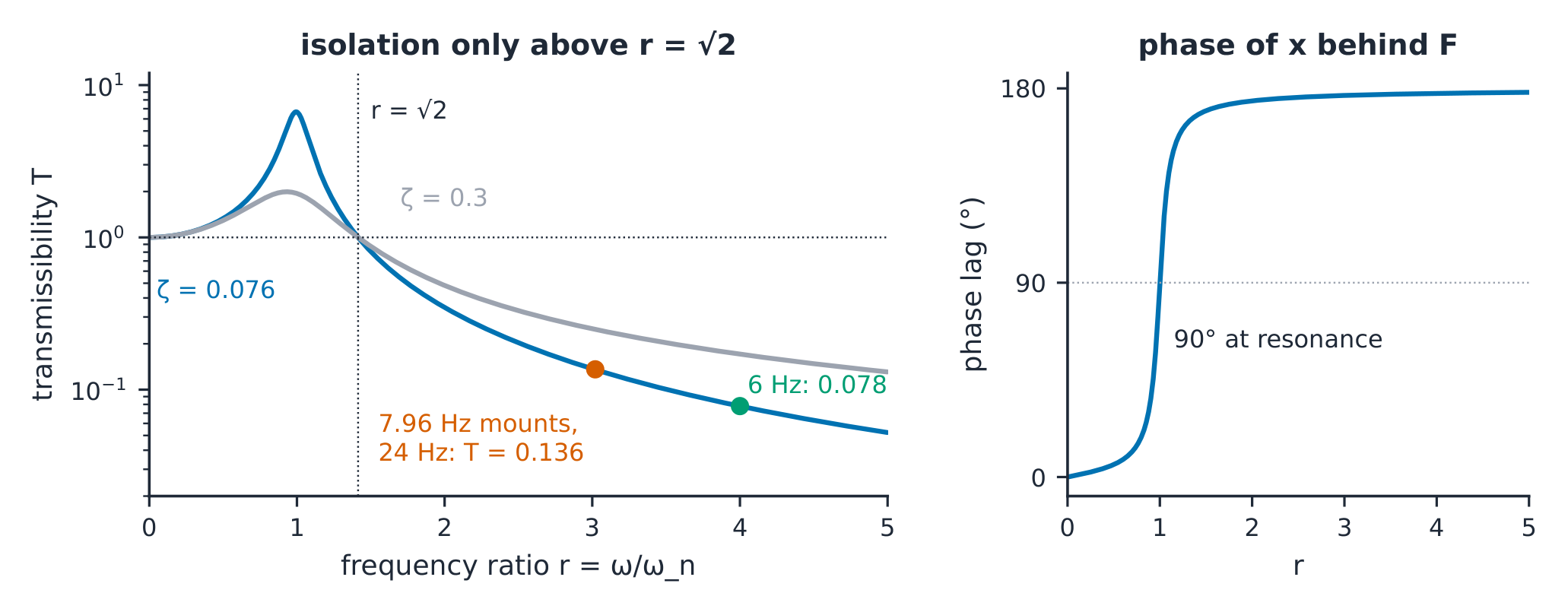
Transmissibility
- The transmissibility, force to the floor over force applied, is $T = \sqrt{[1 + (2\zeta r)^2]/[(1 - r^2)^2 + (2\zeta r)^2]}$.
- $T = 1$ at $r = \sqrt2$ for every $\zeta$: below it mounts amplify, above it they isolate. Vibration isolation wants a low natural frequency and low damping.
Amplify or isolate?
Classify each mount by its frequency ratio.
Frequency ratio above which every mount isolates (three decimals)?
Сложность 2/5 · 140 монет + небольшой бонус за первое завершение сегодня
Root two.
Above r = root 2, more damping makes transmissibility:
Сложность 1/5 · 100 монет + небольшой бонус за первое завершение сегодня
Damping passes force through the mount.
The present mounts
- Residual unbalance 1.2 g·m at 150.8 rad/s: $F_0 = \mathbf{27.3}$ N.
- $r = 24/7.96 = \mathbf{3.02}$ with $\zeta = 0.076$: $T = \mathbf{0.136}$, so 3.7 N reaches the floor and the pump moves 11 µm.
- Passing through resonance at start-up, $X = me/(2\zeta m) = 66$ µm: run up quickly.
Force from 1.2 g m at 150.8 rad/s (one decimal, N)?
Сложность 2/5 · 140 монет + небольшой бонус за первое завершение сегодня
m e omega squared.
Frequency ratio for 24 Hz on 7.96 Hz mounts (two decimals)?
Сложность 2/5 · 140 монет + небольшой бонус за первое завершение сегодня
24 over 7.96.
Force to the floor with T = 0.136 (one decimal, N)?
Сложность 2/5 · 140 монет + небольшой бонус за первое завершение сегодня
0.136 x 27.3.
Designing for 90% isolation
- $T \le 0.1$ at $\zeta = 0.076$ needs $r \ge 3.40$, so $f_n \le 7.06$ Hz. Choose 6 Hz: $k = m(2\pi \times 6)^2 = \mathbf{170.5}$ kN/m, a static deflection of 6.9 mm.
- Then $r = 4.0$ and $T = \mathbf{0.078}$. The cost: softer mounts move more when a pipe pulls, so flexible pipe connections join the design.
Total stiffness for 120 kg at 6 Hz (one decimal, kN/m)?
Сложность 2/5 · 140 монет + небольшой бонус за первое завершение сегодня
m (2 pi f)^2.
Softer mounts improve isolation but increase static deflection.
Сложность 1/5 · 100 монет + небольшой бонус за первое завершение сегодня
6.9 mm at 6 Hz against 3.9 mm before.
Isolation from a spring's sag
- For a spring mount, $f_n = \tfrac{1}{2\pi}\sqrt{g/\delta_{st}}$, which is $15.76/\sqrt{\delta_{st}}$ Hz with $\delta_{st}$ in mm. Suppliers sell mounts by deflection for that reason.
- The 6 Hz design needs $\delta_{st} = 6.9$ mm; a 25 mm deflection spring gives $15.76/5 = \mathbf{3.15}$ Hz, for even better isolation and a much softer installation.
A mount with 25 mm static deflection: natural frequency (two decimals, Hz)?
Сложность 2/5 · 140 монет + небольшой бонус за первое завершение сегодня
$15.76/\sqrt{25} = 3.15$ Hz.
Worked example: an inertia block
- Bolt the pump to a 200 kg concrete block and size the springs for the same 6 Hz: $k = 320 \times (2\pi \times 6)^2 = 455$ kN/m.
- $T$ is unchanged at $r = 4$, but the motion is $X = F_0/[k(r^2 - 1)] = 27.3/(455\,000 \times 15) = \mathbf{4.0}$ µm instead of 10.7. The block steadies the pump for the pipes, not the floor.
27.3 N at $r = 4$ on 320 kg with springs for 6 Hz: pump motion (one decimal, µm)?
Сложность 2/5 · 140 монет + небольшой бонус за первое завершение сегодня
$k = 320 \times 37.7^2 = 454.8$ kN/m; $27.3/(454\,800 \times 15) = 4.0 \times 10^{-6}$ m.
An inertia block on springs of the same natural frequency lowers the force sent to the floor.
Сложность 1/5 · 100 монет + небольшой бонус за первое завершение сегодня
$T$ depends only on $r$ и $\zeta$, which are unchanged. The block reduces the motion, not the transmitted force.
Three isolation slips
- $f_n$ near the running speed. That is resonance.
- More damping to improve isolation above $\sqrt2$. It makes it worse.
- Forgetting start-up. The pump passes through resonance.
Recap
- $T$ depends on $r$ and $\zeta$; isolation needs $r > \sqrt2$, ideally 3 or more.
- Present mounts: $T = 0.136$, 3.7 N to the floor.
- 6 Hz mounts: 170.5 kN/m, $T = 0.078$.