Thermal design: the heat sink with a margin
Введено| English | Значение |
|---|---|
| fin efficiency | The actual heat transfer from a fin divided by what it would transfer if all of it were at the base temperature. |
| fins/fɪnz/ | Extended surfaces attached to a wall to increase the area for convection. |
| thermal interface material | A paste, pad or film placed between two surfaces to fill air gaps and lower the contact resistance to heat. |
170 W that must not reach 125 °C
- The pump drive loses 3% of 5.65 kW, 170 W, in its power module. If the silicon passes 125 °C it fails, so the cooling must be designed with a margin that can be defended.
- Combine everything into one network: junction, case, sink, air.
The allowed resistance
- $T_j \le 125$ °C, air at 40 °C, $P = 170$ W, $R_{jc} = 0.10$ and $R_{cs} = 0.05$ K/W.
- $R_{sa,max} = (125 - 40)/170 - 0.15 = \mathbf{0.35}$ K/W: the sink must beat this.
Allowed sink resistance: 125 degrees C limit, 40 degrees C air, 170 W, 0.15 K/W above the sink (two decimals, K/W)?
Сложность 2/5 · 140 монет + небольшой бонус за первое завершение сегодня
(125 - 40)/170 - 0.15.
Fin efficiency
- Fins add area, but a fin is less useful far from its base. With an insulated tip, the fin efficiency is $\eta_f = \tanh(mH)/(mH)$, with $m = \sqrt{2h/(kt)}$.
- The sink's conductance is $h(A_b + \eta_fA_f)$, so $R_{sa} = 1/[h(A_b + \eta_fA_f)]$.
Which part of the chain?
Place each number in the junction-to-air chain.
A fin is less useful far from its base because:
Сложность 1/5 · 100 монет + небольшой бонус за первое завершение сегодня
The driving difference shrinks toward the tip.
The fin array
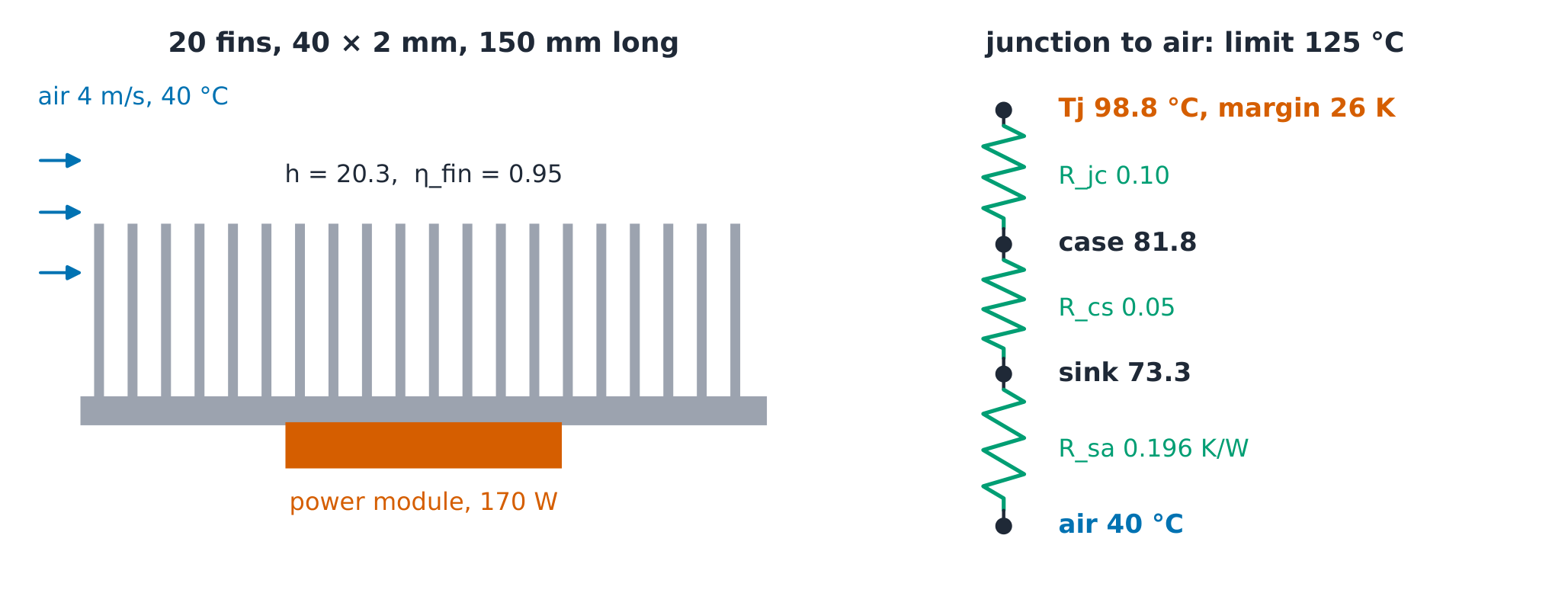
- Aluminium, 20 fins 40 mm high and 2 mm thick, $h = 20.3$: $m = 10.1$ per metre, $mH = 0.40$, $\eta_f = \mathbf{0.95}$.
- $A_f = 0.24$ m², $A_b = 0.024$ m²: $R_{sa} = \mathbf{0.196}$ K/W.
- $T_j = 40 + 170(0.10 + 0.05 + 0.196) = \mathbf{98.8}$ °C: a 26 K margin. Radiation, about 10% extra, is left out on purpose.
m = root(2h/kt) with h = 20.3, k = 200, t = 0.002 m (one decimal, per metre)?
Сложность 2/5 · 140 монет + небольшой бонус за первое завершение сегодня
Root of 40.6/0.4.
Fin efficiency tanh(mH)/(mH) at mH = 0.40 (two decimals)?
Сложность 2/5 · 140 монет + небольшой бонус за первое завершение сегодня
tanh 0.4 = 0.380.
Junction temperature with R_sa = 0.196 K/W (one decimal, degrees C)?
Сложность 2/5 · 140 монет + небольшой бонус за первое завершение сегодня
40 + 170 x 0.346.
Ignoring radiation from the sink is a conservative assumption.
Сложность 1/5 · 100 монет + небольшой бонус за первое завершение сегодня
Radiation would only remove more heat.
The cheapest kelvins: the interface
- The 0.05 K/W between case and sink is mostly air trapped in surface roughness. A better thermal interface material 导热界面材料 halves it to 0.025 K/W.
- At 170 W that is $170 \times 0.025 = \mathbf{4.25}$ K off the junction for a few cents of paste. Check the small resistances in the chain before buying a bigger sink.
Interface resistance cut from 0.05 to 0.025 K/W at 170 W: drop in junction temperature (two decimals, K)?
Сложность 2/5 · 140 монет + небольшой бонус за первое завершение сегодня
$170 \times 0.025 = 4.25$ K.
Worked example: add a fan
- Doubling the air speed over the laminar fins raises $h$ by $\sqrt2$, to 28.7. Then $mH = 0.48$ and $\eta_f = 0.93$: the fins work a little less well.
- $R_{sa} = 1/[28.7(0.024 + 0.93 \times 0.24)] = 0.141$ K/W, and $T_j = 40 + 170(0.15 + 0.141) = \mathbf{89.5}$ °C: 9 K more margin, paid for with a fan that can itself fail.
With $h = 28.7$ и $\eta_f = 0.93$: junction temperature (one decimal, °C)?
Сложность 2/5 · 140 монет + небольшой бонус за первое завершение сегодня
$R_{sa} = 1/(28.7 \times 0.2472) = 0.141$; $40 + 170 \times 0.291 = 89.5$ °C.
A higher $h$ raises the fin efficiency as well as the heat transfer.
Сложность 1/5 · 100 монет + небольшой бонус за первое завершение сегодня
$m = \sqrt{2h/kt}$ grows with $h$, so $\eta_f$ falls (0.95 to 0.93); the conductance still rises because $h$ rises more.
Three thermal-design slips
- Room air instead of the worst-case cabinet air. Design at 40 °C.
- Fins counted at full efficiency. Multiply by $\eta_f$.
- A margin without assumptions. State what was ignored and why it is conservative.
Recap
- $R_{sa,max} = 0.35$ K/W from the junction limit.
- $\eta_f = \tanh(mH)/mH = 0.95$; $R_{sa} = 0.196$ K/W.
- $T_j = 98.8$ °C, a 26 K margin.