Pipe flow: choosing the pump against the system
Введено| English | Значение |
|---|---|
| head loss | The energy lost to friction per unit weight of fluid, expressed as a height of the fluid. |
| minor loss | The head loss caused by a fitting such as a bend, valve, entrance or exit, written as K times the velocity head. |
| major loss | The head loss from friction along a straight length of pipe, given by the Darcy–Weisbach equation. |
| friction factor | The dimensionless coefficient f in the Darcy–Weisbach equation, equal to 64/Re in laminar flow. |
The pump runs where it wants
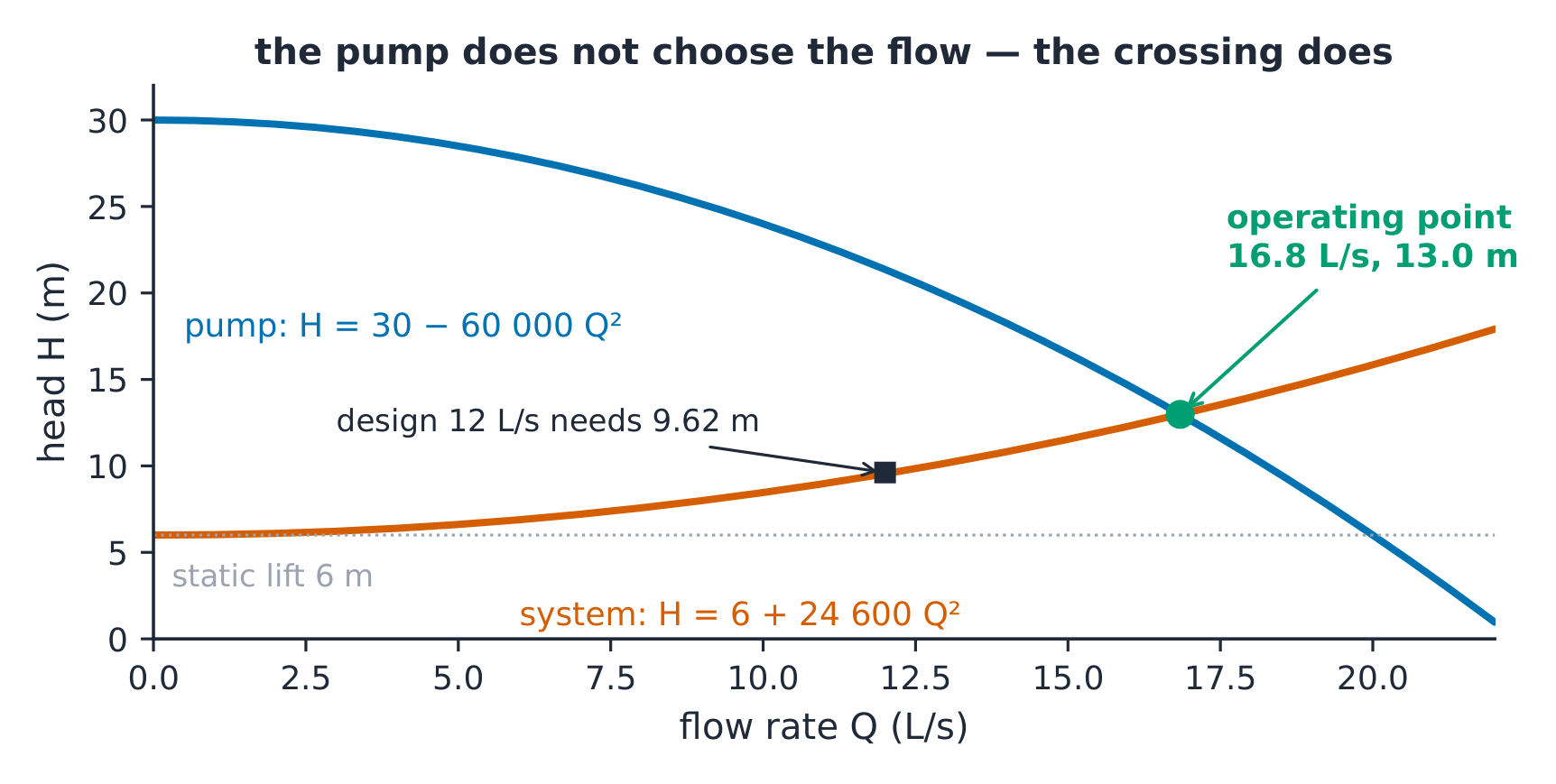
- A pump does not run at the flow you designed for: it runs where its curve crosses the pipe system's curve. Undersize the losses and the loop runs short; oversize them and the pump wastes power for its whole life.
- The energy equation includes a head loss 水头损失 $h_L$: major (pipe friction) plus minor (fittings).
A pump runs at:
Сложность 1/5 · 100 монет + небольшой бонус за первое завершение сегодня
Only the crossing satisfies both curves.
Major and minor losses 局部损失
- Major loss 沿程损失 (Darcy-Weisbach): $h_f = f\,(L/D)\,V^2/2g$. Minor loss: $h_m = \sum K\,V^2/2g$.
- The friction factor 摩擦系数 is $f = 64/Re$ for laminar flow, from the parabolic profile. For turbulent flow it depends on $Re$ and $\varepsilon/D$, through the Colebrook equation or the Moody chart.
Major, minor or static?
Sort each part of the pump's head into its kind of loss.
In laminar pipe flow the friction factor is 64/Re.
Сложность 1/5 · 100 монет + небольшой бонус за первое завершение сегодня
From the Hagen-Poiseuille parabola.
Laminar oil
- Oil ($\nu = 10^{-4}\ \mathrm{m^2/s}$, $\rho = 870$) at 0.5 m/s in a 20 mm line: $Re = \mathbf{100}$, so $f = 0.64$.
- Over 10 m: $h_f = 0.64 \times 500 \times 0.01274 = \mathbf{4.08}$ m of oil, a pressure drop of $\mathbf{34.8}$ kPa.
Oil, nu = 1.0e-4 m2/s, 0.5 m/s, 20 mm bore: Re?
Сложность 2/5 · 140 монет + небольшой бонус за первое завершение сегодня
VD over nu.
Its head loss over 10 m, f = 0.64 (two decimals, m)?
Сложность 2/5 · 140 монет + небольшой бонус за первое завершение сегодня
f times L/D times V^2/2g = 0.64 x 500 x 0.01274.
The loop and its pump
- 40 m of 80 mm steel, $\sum K = 2.85$, 6 m of lift. At 12 L/s, Colebrook gives $f = 0.0192$ and $V^2/2g = 0.290$ m.
- $h_f = 2.79$ m and $h_m = 0.83$ m, so the system needs $H = 6 + 2.79 + 0.83 = \mathbf{9.62}$ m.
- The pump curve $H = 30 - 60\,000Q^2$ crosses the system curve at $\mathbf{16.8}$ L/s and 13.0 m: 40% above design. Shaft power at 70% efficiency is $\mathbf{3.06}$ kW.
System head at design: 6 m lift, h_f = 2.79 m, h_m = 0.83 m (two decimals, m)?
Сложность 2/5 · 140 монет + небольшой бонус за первое завершение сегодня
Add the three.
Minor loss with sum K = 2.85 and V^2/2g = 0.290 m (two decimals, m)?
Сложность 2/5 · 140 монет + небольшой бонус за первое завершение сегодня
Sum K times the velocity head.
Water power at 16.8 L/s and 13.0 m (two decimals, kW)?
Сложность 2/5 · 140 монет + небольшой бонус за первое завершение сегодня
rho g Q H.
Throttling back to design
- To hold 12 L/s, close a valve until the system needs what the pump gives there: $30 - 60\,000 \times 0.012^2 = 21.36$ m, against 9.62 m needed.
- The valve burns $21.36 - 9.62 = 11.74$ m of head, $\rho g Q \times 11.74 = \mathbf{1.38}$ kW of water power, for the pump's whole life. A trimmed impeller or a variable-speed drive saves most of it.
Насос $H = 30 - 60\,000Q^2$ held at 12 L/s where the system needs 9.62 m: head the valve must take (two decimals, m)?
Сложность 2/5 · 140 монет + небольшой бонус за первое завершение сегодня
$30 - 60\,000 \times 1.44 \times 10^{-4} = 21.36$ m; $21.36 - 9.62 = 11.74$ m.
Water power burnt in that valve at 12 L/s (two decimals, kW)?
Сложность 2/5 · 140 монет + небольшой бонус за первое завершение сегодня
$998 \times 9.81 \times 0.012 \times 11.74 = 1379$ W.
Worked example: friction factor without iteration
- Colebrook is implicit in $f$. The Haaland equation is explicit: $1/\sqrt f = -1.8\log_{10}[(\varepsilon/D/3.7)^{1.11} + 6.9/Re]$.
- For the loop, $\varepsilon/D = 5.63 \times 10^{-4}$ and $Re = 1.90 \times 10^5$: $1/\sqrt f = 7.25$, so $f = \mathbf{0.0190}$, within 1% of Colebrook's 0.0192, and good enough to size from.
Haaland for $\varepsilon/D = 5.63 \times 10^{-4}$, $Re = 1.90 \times 10^5$: friction factor (four decimals)?
Сложность 2/5 · 140 монет + небольшой бонус за первое завершение сегодня
$(1.52 \times 10^{-4})^{1.11} + 3.63 \times 10^{-5} = 9.41 \times 10^{-5}$; $1/\sqrt f = -1.8\log_{10}(9.41 \times 10^{-5}) = 7.25$; $f = 0.0190$.
Three pipe-flow slips
- Treating $f$ as fixed. It changes with the flow; recompute it.
- Re from the wrong diameter. Use the pipe's own bore.
- Picking a pump at the design point only. Draw the system curve; the pump runs at the crossing.
Recap
- $h_f = f(L/D)V^2/2g$, $h_m = \sum KV^2/2g$; $f = 64/Re$ laminar, Colebrook turbulent.
- The loop needs 9.62 m at 12 L/s but runs at 16.8 L/s and 13.0 m unless throttled.
- Shaft power $\rho gQH/\eta = 3.06$ kW.