Speculation, leverage and market bubbles
Введено| English | Значение |
|---|---|
| speculative bubble/ˈspekjʊlətɪv ˈbʌbl/ | спекулятивный пузырь |
| leverage/ˈliːvərɪdʒ/ | финансовый рычаг |
A decision you can investigate
- Buyers may purchase an asset because they expect another buyer to pay more later. Rising prices can seem to confirm that belief and attract still more borrowing.
- An expectation of resale is different from valuing the income or services an asset provides.
Build the explanation
- Speculation involves buying or selling on expected price changes. A bubble can develop when expectations and imitation feed price increases beyond levels supported by expected fundamental returns. Easy borrowing may amplify demand; collateral values can support further loans; falling prices can reverse that loop through forced sales and tighter credit.
- Housing provides accommodation and equity gives claims on uncertain business returns. A price rise may reflect genuine scarcity, improved profits or lower discount rates rather than a bubble. The future is uncertain: describe the feedback mechanism rather than declaring every rapid rise irrational.
Work through the evidence
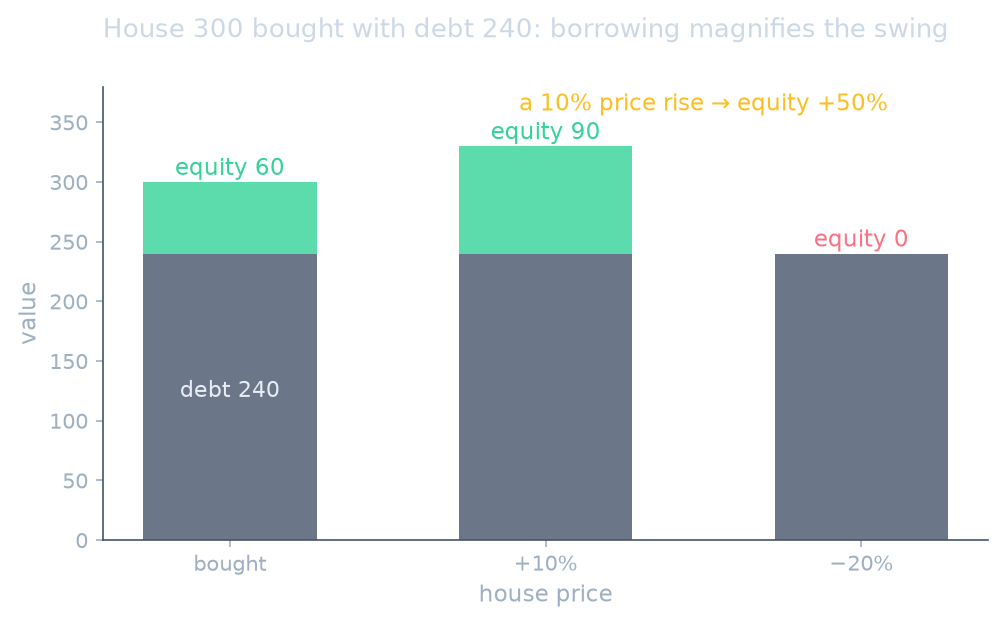
- A fictional house costs 300, financed with debt 240 and equity 60. If its price rises 10%, its value is 330 and equity becomes 90 with debt unchanged: equity gain=(90−60)/60 ×100=50%. If the price instead falls 20% to 240, equity is zero before sale costs; a further fall to 220 leaves asset value 20 below debt.
- A separate unleveraged share purchase of 100 rising to 120 then falling 25% reaches 90, a 10% loss relative to its initial value. Percentage rises and falls use different bases. Borrowing can magnify losses; this arithmetic makes no forecast or investment recommendation.
What is equity after a 20% fall in the house value?
Сложность 1/5 · 100 монет + небольшой бонус за первое выполнение сегодня
House value 240 minus unchanged debt 240 equals zero.
Test the limits
- During expansion, owners may enjoy wealth gains, construction and related firms may expand, and workers may gain jobs. After a reversal, indebted households may cut spending; developers and banks may suffer losses; workers can face unemployment; government revenue may fall while support demands rise. Some renters or new buyers may benefit from lower housing prices if finance remains available.
- Loan terms, recourse, income, interest, liquidity and regulation affect the outcome. A loss in market value is not automatically a realized cash loss, but it can affect collateral and spending. Equity prices can adjust to revised profits without a speculative bubble 投机泡沫.
What is final value of the unleveraged share after the stated changes?
Сложность 1/5 · 100 монет + небольшой бонус за первое выполнение сегодня
120 ×0.75=90; do not subtract 25 from the original 100.
A 10% rise followed by a 10% fall returns an asset to its original value.
Сложность 1/5 · 100 монет + небольшой бонус за первое выполнение сегодня
The fall acts on the higher base:100 ×1.10 ×0.90=99.
Apply and explain your answer
- Why is a 10% house-price gain a 50% equity gain in the leveraged example?
- The asset gains 30 while starting equity is only 60; debt stays 240, so the gain is measured against the smaller equity base.
Which explanation links a price rise to fundamental returns rather than resale feedback?
Сложность 1/5 · 100 монет + небольшой бонус за первое выполнение сегодня
Evidence of higher expected profits can support a valuation rise without a resale-expectation loop.
Use the terms precisely
- speculative bubble: Expectation-driven price feedback can move an asset beyond levels supported by expected fundamental returns.
- leverage 杠杆: Use of borrowing that makes changes in asset value larger relative to the owner’s equity.
Match the terms to their meanings.
Сложность 2/5 · 140 монет + небольшой бонус за первое выполнение сегодня
Use each term for its stated economic relationship.
A fictional house costs 300, financed with debt 240 and equity 60. If its price rises 10%, its value is 330 and equity becomes 90 with debt unchanged: equity gain=(90−60)/60 ×100=50%. If the price instead falls 20% to 240, equity is zero before sale costs; a further fall to 220 leaves asset value 20 below debt. A separate unleveraged share purchase of 100 rising to 120 then falling 25% reaches 90, a 10% loss relative to its initial value. Percentage rises and falls use different bases. Borrowing can magnify losses; this arithmetic makes no forecast or investment recommendation.
During expansion, owners may enjoy wealth gains, construction and related firms may expand, and workers may gain jobs. After a reversal, indebted households may cut spending; developers and banks may suffer losses; workers can face unemployment; government revenue may fall while support demands rise. Some renters or new buyers may benefit from lower housing prices if finance remains available. Loan terms, recourse, income, interest, liquidity and regulation affect the outcome. A loss in market value is not automatically a realized cash loss, but it can affect collateral and spending. Equity prices can adjust to revised profits without a speculative bubble.
Speculation involves buying or selling on expected price changes. A bubble can develop when expectations and imitation feed price increases beyond levels supported by expected fundamental returns. Easy borrowing may amplify demand; collateral values can support further loans; falling prices can reverse that loop through forced sales and tighter credit.
Write from a smaller house
- A house costs 200, with debt 150 and equity 50. Compare a 10 percent price rise with a 25 percent fall.
- A separate unleveraged holding rises from 50 to 60 and then falls 25 percent. A paper loss is not automatically cash.
A house costs 200, financed with debt 150 and equity 50. What is the equity gain if the price rises 10 percent? What equity remains if the price falls 25 percent? Why is the unleveraged fall from 60 to 45 a 10 percent loss on the original 50?
Debt stays fixed, so the asset's gain or loss is measured against the smaller equity. A later percentage uses the new base.
Why is a 10 percent house-price gain a 40 percent equity gain here?
Сложность 1/5 · 100 монет + небольшой бонус за первое выполнение сегодня
20 divided by 50 is 40 percent. The debt does not share that gain. An unsold gain is not yet cash.