Введение в задачи на связанные ставки
Введено| English | Значение |
|---|---|
| related rates/rɪˈleɪtɪd reɪts/ | связанные скорости изменения |
| time/taɪm/ | время |
When one rate drives another
- Blow up a balloon: its radius grows, and because of that, its volume grows too.
- The two rates are linked — knowing how fast the radius changes tells you how fast the volume changes.
- Problems like this are related rates 相关变化率: several quantities changing together in time.
- The engine that links them is the chain rule, applied with respect to time 时间.
Задача на связанные ставки связывает ставки изменений величин, которые зависят друг от...
Сложность 1/5 · 100 монет + небольшой бонус за первое выполнение сегодня
Переменные являются функциями времени, связанными через правило дифференцирования сложной функции.
Start with an equation relating the variables
- First, find an equation that ties the quantities together — usually geometry or a formula.
- Balloon: $V=\tfrac43\pi r^3$ links volume and radius.
- Ladder sliding down a wall: $x^2+y^2=L^2$ (Pythagoras) links the two distances.
- This relating equation is true at every instant, so we can differentiate it in time.
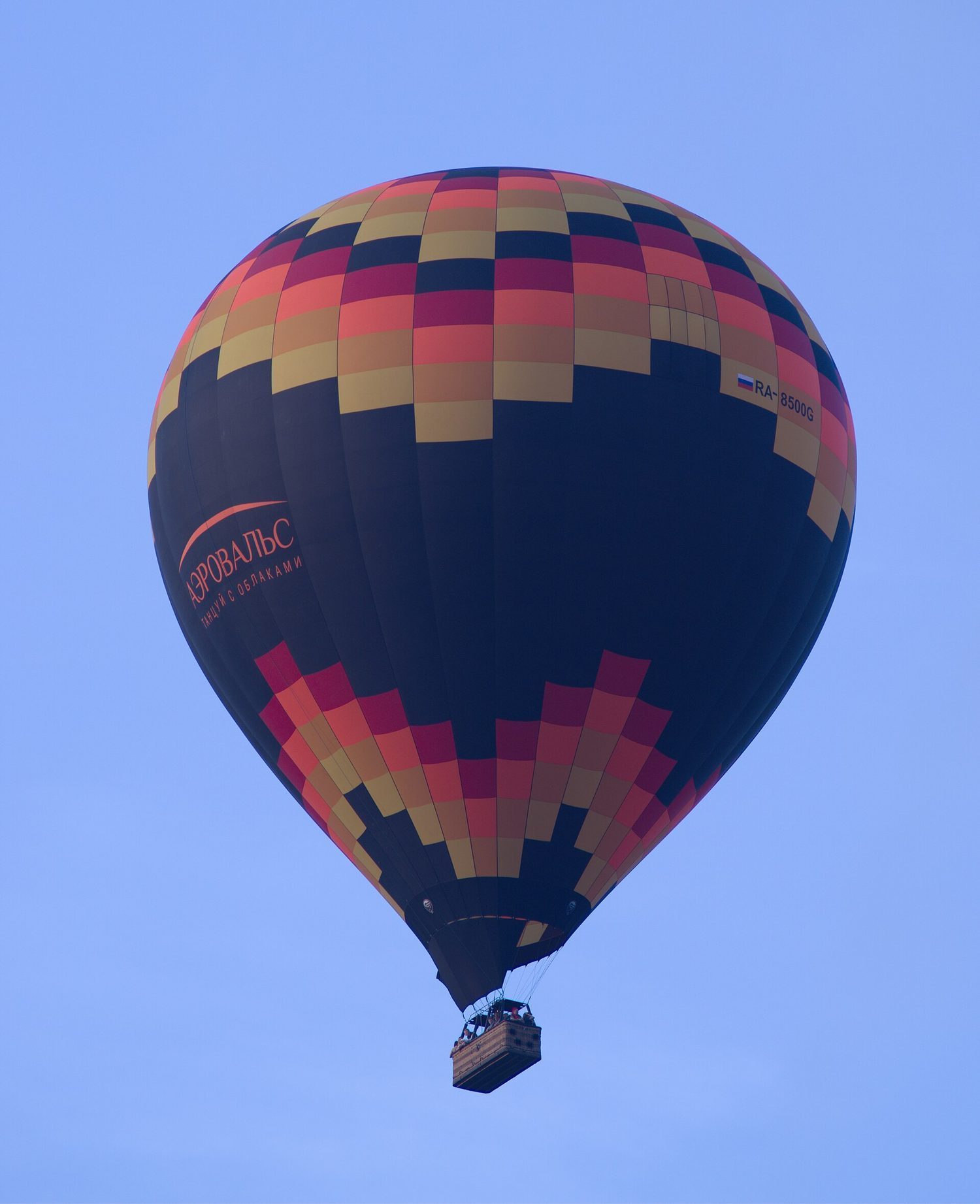
A rising balloon: related rates link how fast radius, volume and height change together
Объем растет вместе с радиусом
y = a·x³ (V vs r)
$V=\tfrac43\pi r^3$ резко возрастает — небольшая ставка изменения радиуса дает большую ставку изменения объема, когда $r$ велико.
Первый шаг — записать ____ , которое связывает изменяющиеся переменные.
Сложность 1/5 · 100 монет + небольшой бонус за первое выполнение сегодня
Обычно геометрическая или физическая зависимость.
Лестница длиной $L$ опирается на стену. Какое уравнение связывает расстояние от стены $x$ и высоту $y$?
Сложность 1/5 · 100 монет + небольшой бонус за первое выполнение сегодня
Теорема Пифагора: стена и пол образуют прямой угол, поэтому $x^2+y^2=L^2$.
Differentiate with respect to time
- Every variable secretly depends on $t$, so differentiating brings in a rate for each — via the chain rule.
- $\dfrac{d}{dt}\big[V=\tfrac43\pi r^3\big]$ gives $\dfrac{dV}{dt}=4\pi r^2\dfrac{dr}{dt}$.
- Each term contributes a "$\tfrac{d(\text{that variable})}{dt}$" factor — exactly like implicit differentiation, but the hidden variable is $t$.
- Now the equation links the rates $\tfrac{dV}{dt}$ and $\tfrac{dr}{dt}$.
Дифференцирование $V=\tfrac43\pi r^3$ по переменной $t$ дает $\dfrac{dV}{dt}=$
Сложность 1/5 · 100 монет + небольшой бонус за первое выполнение сегодня
Правило сложной функции во времени: $4\pi r^2$ умножить на $\tfrac{dr}{dt}$.
Sort the givens from the unknown
- Read the problem and label: which rates are given, and which single rate is wanted?
- "The radius grows at $2\,\tfrac{\text{cm}}{\text{s}}$" → $\tfrac{dr}{dt}=2$ is given.
- "How fast is the volume growing?" → $\tfrac{dV}{dt}$ is the unknown.
- Also note any fixed quantities (like the radius at the instant asked about).
Дифференцирование $r^3$ по времени дает просто $3r^2$.
Сложность 1/5 · 100 монет + небольшой бонус за первое выполнение сегодня
Оно дает $3r^2\tfrac{dr}{dt}$ — необходим множитель ставки.
"Радиус увеличивается со скоростью $2$ см/с; как быстро увеличивается объем?" Выберите все правильные метки.
Сложность 2/5 · 140 монет + небольшой бонус за первое выполнение сегодня
Ставка изменения радиуса дана, ставка изменения объема нужна, и $V=\tfrac43\pi r^3$ их связывает.
Related-rates variables are functions of time, so differentiating $r^3$ gives $3r^2\tfrac{dr}{dt}$ — never just $3r^2$. Forgetting the $\tfrac{dr}{dt}$ (the chain-rule rate factor) is the defining error. Every changing quantity contributes its own $\tfrac{d(\ )}{dt}$.
A balloon's volume is $V=\tfrac43\pi r^3$. Set up the related-rates equation.
- Differentiate with respect to $t$: $\dfrac{dV}{dt}=\dfrac43\pi\cdot 3r^2\cdot\dfrac{dr}{dt}=4\pi r^2\dfrac{dr}{dt}$.
- This links the growth rate of volume to the growth rate of radius.
- Given $\tfrac{dr}{dt}$ and the current $r$, we could now solve for $\tfrac{dV}{dt}$ (next lesson).
A related rates problem links the rates of two or more quantities changing in time. Write an equation relating the variables (often geometry), differentiate it with respect to $t$ using the chain rule (each variable gets a $\tfrac{d(\ )}{dt}$), and identify which rates are given and which is wanted.