Связь пределов на бесконечности и горизонтальных асимптот
Введено| English | Значение |
|---|---|
| end behavior/end bɪˈheɪvjə/ | поведение на бесконечности |
| limits at infinity/ˈlɪmɪts æt ɪnˈfɪnɪti/ | пределы на бесконечности |
| horizontal asymptote/ˌhɒrɪˈzɒntl ˈæsɪmptəʊt/ | горизонтальная асимптота |
Zoom out: what happens far away?
- Instead of $x\to c$, now let $x$ run off to $+\infty$ or $-\infty$.
- This describes the function's end behavior 末端行为 — its shape at the far left and far right.
- We write $\displaystyle\lim_{x\to\infty}f(x)=L$: as $x$ grows huge, $f$ settles toward $L$.
- These are limits at infinity 无穷远处的极限, and they reveal horizontal trends.
Race of the highest powers
- For a rational function, end behavior is a race between the top and bottom degrees.
- Bottom wins (denominator higher degree): $f\to0$. Example $\dfrac{x}{x^2+1}\to0$.
- Tie (equal degrees): $f\to$ the ratio of leading coefficients. Example $\dfrac{3x^2+1}{x^2-5}\to3$.
- Top wins (numerator higher degree): $f\to\pm\infty$ — no horizontal asymptote (it grows).
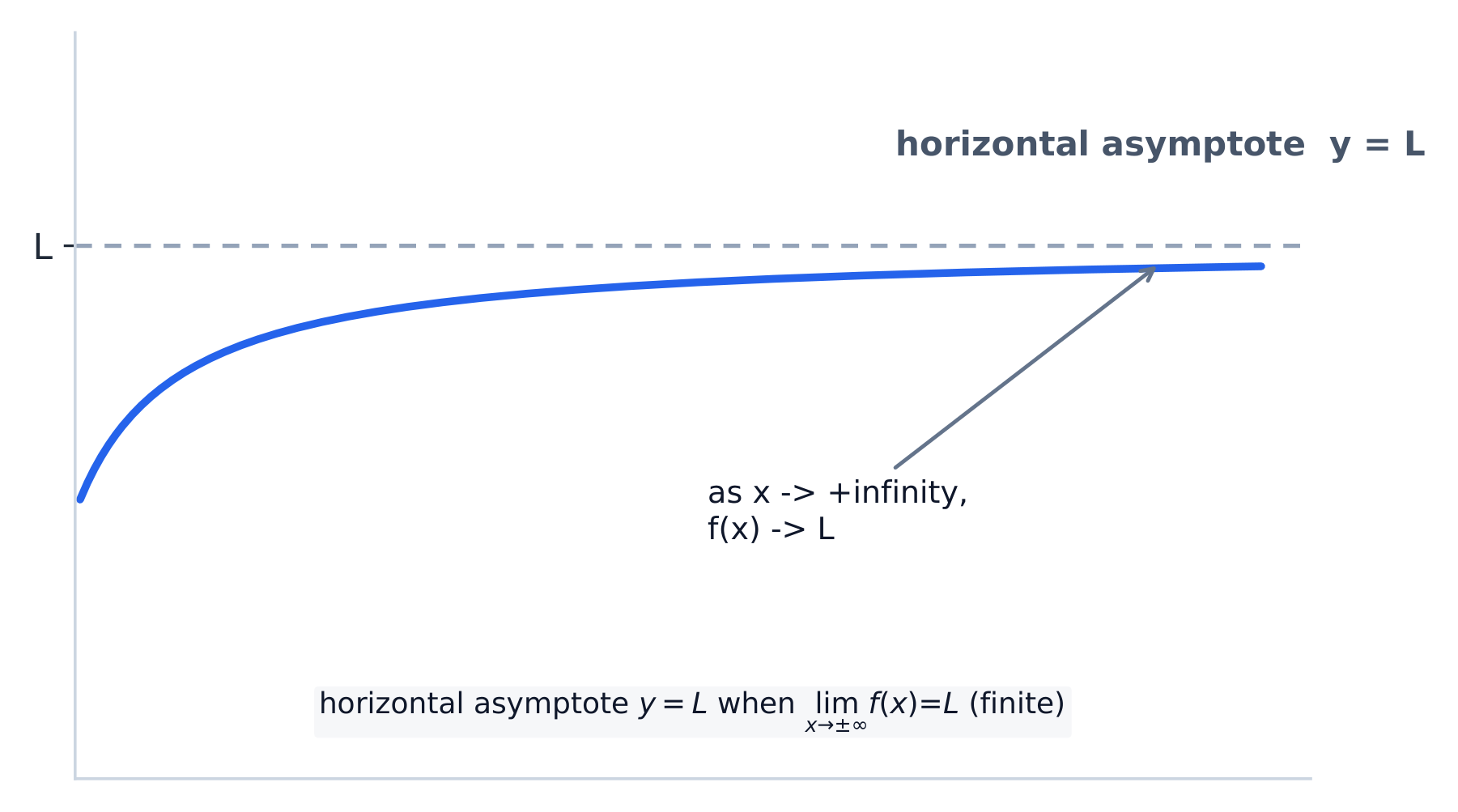
A horizontal asymptote y = L: f approaches L as x grows without bound
Кривая, которая выравнивается на удалении
y = a / (x − b) + d
Сдвиньте $x$ к краям — кривая типа обратной величины выравнивается по направлению к горизонтальной асимптоте, когда $x\to\pm\infty$.
Чему равно $\displaystyle\lim_{x\to\infty}\dfrac{x}{x^2+1}$?
Сложность 1/5 · 100 монет + небольшой бонус за первое выполнение сегодня
Степень знаменателя выше, поэтому дробь стремится к $0$.
Выберите все рациональные функции с горизонтальной асимптотой $y=0$.
Сложность 2/5 · 140 монет + небольшой бонус за первое выполнение сегодня
Степень знаменателя выше → $y=0$. Третий вариант имеет равные степени, давая $y=3$ вместо этого.
The horizontal asymptote
- If $\displaystyle\lim_{x\to\pm\infty}f(x)=L$ (a finite number), the line $y=L$ is a horizontal asymptote 水平渐近线.
- The graph flattens out and runs alongside $y=L$ far from the origin.
- Trick: divide every term by the highest power of $x$ in the denominator, then send $x\to\infty$ (each $\tfrac1{x^n}\to0$).
- $\dfrac{3x^2+1}{x^2-5}=\dfrac{3+\tfrac1{x^2}}{1-\tfrac5{x^2}}\to\dfrac{3}{1}=3$.
Вычислите $\displaystyle\lim_{x\to\infty}\dfrac{3x^2+1}{x^2-5}$.
Сложность 2/5 · 140 монет + небольшой бонус за первое выполнение сегодня
Равные степени → отношение старших коэффициентов $\frac31=3$.
Конечный предел на бесконечности, $\lim_{x\to\infty}f(x)=L$, дает ____ асимптоту $y=L$.
Сложность 1/5 · 100 монет + небольшой бонус за первое выполнение сегодня
График выравнивается по направлению к $y=L$.
The two ends can differ
- A function may approach one value as $x\to+\infty$ and a different value as $x\to-\infty$.
- $\arctan x\to\tfrac{\pi}{2}$ on the right but $\to-\tfrac{\pi}{2}$ on the left — two horizontal asymptotes.
- So always check both directions; don't assume symmetry.
- Unlike a vertical asymptote (a break in the middle), a horizontal asymptote is about the far-away trend, and a curve may even cross it.
График может пересечь свою горизонтальную асимптоту посередине и все равно приближаться к ней на концах.
Сложность 1/5 · 100 монет + небольшой бонус за первое выполнение сегодня
Горизонтальные асимптоты описывают поведение только на большом удалении; пересечение посередине разрешено.
Для $\arctan x$ два предела $\lim_{x\to+\infty}$ и $\lim_{x\to-\infty}$ являются...
Сложность 1/5 · 100 монет + небольшой бонус за первое выполнение сегодня
Два конца могут отличаться — здесь две горизонтальные асимптоты.
A vertical asymptote and a horizontal asymptote are different beasts. Vertical ($x=c$): the output blows up at a specific input — a graph never crosses it. Horizontal ($y=L$): the far-away trend as $x\to\pm\infty$ — a graph may cross it in the middle and still approach it at the ends.
Find $\displaystyle\lim_{x\to\infty}\dfrac{2x^2-3x}{5x^2+7}$ and the horizontal asymptote.
- Degrees tie (both $2$), so divide by $x^2$: $\dfrac{2-\tfrac3x}{5+\tfrac7{x^2}}$.
- As $x\to\infty$, the $\tfrac3x$ and $\tfrac7{x^2}$ terms $\to0$.
- Limit $=\dfrac{2}{5}$, so $y=\tfrac25$ is the horizontal asymptote.
Limits at infinity describe end behavior. For rationals: denominator wins → $0$; degrees tie → ratio of leading coefficients; numerator wins → $\pm\infty$ (no horizontal asymptote). A finite $\lim_{x\to\pm\infty}f(x)=L$ gives a horizontal asymptote $y=L$, and the two ends may differ.