Определение пределов с помощью алгебраических преобразований
Введено| English | Значение |
|---|---|
| equivalent/ɪˈkwɪvələnt/ | Эквивалентность |
| factoring/ˈfæktərɪŋ/ | Разложение на множители |
| conjugate/ˈkɒndʒuːɡeɪt/ | Сопряжённое выражение |
$\tfrac00$ is a locked door — algebra is the key
- Direct substitution just gave you $\dfrac00$. Do not give up — rewrite the function first.
- The trick: find an equivalent 等价 expression that agrees with the original everywhere except the troublesome point.
- Since a limit ignores the single point $x=c$, the rewritten function has the same limit.
- Three tools do almost all the work: factor, rationalize, and combine fractions.
Алгебраические преобразования заменяют функцию на эквивалентную, которая совпадает со старой везде, кроме удаленной точки.
Сложность 1/5 · 100 монет + небольшой бонус за первое выполнение сегодня
Одинаковые значения вне точки разрыва означают одинаковый предел.
Tool 1 — factor and cancel
- A $\tfrac00$ in a rational function means $(x-c)$ divides both top and bottom.
- Use factoring 因式分解 on each, cancel the common $(x-c)$, then substitute.
- $\displaystyle\lim_{x\to 3}\frac{x^2-9}{x-3}=\lim_{x\to 3}\frac{(x-3)(x+3)}{x-3}=\lim_{x\to 3}(x+3)=6$.
- The cancelled form is identical to the original for every $x\neq 3$ — exactly where the limit lives.
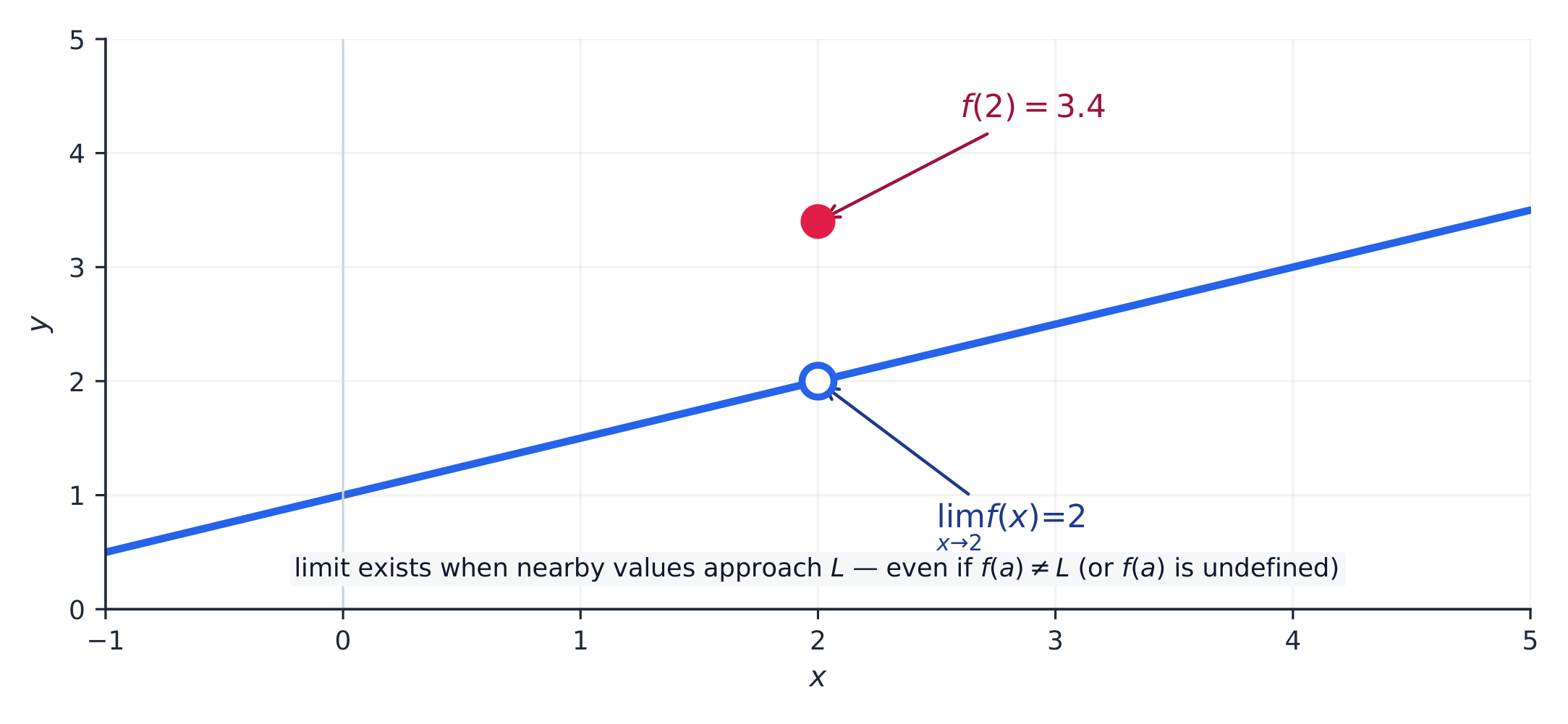
The limit at x = 2 is the height the graph approaches, even though f(2) is defined elsewhere
Кривая гладкая, за исключением точки разрыва
y = x + 3 (после сокращения (x−3))
После факторизации и сокращения график становится обычной кривой с одной отсутствующей точкой — предел считывается по этому разрыву.
Вычислите $\displaystyle\lim_{x\to 4}\dfrac{x^2-16}{x-4}$.
Сложность 2/5 · 140 монет + небольшой бонус за первое выполнение сегодня
Разложение на множители: $\frac{(x-4)(x+4)}{x-4}=x+4\to 8$.
Tool 2 — rationalize the root
- When a square root causes the $\tfrac00$, multiply top and bottom by the conjugate 共轭式.
- This clears the root and exposes a cancellable factor.
- $\displaystyle\lim_{x\to 0}\frac{\sqrt{x+4}-2}{x}=\lim_{x\to 0}\frac{(\sqrt{x+4}-2)(\sqrt{x+4}+2)}{x(\sqrt{x+4}+2)}=\lim_{x\to 0}\frac{x}{x(\sqrt{x+4}+2)}=\frac14$.
Предел $\displaystyle\lim_{x\to 0}\dfrac{\sqrt{x+9}-3}{x}$ лучше всего решается путем...
Сложность 1/5 · 100 монет + небольшой бонус за первое выполнение сегодня
Корень, вызывающий $\tfrac00$, требует применения сопряженного; здесь предел равен $\tfrac16$.
Вычислите $\displaystyle\lim_{x\to 0}\dfrac{\sqrt{x+4}-2}{x}$.
Сложность 2/5 · 140 монет + небольшой бонус за первое выполнение сегодня
Рационализируйте до формы $\frac{1}{\sqrt{x+4}+2}\to\frac{1}{4}$.
Tool 3 — combine the fractions
- A difference of fractions like $\dfrac{1}{x+2}-\dfrac12$ over $x$ hides a factor once you use a common denominator.
- Combine into a single fraction, simplify, and the $(x-c)$ cancels.
- After any of these moves, finish with direct substitution — the door is now unlocked.
- Whichever tool you use, you are producing an equivalent function that lets substitution succeed.
Выберите все алгебраические инструменты, способные решить предел типа $\tfrac00$.
Сложность 2/5 · 140 монет + небольшой бонус за первое выполнение сегодня
Первые три являются корректными преобразованиями; округление — недопустимый метод.
Cancelling $(x-c)$ changes the function at exactly one point: the rewritten expression is defined at $c$ while the original has a hole there. That is fine for the limit (which never looks at $x=c$), but do not claim the two functions are identical — they differ at the removed point.
После сокращения $(x-3)$ упрощенная функция полностью идентична исходной во всех точках, включая $x=3$.
Сложность 1/5 · 100 монет + небольшой бонус за первое выполнение сегодня
Они совпадают везде, кроме $x=3$, где у исходной функции есть точка разрыва. Предел не меняется, но функции там различаются.
Find $\displaystyle\lim_{x\to -1}\frac{x^2-1}{x^2+3x+2}$.
- Substitution gives $\tfrac00$ — factor both.
- $\dfrac{(x-1)(x+1)}{(x+1)(x+2)}=\dfrac{x-1}{x+2}$ for $x\neq -1$.
- Substitute: $\dfrac{-1-1}{-1+2}=\dfrac{-2}{1}=-2$.
When substitution gives $\tfrac00$, rewrite the function into an equivalent form that agrees everywhere except at $c$: factor and cancel, rationalize with a conjugate, or combine fractions. Then substitute. The rewrite has the same limit because a limit ignores the single removed point.