Inventory: where ordering meets holding
Introduzido| English | Significado |
|---|---|
| economic order quantity | the order size that minimises the sum of ordering and holding costs |
| reorder point | the stock level that triggers an order - lead-time demand plus safety stock |
| lead time/liːd taɪm/ | the time from placing an order to receiving it |
| safety stock | buffer stock held above expected lead-time demand to reach a service level |
Flour is 60% of a bun and 48,000 kg a year of cash
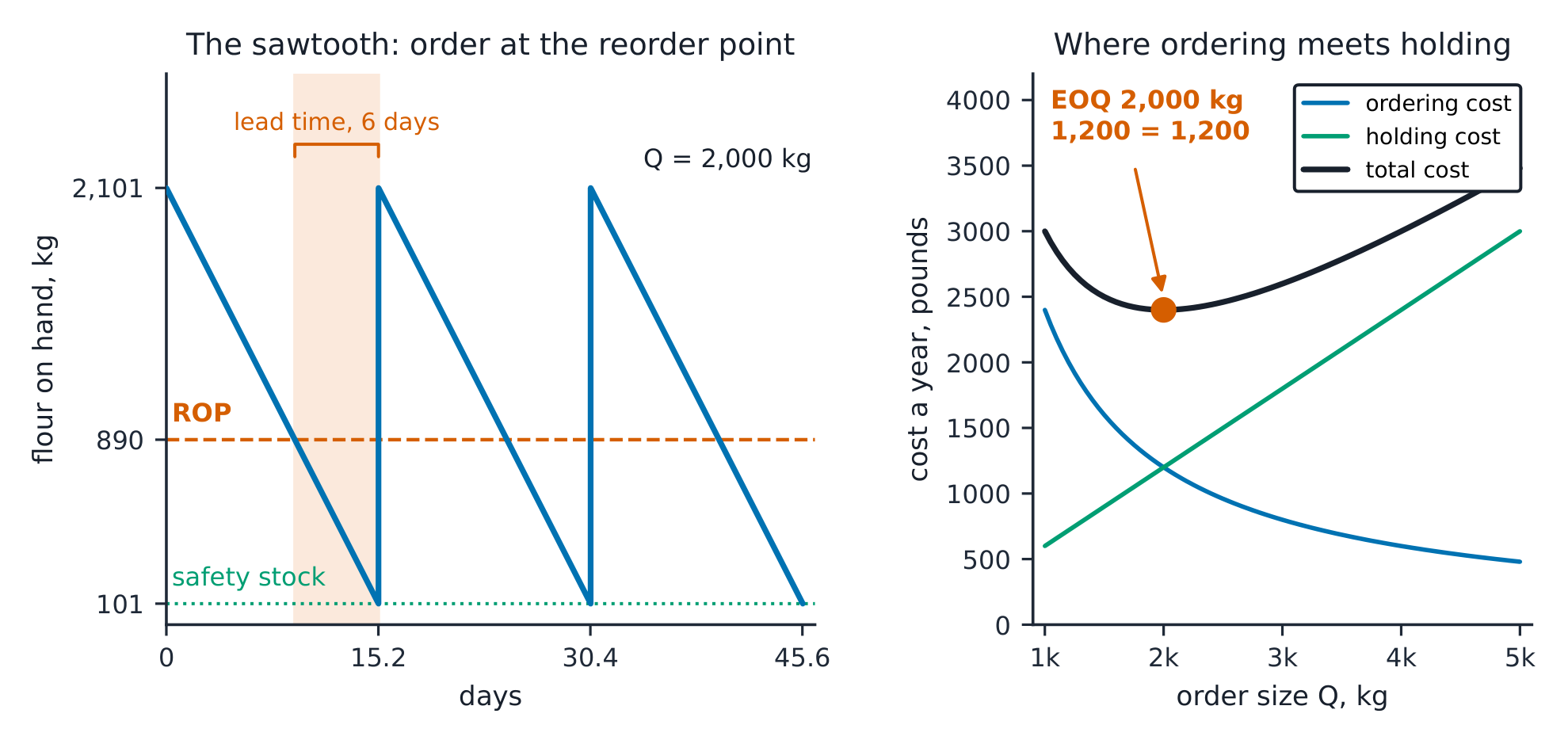
- Too little stops the line; too much is money mouldering in bins. Two costs pull against each other: ordering (50 pounds an order) and holding (1.20 a kg a year).
- The economic order quantity 经济订货批量 is where they balance.
The EOQ
- $EOQ = \sqrt{2DS/H} = \sqrt{2 \times 48{,}000 \times 50 / 1.20} = 2{,}000$ kg: 24 orders a year, one every 15.2 days.
- At the EOQ the costs tie: ordering $24 \times 50 = 1{,}200$, holding $1{,}000 \times 1.20 = 1{,}200$.
D = 48,000 kg, S = 50, H = 1.20. The EOQ in kg?
Dificuldade 2/5 · Moedas 140 + pequeno bônus na primeira conclusão hoje
$\sqrt{2 \times 48{,}000 \times 50/1.2} = \sqrt{4{,}000{,}000} = 2{,}000$.
Orders a year at the EOQ?
Dificuldade 2/5 · Moedas 140 + pequeno bônus na primeira conclusão hoje
48,000 / 2,000 = 24.
At the EOQ, how do annual ordering and holding costs compare?
Dificuldade 1/5 · Moedas 100 + pequeno bônus na primeira conclusão hoje
The EOQ is defined by the balance: D/Q x S = Q/2 x H.
Match each symbol to its meaning.
Dificuldade 2/5 · Moedas 140 + pequeno bônus na primeira conclusão hoje
Two costs and a demand make the EOQ; z sizes the buffer.
The reorder point
- Daily demand $48{,}000/365 = 131.5$ kg; the lead time 交货期 is 6 days, so $131.5 \times 6 = 789$ kg leaves the bin while the order is on the road.
- Demand sd 25 a day gives $\sigma_{LT} = 25\sqrt{6} = 61.2$; at 95% service $z = 1.645$, safety stock 安全库存 $= 101$ kg and the reorder point 再订货点 $= 789 + 101 = 890$ kg.
Lead-time demand 789 kg, safety stock 101 kg. The reorder point?
Dificuldade 2/5 · Moedas 140 + pequeno bônus na primeira conclusão hoje
789 + 101 = 890 kg.
Safety stock at 95% service with sigma over the lead time 61.2 kg (z = 1.645), to the nearest kg?
Dificuldade 2/5 · Moedas 140 + pequeno bônus na primeira conclusão hoje
$1.645 \times 61.2 = 100.7 \approx 101$.
The discount that had to be checked
- 2% off 2.00 a kg for orders of 4,000 kg: purchase 94,080 + ordering 600 + holding 2,400 = 97,080 against 98,400 at the EOQ - saves 1,320 a year.
- The extra logistics cost is exactly 600, so the breakeven discount is $600/96{,}000 = 0.625\%$. The EOQ is the number every deviation must beat.
The 2% discount at 4,000 kg against the EOQ saves, per year:
Dificuldade 1/5 · Moedas 100 + pequeno bônus na primeira conclusão hoje
Purchase saves 1,920; logistics cost 600 more; net 1,320.
The shortage that was predictable
- Festival week runs 180 kg a day. The bin hits 890 and an order goes out - but $180 \times 6 = 1{,}080$ kg leaves before it lands: a 190 kg stockout.
- Safety stock was sized for sd 25 noise, not a calendar event 49 a day above the mean. Events need a scheduled pre-buy, not a bigger buffer.
Which tool handles this?
Route each situation to the EOQ, the safety stock, a total-cost check, or a plan.
Safety stock sized for sd 25 a day covers a festival week running 49 kg a day above the mean.
Dificuldade 1/5 · Moedas 100 + pequeno bônus na primeira conclusão hoje
180 x 6 = 1,080 leaves before the order lands against an ROP of 890 - a 190 kg stockout. Plan it.
Three inventory slips
- Reordering when the bin looks low. No lead time in that rule.
- Treating the EOQ as eternal. Demand moves; the square root moves.
- Taking a discount without the total-cost check. Breakeven here is 0.625%.
Recap
- $EOQ = \sqrt{2DS/H}$ = 2,000 kg, where ordering = holding.
- ROP = lead-time demand + $z\sigma_{LT}$ = 789 + 101 = 890.
- Safety stock is for noise; calendars need planning.