Compare dois textos sem fundir suas afirmações
Introduzido| English | Significado |
|---|---|
| qualify/ˈkwɒlɪfaɪ/ | qualificar |
| premature/prɪməˈtʃʊə/ | prematura |
Two scientists, one question
- Text 1 says a new painkiller "is clearly safer than older drugs". Text 2 says the trials "were too short to judge long-term safety".
- Cross-text questions ask how the second author would respond to the first. Keep each author's claim separate before you compare them.
Summarise each text alone
- Write one line per text: who claims what, and how certain they are. Text 1: the drug is safer (strong certainty). Text 2: we cannot know yet (doubt about the evidence).
- Note what each text is about; sometimes they discuss different aspects of the same topic.
Put the cross-text method in order.
Dificuldade 3/5 · Moedas 200 + pequeno bônus na primeira conclusão hoje
Keeping the texts separate first prevents merging their claims.
The relationship
- Agree, disagree, or qualify 限定 (accept part, but add a limit). Text 2 does not say the drug is unsafe; it questions whether the evidence supports "clearly safer".
- So the best answer is a qualification: "Text 2's author would argue that Text 1's conclusion is premature 过早的."
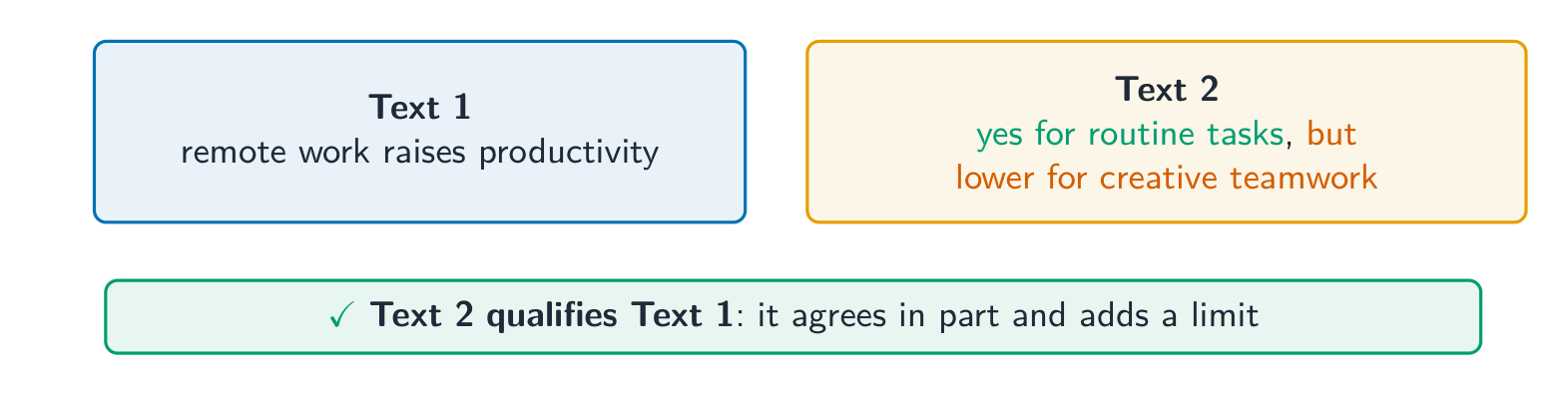
Text 1: "Remote work raises productivity." Text 2: "Remote work raises productivity for routine tasks but lowers it for creative teamwork." Relationship: Text 2 qualifies Text 1 — it agrees in part and adds a limit.
Concordar, discordar ou qualificar?
Classificar a relação entre dois textos curtos.
Text 1: “City parks reduce stress for residents.” Text 2: “Parks reduce stress, but only when they are quiet; parks next to busy roads show no effect.” How does Text 2 relate to Text 1?
Dificuldade 1/5 · Moedas 100 + pequeno bônus na primeira conclusão hoje
Text 2 agrees in part and adds a limit.
When an author accepts part of another's claim but adds a limit, they ____ it.
Dificuldade 1/5 · Moedas 100 + pequeno bônus na primeira conclusão hoje
Qualifying is partial agreement with a condition.
Predicting a response
- Use the second author's stated reasoning: if they value long-term data, they will ask for longer trials, not reject the drug outright.
- The predicted response must use only what that author has said or clearly implied.
Text 1 claims a new teaching method improves test scores, based on one school's results. Text 2's author argues that results from a single school cannot be generalised. How would Text 2's author most likely respond to Text 1?
Dificuldade 1/5 · Moedas 100 + pequeno bônus na primeira conclusão hoje
The author's reasoning is about generalising; they would ask for more evidence.
Traps
- Merging the texts: an answer that combines both claims as if one author said them.
- Too strong a disagreement: doubt about the evidence is not the same as saying the opposite.
If one author doubts the evidence for a claim, they must believe the opposite claim is true.
Dificuldade 1/5 · Moedas 100 + pequeno bônus na primeira conclusão hoje
Doubt is not the same as disagreement.
Recap
- Summarise each author's claim and certainty separately.
- Name the relationship — agree, disagree or qualify — and predict responses from the second author's own reasoning.
- premature: Happening or done too early.
- qualify: To limit or restrict a claim.