Palavras no contexto: significado, polaridade e colocação
Introduzido| English | Significado |
|---|---|
| ambivalent/æmˈbɪvələnt/ | ambivalente |
| collocation/ˌkɒləˈkeɪʃn/ | colocação |
The word that fits
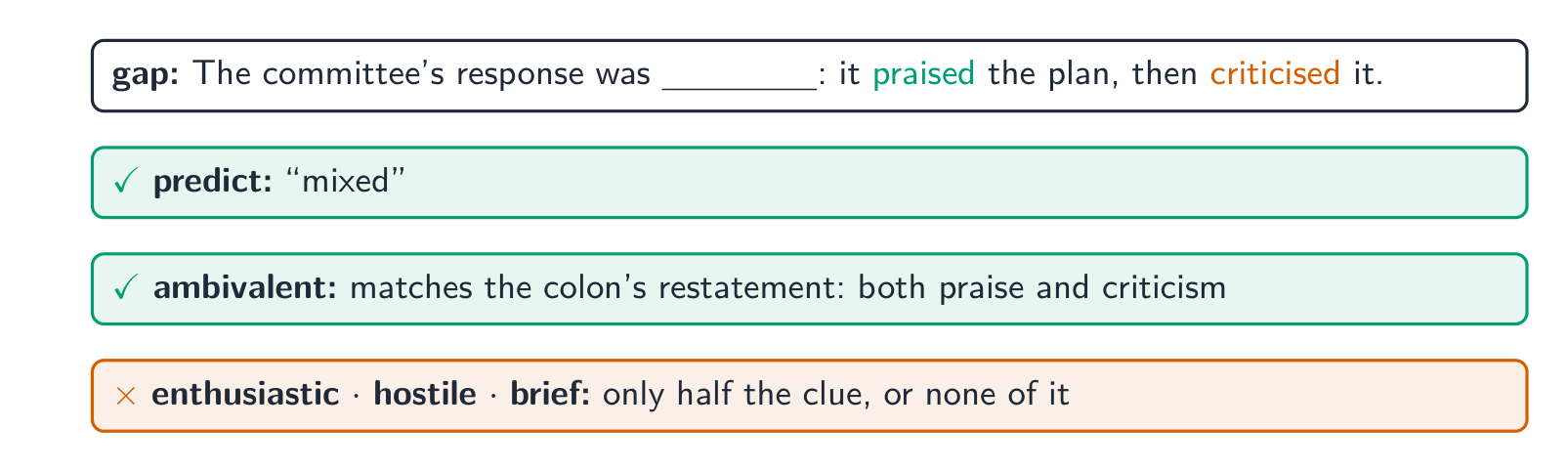
- "The committee's response was ___: it praised the plan in one sentence and criticised it in the next." Choices: ambivalent 矛盾的, enthusiastic, hostile, brief.
- Words in context asks for the word whose meaning, strength and usage fit the sentence. The sentence always contains the clue.
Use the clues
- Look for restatement (a colon or dash), contrast (although, but, despite), and cause (because, so). Here the colon explains: praised and criticised → mixed feelings → ambivalent.
- Predict a simple word first ("mixed"), then find the choice that means that.
Qual pista está na frase?
Identifique o tipo de pista contextual que determina a palavra faltante.
“The new policy was ___ by residents: hundreds attended the meeting to oppose it.” Which word best fits?
Dificuldade 1/5 · Moedas 100 + pequeno bônus na primeira conclusão hoje
Attending to oppose it shows resistance.
A colon or dash often signals that the next part ____ or explains the gap.
Dificuldade 1/5 · Moedas 100 + pequeno bônus na primeira conclusão hoje
Use what follows the colon to work out the missing word.
Degree and direction
- Positive or negative? Strong or mild? "The results were ___ promising" might need "somewhat" if the next sentence lists problems.
- "Unprecedented" is stronger than "unusual"; "dismissed" is stronger than "questioned". Match the strength the context shows.
"Although the medication reduced symptoms, its effect was ___ — most patients still needed a second treatment." The contrast with "reduced symptoms" and the need for a second treatment point to a weak effect: modest, limited. Not dramatic.
“The improvement was ___: test scores rose by only two points.” Which word best fits?
Dificuldade 1/5 · Moedas 100 + pequeno bônus na primeira conclusão hoje
“Only two points” shows a small change.
Collocation 词语搭配 and grammar
- The word must also fit the sentence grammatically and sound natural with its neighbours: "to conduct an experiment", "to pose a question", "a heavy rain" (not "a strong rain").
- Check the part of speech: a gap before a noun needs an adjective; after "to" it needs a verb.
Which word completes the phrase naturally: “to ___ a survey”?
Dificuldade 1/5 · Moedas 100 + pequeno bônus na primeira conclusão hoje
“Conduct a survey” is the standard collocation.
Traps
- The familiar meaning: "the novel's arresting opening" means striking, not related to police.
- Right direction, wrong strength: "devastating" for a result the text calls a small setback.
In “an arresting photograph”, arresting means “striking or eye-catching”.
Dificuldade 1/5 · Moedas 100 + pequeno bônus na primeira conclusão hoje
True. In this context arresting describes something that catches attention, not anything connected with the police.
Recap
- Find the clue (restatement, contrast, cause), predict a simple word, then match meaning and strength.
- Check grammar and natural collocation; beware familiar but wrong meanings.
- ambivalent: Having mixed feelings about something.