Melting, boiling and evaporation · Fusão, ebulição e evaporação
| English | Português |
|---|---|
| melting/ˈmeltɪŋ/ | fusão |
| boiling/ˈbɔɪlɪŋ/ | ebulição |
| evaporation/ɪˌvæpəˈreɪʃn/ | evaporação |
| boiling point/ˈbɔɪlɪŋ pɔɪnt/ | ponto de ebulição |
Why sweating cools you
- When sweat dries off your skin, you feel cooler.
- A changing state — liquid turning to gas — is carrying energy away.
- Let's see how melting 熔化, boiling 沸腾 and evaporation 蒸发 work.
Por que suar resfria você
- Quando o suor seca na sua pele, você se sente mais fresco.
- Uma mudança de estado — líquido virando gás — está levando energia embora.
- Vamos ver como fusão 熔化, ebulição 沸腾 e evaporação 蒸发 funcionam.
Melting and boiling
- Melting (solid → liquid) and boiling (liquid → gas) both need energy.
- But while the state is changing, the temperature stays the same — the energy goes into breaking the forces between particles, not into speeding them up.
- For water at normal air pressure: melting at $0\ {}^{\circ}\text{C}$, boiling at $100\ {}^{\circ}\text{C}$.
Fusão e ebulição
- Fusão (sólido → líquido) e ebulição (líquido → gás) ambas precisam de energia.
- Mas enquanto o estado muda, a temperatura permanece a mesma — a energia vai para quebrar as forças entre partículas, não para acelerá-las.
- Para água na pressão atmosférica normal: fusão em $0\ {}^{\circ}\text{C}$, ebulição em $100\ {}^{\circ}\text{C}$.
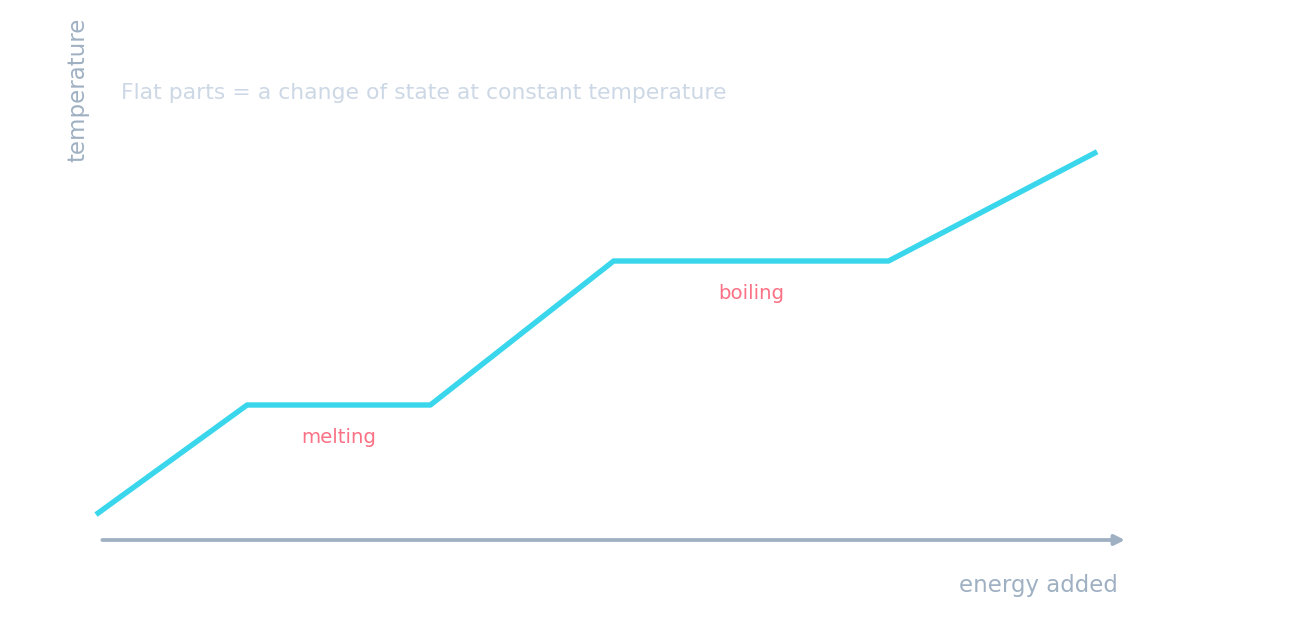
The heating curve — watch the temperature pause · A curva de aquecimento — observe a pausa da temperatura
While the substance is melting or boiling the temperature stays flat, even though heat is still going in — the energy breaks bonds instead of warming it. · Enquanto a substância está fundindo ou fervendo, a temperatura permanece plana, embora o calor ainda esteja entrando — a energia quebra ligações em vez de aquecê-la.
While ice is melting into water, what happens to the temperature? · Enquanto o gelo derrete em água, o que acontece com a temperatura?
During a change of state the energy goes into breaking the forces between particles, so the temperature stays constant until the change is complete. · Durante uma mudança de estado, a energia entra para quebrar as forças entre partículas, então a temperatura permanece constante até que a mudança esteja completa.
On a heating curve, a flat (horizontal) section means: · Em uma curva de aquecimento, uma seção plana (horizontal) significa:
Energy is still being added, but it is used to change the state, so the temperature does not rise — the curve is flat. · Energia ainda está sendo adicionada, mas é usada para mudar o estado, então a temperatura não sobe — a curva é plana.
Evaporation
- Evaporation is a liquid turning to gas at its surface, and it happens below the boiling point 沸点.
- The fastest particles escape from the surface.
- That leaves slower particles behind, so the average energy drops — the liquid cools down.
- This is exactly why evaporating sweat cools your skin.
Temperature stays flat while the substance melts and while it boils
Evaporação
- Evaporação é um líquido virando gás em sua superfície, e acontece abaixo do ponto de ebulição 沸点.
- As partículas mais rápidas escapam da superfície.
- Isso deixa partículas mais lentas para trás, então a energia média cai — o líquido esfria.
- É exatamente por isso que suor evaporando resfria sua pele.
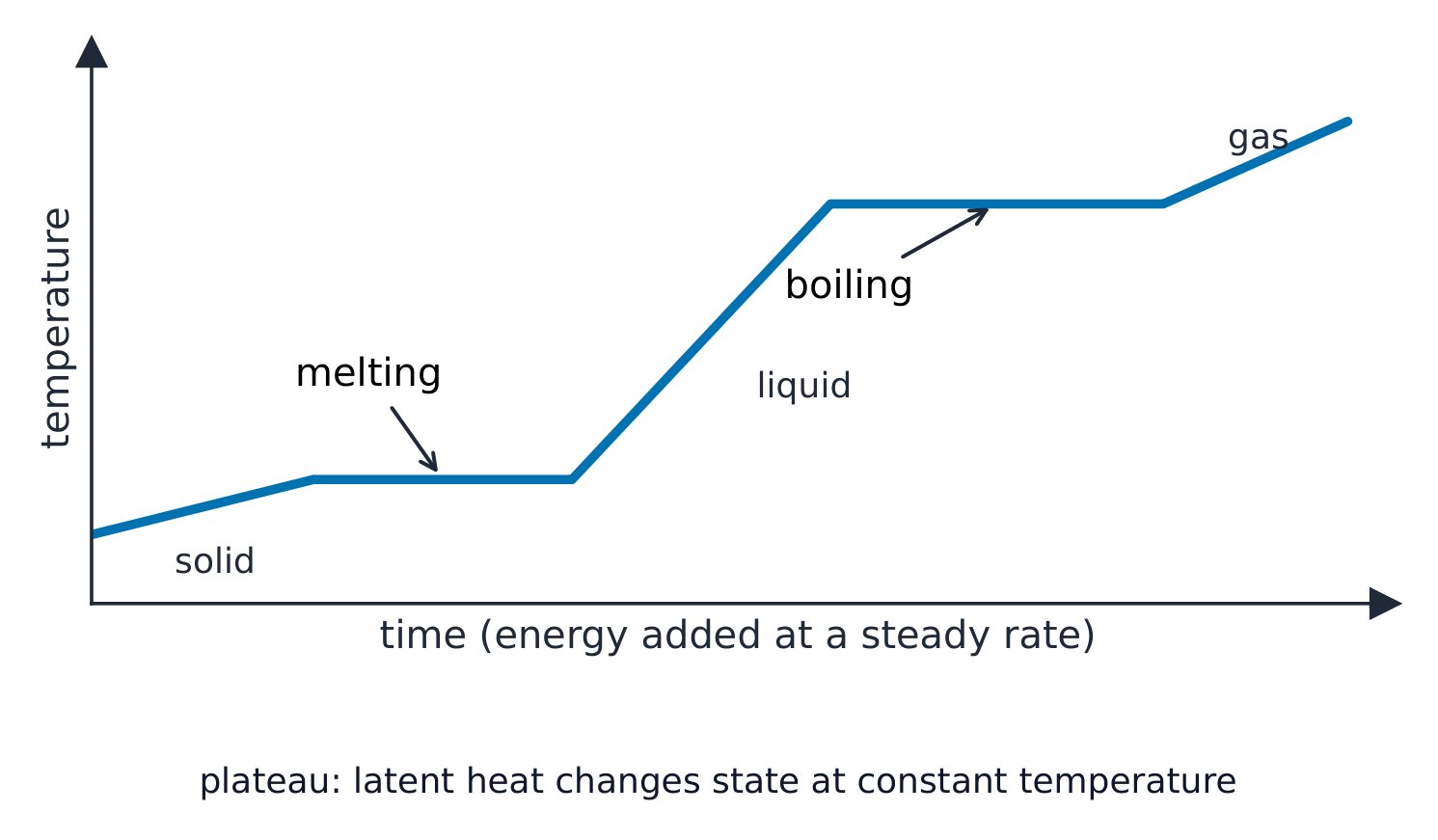
Temperatura permanece plana enquanto a substância funde e enquanto ela ferve
Evaporation can happen below the boiling point. · A evaporação pode acontecer abaixo do ponto de ebulição.
Evaporation happens at the surface at any temperature — the fastest surface particles escape. Boiling happens throughout the liquid at the boiling point. · A evaporação acontece na superfície a qualquer temperatura — as partículas superficiais mais rápidas escapam. A ebulição acontece em toda a液体 no ponto de ebulição.
Why does an evaporating liquid cool down? · Por que um líquido em evaporação esfria?
The most energetic particles leave the surface, so the particles left behind have a lower average energy — a lower temperature. · As partículas mais energéticas saem da superfície, então as partículas restantes têm energia média mais baixa — uma temperatura mais baixa.
What speeds up evaporation
- Higher temperature — more particles are moving fast enough to escape.
- Larger surface area — more particles are at the surface.
- More air movement (wind) — escaped particles are carried away, so fewer return.
- That's why washing dries fastest on a warm, breezy day.
O que acelera a evaporação
- Temperatura mais alta — mais partículas estão se movendo rápido o suficiente para escapar.
- Maior área de superfície — mais partículas estão na superfície.
- Mais movimento de ar (vento) — partículas escapadas são levadas embora, então menos retornam.
- É por isso que roupas secam mais rápido em um dia morno e ventoso.
Select all · todos the things that make a puddle evaporate faster · mais rápido. · Selecione todas as coisas que fazem uma poça evaporar mais rápido.
Higher temperature, larger surface area, and more airflow all speed up evaporation. A lower temperature slows it down. · Temperatura mais alta, maior área de superfície e mais fluxo de ar aceleram a evaporação. Uma temperatura mais baixa a desacelera.
You've got it
- melting and boiling need energy, but the temperature stays constant during the change
- a flat part on a heating curve = a change of state
- evaporation happens at the surface, below boiling; the fastest particles leave, so the liquid cools
- faster evaporation: higher temperature, bigger surface area, more airflow
Entendeu?
- fusão e ebulição precisam de energia, mas a temperatura permanece constante durante a mudança
- uma parte plana em uma curva de aquecimento = uma mudança de estado
- evaporação acontece na superfície, abaixo da ebulição; as partículas mais rápidas saem, então o líquido esfria
- evaporação mais rápida: temperatura mais alta, área de superfície maior, mais fluxo de ar