Thermal expansion and specific heat capacity · Expansão térmica e capacidade calorífica específica
| English | Português |
|---|---|
| specific heat capacity/spəˈsɪfɪk hiːt kəˈpæsɪti/ | capacidade térmica específica |
| thermal expansion/ˈθɜːml ekˈspænʃn/ | expansão térmica |
| internal energy/ɪnˈtɜːnl ˈenədʒi/ | energia interna |
Why bridges have gaps
- Railway lines have small gaps; bridges sit on rollers; power cables hang loose in summer.
- All for the same reason: things get bigger when they are heated.
- Heating also stores energy inside matter — measured by its specific heat capacity 比热容.
Por que pontes têm juntas de dilatação
- Trilhos de trem têm pequenas lacunas; pontes assentam sobre roletes; cabos de energia ficam soltos no verão.
- Tudo pela mesma razão: coisas ficam maiores quando aquecidas.
- O aquecimento também armazena energia dentro da matéria — medida por sua capacidade térmica específica 比热容.
Thermal expansion 热膨胀
- Heat a material and its particles move more, so they take up more space — it expands.
- Gases expand the most, then liquids, then solids (whose particles are held tightly).
- Engineers leave gaps in rails and put bridges on rollers so the expansion does not buckle them.
- A tight metal jar lid loosens when you run it under hot water — the metal expands.
Thermal expansion: heating makes the rail longer, closing the gap left for it.
Worked example. A steel bridge is $50\ \text{m}$ long at $10\ {}^{\circ}\text{C}$. Steel expands about $0.012\ \text{mm}$ per metre per ${}^{\circ}\text{C}$. If the temperature rises to $40\ {}^{\circ}\text{C}$ (a $30\ {}^{\circ}\text{C}$ rise): expansion $= 50 \times 0.012 \times 30 = 18\ \text{mm}$. That's why bridges have expansion joints!
The particles don't get bigger. When a solid expands, the particles themselves stay the same size — they just vibrate more and push further apart. This is a common exam misconception.
Expansão térmica 热膨胀
- Aqueça um material e suas partículas se movem mais, ocupando mais espaço — ele expande.
- Gases expandem mais, depois líquidos, depois sólidos (cujas partículas são mantidas firmemente).
- Engenheiros deixam lacunas em trilhos e colocam pontes sobre roletes para que a expansão não os torça.
- Uma tampa de lata de metal apertada afrouxa quando você a passa sob água quente — o metal expande.
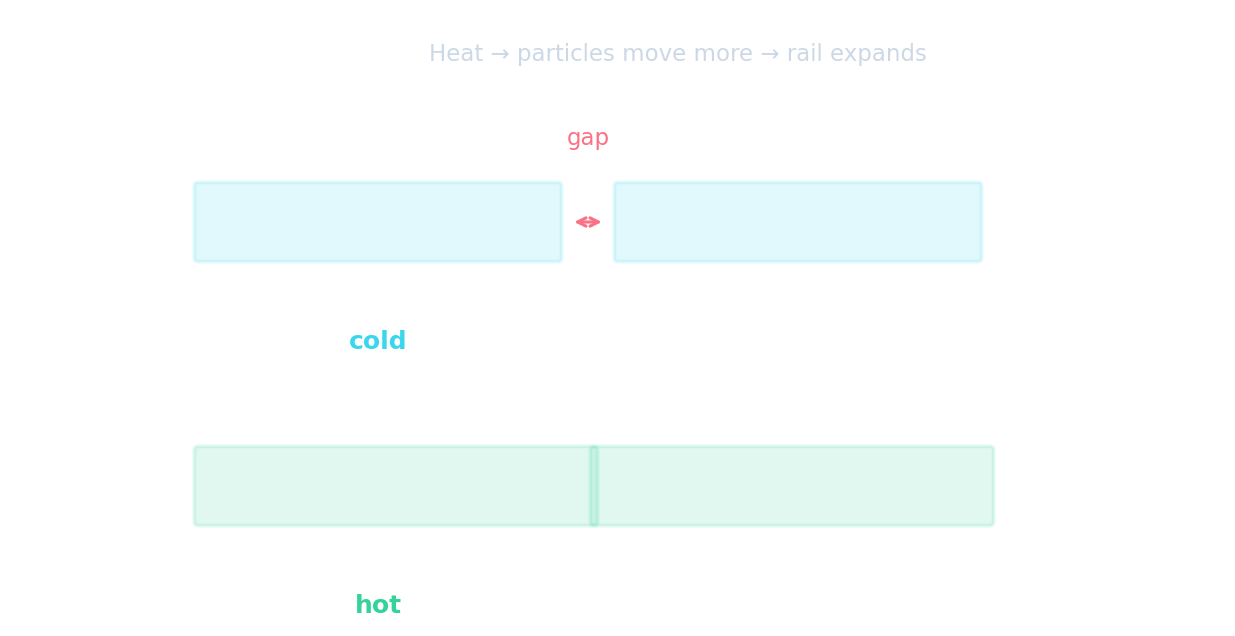
Expansão térmica: aquecer torna o trilho mais longo, fechando a lacuna deixada para ele.
Exemplo resolvido. Uma ponte de aço tem $50\ \text{m}$ de comprimento a $10\ {}^{\circ}\text{C}$. Aço expande cerca de $0.012\ \text{mm}$ por metro por ${}^{\circ}\text{C}$. Se a temperatura subir para $40\ {}^{\circ}\text{C}$ (um aumento de $30\ {}^{\circ}\text{C}$): expansão $= 50 \times 0.012 \times 30 = 18\ \text{mm}$. É por isso que pontes têm juntas de expansão!
As partículas não ficam maiores. Quando um sólido expande, as próprias partículas permanecem do mesmo tamanho — elas apenas vibram mais e se afastam mais. Este é um erro comum em exames.
Heating and specific heat capacity · Aquecimento e capacidade calorífica específica
Q = mcΔT
The heat energy needed is proportional to the temperature rise for a given mass of material. · A energia térmica necessária é proporcional ao aumento de temperatura para uma dada massa de material.
For the same rise in temperature, which expands the most? · Para o mesmo aumento de temperatura, qual se expande mais?
Gases expand the most, then liquids, then solids (whose particles are held most tightly). · Gases expandem mais, depois líquidos, depois sólidos (cujas partículas são mantidas mais firmemente).
Why are small gaps left between railway lines? · Por que são deixadas pequenas lacunas entre trilhos de trem?
On a hot day the rails expand. The gaps give the extra length somewhere to go, so the track does not bend out of shape. · Em um dia quente os trilhos se expandem. As lacunas dão lugar extra para esse comprimento adicional, para que o trilho não se curve fora de forma.
Internal energy 内能
- The internal energy of an object is the total energy of all its particles (their movement and arrangement).
- Heating an object raises its internal energy — usually raising its temperature too.
The same hand in ordinary light and through a thermal (infrared) camera
Energia interna 内能
- A energia interna de um objeto é a energia total de todas as suas partículas (seu movimento e arranjo).
- Aquecer um objeto eleva sua energia interna — geralmente elevando também sua temperatura.

A mesma mão em luz normal e através de uma câmera térmica (infravermelha)
Specific heat capacity
- The specific heat capacity $c$ is the energy needed to raise the temperature of $1\ \text{kg}$ of a material by $1\ {}^{\circ}\text{C}$:
- So the energy to warm something is $\Delta E = m c\,\Delta\theta$.
- Water has a very high $c$ ($\approx 4200$ joules per kg per °C): it needs a lot of energy to warm up and cools down slowly. That is why the sea stays mild and water is used in heating systems.
A digital thermometer measures temperature
Capacidade calorífica específica
- A capacidade térmica específica $c$ é a energia necessária para elevar a temperatura de $1\ \text{kg}$ de um material em $1\ {}^{\circ}\text{C}$:
- Então a energia para aquecer algo é $\Delta E = m c\,\Delta\theta$.
- Água tem uma capacidade térmica específica muito alta $c$ ($\approx 4200$ joules por kg por °C): precisa de muita energia para aquecer e esfria lentamente. É por isso que o mar permanece ameno e a água é usada em sistemas de aquecimento.
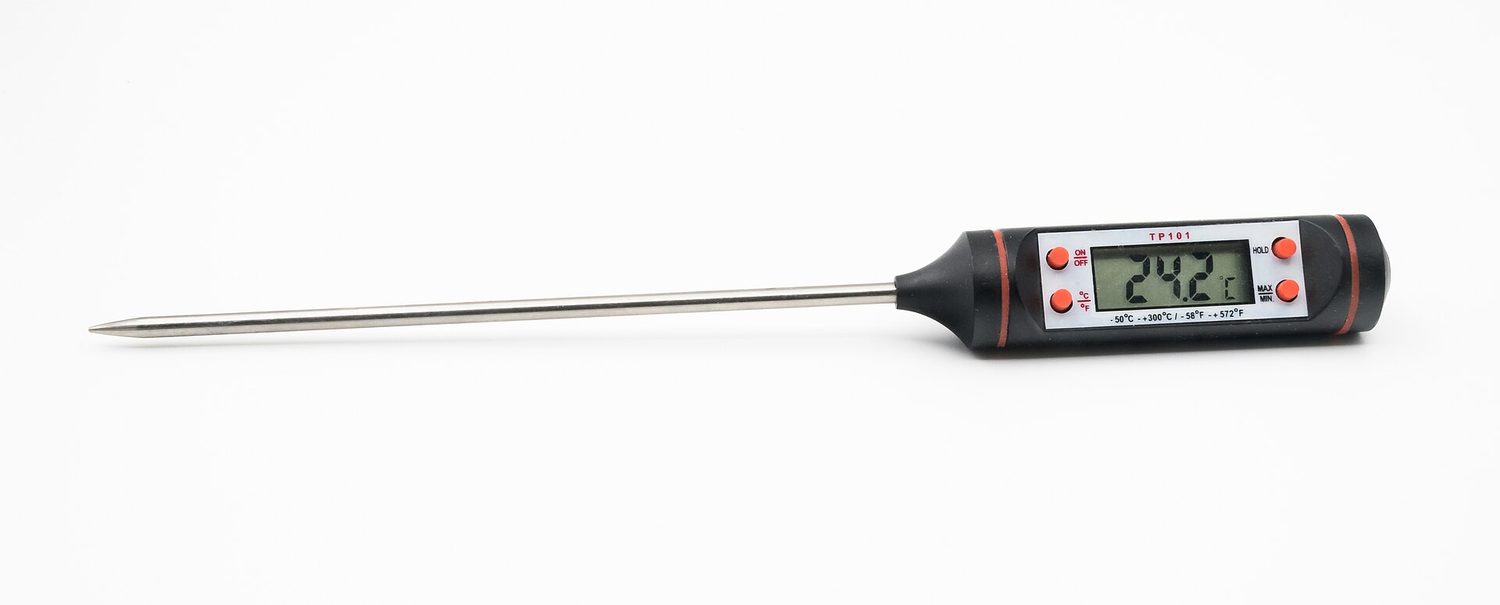
Um termômetro digital mede a temperatura
How much energy is needed to heat $2.0\ \text{kg}$ of water by $10\ {}^{\circ}\text{C}$? (Use $c = 4200$ J per kg per °C.) · Quanta energia é necessária para aquecer $2.0\ \text{kg}$ de água em $10\ {}^{\circ}\text{C}$? (Use $c = 4200$ J por kg por °C.)
$\Delta E = mc\,\Delta\theta = 2.0 \times 4200 \times 10 = 84\,000\ \text{J}$.
Adding $8400\ \text{J}$ raises the temperature of $0.50\ \text{kg}$ of a metal by $40\ {}^{\circ}\text{C}$. What is its specific heat capacity, in J per kg per °C? · Adicionar $8400\ \text{J}$ eleva a temperatura de $0.50\ \text{kg}$ de um metal em $40\ {}^{\circ}\text{C}$. Qual é sua capacidade calorífica específica, em J por kg por °C?
$c = \dfrac{\Delta E}{m\,\Delta\theta} = \dfrac{8400}{0.50 \times 40} = \dfrac{8400}{20} = 420$ J per kg per °C. · $c = \dfrac{\Delta E}{m\,\Delta\theta} = \dfrac{8400}{0.50 \times 40} = \dfrac{8400}{20} = 420$ J por kg por °C.
Because water has a high specific heat capacity, it warms up and cools down slowly. · Porque a água tem alta capacidade calorífica específica, ela esquenta e esfria lentamente.
A high specific heat capacity means a lot of energy is needed per degree, so water changes temperature slowly. · Alta capacidade calorífica específica significa que muita energia é necessária por grau, então a água muda de temperatura lentamente.
You've got it
- heating makes matter expand — gases most, solids least; leave gaps for it
- internal energy = total energy of all the particles
- specific heat capacity $c = \dfrac{\Delta E}{m\,\Delta\theta}$, so $\Delta E = mc\,\Delta\theta$
- water has a high $c$ → warms and cools slowly
Entendeu?
- aquecimento faz a matéria expandir — gases mais, sólidos menos; deixe lacunas para isso
- energia interna = energia total de todas as partículas
- capacidade térmica específica $c = \dfrac{\Delta E}{m\,\Delta\theta}$, logo $\Delta E = mc\,\Delta\theta$
- a água tem um alto $c$ → aquece e esfria lentamente