The kinetic particle model
Introduzido| English | Significado |
|---|---|
| particles/ˈpɑːtɪklz/ | partículas |
| kinetic particle model/kɪˈnetɪk ˈpɑːtɪkl ˈmɒdl/ | modelo cinético das partículas |
| solid/ˈsɒlɪd/ | sólido |
| liquid/ˈlɪkwɪd/ | líquido |
| gas/ɡæs/ | gás |
| temperature/ˈtemprɪtʃə/ | temperatura |
| absolute zero/ˈæbsəluːt ˈzɪərəʊ/ | zero absoluto |
| kelvin/ˈkelvɪn/ | kelvin |
| Brownian motion/ˈbraʊnɪən ˈməʊʃn/ | movimento browniano |
Everything is made of particles 粒子
- Look closely enough and all matter is tiny particles that never stop moving.
- This one idea — the kinetic particle model 分子动理论 — explains solids 固体, liquids 液体, gases 气体, heat and pressure.
- Let's see what the particles are doing.
The three states of matter
| State | Particles (arrangement, separation, motion) → properties |
|---|---|
| solid | regular pattern, very close, vibrate about fixed positions → fixed shape and volume |
| liquid | random, close, slide past each other → takes the container's shape, fixed volume |
| gas | random, far apart, move fast in all directions → fills the whole container |
- Forces between particles explain the table: strong forces hold solid particles in place; in a liquid they are weaker, so particles can move past each other; in a gas the particles are so far apart that the forces are almost zero.
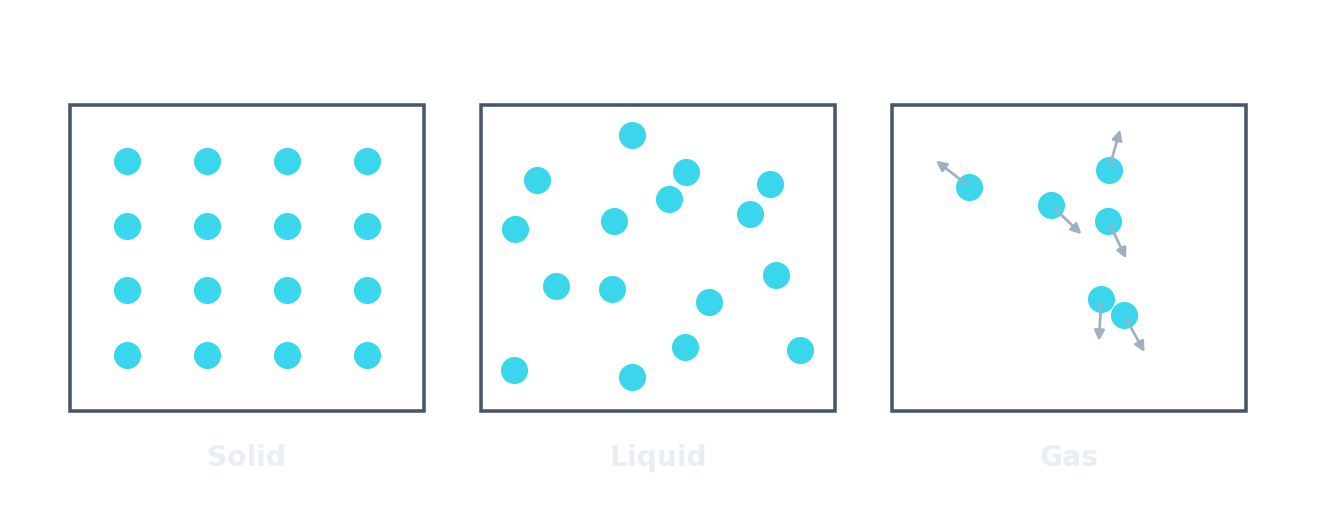
- Changes of state: solid → liquid is melting; liquid → solid is freezing (solidifying); liquid → gas is boiling or evaporating; gas → liquid is condensing.
Squeeze a gas (Boyle's law)
Slide the piston in to shrink the volume. The same particles get crammed into less space, so they hit the walls more often and the pressure climbs — while pressure × volume stays constant.
In which state are the particles far apart, fast, and moving in random directions?
Dificuldade 1/5 · Moedas 100 + pequeno bônus na primeira conclusão hoje
Gas particles are far apart and move quickly in random directions, filling the container. Solids only vibrate; liquids slide past each other.
Water vapour on a cold window turns into drops of water. What is this change of state called?
Dificuldade 1/5 · Moedas 100 + pequeno bônus na primeira conclusão hoje
Gas → liquid is condensing. Evaporating is the opposite (liquid → gas).
Why can a gas be squashed into a smaller volume, but a liquid cannot?
Dificuldade 1/5 · Moedas 100 + pequeno bônus na primeira conclusão hoje
The separation of gas particles is large, so they can be pushed closer together. Liquid particles are already touching.
Temperature 温度 and particle energy
- Heat a substance and its particles move faster — they gain kinetic energy.
- Temperature is a measure of the average kinetic energy of the particles.
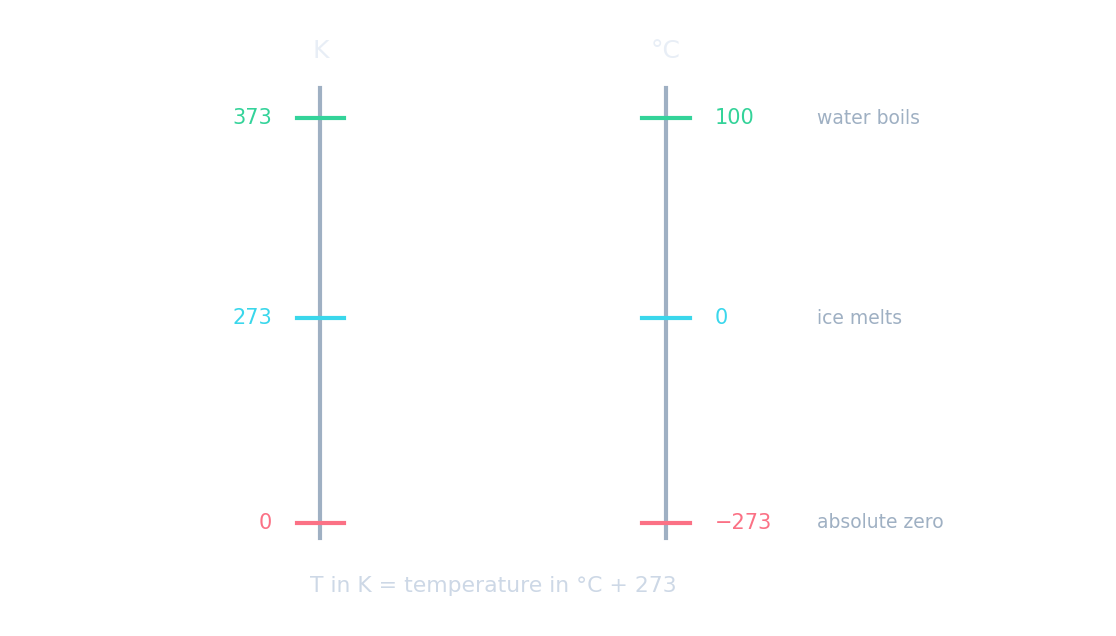
- The lowest possible temperature is absolute zero 绝对零度, $-273\ {}^{\circ}\text{C}$. There the particles have the least kinetic energy: they cannot be slowed any further.
Temperature is a measure of:
Dificuldade 1/5 · Moedas 100 + pequeno bônus na primeira conclusão hoje
Hotter means the particles move faster, so temperature measures their average kinetic energy.
The kelvin 开尔文 scale
- Scientists often measure temperature in kelvin (K), starting from absolute zero.
- To convert:
- So $0\ {}^{\circ}\text{C} = 273\ \text{K}$ and $27\ {}^{\circ}\text{C} = 300\ \text{K}$.
Convert $27\ {}^{\circ}\text{C}$ to kelvin.
Dificuldade 2/5 · Moedas 140 + pequeno bônus na primeira conclusão hoje
$T = \theta + 273 = 27 + 273 = 300\ \text{K}$.
Gas pressure
- Gas particles constantly hit the walls of their container. Each hit is a tiny push.
- The pressure is the total force of these hits on each unit of area.
- Heat the gas (fixed volume) → faster, harder, more frequent hits → higher pressure.
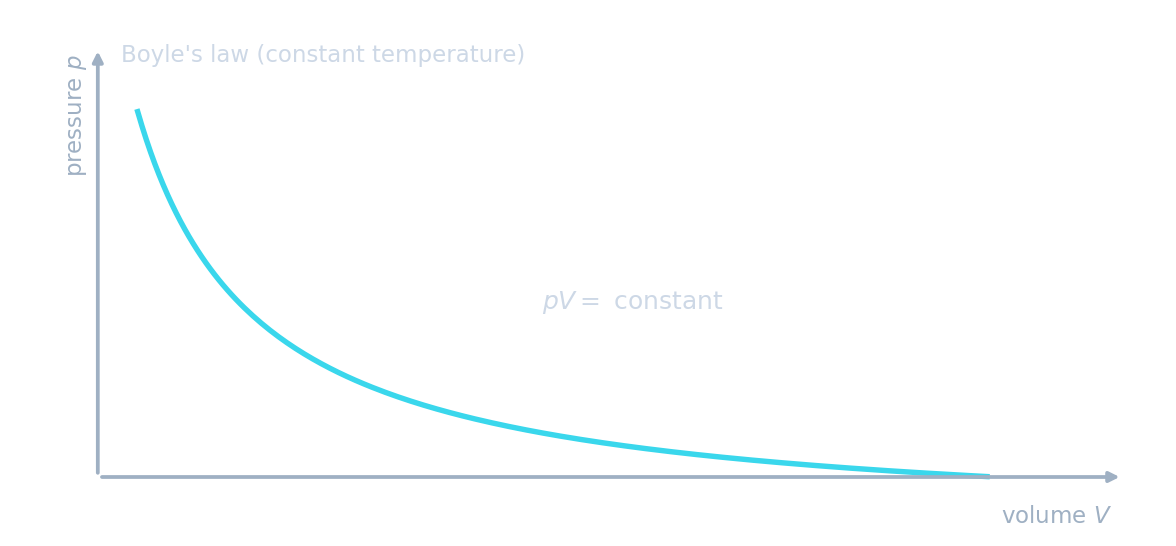
- Squeeze it smaller (fixed temperature) → more hits per second on each area → higher pressure.
- For a fixed mass of gas at constant temperature, $pV = \text{constant}$ (halve the volume → double the pressure).
Exam question. A sealed can of gas is heated. The volume does not change. Explain, in terms of particles, why the pressure increases. [3]
- Model answer: The particles gain kinetic energy and move faster (1). They hit the walls more often (1) and with more force each time (1), so the force on each unit area of wall, the pressure, increases.
- Mark-scheme reasoning: "the particles hit the walls more" earns one mark; you need faster, more frequent and harder collisions. Never say the particles expand or get bigger.
A gas has a volume of $200\ \text{cm}^3$ at $100\ \text{kPa}$. It is squeezed to $100\ \text{cm}^3$ at constant temperature. What is the new pressure, in kPa?
Dificuldade 2/5 · Moedas 140 + pequeno bônus na primeira conclusão hoje
$pV$ is constant: $100 \times 200 = p \times 100$, so $p = 200\ \text{kPa}$. Halving the volume doubles the pressure.
Heating a gas in a sealed, fixed-volume can increases its pressure.
Dificuldade 1/5 · Moedas 100 + pequeno bônus na primeira conclusão hoje
Hotter particles move faster and hit the walls harder and more often, so the pressure rises.
A gas is heated at constant volume. Which statement explains why its pressure rises?
Dificuldade 1/5 · Moedas 100 + pequeno bônus na primeira conclusão hoje
Higher temperature means more kinetic energy, so faster particles: more frequent and harder collisions mean a larger force on each unit area. The particles never expand.
Brownian motion 布朗运动
- Under a microscope, smoke specks in air jiggle along jerky, random paths.
- This is Brownian motion: the big specks are knocked about by fast, invisible air particles.
- It is strong evidence that matter really is made of moving particles.
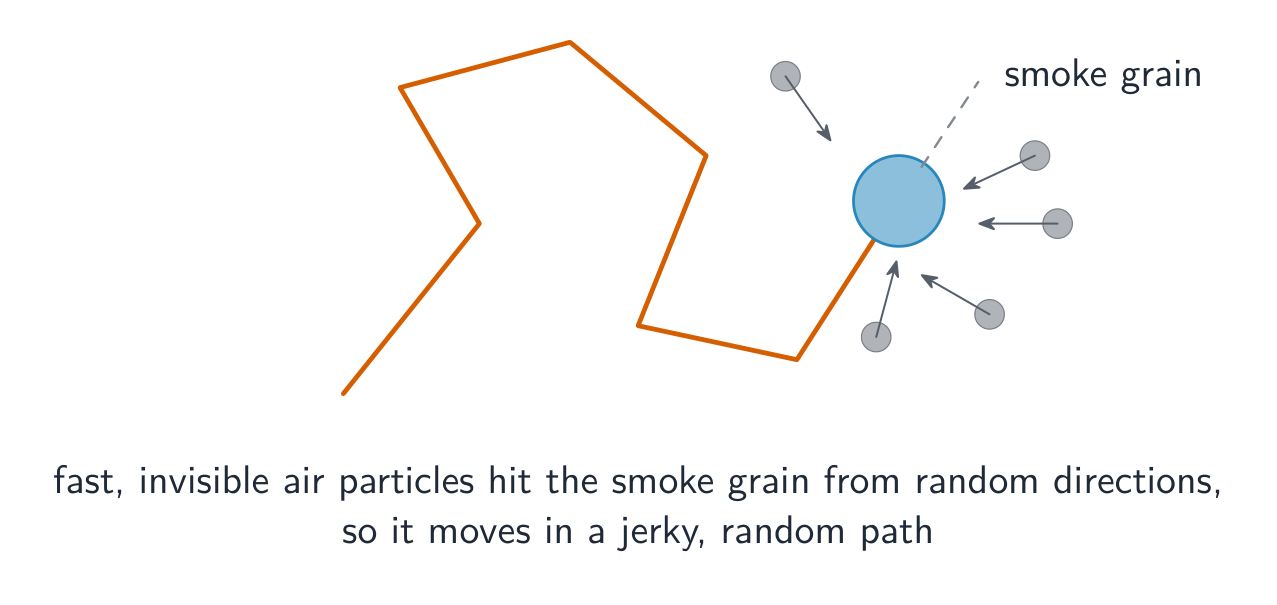
Random hits from fast, invisible air particles push a smoke grain along a jerky, random path
- Use the right words: the smoke specks are microscopic particles, big enough to see in a microscope. The air molecules that hit them are much smaller, lighter and faster, and cannot be seen. The specks move because they are hit unevenly, by more molecules on one side than the other.
Smoke specks seen under a microscope jiggle randomly. This is because:
Dificuldade 1/5 · Moedas 100 + pequeno bônus na primeira conclusão hoje
Brownian motion: tiny fast air particles knock the larger smoke specks about, evidence for moving particles.
Worked examples
1. A gas at $100\ \text{kPa}$ fills $2.0\ \text{m}^3$. It is squeezed to $0.50\ \text{m}^3$ at constant temperature. $pV$ stays constant: $100 \times 2.0 = p \times 0.50$, so $p = 400\ \text{kPa}$. A quarter of the volume gives four times the pressure.
2. Convert $27\ {}^{\circ}\text{C}$ and $-73\ {}^{\circ}\text{C}$ to kelvin: add 273, giving $300\ \text{K}$ and $200\ \text{K}$.
Change to kelvin only when the formula needs it. A temperature change is the same in °C and K, but $0\ {}^{\circ}\text{C}$ is not zero energy: absolute zero is $-273\ {}^{\circ}\text{C}$. In $pV = \text{constant}$, keep the units of $p$ and $V$ the same on both sides.
You've got it
- solid (regular, close, vibrating) · liquid (random, close, sliding) · gas (random, far apart, fast)
- melting, freezing, boiling/evaporating, condensing
- temperature = average kinetic energy of particles; absolute zero $= -273\ {}^{\circ}\text{C}$
- $T\,(\text{K}) = \theta\,({}^{\circ}\text{C}) + 273$
- gas pressure = force of particle hits per unit area; hotter → faster, more frequent, harder hits; at constant temperature $pV = \text{constant}$
- Brownian motion: microscopic particles moved by random hits from light, fast, invisible molecules
Write from the data: find the pressure
- 15 degrees Celsius is converted to kelvin. A gas at 80 kPa occupies 60 cubic centimetres and is squeezed to 40 cubic centimetres at the same temperature.
- Find the kelvin temperature and the new pressure.
Convert 15 degrees Celsius to kelvin. A gas at 80 kPa occupies 60 cubic centimetres and is compressed to 40 cubic centimetres at constant temperature. What is the new pressure?
15 plus 273 is 288. 80 times 60 divided by 40 is 120 kilopascals.
What is the new pressure?
Dificuldade 1/5 · Moedas 100 + pequeno bônus na primeira conclusão hoje
80 times 1.5 is 120 kilopascals.