Resolved artworks and curatorial rationale
Introduzido| English | Significado |
|---|---|
| curation/kjʊəˈreɪʃn/ | selecting and arranging artworks so that together they communicate meaning |
| resolved artwork/rɪˈzɒlvd ˈɑːtwɜːk/ | obra resolvida |
| curatorial rationale/ˌkjʊərəˈtɔːrɪəl ˌræʃəˈnæl/ | a written explanation of an exhibition's intentions and of why the works were chosen and arranged as they are |
A chart on a museum wall, 1936
- For the 1936 exhibition Cubism and Abstract Art at the Museum of Modern Art in New York, the director Alfred Barr printed a chart on the catalogue cover. Arrows linked movements — from Japanese prints and Cézanne to Cubism and abstract art — and the galleries followed that story.
- Barr's arrangement told visitors how to read the works. Choosing and ordering artworks to make meaning is curation 策展.
What did Alfred Barr's 1936 chart do?
Dificuldade 1/5 · Moedas 100 + pequeno bônus na primeira conclusão hoje
Arrangement told visitors how to read the works.
Resolved artworks
- A resolved artwork 完成作品 is finished: its ideas, materials and technique work together, after testing and revision.
- An exhibition shows a selection of resolved works, chosen to communicate your intentions.
A resolved artwork is a first quick sketch.
Dificuldade 1/5 · Moedas 100 + pequeno bônus na primeira conclusão hoje
It is finished after testing and revision.
Two ways to hang the same works
- Group works by material (all prints, then all paintings) and the visitor compares techniques. Group them by developing theme and the visitor follows an idea as it changes.
- Choose the sequence that serves your intention, and consider spacing, height, lighting and the first and last work seen.
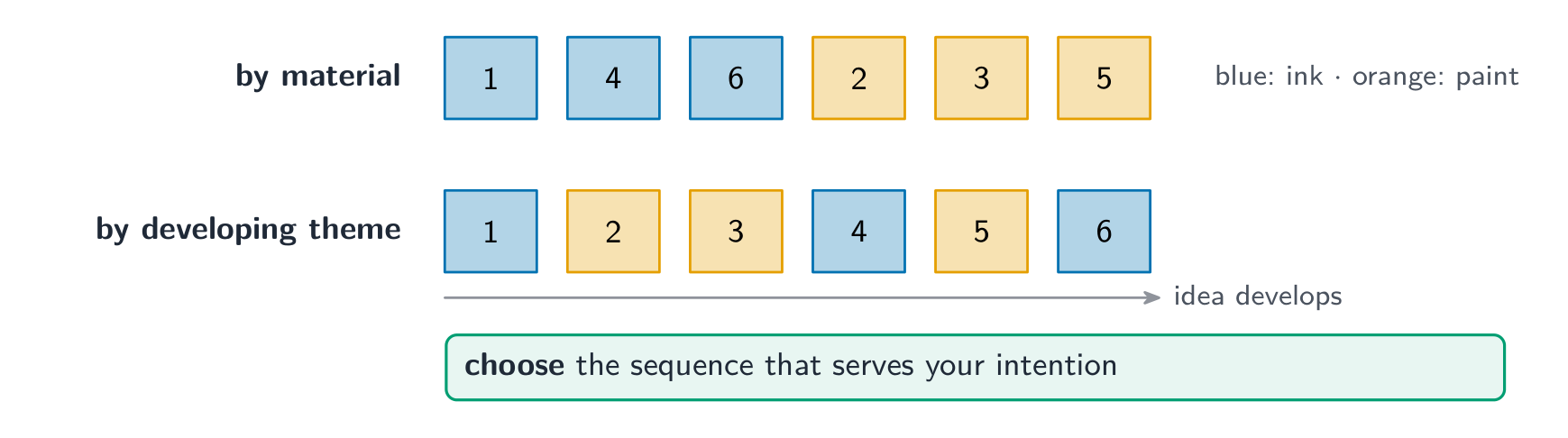
Match each arrangement to what the visitor notices.
Dificuldade 2/5 · Moedas 140 + pequeno bônus na primeira conclusão hoje
The arrangement changes the visitor's experience.
Which are curatorial decisions?
Dificuldade 2/5 · Moedas 140 + pequeno bônus na primeira conclusão hoje
These shape how the works are read.
Worked example: ordering an exhibition
A student has six works on the theme of home: two prints, two paintings and two photographs.
- By material: prints, then paintings, then photos. Visitors notice technique but the idea of home is scattered.
- By theme: first a photo of the family's old flat; then prints of a door and window, growing more abstract; last a painting of an empty room. The visitor travels from a real place to memory and loss.
- Choice: the theme order serves the intention — "how memory changes the idea of home" — so the student hangs the works that way and explains it in the curatorial rationale.
In the worked example, why does the theme order work better?
Dificuldade 1/5 · Moedas 100 + pequeno bônus na primeira conclusão hoje
The sequence serves the intention.
The curatorial rationale
- The curatorial rationale 策展理念 explains your intentions, how the works relate, and why you chose the selection and arrangement.
- Refer to specific works and decisions: "the empty room is hung last and alone, so the exhibition ends in silence".
Which sentence belongs in a curatorial rationale?
Dificuldade 1/5 · Moedas 100 + pequeno bônus na primeira conclusão hoje
Explain a specific decision and its effect.
Labels and titles
- Each work needs a label: title, medium, size and a short note on intention where useful.
- Titles guide reading; choose them as carefully as the works.
"These are my best works" is not a rationale. Explain what connects the works, how the arrangement guides the viewer, and what you want them to experience.
"These are my best works" is a complete rationale.
Dificuldade 1/5 · Moedas 100 + pequeno bônus na primeira conclusão hoje
Explain connections and arrangement.
Curation chooses and orders resolved artworks to make meaning. Decide whether material or theme serves your intention, plan the sequence, spacing and first and last works, and write a curatorial rationale that explains specific decisions.
Plan the order of four of your own works and justify the first and last.
Theme, sequence, intention.