Visual analysis, context and comparison
Introduzido| English | Significado |
|---|---|
| composition/ˌkɒmpəˈzɪʃn/ | composição |
| balance/ˈbæləns/ | An arrangement in which competing parts or influences are kept in a suitable proportion. |
| negative space/ˈneɡətɪv speɪs/ | The area around and between the main forms in an artwork. |
| formal elements | the basic visual parts of an artwork: line, shape, colour, tone, texture and space |
| context/ˈkɒntekst/ | The surrounding circumstances, information or language that help determine meaning and interpretation. |
A small mountain behind a huge wave, c. 1831
- Around 1831 the Japanese artist Katsushika Hokusai published the woodblock print Under the Wave off Kanagawa. A giant wave curls over three boats; Mount Fuji, Japan's sacred mountain, sits tiny and low in the background, framed by the wave's curve.
- Hokusai placed the subject of his series — Fuji — off-centre and small. That choice of composition 构图 makes the viewer feel the power of nature and the fragility of the boatmen.
How does Hokusai place Mount Fuji in The Great Wave?
Dificuldade 1/5 · Moedas 100 + pequeno bônus na primeira conclusão hoje
The composition stresses nature's power over the boatmen.
Composition and balance
- Composition is the arrangement of elements in an artwork. Balance 平衡 can be symmetrical (centred, calm) or asymmetrical (off-centre, dynamic).
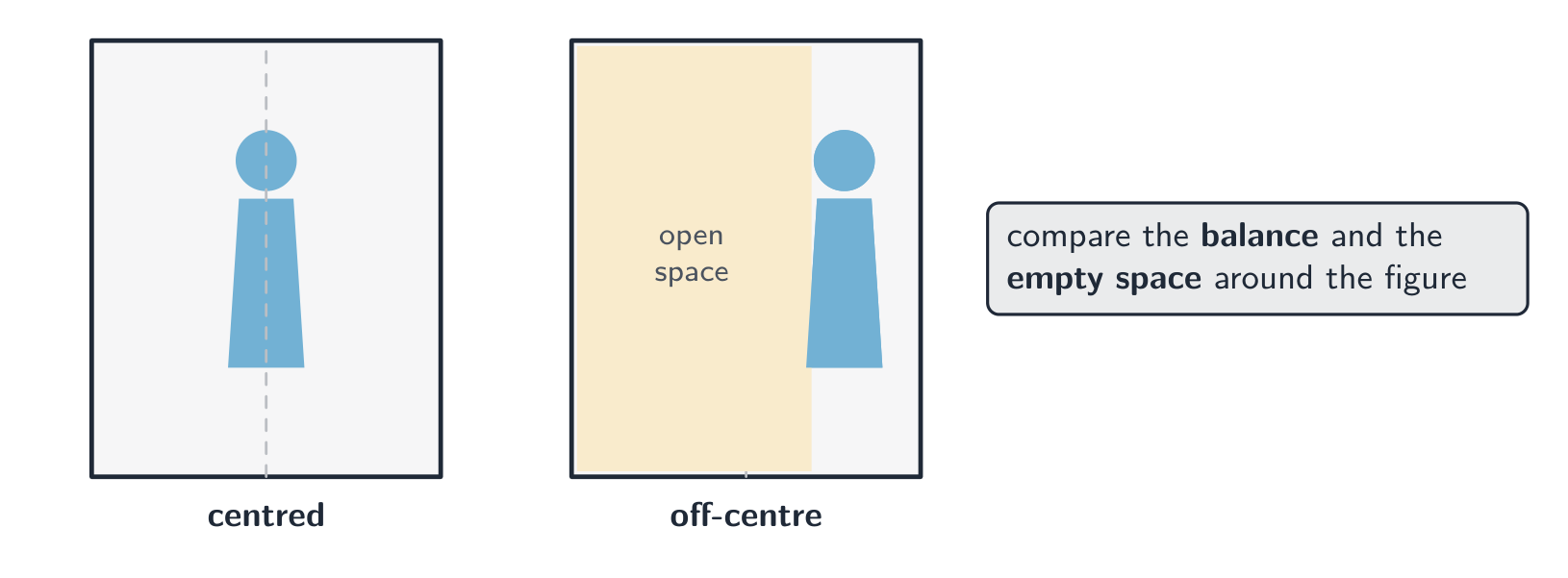
- Negative space 负空间 is the empty area around a subject. More empty space can isolate a figure or give a sense of distance.
Match each term to its effect.
Dificuldade 2/5 · Moedas 140 + pequeno bônus na primeira conclusão hoje
Composition choices create effects.
Formal analysis
- Describe the formal elements 形式要素: line, shape, colour, tone, texture, space. Then explain their effect.
- In The Great Wave, the claw-like foam lines lead the eye from the crest down to the boats; the Prussian blue, a new imported pigment, gives the sea depth.
Which are formal elements?
Dificuldade 2/5 · Moedas 140 + pequeno bônus na primeira conclusão hoje
Price is context, not a formal element.
Worked example: centred or off-centre?
A student draws one figure on a beach, twice.
- Centred: the figure stands in the middle with equal space either side. The image feels stable and posed — the person is clearly the subject.
- Off-centre: the figure stands near the right edge, facing the large empty beach to the left. The empty space becomes part of the meaning: the figure seems to be looking out at something, or to feel alone.
- Judgement: for an artwork about waiting or loneliness, the off-centre version is stronger, because the negative space carries the emotion.
In the worked example, why is the off-centre version stronger for an artwork about loneliness?
Dificuldade 1/5 · Moedas 100 + pequeno bônus na primeira conclusão hoje
Negative space becomes part of the meaning.
Context
- Context 背景 includes when, where and why an artwork was made, and for whom. Hokusai's prints were cheap, mass-produced images sold to ordinary city dwellers in Edo (Tokyo).
- Later, Japanese prints influenced European artists such as Monet and Van Gogh — context includes how a work travelled.
Hokusai's prints were cheap images sold to ordinary city dwellers.
Dificuldade 1/5 · Moedas 100 + pequeno bônus na primeira conclusão hoje
Woodblock prints were mass-produced.
Which European artists were influenced by Japanese prints?
Dificuldade 1/5 · Moedas 100 + pequeno bônus na primeira conclusão hoje
Japanese prints reached Europe in the 19th century.
Comparing artworks
- Compare two works on the same criteria: composition, formal elements, context, meaning. Find both similarities and differences.
- Use precise visual evidence: "the horizon sits low, two-thirds of the image is sky".
"I like the colours" is not analysis. Say which colours, where, and what they do: "the deep blue of the wave contrasts with the pale sky, making the crest seem to rise out of the picture".
"I like the colours" is a complete analytical point.
Dificuldade 1/5 · Moedas 100 + pequeno bônus na primeira conclusão hoje
Name the colours, where they are and what they do.
Analyse artworks through composition, balance, negative space and the formal elements, explaining each effect with visual evidence. Place works in their context, including how they travelled, and compare works on the same criteria.
Analyse the composition of an artwork or photograph you know in three sentences.
Composition, evidence, effect.