The arts: how can an interpretation earn support?
Introduzido| English | Significado |
|---|---|
| ambiguity/ˌæmbɪˈɡjuːɪti/ | ambiguidade |
| criteria/kraɪˈtɪərɪə/ | critérios |
| interpretation/ɪnˌtɜːprɪˈteɪʃn/ | interpretação |
One photograph, many stories, 1936
- In March 1936 Dorothea Lange photographed a mother and her children in a camp for pea pickers in Nipomo, California. Migrant Mother became the symbol of the Great Depression: worried, dignified, enduring.
- In 1978 the woman, Florence Owens Thompson, was identified. She said she had never been asked about the photo's use and had gained nothing from its fame; her family disputed parts of Lange's notes. The image supports many interpretations 诠释 — but which ones can earn support?
What did Florence Owens Thompson say after she was identified in 1978?
Dificuldade 1/5 · Moedas 100 + pequeno bônus na primeira conclusão hoje
Her view adds questions about consent and ownership of a story.
Effect, intention and fact
- Three different questions: what effect does the work have on viewers? What did the artist intend? What facts does it show about the world?
- Each needs different evidence. Effect rests on features of the work; intention on the artist's own words and context; fact on documents beyond the image.
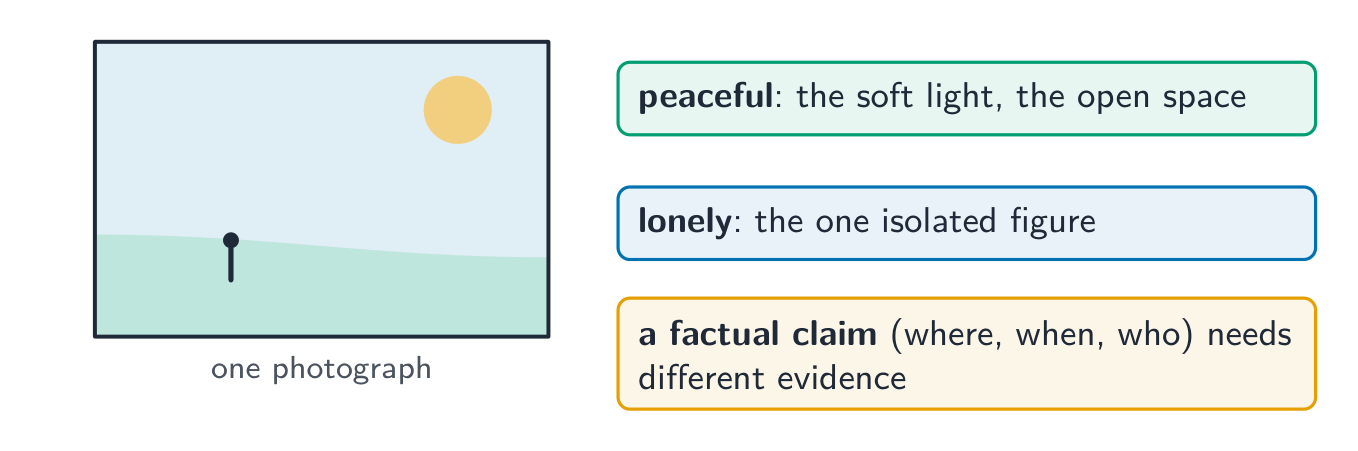
Match each claim to its type.
Dificuldade 2/5 · Moedas 140 + pequeno bônus na primeira conclusão hoje
Each needs different evidence.
Which evidence best supports a claim about the artist's intention?
Dificuldade 1/5 · Moedas 100 + pequeno bônus na primeira conclusão hoje
Intention rests on context.
Reasons for competing readings
- A reading earns support by pointing to features: in Migrant Mother, the hand raised to the face suggests worry; the children turning away frame the mother as the centre.
- Ambiguity 多义性 allows more than one reasonable reading, but not every reading: "a carefree holiday scene" conflicts with the visible features.
Ambiguity means every reading is equally supported.
Dificuldade 1/5 · Moedas 100 + pequeno bônus na primeira conclusão hoje
Readings must fit the visible features.
Worked example: three claims about one photograph
- Effect: "The photograph makes viewers feel sympathy." Support: the close framing, the mother's distant gaze and the hidden faces of the children invite viewers to imagine her situation.
- Intention: "Lange meant to persuade the government to help migrant workers." Support needs context: she worked for the federal Resettlement Administration, and her photos were sent to newspapers to argue for relief camps.
- Fact: "The family had sold their car tyres to buy food." This is from Lange's notes; Thompson's family later disputed it. The image itself cannot settle it — documents and testimony are needed.
Why can the image not settle whether the family sold their tyres?
Dificuldade 1/5 · Moedas 100 + pequeno bônus na primeira conclusão hoje
Facts beyond the frame need other evidence.
Criteria and context
- Different criteria 判断标准 answer different questions: documentary accuracy, emotional power, artistic composition. A photograph can be powerful as art and weaker as a record.
- Context changes a reading without erasing the work's features: knowing Thompson's view adds a question about consent and who owns a story.
A photograph can be powerful as art and weaker as a historical record.
Dificuldade 1/5 · Moedas 100 + pequeno bônus na primeira conclusão hoje
Different criteria answer different questions.
The knowledge question
- How can an interpretation of art be supported when viewers disagree? By naming the question, pointing to features, adding relevant context and stating the criterion.
- Personal response is evidence of effect on one viewer — useful, but not a proof of meaning for all.
"Art means whatever you feel" and "art has one true meaning" are both wrong. Ambiguity allows several readings, but each must be supported by the work's features and, for intention or fact, by context and documents.
"Art means whatever you feel" is a well-supported view.
Dificuldade 1/5 · Moedas 100 + pequeno bônus na primeira conclusão hoje
Readings need support from features and context.
Separate claims about a work's effect, the artist's intention and the facts it shows; each needs different evidence. Support interpretations with specific features, add context, state the criterion you judge by, and recognise that ambiguity allows several readings, not any reading.
Choose an artwork and make one supported claim each about its effect, the artist's intention and a fact.
Effect, intention, fact.