Uncertainty, gradients and model testing
Introduzido| English | Significado |
|---|---|
| systematic error/ˌsɪstəˈmætɪk ˈerə/ | erro sistemático |
| uncertainty/ʌnˈsɜːtənti/ | incerteza |
| hypothesis/haɪˈpɒθəsɪs/ | A proposed explanation or prediction that can be tested using evidence. |
| counterbalancing/ˈkaʊntəbælənsɪŋ/ | Varying the order of experimental conditions across participants to reduce order effects. |
| informed consent/ɪnˈfɔːmd kənˈsent/ | Voluntary agreement to participate after receiving and understanding information about what participation involves and its relevant risks. |
| anonymous | Recorded so that no participant can be identified. |
| validity/væˈlɪdɪti/ | How well a measure or study represents the concept or conclusion it is intended to address. |
| reliability/rɪˌlaɪəˈbɪlɪti/ | The consistency of a measurement or assessment when repeated under comparable conditions. |
| internal validity | How confidently a measured effect can be attributed to the variable tested. |
| external validity | How far results apply beyond the study's participants and setting. |
| ecological validity | How closely study conditions match real-world performance. |
| biological variation | Natural differences between people, and within one person over time. |
| error bar/ˈerə bɑː/ | A line on a graph showing the spread or uncertainty of a value. |
| statistically significant/stəˈtɪstɪkli sɪɡˈnɪfɪkənt/ | Unlikely enough under the null hypothesis that the result passes the chosen threshold. |
| scientific investigation | The individual IB internal assessment task: a student's own research question and data. |
| dependent variable/dɪˈpendənt ˈveərɪəbl/ | The measured or calculated outcome whose response to changes in another variable is studied. |
What would explain this observation?
- A line passing near every data point is useful, but its gradient can still be uncertain. A graph is evidence for a model within the measurement range.
Build the model
- Random variation makes repeated readings differ.
- Systematic error 系统误差 shifts results consistently.
- Absolute uncertainty 不确定度 has the measured unit; relative or percentage uncertainty compares uncertainty with the measured value.
- uncertainty: A quantified limitation on a measured result.
- systematic error: A consistent measurement bias.

Which is most likely a systematic error?
Dificuldade 1/5 · Moedas 100 + pequeno bônus na primeira conclusão hoje
A fixed 0.20 g balance zero offset is a systematic error. Independent repeats reduce random uncertainty in the mean, not scatter in individual readings or a shared offset. Reaction timing can have both random and systematic contributions.
Match each technical term to its precise meaning.
Dificuldade 2/5 · Moedas 140 + pequeno bônus na primeira conclusão hoje
Use the definitions to distinguish related quantities and processes.
Choose evidence that can test it
- For a product or quotient, adding fractional uncertainties is a common maximum-uncertainty approximation.
- For a difference, add absolute uncertainties.
- A nonzero intercept can reveal an offset or an incomplete model.
In the lab: Show units on axes and choose a sensible scale. Plot uncertainty bars where justified, draw a best-fit line rather than joining every point, and estimate steepest and shallowest plausible gradients when the course method calls for them.
Which two habits make the investigation or model in this case more defensible?
Dificuldade 2/5 · Moedas 140 + pequeno bônus na primeira conclusão hoje
Stating the conditions and assumptions lets others repeat the work exactly, and recording the supporting evidence lets them check the conclusion. Hiding disagreeing results removes the evidence that could challenge a wrong conclusion, and one measurement can never establish a wider claim.
Work from known quantities
- Known: length = 50.0 mm with uncertainty 1.0 mm.
- Percentage uncertainty = absolute uncertainty/value ×100 = 1.0/50.0×100 = 2.0%.
- For a quotient of two independently measured quantities with maximum percentage uncertainties 2% and 3%, the summed maximum estimate is 5%.
Your turn: A 40 cm reading has an absolute uncertainty of 1 cm. Find percentage uncertainty.
Measurement ranges and the quotient estimate
50 ± 1 mm has a 2% uncertainty. Compare it with a 100 ± 3 mm reading: the summed quotient estimate is 5%, while exact endpoint calculations reveal a slightly asymmetric range.
A 40 cm reading has an absolute uncertainty of 1 cm. Find percentage uncertainty.
Dificuldade 2/5 · Moedas 140 + pequeno bônus na primeira conclusão hoje
The result is 2.5 %. Known: reading 40 cm; absolute uncertainty 1 cm. Use percentage uncertainty = absolute uncertainty / value x 100. Percentage uncertainty = 1/40 x 100 = 2.5%. Smaller measured values carry larger percentage uncertainties for the same absolute uncertainty.
Check the conclusion and its limits
- Repeating readings reduces random uncertainty in a mean but does not automatically remove a zero error.
- Do not quote more decimal places than your measurement can support.
Not true: Repeating a measurement always removes a calibration offset. Independent repeats and averaging can reduce random uncertainty of the mean, while a calibration offset can remain. Check calibration and apply a justified correction where appropriate.
- Random variation makes repeated readings differ.
- For a product or quotient, adding fractional uncertainties is a common maximum-uncertainty approximation.
- Watch for: repeating readings reduces random uncertainty in a mean but does not automatically remove a zero error.
Repeating a measurement always removes a calibration offset.
Dificuldade 1/5 · Moedas 100 + pequeno bônus na primeira conclusão hoje
Independent repeats and averaging can reduce random uncertainty of the mean, while a calibration offset can remain. Check calibration and apply a justified correction where appropriate.
A quantified limitation on a measured result: write the technical term.
Dificuldade 1/5 · Moedas 100 + pequeno bônus na primeira conclusão hoje
uncertainty means A quantified limitation on a measured result.
Write from a percentage uncertainty of 4 percent
- A reading is 50 cm and the absolute uncertainty is 2 cm.
- Find the percentage uncertainty. Repeating the measurement does not remove a calibration offset.
A reading is 50 cm and the absolute uncertainty is 2 cm. What is the percentage uncertainty, and what does repeating the measurement not remove?
Percentage uncertainty is the absolute uncertainty divided by the reading, then multiplied by 100.
A reading is 50 cm with absolute uncertainty 2 cm. What is its percentage uncertainty?
Dificuldade 1/5 · Moedas 100 + pequeno bônus na primeira conclusão hoje
2 divided by 50, times 100, is 4 percent. The centimetre values are the inputs. Other options — 2 percent (the absolute uncertainty in centimetres); 50 percent (the reading).
Practical: Define the question and design
- Specify the population, comparison/explanatory variable, measured outcome with units and conditions. An experiment manipulates a variable; an observational study measures an exposure.
- A hypothesis 假设 is a testable prediction with a reason. A null specifies the tested parameter/model; failure to reject does not establish no effect. All numerical cases here are invented.
Does observing an exposure automatically establish its causal effect?
Dificuldade 1/5 · Moedas 100 + pequeno bônus na primeira conclusão hoje
Separate the measured comparison from causal interpretation.
Practical: Separate sampling and allocation
- Sampling selects participants; allocation assigns conditions. Random allocation reduces systematic allocation bias but small groups can still differ.
- A larger appropriate sample can improve precision; it does not repair selection bias or poor measurement. Choose feasible recruitment suited to the question rather than a magic minimum.
Does random allocation guarantee identical small groups?
Dificuldade 1/5 · Moedas 100 + pequeno bônus na primeira conclusão hoje
Random allocation balances in expectation, not by a guarantee.
Practical: Identify the sampling unit
- Five participants each completing ten trials still supply five independent people, not fifty. Repeated trials can improve a planned within-person summary.
- Predefine a mean/best summary or a suitable repeated-measure model. Treating all dependent trials as independent exaggerates the apparent amount of independent evidence.
How many independent people are in five people with ten trials each?
Dificuldade 1/5 · Moedas 100 + pequeno bônus na primeira conclusão hoje
Trials and participants are different units.
Practical: Reduce order and expectation bias
- Familiarisation can reduce learning effects during measurement; counterbalancing 平衡设计 distributes condition order and can reduce alignment with fatigue or learning. Pilot procedures and consider carry-over and recovery.
- Blinding specifies who does not know the condition. It can reduce expectation-related bias but may be infeasible or fail; none of these labels eliminates every alternative.
Does familiarisation guarantee that learning effects disappear?
Dificuldade 1/5 · Moedas 100 + pequeno bônus na primeira conclusão hoje
A useful control has limits that should be recorded.
Practical: Protect voluntary participation
- Obtain appropriate school approval, informed consent 知情同意/assent and parent/guardian consent as required. Explain tasks, risks, data use and withdrawal arrangements.
- Use suitable low-risk tasks, supervision and equipment. Do not pressure participation, induce exhaustion, restrict food/drink or administer supplements/caffeine; use an appropriate alternative if needed.
Can a student be pressured to finish a trial for a complete data table?
Dificuldade 1/5 · Moedas 100 + pequeno bônus na primeira conclusão hoje
A method must remain appropriate during data collection.
Practical: Distinguish screening and anonymity
- A screening questionnaire supports review; it is not medical clearance or a classroom diagnosis. Relevant concerns need an appropriate decision by the responsible adult or professional.
- Codes linked to a name key are pseudonymised and need confidentiality safeguards. Truly anonymous 匿名 data cannot reasonably be relinked; explain when withdrawal of unlinked data becomes impractical.
Are P 1/P 2 codes fully anonymous when a name key remains?
Dificuldade 1/5 · Moedas 100 + pequeno bônus na primeira conclusão hoje
Consider the retained information, not only the public label.
Practical: Interpret validity 效度 and reliability 信度
- Reliability concerns consistency under suitably repeated conditions. Validity concerns evidence for an intended interpretation or use. A repeatable score can still miss the intended construct.
- Target patterns illustrate bias and scatter, not proof of construct validity. Sit-and-reach reflects a specific reaching task, influenced by proportions and technique, rather than all joints.
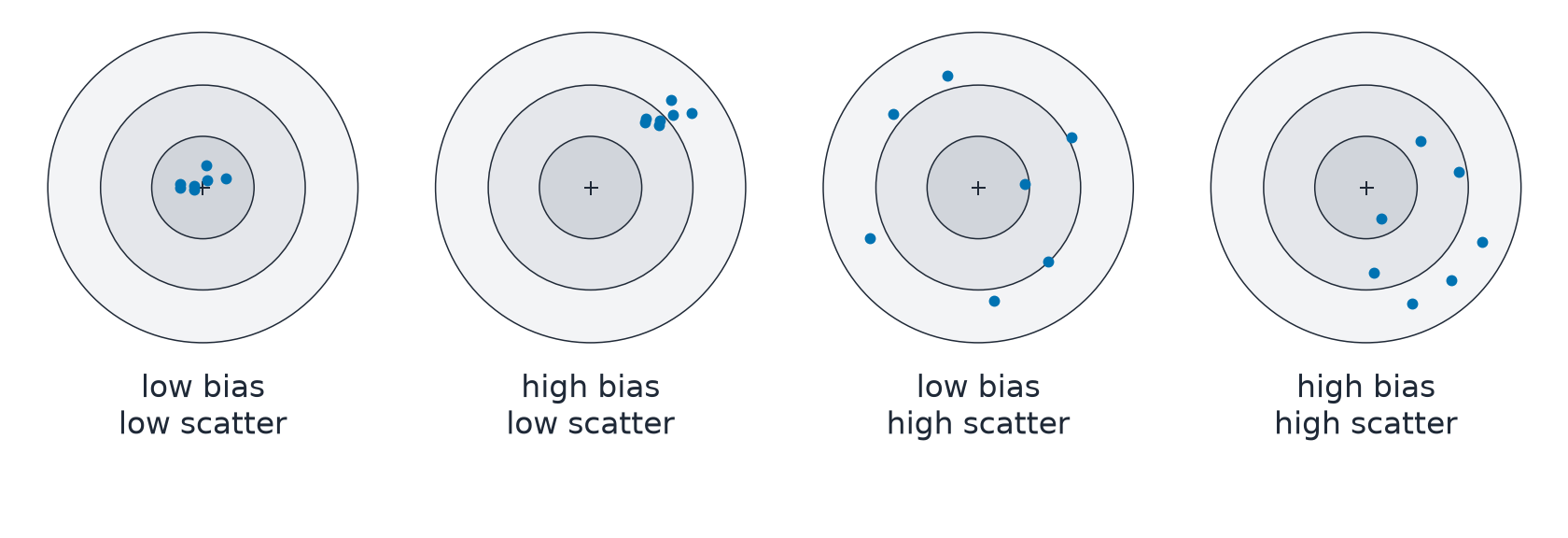
Does tight scatter alone prove validity for every intended use?
Dificuldade 1/5 · Moedas 100 + pequeno bônus na primeira conclusão hoje
Consistency and interpretation ask different questions.
Practical: Choose a test for its purpose
- Criterion validity considers an appropriate reference; internal validity 内部效度 concerns causal inference; external validity 外部效度 concerns application beyond the sample; ecological validity 生态效度 concerns relevance to the real task.
- Laboratory location does not guarantee quality. Planned change-of-direction courses do not by themselves test reactive agility. Norms require an appropriate population and matching protocol.
Does a laboratory automatically make a measure more valid for real sport?
Dificuldade 1/5 · Moedas 100 + pequeno bônus na primeira conclusão hoje
Evaluate the specific interpretation rather than the location label.
Practical: Distinguish random variation and bias
- Independent repeats and averaging can reduce random uncertainty of a mean. Systematic bias can remain in every repeat. Biological variation 生物学变异 and correlated errors need separate consideration.
- Calibration compares with a suitable reference. A justified correction, repair or different method may be needed; calibration does not make all uncertainty disappear.
What can repeating a biased device leave unchanged?
Dificuldade 1/5 · Moedas 100 + pequeno bônus na primeira conclusão hoje
The error mechanism determines which improvement can help.
Practical: State the uncertainty convention
- Resolution is the readout increment, not total uncertainty. Use specifications, calibration and the actual protocol. A supplied ±0.20 s hand-timing bound is a teaching assumption, not a universal reaction time.
- For stated maximum bounds, add absolute bounds in sums/differences and fractional bounds in products/quotients. Independent standard uncertainties require a different combination rule under a suitable model.
Can maximum bounds and standard uncertainties be mixed without explanation?
Dificuldade 1/5 · Moedas 100 + pequeno bônus na primeira conclusão hoje
Define what the interval represents before processing it.
Practical: Calculate a speed uncertainty budget
- For invented 30.0±0.1 m and 4.20±0.20 s as maximum bounds, speed = 30.0/4.20 = 7.142857… m/s. The first-order fractional sum is 0.1/30.0 + 0.20/4.20 = 0.05095238… or 5.095238…%.
- The approximate absolute uncertainty is 7.142857…×0.05095238… = 0.363945… m/s; one-significant-figure uncertainty gives 7.1±0.4 m/s. Keep unrounded intermediate values and match the value’s decimal place to the final uncertainty.
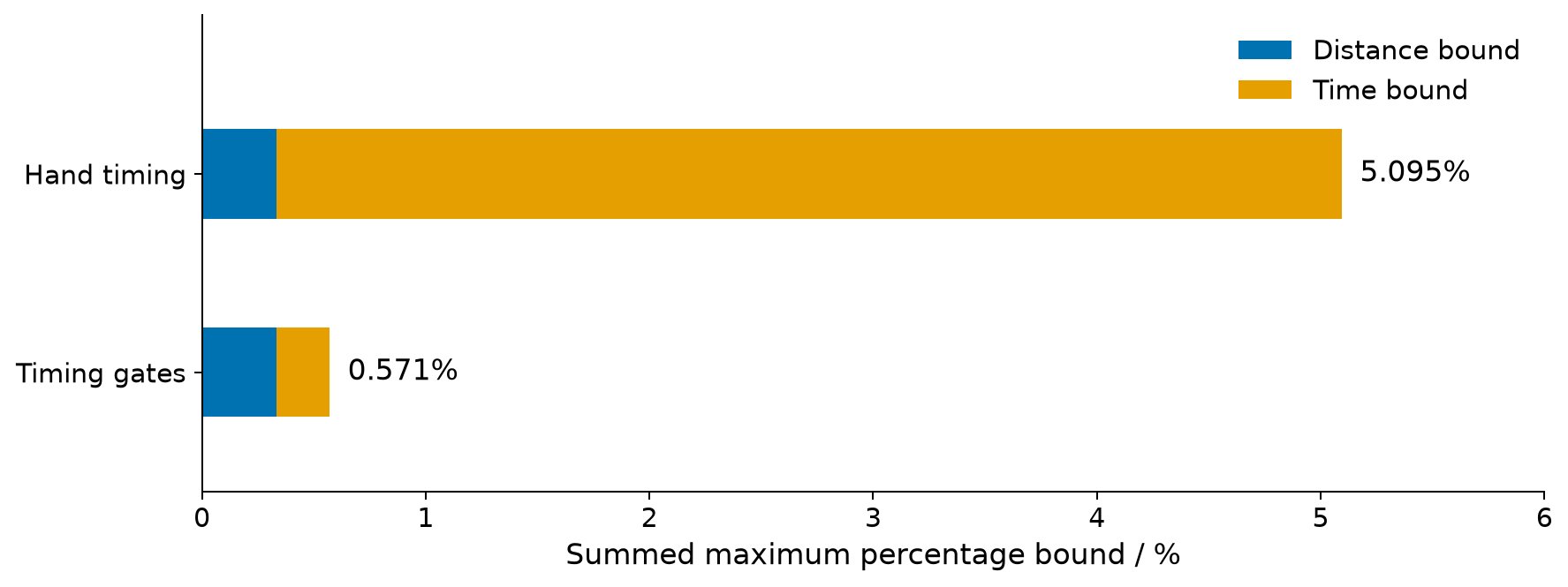
Distance is 30.0 ± 0.1 m and time is 4.20 ± 0.20 s. Using the first-order sum of maximum fractional uncertainties for speed = distance/time, which expression gives the fractional uncertainty?
Dificuldade 1/5 · Moedas 100 + pequeno bônus na primeira conclusão hoje
Fractional uncertainty ≈ distance bound/distance + time bound/time = 0.1/30.0 + 0.20/4.20 = 0.05095238… . Multiplying by 100 gives 5.095238…%. The two fractions are dimensionless; adding metres directly to seconds is invalid.
Find summed maximum percentage bound for 30±0.1 m and 4.20±0.20 s.
Dificuldade 2/5 · Moedas 140 + pequeno bônus na primeira conclusão hoje
(0.1/30+0.2/4.2)×100=5.095238…%.
Practical: Retain other uncertainty components
- Changing only the time bound to ±0.01 s gives (0.1/30.0 + 0.01/4.20)×100 = 0.5714286…%; multiplying the fractional sum by unrounded speed gives approximate absolute uncertainty 0.0408163… m/s. Report 7.14±0.04 m/s.
- The unrounded improvement factor is 8.91666…, not exactly ten. Distance uncertainty remains; a better timing device does not remove every limitation or establish validity.
For speed from 30.0 ± 0.1 m in 4.20 s, only the maximum timing bound changes from ±0.20 to ±0.01 s. Why does the summed fractional uncertainty not improve by the timing-only factor of 20?
Dificuldade 1/5 · Moedas 100 + pequeno bônus na primeira conclusão hoje
Old fractional sum = 0.1/30.0 + 0.20/4.20 = 0.05095238… . New sum = 0.1/30.0 + 0.01/4.20 = 0.005714286… . Their ratio is 8.91666… . The distance contribution remains, so the total does not improve twentyfold.
Practical: Recompute a swimmer’s speed
- Invented 50.0±0.1 m in 31.50±0.20 s gives speed 1.5873016… m/s. Maximum fractional bound is 0.008349206…; absolute bound is 0.0132527… m/s.
- Two significant figures in uncertainty give 1.587±0.013 m/s; a stated one-significant-figure convention gives 1.59±0.01 m/s. Neither permits rounded intermediate percentages to replace the calculation.
Is 0.0132527… m/s an absolute or percentage uncertainty?
Dificuldade 1/5 · Moedas 100 + pequeno bônus na primeira conclusão hoje
Units identify the quantity.
Find mean speed for 50.0 m in 31.50 s.
Dificuldade 2/5 · Moedas 140 + pequeno bônus na primeira conclusão hoje
Speed = distance/time = 50.0/31.50 = 1.587301587…m/s, or 1.59 m/s to three significant figures. Keep the unrounded speed for later uncertainty calculations.
Practical: Describe centre and range
- Sorted invented jumps are 42, 43, 44, 45, 46 cm. Mean and median are 44 cm; there is no single mode because no value repeats. Range is 4 cm.
- Under a convention excluding the median from the half-samples, Q 1=42.5 and Q 3=45.5 cm, so IQR=3 cm. Software quartile conventions can differ; state which is used.
Sorted jumps are 42, 43, 44, 45 and 46 cm. Exclude the median when forming the two halves for quartiles. Does the full range equal the IQR?
Dificuldade 1/5 · Moedas 100 + pequeno bônus na primeira conclusão hoje
Full range = 46 − 42 = 4 cm. Excluding median 44 gives Q1 = (42+43)/2 = 42.5 cm and Q3 = (45+46)/2 = 45.5 cm. IQR = 45.5 − 42.5 = 3 cm; it differs from the full range.
Practical: Calculate sample spread
- For jumps 42, 45, 44, 43, 46 cm, squared deviations from mean 44 sum 10 cm². Sample SD=√(10/4)=1.5811388… cm.
- CV=SD/mean×100=3.593497…%. Use suitable ratio-scale values and a meaningful nonzero mean; Celsius and means near zero make CV problematic. A low CV does not establish validity or absence of bias.
Five jumps are 42, 45, 44, 43 and 46 cm. When estimating sample variance, why divide their squared-deviation sum by four?
Dificuldade 1/5 · Moedas 100 + pequeno bônus na primeira conclusão hoje
The five values have mean 44 cm. Squared deviations sum to 4 + 1 + 0 + 1 + 4 = 10 cm². Sample variance uses n − 1 = 5 − 1 = 4: 10/4 = 2.5 cm². Sample SD is √2.5 cm.
Find CV as a percentage for mean 44 cm and sampleSD√2.5 cm.
Dificuldade 2/5 · Moedas 140 + pequeno bônus na primeira conclusão hoje
√2.5/44×100=3.593497…%.
Practical: Separate SD, SE and half-range
- SD describes observation spread; under suitable independent sampling, SE of the mean=SD/√n. For these jumps, SE=0.7071068… cm; half-range is 2 cm.
- Five trials from one student do not create five independent students or establish population precision. Label every ± quantity; half-range is not automatically a standard error or confidence interval.
What does SD most directly describe?
Dificuldade 1/5 · Moedas 100 + pequeno bônus na primeira conclusão hoje
Different error bars answer different questions.
Find SE for five independent observations with sampleSD√2.5 cm.
Dificuldade 2/5 · Moedas 140 + pequeno bônus na primeira conclusão hoje
SE = sample SD/√n = √2.5/√5 = √0.5 = 0.70710678… cm, assuming the five observations are independent under the stated model.
Practical: Choose the percentage reference
- For positive lengths 40 and 44 cm, change from 40 is 4/40×100=10%. Absolute percentage error of 44 relative to a 40 reference is also 10%, but asks a different question.
- A symmetric percentage difference using their mean is 4/42×100=9.5238…%. A raw test-score change 8.0→9.2 is 15%; this need not be a 15% change in physiological capacity.
Two lengths are 40 and 44 cm. For symmetric percentage difference defined as absolute difference divided by their mean, then multiplied by 100, what denominator is required?
Dificuldade 1/5 · Moedas 100 + pequeno bônus na primeira conclusão hoje
Mean = (40 + 44)/2 = 42 cm. Absolute difference = 4 cm. Symmetric percentage difference = 4/42 × 100 ≈ 9.52%. Dividing by 40 gives change relative to that reference instead.
Find symmetric percentage difference for 40 and 44 cm using their mean.
Dificuldade 2/5 · Moedas 140 + pequeno bônus na primeira conclusão hoje
Absolute difference = |44 − 40| = 4 cm. Mean = (40 + 44)/2 = 42 cm. Symmetric percentage difference = 4/42 × 100 = 9.52380952…%.
Practical: Choose and label graphs
- Use bars for categorical counts, a histogram for a quantitative distribution, scatter plots for paired quantities and line plots for time courses. Fit a justified straight or curved model and inspect residuals.
- Label quantities, units, n and error-bar 误差线 definitions. Gradient has y-units/x-units and area has the product of axis units. Interpolation remains inside the measured range; extrapolation requires stronger assumptions.
What is the gradient unit for distance in metres against time in seconds?
Dificuldade 1/5 · Moedas 100 + pequeno bônus na primeira conclusão hoje
A gradient is a ratio of changes.
Practical: Interpret SD bars without inventing a test
- Invented group means change 3.42→3.28 s and 3.44→3.41 s: reductions 0.14 and 0.03 s, a descriptive difference in changes 0.11 s. The plotted bars show between-person SD.
- SD-bar overlap does not determine a paired-test p-value. Means/SDs alone lack within-person covariance; a suitable model and design are needed to assess a between-group effect.
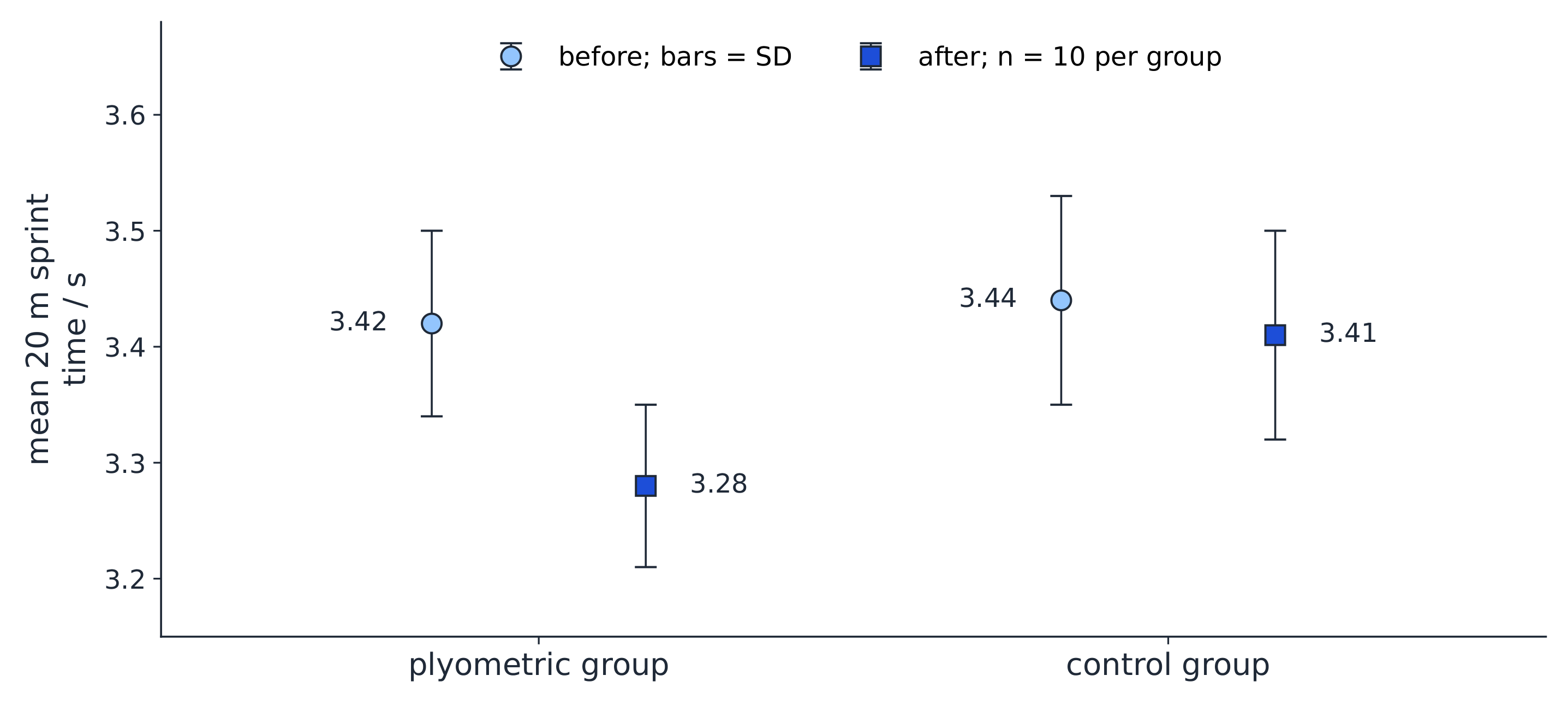
Can these before/after means and SDs alone supply a paired p-value?
Dificuldade 1/5 · Moedas 100 + pequeno bônus na primeira conclusão hoje
Distinguish spread from uncertainty of paired change.
Practical: Select a t-test for the design
- A paired t-test uses one signed difference per independent participant. For a small sample, examine whether a normal model for differences and absence of influential outliers are reasonable.
- An unpaired method compares independent groups; Welch’s version need not assume equal variances. No test label repairs biased recruitment, a wrong sampling unit or a confounded comparison.
Which distribution matters for a small paired t-test?
Dificuldade 1/5 · Moedas 100 + pequeno bônus na primeira conclusão hoje
The paired analysis operates on differences.
Practical: Apply the paired-difference calculation
- Invented reductions 0.10, 0.12, 0.14, 0.16, 0.18 s have mean 0.14 s; squared deviations sum 0.004 s². SD=√(0.004/4)=0.0316228… s and SE=0.0141421… s.
- t=mean/SE=9.89949…, df 4. Above a supplied two-sided 0.05 critical magnitude 2.776, reject the specified zero-mean-difference null under the assumptions; do not infer cause or universal practical importance.
For a paired t-test of a zero mean signed difference, t = observed mean difference divided by which quantity?
Dificuldade 1/5 · Moedas 100 + pequeno bônus na primeira conclusão hoje
The denominator is the standard error of the mean signed difference: SE = sample SD of differences/√n. Thus t = mean difference/SE for the stated zero-difference null.
Find t for mean reduction 0.14 s and SE√0.0002 s.
Dificuldade 2/5 · Moedas 140 + pequeno bônus na primeira conclusão hoje
0.14/√0.0002=9.89949494… .
Practical: Interpret a p-value correctly
- A p-value is the probability, under the specified null model and test assumptions, of a statistic at least as incompatible with the null as observed.
- p=0.03 leads to rejection at a preselected 0.05 level. It is not a 3% probability that the null is true or that the result was caused by chance. Failure to reject does not establish equivalence.
Does p=0.03 mean a 3% probability the null is true?
Dificuldade 1/5 · Moedas 100 + pequeno bônus na primeira conclusão hoje
Keep the conditioning direction correct.
Practical: Separate significance, size and cause
- A statistically significant 统计学显著 result may be too small to matter in sport; consider magnitude, uncertainty, design and relevance. Predefine the main test and alternative rather than selecting favourable results afterwards.
- One significant within-group change and one non-significant change do not establish a significant difference between changes. Test the comparison actually needed.
Does significance in groupA but not groupB prove a difference between their effects?
Dificuldade 1/5 · Moedas 100 + pequeno bônus na primeira conclusão hoje
A difference in labels is not a test of the difference.
Practical: Read correlation and fit cautiously
- For the invented ten-pair jump/sprint data, Pearson r=−0.828384… and r²=0.686220…. For a fitted ordinary least-squares line with an intercept, this accounts for about 68.6% of sample outcome variation.
- It is not a percentage caused by jump height. r near zero does not exclude a curved relationship; Spearman concerns monotonic ranks, not every non-linear form. Check outliers and model fit.
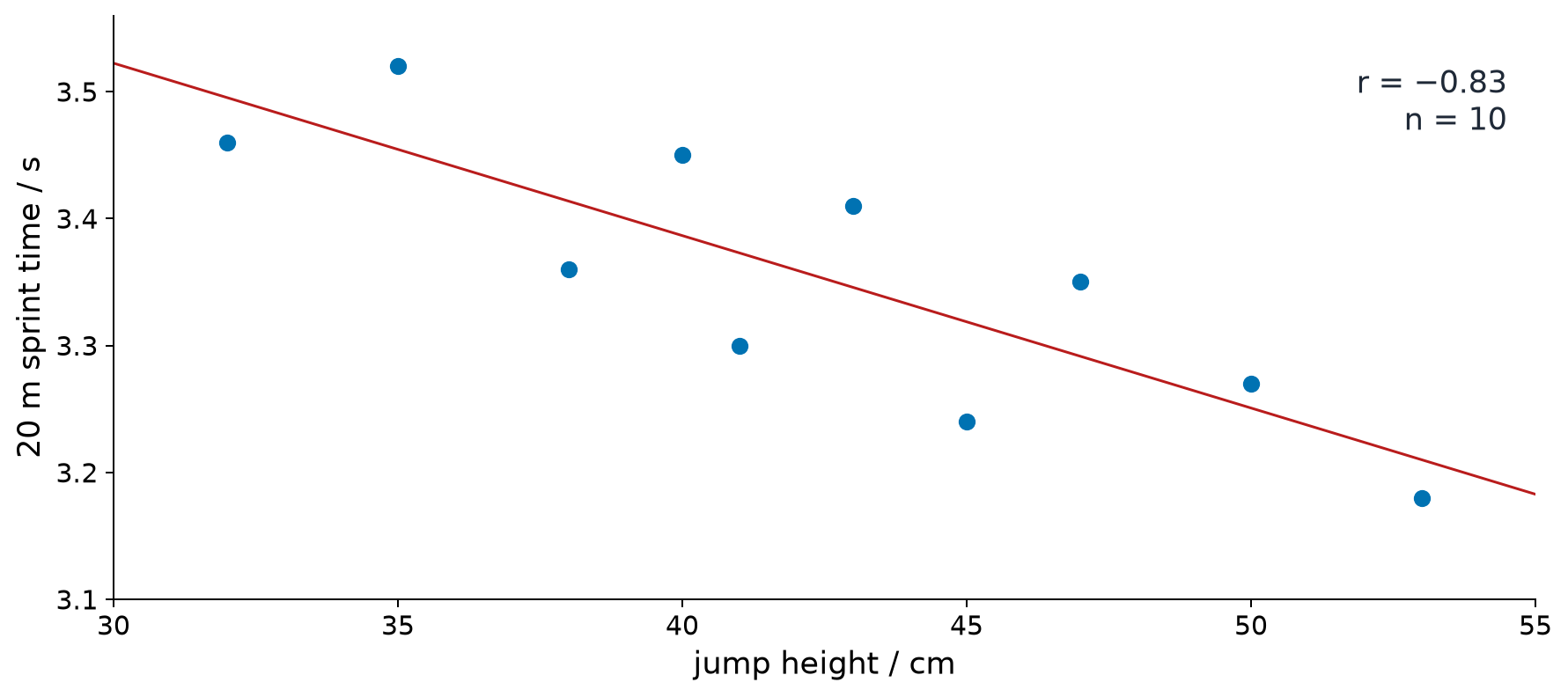
Does r²=0.686 mean jump height caused 68.6% of sprint performance?
Dificuldade 1/5 · Moedas 100 + pequeno bônus na primeira conclusão hoje
Accounted-for sample variation is not causal attribution.
Practical: Use the supplied critical magnitude
- For 12 independent pairs, supplied r=0.54 and appropriate critical magnitude 0.576 give |0.54|<0.576: fail to reject the specified zero-correlation null.
- Do not prove no relationship, promise significance with more data or extrapolate to all athletes. The stated n, test, alternative and assumptions determine the comparison.
For a two-sided Pearson correlation test at the 0.05 level with 12 independent pairs, r = 0.54 and the supplied critical magnitude is 0.576. What decision follows?
Dificuldade 1/5 · Moedas 100 + pequeno bônus na primeira conclusão hoje
Compare |r| = 0.54 with 0.576. Since 0.54 < 0.576, fail to reject the specified zero-correlation null at this test level. This does not prove the absence of every relationship.
Practical: Evaluate and conclude proportionately
- Explain each limitation, its consequence and a feasible improvement. A small convenience sample, phone timing, one trial and changed testing days create different limitations.
- Use suitable recruitment, justified repeats, feasible controls and relevant references. Agreement with a paper does not remove bias, and disagreement should not be hidden. State the population and causal limits.
Does a larger sample alone repair a biased timing protocol?
Dificuldade 1/5 · Moedas 100 + pequeno bônus na primeira conclusão hoje
Match the improvement to the mechanism of the limitation.
Practical: Preserve individual investigation work
- The official scientific investigation 科学探究 is an individual report, with a unique question and non-identical selected raw data even when optional collaboration is used in groups no larger than three.
- Students may use different independent/dependent variables 因变量 or allowed distinct data selections from communal data. All authoring, including methodology, is individual. The report is at most 3200 words; the task is 10 hours and 24% weighting.
May collaborators submit the same raw data set and shared methodology wording as individual work?
Dificuldade 1/5 · Moedas 100 + pequeno bônus na primeira conclusão hoje
Collaboration does not remove individual investigation requirements.
Practical: Connect tools, inquiry and course time
- The experimental programme totals 40 h SL / 60 h HL: practical 20/40 h plus project 10 h and investigation 10 h in both levels. Do not add those two ten-hour components again.
- Tools combine experimental techniques, technology and mathematics. Inquiry links exploring/designing, collecting/processing and concluding/evaluating. The investigation criteria are research design, data analysis, conclusion and evaluation.
What practical-work hours sit inside the total 40 h SL / 60 h HL?
Dificuldade 1/5 · Moedas 100 + pequeno bônus na primeira conclusão hoje
Distinguish the component from the experimental-programme total.
Practical: Use units and conditional models
- 3500 ms=3.5 s; 2.5×10³ J=2.5 kJ. A steady 120 beats/min=2 beats/s has reciprocal 0.5 s/beat. Scientific notation and an order-of-magnitude estimate help check scale.
- For v=d/t, doubling distance at fixed time doubles speed; doubling time at fixed distance halves speed. Convert units and state what remains fixed.
At fixed distance, what happens to speed when time doubles?
Dificuldade 1/5 · Moedas 100 + pequeno bônus na primeira conclusão hoje
Use the model and its fixed condition.
Practical: Evaluate technology and testing protocols
- At constant 240 frames/s, frame indices 120→240 imply 120/240=0.50 s. A 2 m same-plane reference spanning 400 pixels gives 0.005 m/pixel;60 pixels represent 0.30 m.
- Check timestamps, calibration and parallax; preserve raw inputs and verify spreadsheet formulas. Label simulated data as generated. Component tests need a defined endpoint, and perceived-exertion scores need actual scale anchors:0–10 and 6–20 are not interchangeable.
Does a pixel count alone establish an accurate physical distance?
Dificuldade 1/5 · Moedas 100 + pequeno bônus na primeira conclusão hoje
Connect the device output to a justified measurement model.