Motor control: feedback, timing and evidence
Introduzido| English | Significado |
|---|---|
| feedback/ˈfiːdbæk/ | Information about an outcome returned to a person or system to guide subsequent action. |
| augmented feedback/ɔːɡˈmentɪd ˈfiːdbæk/ | feedback ampliado |
| knowledge of result | Feedback about the outcome of a movement. |
| motor skill | motor skill |
| ability/əˈbɪləti/ | A supporting capacity such as coordination or strength. |
| selective attention/sɪˈlektɪv əˈtenʃn/ | Focusing on relevant information and filtering out the rest. |
| short-term memory/ʃɔːt tɜːm ˈmeməri/ | A limited store holding information for a few seconds. |
| long-term memory/lɒŋ tɜːm ˈmeməri/ | A large and lasting store of knowledge and skills. |
| reaction time/rɪˈækʃn taɪm/ | The time from a stimulus to the start of a response. |
| anticipation/ænˈtɪsɪpeɪʃn/ | Predicting what will happen and when, using cues. |
| schema theory | The idea that skills use general rules that adapt to new situations. |
What would explain this observation?
- A learner adjusts a slow movement after seeing an error, but a very fast action may end before visual feedback can change it. Timing constrains the role of feedback.
Build the model
- Open-loop control emphasizes a pre-organized command during an action; closed-loop control uses feedback to compare the result with a goal and modify control.
- Many sporting actions combine feedforward preparation with feedback.
- Intrinsic feedback arises from the performer’s sensory information, while augmented feedback 附加反馈 is additional information supplied by another source.
- augmented feedback: Additional task information supplied beyond the performer’s own sensory feedback.
- knowledge of results 结果反馈: Feedback about the outcome of an action.

Which comparison best examines persistence after practice?
Dificuldade 1/5 · Moedas 100 + pequeno bônus na primeira conclusão hoje
Persistence means the skill survives without support, so a delayed test with no practice prompts is the right comparison. The best prompted attempt measures ceiling under help, and unequal attempt counts make groups incomparable.
Match each technical term to its precise meaning.
Dificuldade 2/5 · Moedas 140 + pequeno bônus na primeira conclusão hoje
Use the definitions to distinguish related quantities and processes.
Choose evidence that can test it
- Distinguish knowledge of results from knowledge of performance.
- A score reports the outcome; a description of arm position reports movement features.
- Feedback can guide practice, yet immediate success with continuous prompts may not persist when prompts are removed.
- Retention and transfer therefore provide stronger learning evidence than one practice score.
In the lab: Use a voluntary, low-risk seated target or tracing task. Define the outcome, keep practice opportunities equal, give an agreed feedback schedule and assess delayed performance without feedback. Counterbalance group order where feasible and use anonymous records. Do not claim the task completely models elite performance.
Which two habits make the investigation or model in this case more defensible?
Dificuldade 2/5 · Moedas 140 + pequeno bônus na primeira conclusão hoje
Stating the conditions and assumptions lets others repeat the work exactly, and recording the supporting evidence lets them check the conclusion. Hiding disagreeing results removes the evidence that could challenge a wrong conclusion, and one measurement can never establish a wider claim.
Work from known quantities
- Known: one trial provides 20 attempts and 14 successes, or 70%.
- A delayed no-feedback test provides 20 attempts and 10 successes, or 50%.
- The decline is 20 percentage points, not a 20% relative decline; relative decline is (14−10)/14 ×100, approximately 28.6%.
- The observation supports investigating dependence on prompts, not a guaranteed explanation.
Your turn: Success rate changes from 80% in practice to 55% in retention. Find the decrease in percentage points.
Success rate changes from 80% in practice to 55% in retention. Find the decrease in percentage points.
Dificuldade 2/5 · Moedas 140 + pequeno bônus na primeira conclusão hoje
The result is 25 percentage points. Known: success 80% in practice, 55% in retention. Decrease = 80 - 55 = 25 percentage points. As a relative decline that is (80 - 55)/80 x 100 = 31.25% - the two measures answer different questions.
Check the conclusion and its limits
- Open-loop and closed-loop are models, not a claim that an athlete’s nervous system uses only one mechanism.
- Feedback timing, task complexity and sensory availability affect what can be inferred.
Not true: A strong score with continuous prompts proves lasting motor learning. Guidance can temporarily improve performance without establishing a lasting change in capability. Compare delayed unassisted retention and suitable transfer with starting performance under comparable conditions. Fatigue, motivation and task changes can also affect test scores; one drop does not uniquely establish dependence on guidance.
- Open-loop control emphasizes a pre-organized command during an action; closed-loop control uses feedback to compare the result with a goal and modify control.
- Distinguish knowledge of results from knowledge of performance.
- Watch for: open-loop and closed-loop are models, not a claim that an athlete’s nervous system uses only one mechanism.
A strong score with continuous prompts proves lasting motor learning.
Dificuldade 1/5 · Moedas 100 + pequeno bônus na primeira conclusão hoje
Guidance can temporarily improve performance without establishing a lasting change in capability. Compare delayed unassisted retention and suitable transfer with starting performance under comparable conditions. Fatigue, motivation and task changes can also affect test scores; one drop does not uniquely establish dependence on guidance.
Additional task information supplied beyond the performer’s own sensory feedback: write the technical term.
Dificuldade 1/5 · Moedas 100 + pequeno bônus na primeira conclusão hoje
augmented feedback means Additional task information supplied beyond the performer’s own sensory feedback.
Write from a fall of 30 percentage points
- A practice success rate is 60 percent. A delayed no-feedback test is 30 percent.
- Find the fall in percentage points. A prompted practice score does not prove lasting learning.
Success changes from 60 percent in practice to 30 percent in a delayed no-feedback test. What is the fall in percentage points, and why is the practice score not proof of lasting learning?
Percentage-point change is the second rate subtracted from the first. Relative change divides that gap by the starting rate.
Practice success is 60%; delayed no-feedback success is 30%. Find the fall in percentage points.
Dificuldade 1/5 · Moedas 100 + pequeno bônus na primeira conclusão hoje
Percentage-point fall = 60 − 30 = 30 percentage points. Relative fall instead = (60 − 30)/60 × 100 = 50%. The 60% option is the initial practice score, not its change.
C.2: Define a skill and its supporting abilities
- A motor skill 运动技能 is learned, goal-directed movement; an ability 能力 is a supporting capacity such as coordination or strength. Biological development, inherited influences and experience contribute.
- Strength and flexibility can be trained. A capacity is not a fixed ceiling or a guarantee of success; practice quality, opportunity and task demands matter. Numerical cases in these lessons are invented.
Does one ability measurement determine future sporting success?
Dificuldade 1/5 · Moedas 100 + pequeno bônus na primeira conclusão hoje
Distinguish current capacity from learned task-specific capability.
C.2: Classify the specified task
- A free throw is relatively closed, discrete and self-paced within its rules. A live match dribble is relatively open, continuous or serial, and influenced by defenders.
- Gross–fine concerns muscular precision; open–closed concerns environmental predictability; discrete–continuous concerns organisation over time. These are continua, not immutable labels for an entire sport.
Can a stationary passing drill and match passing have different classifications?
Dificuldade 1/5 · Moedas 100 + pequeno bônus na primeira conclusão hoje
State which version of the action is being classified.
C.2: Trace the information-processing model
- A batter receives ball, bowler and body information, perceives relevant cues, compares experience, selects a response and sends motor commands to muscles. Movement produces sensory and outcome feedback.
- This staged model organises an explanation. It is not proof that every brain process is a computer-like serial operation or that environmental information stops once movement begins.
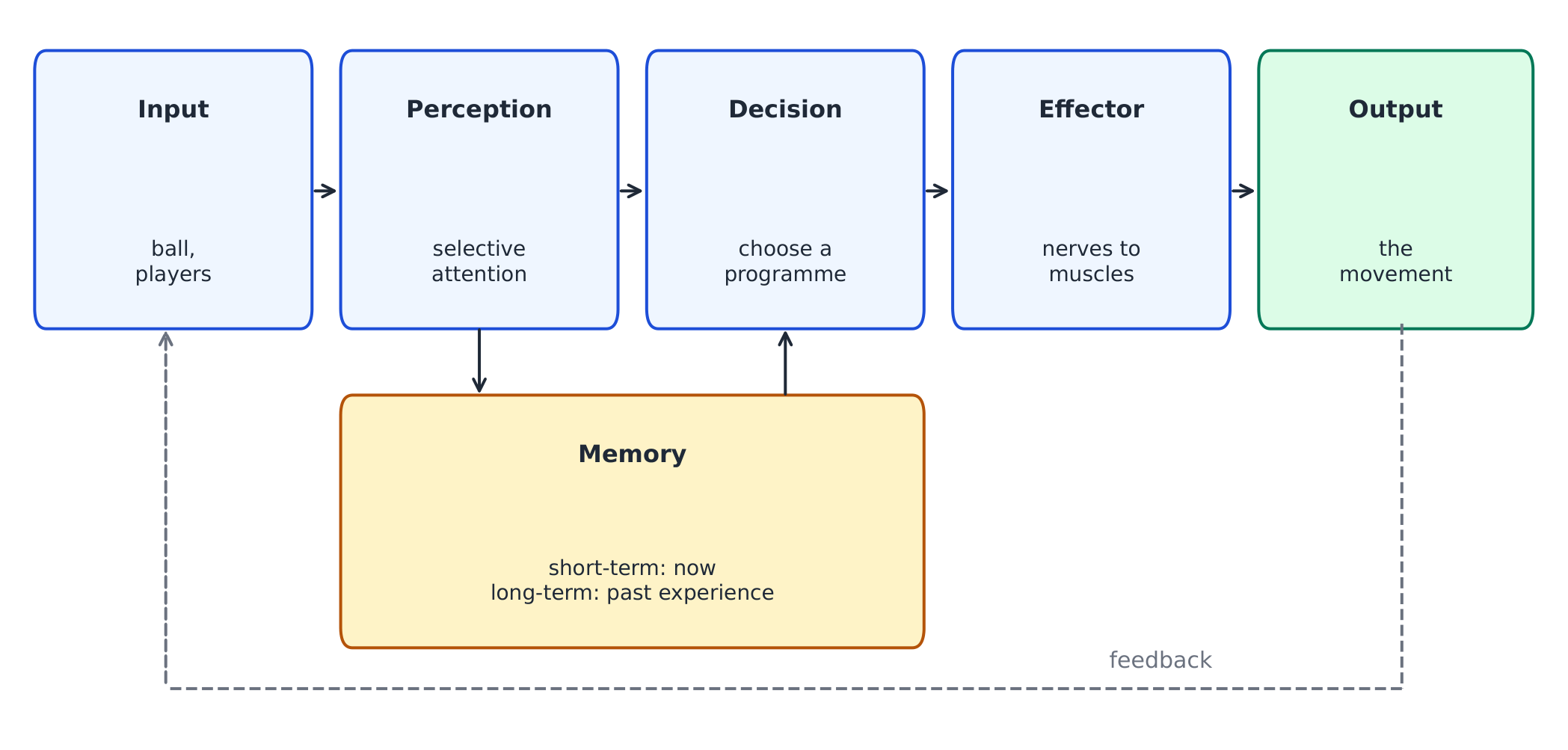
What is a useful application of the model?
Dificuldade 1/5 · Moedas 100 + pequeno bônus na primeira conclusão hoje
Explain the mechanism in context rather than reciting labels.
C.2: Select relevant information
- Selective attention 选择性注意 prioritises information relevant to the action. An opponent’s racket orientation may matter more than unrelated crowd movement.
- Prioritisation helps manage limited resources but can miss an unexpected relevant cue. Do not promise that ignoring more information always improves speed and accuracy.
Is all information outside the ball irrelevant?
Dificuldade 1/5 · Moedas 100 + pequeno bônus na primeira conclusão hoje
Relevance depends on the decision and phase.
C.2: Use memory without a magic limit
- Short-term memory 短时记忆 holds information in current use; long-term memory 长时记忆 supports learned experience and patterns. Chunking groups information into meaningful units.
- Capacity and duration vary with task, rehearsal and interference. The historical seven-plus-or-minus-two estimate is not a universal allowance for seven coaching commands. Use concise cues and check understanding.
Should a coach assume every novice can process exactly seven new instructions?
Dificuldade 1/5 · Moedas 100 + pequeno bônus na primeira conclusão hoje
A memory model is not an individual diagnostic count.
C.2: Define the timing endpoints
- Reaction time 反应时 runs from the defined stimulus to movement onset. Movement time runs from that onset to the specified endpoint. Response time is their sum.
- With supplied reaction 0.35 s and movement 0.45 s, response is 0.80 s. A quick reaction alone does not establish that a whole save or return finishes in time.
Reaction time from stimulus to movement onset is 0.35 s; movement time from onset to the endpoint is 0.45 s. What is the whole response time?
Dificuldade 1/5 · Moedas 100 + pequeno bônus na primeira conclusão hoje
Response time = reaction time + movement time = 0.35 + 0.45 = 0.80 s. Using only 0.35 s leaves out the movement needed to finish the response.
Add supplied reaction 0.35 s and movement 0.45 s to find response time.
Dificuldade 2/5 · Moedas 140 + pequeno bônus na primeira conclusão hoje
0.35+0.45=0.80 s.
C.2: Calculate a Hick-type model
- For the invented equation RT = 0.20 + 0.15 log₂(N) seconds, 1,2,4,8 equally likely choices give 0.20,0.35,0.50,0.65 s.
- Each doubling adds 0.15 s in this supplied model. Real choice tasks differ in probability, compatibility, practice and anticipation 预判; these coefficients are not universal athlete constants.
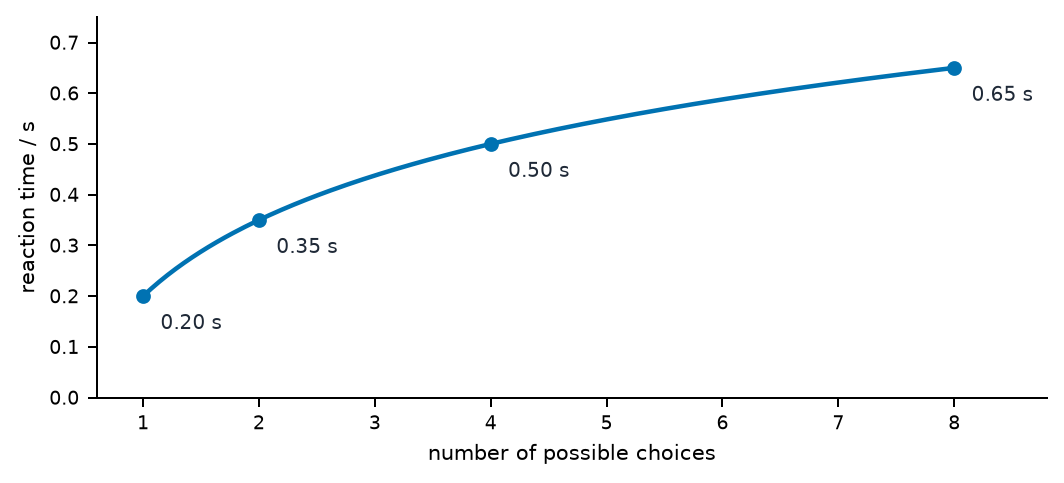
In the invented model RT = 0.20 + 0.15 log₂(N) seconds, N is the number of equally likely choices. What change in RT does doubling N produce?
Dificuldade 1/5 · Moedas 100 + pequeno bônus na primeira conclusão hoje
log₂(2N) = log₂(N) + 1, so doubling N adds 0.15 × 1 = 0.15 s. For example, N = 4 gives 0.20 + 0.15 × 2 = 0.50 s; N = 8 gives 0.65 s. These are supplied model coefficients.
Use RT=0.20+0.15 log₂(N) s at N=8.
Dificuldade 2/5 · Moedas 140 + pequeno bônus na primeira conclusão hoje
log₂(8)=3; 0.20+0.45=0.65 s.
C.2: Compare flight with a whole response
- An invented ball travelling 11 m at constant 25 m/s takes 0.44 s. A supplied 0.80 s whole response exceeds this by 0.36 s.
- For that model response, waiting until the strike is too slow. Anticipation may help if relevant earlier cues are reliable; a wrong prediction can initiate movement in the wrong direction.
Does the comparison prove every real goalkeeper must use identical early movement?
Dificuldade 1/5 · Moedas 100 + pequeno bônus na primeira conclusão hoje
Keep the inference within the model.
C.2: Check a second flight
- At constant 30 m/s over 7.0 m, flight time is 7/30 = 0.233333… s. A supplied 0.60 s response exceeds it by 0.366666… s.
- Retain unrounded values when subtracting. Real flight changes and required movement distances can differ; the calculation does not measure an actual athlete.
A ball travels 7.0 m at constant 30 m/s. The whole response takes 0.60 s from the strike. Which duration is longer?
Dificuldade 1/5 · Moedas 100 + pequeno bônus na primeira conclusão hoje
Flight time = distance/speed = 7.0/30 = 0.233333… s. Response time is 0.60 s, exceeding flight time by 0.60 − 7/30 = 0.366666… s. The whole response is longer.
Find constant-speed flight time over 7.0 m at 30 m/s.
Dificuldade 2/5 · Moedas 140 + pequeno bônus na primeira conclusão hoje
7/30=0.233333… s.
C.2: Explain a refractory delay
- A closely following second stimulus can produce a delayed second response while the first response is being selected or processed. A feint may exploit this delay.
- A response-selection bottleneck is one explanation. It does not mean all sensory information is processed one item at a time, and timing, tasks and practice affect the delay.
Does the refractory effect prove the entire brain has only one process at a time?
Dificuldade 1/5 · Moedas 100 + pequeno bônus na primeira conclusão hoje
Avoid expanding a task-specific model into a universal brain claim.
C.2: Separate prepared and feedback-based control
- An open-loop component executes a prepared command without feedback modifying that component. A closed-loop component uses sensory comparison to adjust movement.
- A fast strike and a slower balance adjustment illustrate the contrast. Most skills combine components; feedback arriving after ball release cannot change that released throw but can inform the next attempt.
Can feedback after release alter the ball through a correction of the released movement?
Dificuldade 1/5 · Moedas 100 + pequeno bônus na primeira conclusão hoje
Locate feedback relative to the action’s correction window.
C.2: Connect schemas and task-specific patterns
- A general throwing pattern can be adapted through force or duration to a particular distance and implement. Subordinate or task-specific versions need not be unrelated programmes for every attempt.
- Schema information connects initial conditions, response specifications, sensory consequences and outcome. Recall supports specifying a response; recognition supports evaluating expected and actual sensory consequences.
Which information belongs in a schema explanation?
Dificuldade 1/5 · Moedas 100 + pequeno bônus na primeira conclusão hoje
Explain what is general and what changes for the task.
C.2: Test a prediction from varied practice
- Schema theory 图式理论 predicts that varied experience can help adaptation to new conditions. Repeating several distances supplies different condition–action–outcome relationships.
- Test retained accuracy at an unpractised distance rather than assuming that more variations automatically mean more learning. Keep relevant opportunity and initial capability comparable.
What best tests adaptation to a new distance?
Dificuldade 1/5 · Moedas 100 + pequeno bônus na primeira conclusão hoje
Evaluate the theoretical prediction against the specified outcome.
C.2: Describe an affordance
- In ecological dynamics, an affordance is an opportunity for action relative to a performer’s capabilities. A gap can offer a usable pass for one player but not another.
- The environment and individual jointly matter. The same gap does not invite identical movement for every reach, speed, skill and position.
Is a passing opportunity independent of the player’s capabilities?
Dificuldade 1/5 · Moedas 100 + pequeno bônus na primeira conclusão hoje
Describe a possible action, not just the geometry.
C.2: Preserve perception and action together
- Perception guides action, and action changes the information available. A defender changes a passing lane while the ball carrier’s movement changes the defender’s options.
- Representative practice preserves important information–movement relationships. A cone task may train a component while omitting the live decisions required in a match.
Which task better preserves the information needed to evade a moving defender?
Dificuldade 1/5 · Moedas 100 + pequeno bônus na primeira conclusão hoje
Specify the relevant information rather than copying every surface feature.
C.2: Organise degrees of freedom
- A body has many joints, muscles and timing relationships that can vary. Coordination organises these degrees of freedom into a workable solution.
- A novice may restrict some motion initially, then explore more adaptable coordination. Self-organisation means a pattern emerges through performer–task–environment interactions, not that coaching or goals disappear.
Does self-organisation require the coach to remove all goals and safety boundaries?
Dificuldade 1/5 · Moedas 100 + pequeno bônus na primeira conclusão hoje
Distinguish the source of a coordination pattern from absence of teaching.
C.2: Identify three constraint types
- Individual constraints include reach, experience or fatigue. Task constraints include target size, rules, equipment and player numbers. Environmental constraints include surface, light and wind.
- They interact: equipment size matters relative to reach. Categories guide analysis; they are not independent isolated causes.
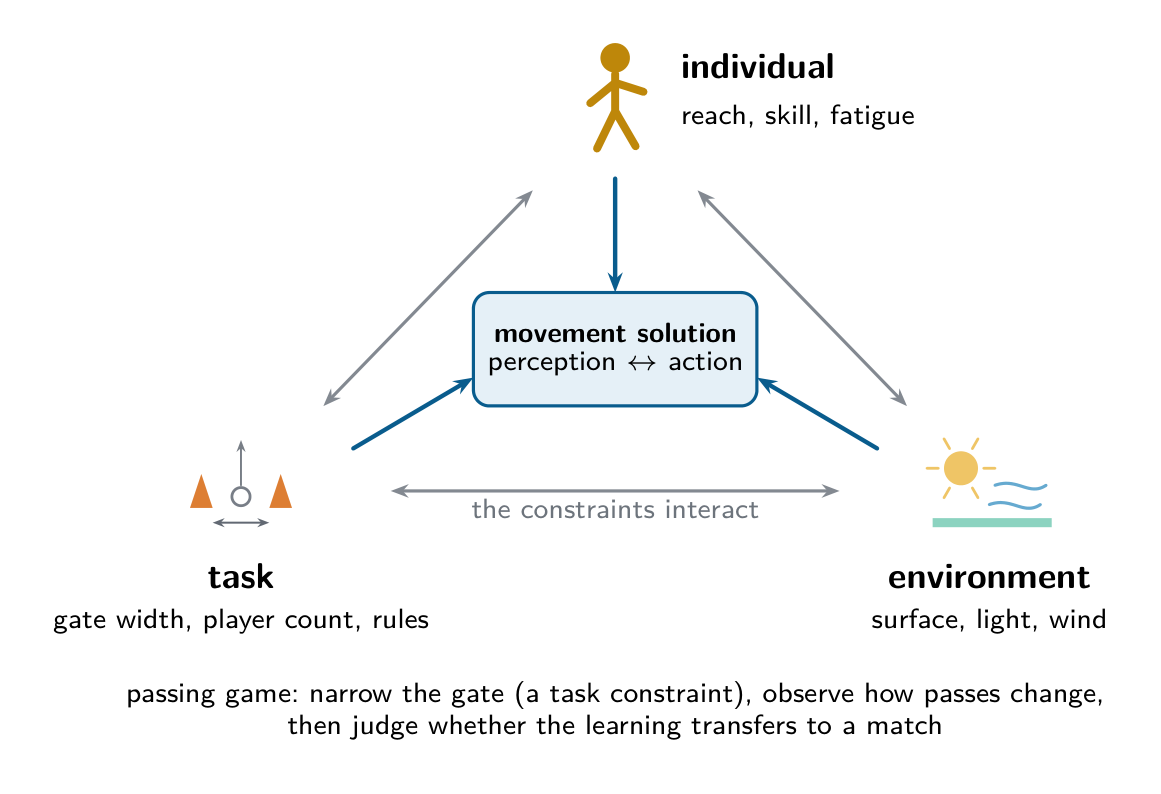
Which is a task constraint in a passing exercise?
Dificuldade 1/5 · Moedas 100 + pequeno bônus na primeira conclusão hoje
Identify what the coach actually changes.
C.2: Design one meaningful change
- A supervised low-risk passing game can keep a live defender while widening a gate. This changes an action opportunity without removing all decision information.
- If gate width, player numbers and equipment change at once, it is hard to identify the effective change. Record what altered, whether goals were met and whether a useful response persists later.
Why change one planned feature in a controlled comparison?
Dificuldade 1/5 · Moedas 100 + pequeno bônus na primeira conclusão hoje
Control improves inference without removing all uncertainty.
C.2: Distinguish functional variability from error
- Variation may reflect useful adaptation, random misses or measurement noise. Two successful passes can use different coordination because defenders and distances differ.
- Judge variation against the task goal and relevant conditions. More variability is not automatically better, and repeated unsafe solutions are not a desirable exploration strategy.
Do different movement patterns necessarily show worse learning?
Dificuldade 1/5 · Moedas 100 + pequeno bônus na primeira conclusão hoje
Assess the purpose and consequences of the variation.
C.2: Compare linear and non-linear teaching
- A traditional linear lesson often models a movement and uses sequenced practice and explicit correction. A non-linear lesson can invite exploration through meaningful constraints.
- Progress need not be proportional to each small change; a new coordination may emerge after several attempts. Real teaching can combine demonstration, concise cues and exploration.
Does non-linear teaching mean random practice without an intended goal?
Dificuldade 1/5 · Moedas 100 + pequeno bônus na primeira conclusão hoje
Describe what the learner explores and why it matters.
C.2: Separate attentional width and direction
- Internal/external concerns the direction of attention; broad/narrow concerns its width. Broad external focus scans players and spaces; narrow external focus attends to one selected target.
- Broad internal focus can review several tactical choices during a pause; narrow internal focus can attend to one breathing cue during a reset. The appropriate focus changes with the phase.
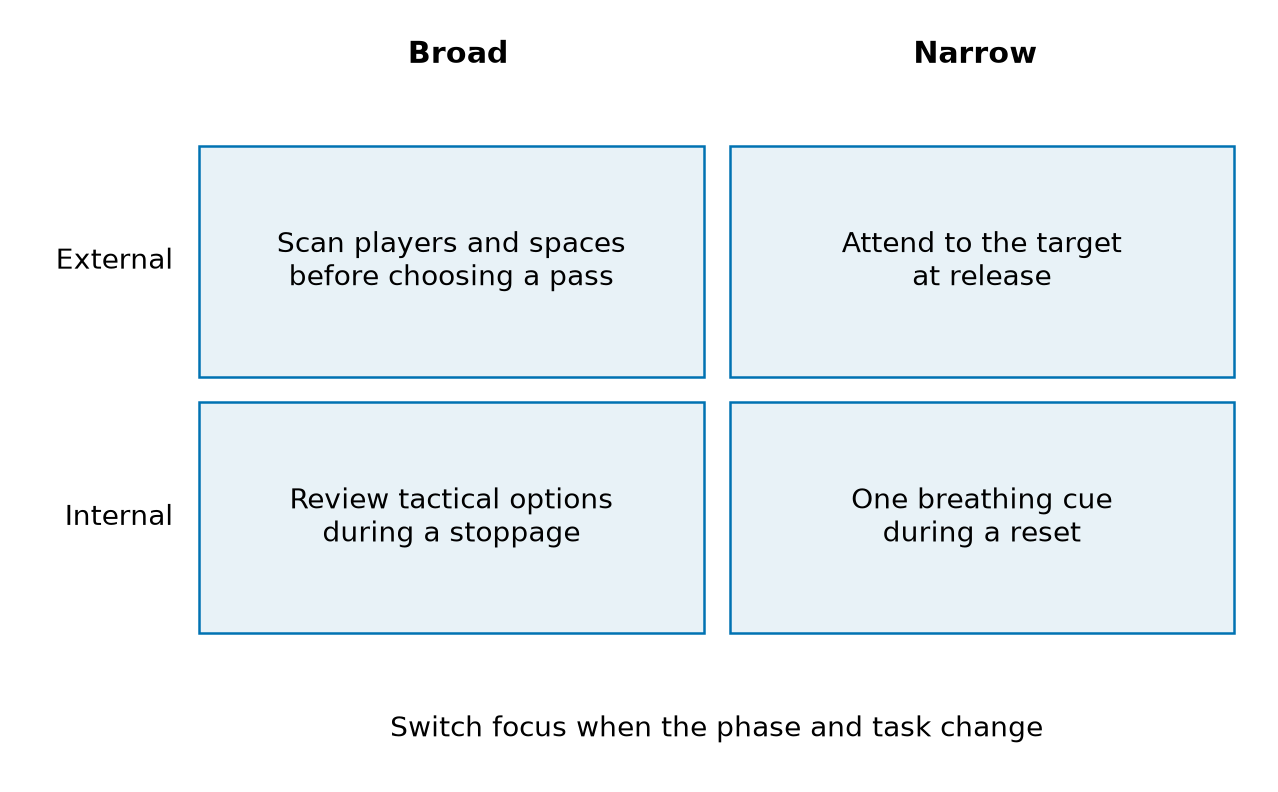
What does broad external focus describe?
Dificuldade 1/5 · Moedas 100 + pequeno bônus na primeira conclusão hoje
Keep width distinct from direction.
C.2: Identify distraction by relevance
- External distractors can be irrelevant sounds or sights. Internal distraction can involve worry about a previous error or thoughts unrelated to the goal.
- A teammate’s useful call is external information but may be essential. Lost concentration means focus has shifted from the relevant demand, not necessarily that all attention has vanished.
Is every external sound automatically a distraction?
Dificuldade 1/5 · Moedas 100 + pequeno bônus na primeira conclusão hoje
Classify what attention is directed towards and why it matters.
C.2: Explain narrowing under arousal
- High arousal can narrow attention. Excluding irrelevant cues may help one action, but missing peripheral teammates can harm a decision that needs a broad scan.
- Avoid claiming that every level of arousal has the same effect or that a chosen cue guarantees identical results. Observe the particular person, phase and outcome.
Can narrowed attention be costly when several passing options matter?
Dificuldade 1/5 · Moedas 100 + pequeno bônus na primeira conclusão hoje
Connect the effect to the informational demands.
C.2: Rehearse safe controlled distraction
- After establishing a routine, introduce mild agreed background cues in safe practice and rehearse returning attention to the task. Keep safety and communication signals available.
- Participation must be informed and manageable; do not create hazards or provoke distress. Compare a defined task, then check retained transfer without extra coaching prompts.
What is an appropriate controlled-distraction feature?
Dificuldade 1/5 · Moedas 100 + pequeno bônus na primeira conclusão hoje
The learning demand should not remove ordinary safety boundaries.
C.2: Choose actionable self-talk and goals
- A cue such as scan, choose, pass can direct an action sequence; a process goal such as checking the defender before a pass focuses on a feasible behaviour.
- Evaluate the cue with the performer. Extra words can overload a novice or disrupt an automated action; no mantra or goal guarantees a score or replaces technical practice.
Which goal directly guides attention to a controllable action?
Dificuldade 1/5 · Moedas 100 + pequeno bônus na primeira conclusão hoje
Distinguish an actionable process from an outcome beyond one player’s control.