Electric fields: force and a positive test charge
Introduzido| English | Significado |
|---|---|
| test charge/test tʃɑːdʒ/ | carga de prova |
| electric field strength/ɪˈlektrɪk fiːld streŋθ/ | intensidade do campo elétrico |
What would explain this observation?
- A negatively charged particle moves opposite to the direction of the electric field. Field direction is defined using a positive test charge 试探电荷.
Build the model
- Electric field strength 电场强度 is force per unit positive test charge.
- Like charges repel and unlike charges attract.
- Field lines point away from positive charges and toward negative charges.
- Closely spaced lines represent a stronger field within a consistently drawn diagram.
- electric field strength: Electric force per unit positive test charge.
- test charge: A small charge used to probe an electric field.

What happens to force direction if the test charge changes sign?
Dificuldade 1/5 · Moedas 100 + pequeno bônus na primeira conclusão hoje
Force on a charge in a field is F = qE, so reversing the sign of q reverses the force while the field itself - defined by the source charges - is unchanged. Field direction is defined by the force on a positive test charge.
Match each technical term to its precise meaning.
Dificuldade 2/5 · Moedas 140 + pequeno bônus na primeira conclusão hoje
Use the definitions to distinguish related quantities and processes.
Choose evidence that can test it
- In a uniform field between ideal parallel plates, E = V/d away from edge effects.
- The force is F = qE, so its direction reverses for a negative charge.
- Coulomb force between ideal point charges decreases with separation squared.
In the lab: Sketch labelled plate polarities, field arrows and the charge before calculating. Convert separation to metres. In school, use simulations or approved low-voltage electrostatic models rather than exposed high-voltage equipment.
Which two habits make the investigation or model in this case more defensible?
Dificuldade 2/5 · Moedas 140 + pequeno bônus na primeira conclusão hoje
Stating the conditions and assumptions lets others repeat the work exactly, and recording the supporting evidence lets them check the conclusion. Hiding disagreeing results removes the evidence that could challenge a wrong conclusion, and one measurement can never establish a wider claim.
Work from known quantities
- Known: plate potential difference is 120 V and separation is 0.020 m.
- E = V/d = 6,000 V/m.
- A +2.0 microcoulomb charge experiences F = qE = 0.012 N along the field; a −2.0 microcoulomb charge experiences the same magnitude opposite to it.
Your turn: Use E = V/d. Find E for 100 V across 0.025 m.
Same field, opposite forces
120 V across 20 mm gives 6,000 V/m. Compare +2 and −2 μC probes: the force magnitude is 0.012 N, while its direction depends on the charge sign.
Use E = V/d. Find E for 100 V across 0.025 m.
Dificuldade 2/5 · Moedas 140 + pequeno bônus na primeira conclusão hoje
The result is 4000 V/m. Known: V = 100 V; d = 0.025 m, uniform field between plates. Use E = V/d. E = 100/0.025 = 4,000 V per m. The same field acts on a charge anywhere between the plates in this uniform-field model.
Check the conclusion and its limits
- Field strength is a vector.
- Potential difference is energy per charge and is not the same quantity.
- A field-line drawing is a model, not a set of physical threads.
Not true: Every charged particle experiences a force along the electric field direction. Field direction is defined by the force on a POSITIVE charge. A negative particle feels a force opposite to the field, so the field direction is not every particle's force direction.
- Electric field strength is force per unit positive test charge.
- In a uniform field between ideal parallel plates, E = V/d away from edge effects.
- Watch for: field strength is a vector.
Field direction is defined by the force on a POSITIVE charge.
Dificuldade 1/5 · Moedas 100 + pequeno bônus na primeira conclusão hoje
True. Field direction is defined by the force on a POSITIVE charge. A negative particle feels a force opposite to the field, so the field direction is not every particle's force direction.
Electric force per unit positive test charge: write the technical term.
Dificuldade 1/5 · Moedas 100 + pequeno bônus na primeira conclusão hoje
electric field strength means Electric force per unit positive test charge.
Write from the data: find the field
- In an ideal uniform field, potential-difference magnitude 60 V is across a gap of 0.020 m along the field.
- Find the electric field strength. A negative charge feels the opposite force.
In an ideal uniform field, potential-difference magnitude 60 V is across a gap of 0.020 m along the field. What is the electric field strength, and which way does a negative charge feel the force?
E = V/d = 60/0.020 = 3000 V/m. Field direction is defined by force on a positive test charge. Since F = qE, a negative charge feels force opposite to the field.
A uniform electric field has potential-difference magnitude 60 V across distance 0.020 m along the field. What is its strength?
Dificuldade 1/5 · Moedas 100 + pequeno bônus na primeira conclusão hoje
60 divided by 0.020 is 3000 volts per metre. Other options — 4000 volts per metre (the lesson gap of 100 V across 0.025 m); 60 V (the potential difference).
Keep net charge, charge carriers and elementary charge separate
- A neutral body has equal positive and negative charge, rather than no charged particles. In ordinary charging of solid objects, electrons can transfer while nuclei remain in the material. Gaining electrons makes the body negative; losing electrons makes it positive. With e = 1.60 × 10⁻¹⁹ C, an invented body with 2.0 × 10¹⁰ extra electrons has q = −3.2 × 10⁻⁹ C, or −3.2 nC.
- Charge conservation applies to the total net charge of an isolated system. If a balloon gains a given negative charge from hair, the hair loses the same negative amount and becomes positive. Rubbing does not create net charge. The integer-electron model describes accessible net charges of the isolated bodies here; measured values have uncertainty and should not be treated as exact mathematical integers merely because charge is quantized. All numerical examples below are invented models unless a historical source is explicitly identified.
An invented isolated body has 2.0 × 10¹⁰ extra electrons. With e = 1.60 × 10⁻¹⁹ C, find its signed net charge in nC.
Dificuldade 2/5 · Moedas 140 + pequeno bônus na primeira conclusão hoje
q = −Ne = −3.2 × 10⁻⁹ C = −3.2 nC. Extra electrons make a negative net charge; electron count is a positive number.
Predict contact charging only with the stated symmetry
- Conductors allow mobile charge to redistribute, whereas charge tends to remain localised on an insulator. Two identical isolated metal spheres, initially +6.0 and −2.0 nC and without nearby charged objects, share total charge +4.0 nC equally after contact and separation: +2.0 nC each. Total charge is conserved even though neither final value equals its own initial charge.
- Equal sharing follows the identical, symmetric arrangement; different sizes or nearby fields can produce unequal final charges. Contact does not mean that every pair of objects must each receive half the total charge. Track which bodies form the isolated system and whether there is an earth connection. Earth can exchange charge with the apparatus, so conservation then applies to the larger combined system, rather than the insulated sphere alone.
Two identical isolated metal spheres carry +6.0 and −2.0 nC with no nearby charged object. After contact and separation, find signed charge on each in nC.
Dificuldade 2/5 · Moedas 140 + pequeno bônus na primeira conclusão hoje
Total +4.0 nC is shared equally by the identical symmetric arrangement: +2.0 nC each. Unequal sizes or nearby sources need not share equally.
Follow induction in the correct order
- Bring a negative rod near a neutral conducting sphere without contact. Mobile electrons redistribute away from the rod, leaving a positive region nearer it and negative region farther away; the sphere's total charge remains zero at this stage. Connect the sphere to Earth while the rod stays in place: electrons can leave. Disconnect Earth first, then remove the rod. The isolated sphere is left positive.
- If the rod is removed while the earth connection remains, charge can flow back and the intended positive charge is not retained. No electrons need to jump from the rod into the sphere in this induction process. The signs in the figure represent charge regions schematically, not moving positive nuclei or a literal count of a few particles. Distinguish temporary charge separation in a neutral conductor from a net charge remaining after grounding and isolation.
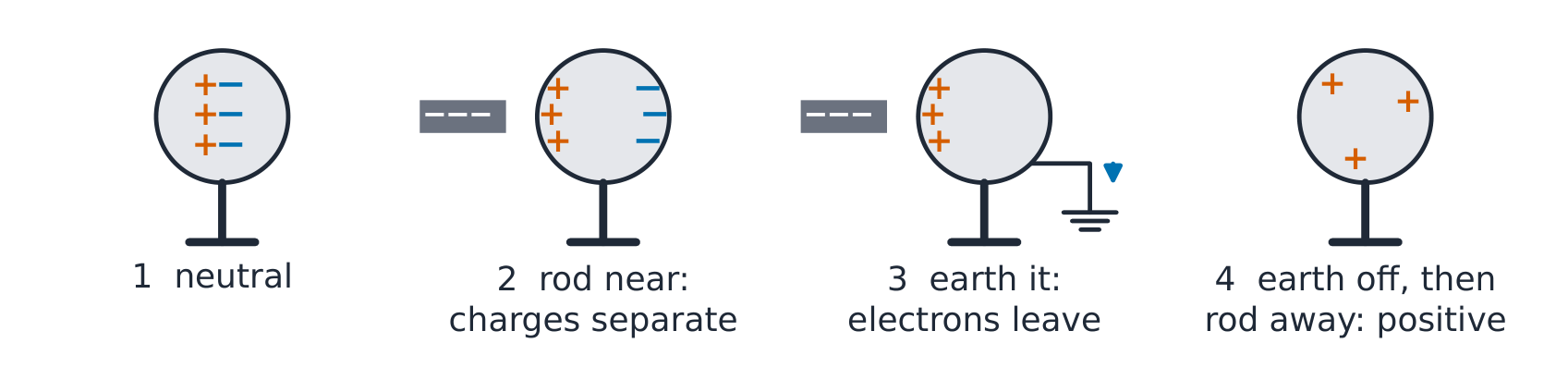
After grounding a conductor near a negative rod, which order retains positive charge on the isolated conductor?
Dificuldade 1/5 · Moedas 100 + pequeno bônus na primeira conclusão hoje
The nearby rod drives the charge redistribution while Earth can exchange electrons. Isolating before removing the rod retains the net positive charge.
Model a suspended oil drop with force directions
- In the simplified oil-drop model, an upper positive plate and lower negative plate create a downward electric field. To balance downward weight, the electric force on the stationary drop must be upward, requiring negative charge. Neglecting buoyancy, the magnitudes obey |q|E = mg and E = V/d, so |q| = mgd/V. The magnitude equation alone cannot tell you whether the drop has extra or missing electrons; the plate polarities supply the sign.
- The illustrated charge-magnitude estimates cluster near integer multiples of e with scatter. They are invented teaching values, not Millikan's original measurements. Millikan's final 1913 publication belongs to the historical evidence for discrete elementary charge; the simple stationary-drop model here neglects corrections needed in a precise measurement. A graph with experimental scatter can support quantization without every measured estimate being exactly an integer multiple.

Recover signed drop charge from magnitude and polarity
- For an invented drop with m = 4.9 × 10⁻¹⁵ kg, plate spacing .010 m, potential-difference magnitude 1000 V and g = 9.81 m/s², the field magnitude is 100,000 N/C. Then |q| = mg/E = 4.8069 × 10⁻¹⁹ C, approximately 3e. With the upper plate positive the drop is negative, so q ≈ −4.8 × 10⁻¹⁹ C and it has about three extra electrons.
- Reversing plate polarity while holding the same negative drop would reverse its electric force, so the old force balance would fail. The same calculated positive charge magnitude would then not imply the same suspended state. Keep millimetres/centimetres, volts and kilograms consistent, and distinguish a signed charge in coulombs from the positive number of extra electrons. A zero charge would provide no electric force to balance weight.
An invented stationary oil drop has mass 4.9 × 10⁻¹⁵ kg between plates .010 m apart at 1000 V, upper plate positive. Neglect buoyancy; use g = 9.81 m/s². Find signed drop charge.
Dificuldade 2/5 · Moedas 140 + pequeno bônus na primeira conclusão hoje
E = V/d = 1000/0.010 = 1.00 × 10⁵ N/C downward. Balance requires upward electric force, so q < 0. Weight is mg = (4.9 × 10⁻¹⁵)(9.81) = 4.8069 × 10⁻¹⁴ N. Hence |q| = mg/E = 4.8069 × 10⁻¹⁹ C and q ≈ −4.8 × 10⁻¹⁹ C, about three extra electrons using e = 1.60 × 10⁻¹⁹ C. Zero charge cannot balance weight.
Apply Coulomb's law as a force magnitude plus a direction
- For point charges in vacuum, $F=\dfrac{k|q_1q_2|}{r^2}$ with k = 8.99 × 10⁹ N m²/C² gives force magnitude. State attraction for unlike signs and repulsion for like signs. Invented +3.0 and −2.0 μC charges .20 m apart attract with magnitude 1.3485 N, about 1.35 N. The two forces are equal and opposite on different bodies; one body's acceleration additionally depends on its mass.
- In an ideal homogeneous linear dielectric with relative permittivity 80, the comparison gives 1.3485/80 ≈ .0169 N. Real water with dissolved ions can also conduct and screen charges; this simple dielectric comparison alone is not a theory of salt solubility. A conducting sphere acts externally as a point charge only with the relevant spherical symmetry; a nearby charge can redistribute its surface charge and spoil that simple pattern.
Invented point charges +3.0 and −2.0 μC are .20 m apart in vacuum. With k = 8.99 × 10⁹ N m²/C², find force magnitude.
Dificuldade 2/5 · Moedas 140 + pequeno bônus na primeira conclusão hoje
Convert the charges to +3.0 × 10⁻⁶ C and −2.0 × 10⁻⁶ C. F = k|q₁q₂|/r² = (8.99 × 10⁹)(3.0 × 10⁻⁶)(2.0 × 10⁻⁶)/(0.20)² = 1.3485 N, attractive. The separation is squared; signed interaction energy uses a different formula.
Separate electric field direction from force on a particular particle
- Electric field is force per unit positive test charge. For a point source charge, the magnitude is k|Q|/r², directed away from positive Q and towards negative Q. At .10 m from +2.0 nC, the model gives 1798 N/C, about 1.8 × 10³ N/C outward. A small probe samples this source field without significantly changing the configuration.
- Force is the signed vector relation F = qE. In an invented uniform field of 5.0 × 10⁴ N/C to the right, q = −3.2 × 10⁻¹⁹ C experiences force magnitude 1.6 × 10⁻¹⁴ N to the left. Doubling that test charge magnitude doubles force while leaving the source field unchanged. Reversing charge sign reverses force, not field direction; an electron does not redefine which way the field arrows point.
At .10 m from an invented +2.0 nC point source, find field magnitude using k = 8.99 × 10⁹ N m²/C².
Dificuldade 2/5 · Moedas 140 + pequeno bônus na primeira conclusão hoje
Convert Q = +2.0 nC = +2.0 × 10⁻⁹ C. E = k|Q|/r² = (8.99 × 10⁹)(2.0 × 10⁻⁹)/(0.10)² = 1798 N/C, outward from the positive source. Force additionally depends on the test charge magnitude and sign.
An invented particle has charge −3.2 × 10⁻¹⁹ C in a uniform field 5.0 × 10⁴ N/C to the right. Find force magnitude.
Dificuldade 2/5 · Moedas 140 + pequeno bônus na primeira conclusão hoje
|F| = |q|E = 1.6 × 10⁻¹⁴ N. Its direction is left because q is negative, while the given field direction remains right.
Read superposed charge fields and neutral points
- Field-line arrows show the force direction on a positive test charge. The isolated positive source has outward radial lines; an opposite-charge pair can have lines connecting positive to negative. Equal like charges have a zero-field point midway between them because their contributions oppose there. For unequal like charges, cancellation occurs closer to the smaller source magnitude.
- Between opposite charges the field contributions point the same way and add; they do not cancel merely because the source charges have opposite signs. Field lines cannot cross where a definite nonzero field exists. Their density represents relative field strength, not the literal number of particles passing. A field line is not automatically a charged particle's curved path, since its subsequent motion depends on velocity and acceleration.

At the midpoint between equal positive and negative point charges, how do the electric fields combine?
Dificuldade 1/5 · Moedas 100 + pequeno bônus na primeira conclusão hoje
Field points away from positive and towards negative. At this midpoint both contributions have the same direction; zero total source charge is not zero field everywhere.
State conductor and cavity assumptions
- In electrostatic equilibrium the field within conducting material is zero; otherwise free charges would continue to move. Excess charge resides on surfaces. An isolated spherical conductor has a radial exterior field, while nearby sources can change its surface distribution. A closed empty cavity also has zero electrostatic field, but a charge placed inside that cavity creates a field within the cavity even though the surrounding conducting material still has zero field.
- Between broad oppositely charged plates, sufficiently far from the edges, nearly parallel equally spaced lines model a uniform field. Near edges the lines fringe and the uniform-field approximation fails. The pictured sphere and plates illustrate separate ideal situations: do not infer that every real conductor has the same exterior radial field or that a hollow region containing a charge is equivalent to conducting material.
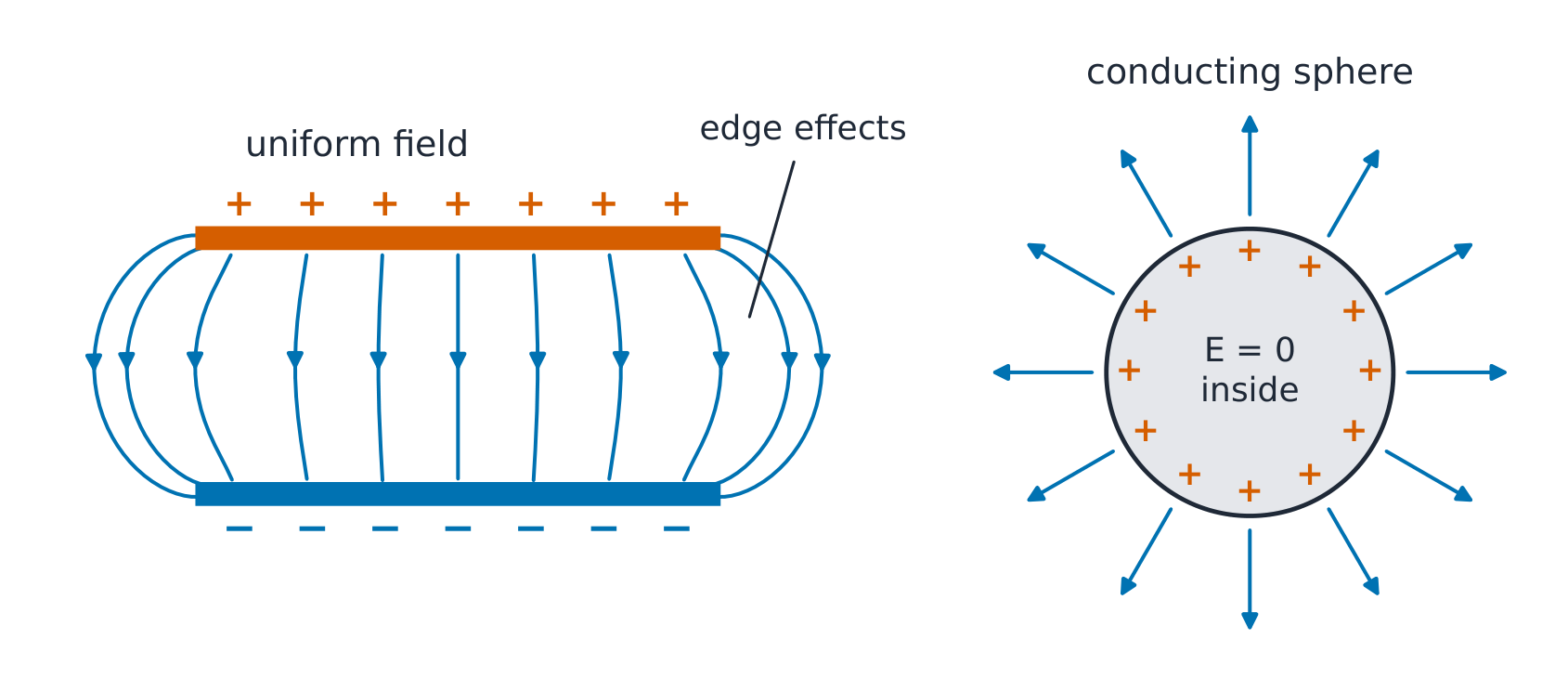
Which zero-field claim is justified for a hollow conductor in electrostatic equilibrium?
Dificuldade 1/5 · Moedas 100 + pequeno bônus na primeira conclusão hoje
Separate conducting material from hollow space. Charges inside a cavity can create a cavity field even though the surrounding material remains at electrostatic equilibrium.
Calculate a plate field before the particle force
- Let V be the positive voltage-difference magnitude and d the gap. The ideal uniform field magnitude is E = V/d, directed from the positive plate towards the negative plate. For 2.0 kV across .040 m, E = 50,000 V/m, equivalent to N/C. An electron has force magnitude eE = 8.0 × 10⁻¹⁵ N towards the positive plate.
- At fixed voltage, halving d doubles E; doubling voltage and halving d multiplies E and the same particle's force magnitude by four. The field is uniform only in the stated central region; it does not depend on where the small test particle is within that ideal region. These high-voltage numbers are calculations, not instructions to build exposed equipment; use approved low-voltage models or simulations in school.
For ideal broad plates, voltage magnitude doubles and gap halves. By what factor does electric-force magnitude on the same electron change?
Dificuldade 2/5 · Moedas 140 + pequeno bônus na primeira conclusão hoje
E = V/d increases by 2/(1/2) = 4. The same |q| makes |F| = |q|E increase by four as well.
Compare magnetic patterns without inventing magnetic charges
- Magnetic field lines indicate the direction a compass north pole points. Outside a bar magnet they run from its north pole to its south pole, then continue through the magnet as closed loops. They do not terminate on isolated positive or negative electric charges. As for electric fields, line density is a drawing convention for relative strength rather than a material substance.
- The figure compares a bar magnet, a long straight current-carrying wire, a circular coil viewed edge-on, and an ideal long solenoid. The wire field circles the wire; the coil field passes along its central axis and returns outside; the long-solenoid interior is approximately uniform away from ends. A real finite coil has fringing and a position-dependent field, so label the region where a uniform approximation is intended.

Apply the grip rule using conventional current and a viewing direction
- For a straight wire, point your right thumb in the direction of conventional current; curled fingers show magnetic-field circulation. Current out of the page, marked by a dot, gives anticlockwise circulation when viewed facing the page. Current into the page, marked by a cross, gives clockwise circulation. For a vertical wire carrying current upward, a view from above sees the current coming towards you, hence an anticlockwise field.
- For a coil or solenoid, curl your fingers along conventional current in the turns; your thumb points along the interior field towards its north end. Reversing current reverses field direction. Electron drift in a metal is opposite conventional current, so substituting electron motion directly into the current grip rule reverses the answer. State which side of the apparatus you view before naming clockwise or anticlockwise.
A vertical wire carries conventional current upwards. Seen from above, how does the magnetic field circulate?
Dificuldade 1/5 · Moedas 100 + pequeno bônus na primeira conclusão hoje
From above, upward conventional current comes towards the viewer. Right thumb points towards you and curled fingers run anticlockwise; electron drift is not substituted for conventional current.
Test the complete charge and field account
- Track net charge through contact or induction, including Earth where it exchanges charge. Draw signs and force directions before using a magnitude equation. Use Coulomb's law with the correct centre/point separation, distinguish source field from test-particle force, and add vector contributions according to their directions. In oil-drop balance infer the charge sign from the plate polarities and treat scatter as measurement uncertainty.
- State uniform-plate, conductor-equilibrium, cavity and dielectric assumptions. Convert nC, μC, centimetres and kilovolts consistently, and check ratios before trusting an absolute result. Draw magnetic loops separately from electric field lines and use conventional current with a named view for grip rules. Explain a zero field through the model that produces it rather than treating every zero as the same physical situation.
Explain ordinary charging, oil-drop balance and electric and magnetic field models with their assumptions and directions.
A complete answer combines an explicit charge or current arrangement with directions, equations and their limits.