Gravitational fields and orbital motion
Introduzido| English | Significado |
|---|---|
| gravitational field/ˌɡrævɪˈteɪʃənl fiːld/ | campo gravitacional |
| centripetal force/senˈtrɪpɪtl fɔːs/ | força centrípeta |
What would explain this observation?
- An orbiting satellite is continuously falling while moving sideways. Being in orbit does not require gravity to vanish.
Build the model
- Gravitational field 引力场 strength is force per unit mass.
- A gravitational force can provide the centripetal force 向心力 for a circular orbit.
- Field and potential describe different quantities.
- gravitational field: A description of gravitational force per unit mass.
- centripetal force: Net force toward the centre of a curved path.

What direction is the net force in uniform circular motion?
Dificuldade 1/5 · Moedas 100 + pequeno bônus na primeira conclusão hoje
Uniform circular motion needs a resultant force toward the centre to keep changing the velocity's direction. Nothing pushes outward; without the inward force the object would carry on in a straight line.
Match each technical term to its precise meaning.
Dificuldade 2/5 · Moedas 140 + pequeno bônus na primeira conclusão hoje
Use the definitions to distinguish related quantities and processes.
Choose evidence that can test it
- For a point mass or outside a spherical mass, field strength follows an inverse-square distance dependence.
- Use distance from the centre, not height above the surface alone.
In the lab: State the circular-orbit approximation and ignore atmospheric drag only when justified. Draw the force toward the central body and velocity tangential to the orbit. Do not add an outward force merely because the path is circular.
Which two habits make the investigation or model in this case more defensible?
Dificuldade 2/5 · Moedas 140 + pequeno bônus na primeira conclusão hoje
Stating the conditions and assumptions lets others repeat the work exactly, and recording the supporting evidence lets them check the conclusion. Hiding disagreeing results removes the evidence that could challenge a wrong conclusion, and one measurement can never establish a wider claim.
Work from known quantities
- Known: field strength is 8 units at distance r from a spherical source.
- At 2r, g2/g1=(r/2r)²=1/4. g2=8/4=2 units.
- The gravitational force on a fixed test mass decreases in the same ratio.
Your turn: Field strength is 18 units at r. Find it at 3r for an inverse-square field.
Twice the centre distance, one-quarter the field
Compare 8 N/kg at R with 2 N/kg at 2R. Keep centre distance separate from height above the surface, and distinguish field strength from force on a test mass.
Field strength is 18 units at r. Find it at 3r for an inverse-square field.
Dificuldade 2/5 · Moedas 140 + pequeno bônus na primeira conclusão hoje
The result is 2 . Known: field 18 units at r; inverse-square field; distance 3r. Use g proportional to 1/r^2. New field = 18/3^2 = 18/9 = 2 units. The force on a fixed mass falls in the same ratio.
Check the conclusion and its limits
- Weightlessness in an orbiting spacecraft means apparent weight is small in free fall, not that there is no gravitational field.
Not true: Gravity is zero everywhere a spacecraft experiences apparent weightlessness. An ideal orbiting spacecraft is in free fall: gravity supplies its orbital acceleration. In low Earth orbit, gravity is still nearly as strong as at the surface; at larger centre distances it is weaker. Crew and craft fall together, so nothing presses them down - that is apparent weightlessness, not zero gravity.
- Gravitational field strength is force per unit mass.
- For a point mass or outside a spherical mass, field strength follows an inverse-square distance dependence.
- Watch for: weightlessness in an orbiting spacecraft means apparent weight is small in free fall, not that there is no gravitational field.
An ideal orbiting spacecraft is in free fall: gravity supplies its orbital acceleration.
Dificuldade 1/5 · Moedas 100 + pequeno bônus na primeira conclusão hoje
True. An ideal orbiting spacecraft is in free fall: gravity supplies its orbital acceleration. In low Earth orbit, gravity is still nearly as strong as at the surface; at larger centre distances it is weaker. Crew and craft fall together, so nothing presses them down - that is apparent weightlessness, not zero gravity.
A description of gravitational force per unit mass: write the technical term.
Dificuldade 1/5 · Moedas 100 + pequeno bônus na primeira conclusão hoje
gravitational field means A description of gravitational force per unit mass.
Write from a field strength of 72 units
- An inverse-square field has strength 72 units at distance r.
- Find the strength at 3r. Apparent weightlessness in orbit is not zero gravity.
An inverse-square gravitational field has strength 72 units at distance r. What is the strength at 3r, and why is apparent weightlessness in orbit not zero gravity?
For the same source, g₂/g₁ = (r/(3r))² = 1/9. Hence g₂ = 72/9 = 8 units. Orbiting crew and craft share free fall, so little contact force is needed even while gravity acts.
An inverse-square gravitational field has strength 72 units at distance r. What is its strength at 3r?
Dificuldade 1/5 · Moedas 100 + pequeno bônus na primeira conclusão hoje
3 squared is 9, and 72 divided by 9 is 8. Other options — 2 units (the lesson field of 18 units at r); 72 units (the strength at r).
Explain orbit as accelerated free fall
- A satellite can keep falling without approaching the ground if it has the right sideways velocity for its height. Gravity curves its path towards Earth's centre while velocity is tangent to the orbit. The ideal cannon diagram compares paths launched at different sideways speeds; the circular path assumes no atmosphere, obstacles or other perturbations. It does not mean any sufficiently fast launch gives the same circular orbit.
- Use a model spherical Earth with G = 6.67 × 10⁻¹¹ N m²/kg², mass M = 5.97 × 10²⁴ kg and radius R = 6.37 × 10⁶ m. Numerical satellite examples here are invented ideal cases, with negligible satellite mass and circular orbits unless stated otherwise. Real spacecraft need corrections for drag and other forces. An inward acceleration changes velocity direction even when circular-orbit speed is constant.

Apply Kepler's laws to the correct orbital quantities
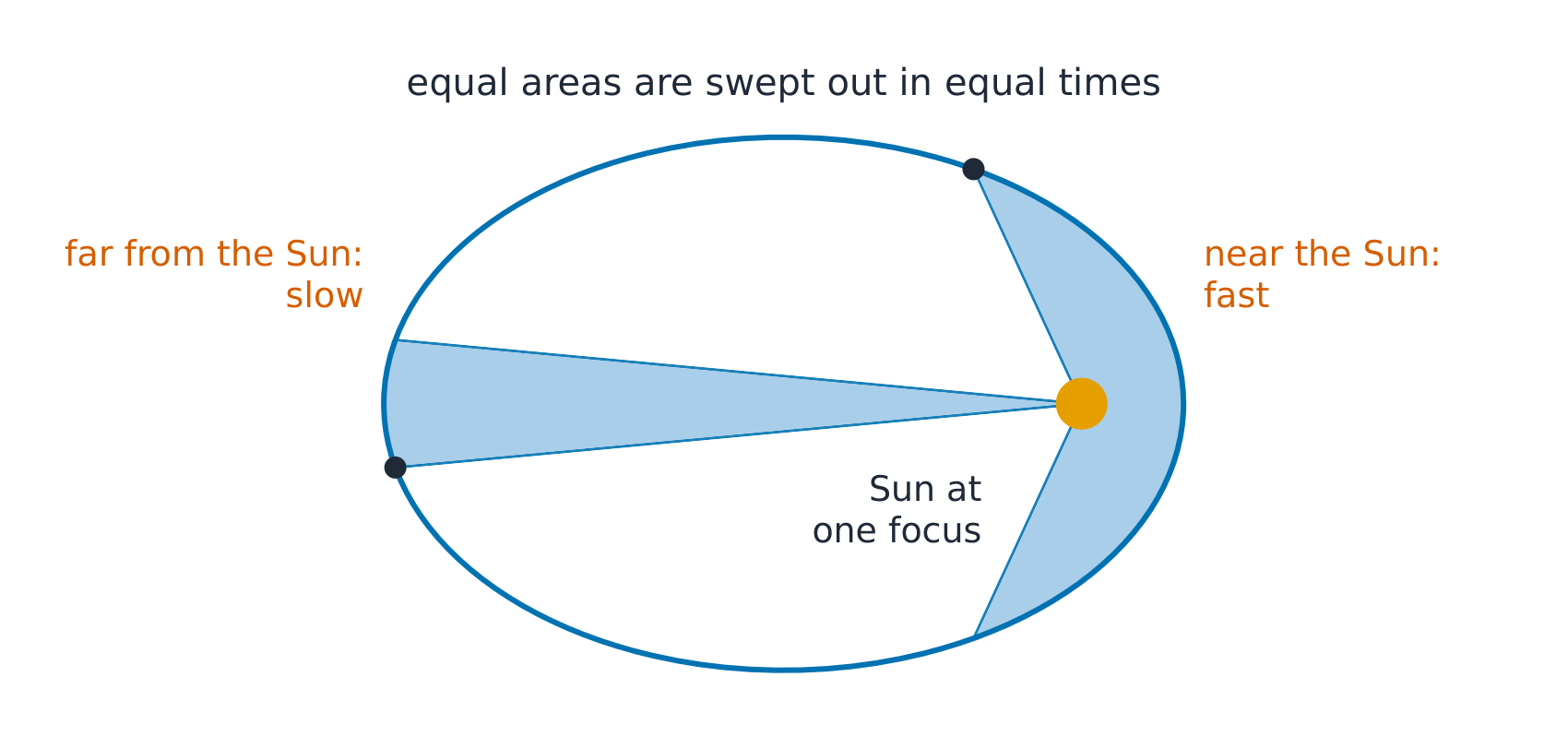
- In the Kepler approximation, a planet follows an ellipse with the Sun at a focus. The Sun–planet line sweeps equal areas in equal times, so motion is faster near the Sun and slower farther away. The diagram uses equal changes in mean anomaly to construct equal-time sectors; the longer near-Sun arc and shorter far-Sun arc enclose equal areas about the focus, rather than equal arc lengths.
- The third law compares T² with a³, where a is the ellipse's semi-major axis. For a circle, a equals its radius r; it is not an arbitrary instantaneous Sun–planet distance. When central mass is effectively the same, a model period ratio 1.88 gives a radius or semi-major-axis ratio 1.88^(2/3) ≈ 1.52. State the common central mass when comparing two orbits rather than applying the same proportionality constant to unrelated planetary systems.
Distinguish a mutual force from either body's acceleration
- Newton's point-mass law gives $F=\dfrac{Gm_1m_2}{r^2}$. The forces on the two masses have equal magnitude and opposite direction, but their accelerations differ because a = F/m. An invented 2 kg and 6 kg pair at fixed separation experiences equal attractions; the 2 kg object's acceleration is three times the 6 kg object's acceleration, rather than its force being three times larger.
- For the stated Earth mass and a Moon mass 7.35 × 10²² kg separated by 3.84 × 10⁸ m, the spherical-body model gives about 1.98 × 10²⁰ N on each body. These are third-law partners acting on different bodies. Do not add them to cancel the force on the Moon. Doubling separation quarters both magnitudes; doubling one body's mass doubles the mutual force while separation stays fixed.
Two isolated model masses 2 kg and 6 kg attract. Which comparison is correct?
Dificuldade 1/5 · Moedas 100 + pequeno bônus na primeira conclusão hoje
Third-law partners act on different bodies. Acceleration is F/m, so the smaller body has greater acceleration under the same force magnitude.
Choose a centre distance and justify the point-mass approximation
- Outside a spherically symmetric mass distribution, its field is equivalent to that of a point mass at its centre. A uniform sphere is one example, but density can vary with radius while retaining spherical symmetry. For arbitrary extended bodies far apart compared with their sizes, the point-mass model can be a good approximation; nearby irregular bodies need a distribution calculation.
- At height h above a spherical planet, centre distance is r = R + h. For a model orbit 400 km above Earth, r = 6.37 × 10⁶ + .400 × 10⁶ = 6.77 × 10⁶ m. Using 400,000 m alone in the inverse square formula would place the orbit inside Earth and enormously exaggerate its field. The exterior GM/r² relation does not describe the interior field of a general extended planet.
Define field strength independently of the small test mass
- Field strength is gravitational force per unit test mass, directed with the force: g = F/m. Outside the spherical source, its magnitude is GM/r². The units N/kg and m/s² are equivalent. A model 20 kg probe at a point with g = 8.0 N/kg has weight 160 N. Doubling that small probe's mass doubles its weight but leaves the source field at that point unchanged.
- For the stated Earth constants, surface g ≈ 9.81 N/kg and g at centre distance 6.77 × 10⁶ m is about 8.69 N/kg. Their ratio is (6.37/6.77)² ≈ .885, or 89%. This is substantial gravity, not a zero-gravity region. The negligible-test-mass assumption prevents the probe itself from significantly changing the source configuration or the field being measured.
For model Earth, G = 6.67 × 10⁻¹¹ N m²/kg², M = 5.97 × 10²⁴ kg, R = 6.37 × 10⁶ m. Find field magnitude at altitude 400 km.
Dificuldade 2/5 · Moedas 140 + pequeno bônus na primeira conclusão hoje
Convert h = 400 km = 4.00 × 10⁵ m, so r = R + h = 6.77 × 10⁶ m. Then g = GM/r² = (6.67 × 10⁻¹¹)(5.97 × 10²⁴)/(6.77 × 10⁶)² = 8.68806 N/kg ≈ 8.69 N/kg. Altitude alone is not the denominator distance.
An invented 20 kg small probe is where the source field is 8.0 N/kg. Find the gravitational force magnitude on it.
Dificuldade 2/5 · Moedas 140 + pequeno bônus na primeira conclusão hoje
F = mg = 20 × 8.0 = 160 N. Doubling small test mass doubles force, while the source field at that point remains 8.0 N/kg.
Use ratios with radius rather than height
- An inverse-square model with field 8.0 N/kg at r has field 2.0 N/kg at 2r and 8/9 ≈ .889 N/kg at 3r. If instead a spacecraft's altitude changes from R to 3R, its centre distance changes from 2R to 4R, so the field quarters. Tripling altitude does not automatically divide field by nine.
- Surface fields depend on both source mass and radius. For a model Mars with M = 6.42 × 10²³ kg and R = 3.39 × 10⁶ m, GM/R² ≈ 3.73 N/kg. An invented planet with twice Earth's mass but twice its radius has half Earth's surface field, because the numerator doubles and denominator quadruples. Name what is held fixed in a comparison before using a proportionality.
An invented spherical planet has twice Earth’s mass and twice its radius. Find its surface-field magnitude as a fraction of Earth’s.
Dificuldade 2/5 · Moedas 140 + pequeno bônus na primeira conclusão hoje
g = GM/R², so the ratio is 2/2² = 1/2. Changing radius and source mass must both be included.
In an invented exterior inverse-square model, altitude above a planet changes from R to 3R, where R is planet radius. Find new field magnitude divided by old.
Dificuldade 2/5 · Moedas 140 + pequeno bônus na primeira conclusão hoje
Centre radii are 2R and 4R. The ratio is (2R/4R)² = 1/4, not 1/9; tripling altitude does not triple centre radius.
Add gravitational fields with their directions
- Field strengths superpose as vectors. Between Earth and Moon their fields point oppositely towards their respective centres. At a cancellation point x from Earth, GM_E/x² = GM_M/(d − x)². Taking the positive square root gives x/(d − x) = √(M_E/M_M) ≈ 9.01, so x ≈ .900d ≈ 3.46 × 10⁸ m. The point is nearer the smaller attracting mass because it must be closer to produce the same field magnitude.
- The plotted logarithmic curves show positive magnitudes of two oppositely directed contributions, not their signed resultant. Their intersection marks cancellation only because the directions oppose between the bodies. On the far side of either body both contributions point towards the pair and add. This static two-source zero-field calculation is not a determination of the rotating Earth–Moon L1 point; orbital equilibrium requires the relevant acceleration as well.
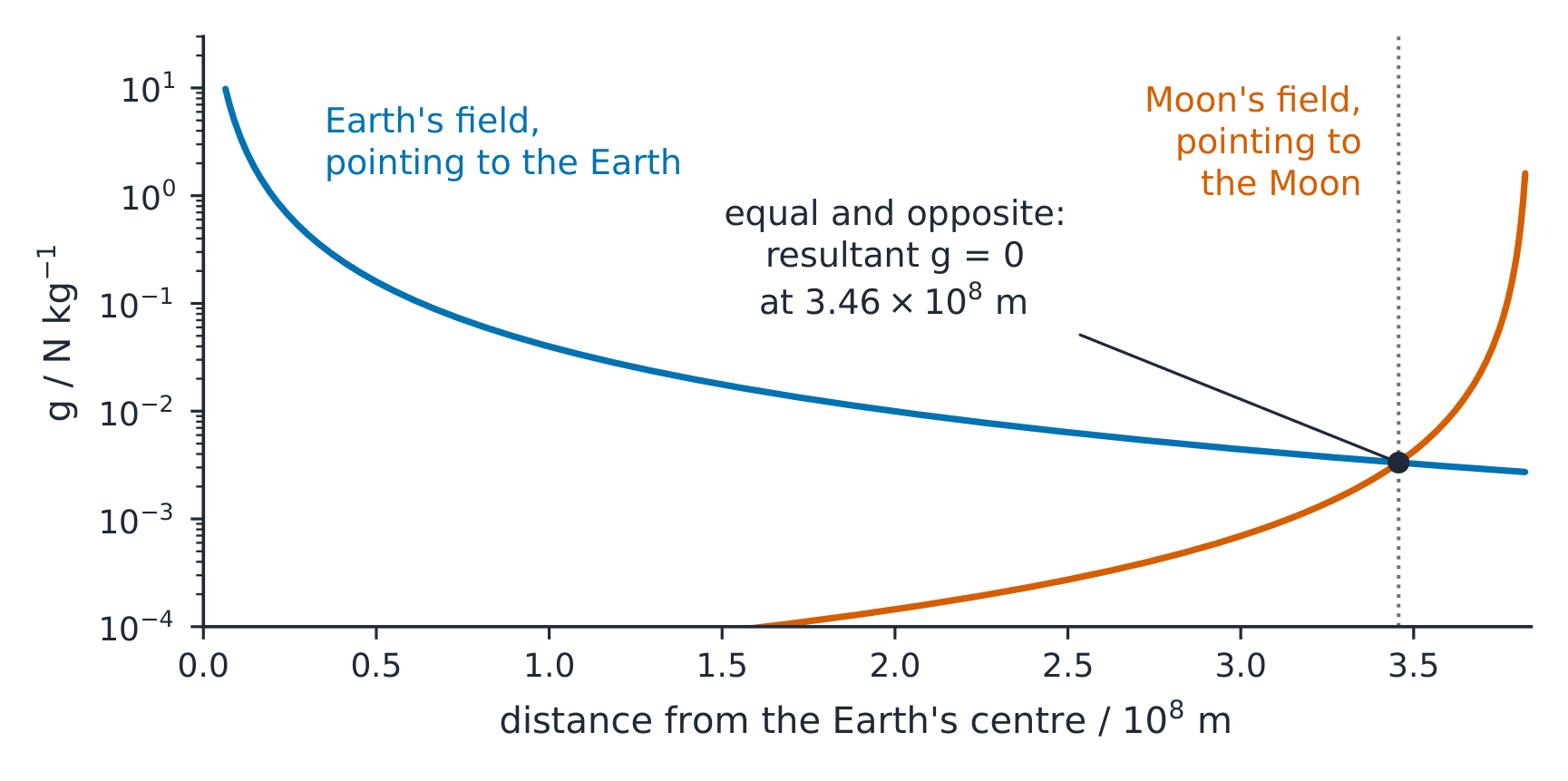
What does the intersection of the two positive Earth–Moon field-magnitude curves mean between their centres?
Dificuldade 1/5 · Moedas 100 + pequeno bônus na primeira conclusão hoje
Read directions separately from positive magnitudes. This static field calculation is not a rotating-frame orbital equilibrium calculation.
Read field lines as a vector model
- A field line is tangent to the force direction on a small test mass. Radial lines around an isolated spherical planet point inward and become less dense farther out. Close to a small patch of the surface, they are nearly parallel and evenly spaced, supporting a local uniform-field approximation. The diagram does not show literal cords pulling objects or a sequence of particle trajectories.
- Two field lines cannot cross at a point with a definite nonzero field because that would assign two force directions there. Line density is a drawing convention for relative strength; a fixed number of arrows on the page is not a direct numerical measurement of g. A locally uniform field can be useful for short drops while the full radial model is needed over distances comparable with the planet's radius.

Derive a circular-orbit period from the force requirement
- With gravity providing the resultant centripetal force, GMm/r² = 4π²mr/T². Cancelling the negligible satellite mass gives $T^2=\dfrac{4\pi^2}{GM}r^3$. There is no separate outward force balancing gravity in an inertial-frame force diagram. The resultant is inward precisely because the velocity direction changes.
- At model Earth radius r = 6.77 × 10⁶ m, T ≈ 5.55 × 10³ s, or about 92.4 min. Doubling circular-orbit radius around the same mass multiplies period by 2^(3/2) ≈ 2.83, rather than two or eight. Satellites of different masses at the same radius share this ideal period; a heavier satellite does not require a shorter period merely because its gravitational force is larger.
Around one fixed dominant mass, an invented circular orbital radius doubles. Find the period multiplication factor.
Dificuldade 2/5 · Moedas 140 + pequeno bônus na primeira conclusão hoje
T² ∝ r³ gives T₂/T₁ = 2^(3/2) ≈ 2.83. The same central mass and negligible satellite mass are part of the comparison.
State every geostationary condition
- A geostationary satellite remains above one equatorial longitude. In the ideal model it needs a circular equatorial orbit in the same direction as Earth rotates and a sidereal period about 86,164 s, or 23 h 56 min. A tilted, elliptical or retrograde orbit does not become geostationary merely by having approximately a one-day period. ESA's orbit guide describes these conditions.
- Using the rounded Earth constants, r = (GMT²/(4π²))^(1/3) ≈ 4.215 × 10⁷ m. Subtract Earth's radius to obtain altitude about 3.578 × 10⁷ m, or 35,800 km. A 24-hour solar day is a useful rough approximation, but label it as approximate if used. Radius and altitude are different requested answers; report which one a number represents.
Using G = 6.67 × 10⁻¹¹, Earth mass 5.97 × 10²⁴ kg, Earth radius 6.37 × 10⁶ m and period 86164 s, estimate geostationary altitude in km.
Dificuldade 2/5 · Moedas 140 + pequeno bônus na primeira conclusão hoje
From T² = 4π²r³/(GM), r = [GMT²/(4π²)]^(1/3) = [(6.67 × 10⁻¹¹)(5.97 × 10²⁴)(86164)²/(4π²)]^(1/3) = 4.214998 × 10⁷ m = 42149.98 km. Altitude is h = r − R = 42149.98 − 6370 = 35779.98 km, or 35800 km to three significant figures.
Which orbit can be geostationary in the ideal Earth model?
Dificuldade 1/5 · Moedas 100 + pequeno bônus na primeira conclusão hoje
Matching period is necessary but insufficient. The plane, circularity and direction must keep the satellite above the same equatorial longitude.
Explain apparent weightlessness and test an orbit model
- In an ideal orbit the spacecraft and freely floating occupants accelerate together, so a floor or scale does not support them as it does on the ground. Apparent weight is therefore small, although gravitational force remains. If gravity vanished, an unpowered spacecraft would no longer follow that circular orbit: it would initially continue along its tangent rather than stay fixed in space.
- Compare a model period or trajectory with observations using the stated centre radius and central mass. Distinguish a stable ideal circular path from slow drag-driven evolution. Measurement uncertainty, Earth's non-sphericity and other bodies' attractions limit a simple GM/r² calculation; disagreement calls for checking those conditions rather than introducing an invented outward force. Draw the force and velocity on the same sketch before choosing an equation.
An astronaut floats in an ideal circular-orbit spacecraft. What accounts for this?
Dificuldade 1/5 · Moedas 100 + pequeno bônus na primeira conclusão hoje
Gravity supplies inward acceleration. Small apparent weight refers to little support force; an invented outward balancing force would remove the required centripetal resultant.
Test the complete field and orbit account
- Identify the source and small test body, justify spherical or point-mass treatment, and turn altitude into centre radius. Use equal-and-opposite force partners on their separate bodies, field strength F/m and vector addition for multiple sources. Apply inverse-square ratios with the correct fixed quantities, and interpret a field diagram through direction and density rather than literal paths.
- Link Kepler's ellipse and equal-area statements to semi-major axis, then derive the circular period using gravity as the centripetal resultant. Check a period ratio, a surface-field comparison and a geostationary radius/altitude conversion independently. Explain why apparent weightlessness does not remove gravity, and state the model's assumptions alongside any numerical result.
AHL: distinguish potential from potential energy
- Choose zero potential and zero interaction energy at infinite separation. Outside one spherical source, V = −GM/r in J/kg and U = mV = −GMm/r in J. The negative sign describes a bound attractive configuration relative to infinity, not negative mass or an arbitrary instruction to subtract all energies. Moving outward increases both V and U because they become less negative.
- For the stated model Earth, surface V ≈ −6.25 × 10⁷ J/kg and a 1,000 kg mass has U ≈ −6.25 × 10¹⁰ J. Different test masses at that same point share V but have different U. For several sources, potentials add as scalars with the same zero convention, while fields add as vectors. Field cancellation between Earth and Moon therefore need not imply zero potential there.
AHL: assign work to the correct agent
- For a slow transfer with no kinetic-energy change, external work is Wext = ΔU = mΔV, whereas gravitational work is Wg = −ΔU. Lifting a model 1,000 kg mass from Earth's surface to 400 km gives ΔU = GMm(1/R − 1/r) ≈ 3.69 × 10⁹ J. Positive external work raises potential energy; gravity does negative work during this outward move.
- Using mgh with surface g would give about 3.93 × 10⁹ J, an overestimate because g falls with height. The small-height approximation comes from treating g as nearly constant, not from a different gravitational force law. A satellite placed at rest at this height has not yet been put in circular orbit: orbital kinetic energy must also be supplied. State whether endpoints are at rest or moving before identifying an energy requirement.
For model Earth G = 6.67 × 10⁻¹¹, M = 5.97 × 10²⁴ kg and R = 6.37 × 10⁶ m, slowly lift an invented 1000 kg mass from the surface to altitude 400 km. Find external work in GJ, neglecting losses and kinetic-energy change.
Dificuldade 2/5 · Moedas 140 + pequeno bônus na primeira conclusão hoje
The final centre radius is r = 6.37 × 10⁶ + 4.00 × 10⁵ = 6.77 × 10⁶ m. Wext = ΔU = GMm(1/R − 1/r) = (6.67 × 10⁻¹¹)(5.97 × 10²⁴)(1000)[1/(6.37 × 10⁶) − 1/(6.77 × 10⁶)] = 3.69345 × 10⁹ J = 3.69 GJ. Gravity does −3.69 GJ; placing the body at rest there is not circular orbit insertion.
AHL: read the signed field from a potential slope
- With outward r positive, the radial field component is gᵣ = −dV/dr. The exterior potential curve −GM/r rises outward, so dV/dr is positive and gᵣ is negative, meaning inward. Its magnitude equals the positive slope. At twice Earth's radius the model slope is about 2.45 J/(kg m), equivalent to 2.45 N/kg; it is not an outward gravitational field.
- A finite difference gives an interval average: between supplied potentials −6.251 × 10⁷ and −6.155 × 10⁷ J/kg separated outward by 100 km, ΔV/Δr = +9.6 N/kg and the mean radial component is −9.6 N/kg. A tangent gives a local derivative, whereas a chord over a large interval need not equal the field at either endpoint. Keep the sign convention and local-versus-average distinction explicit.
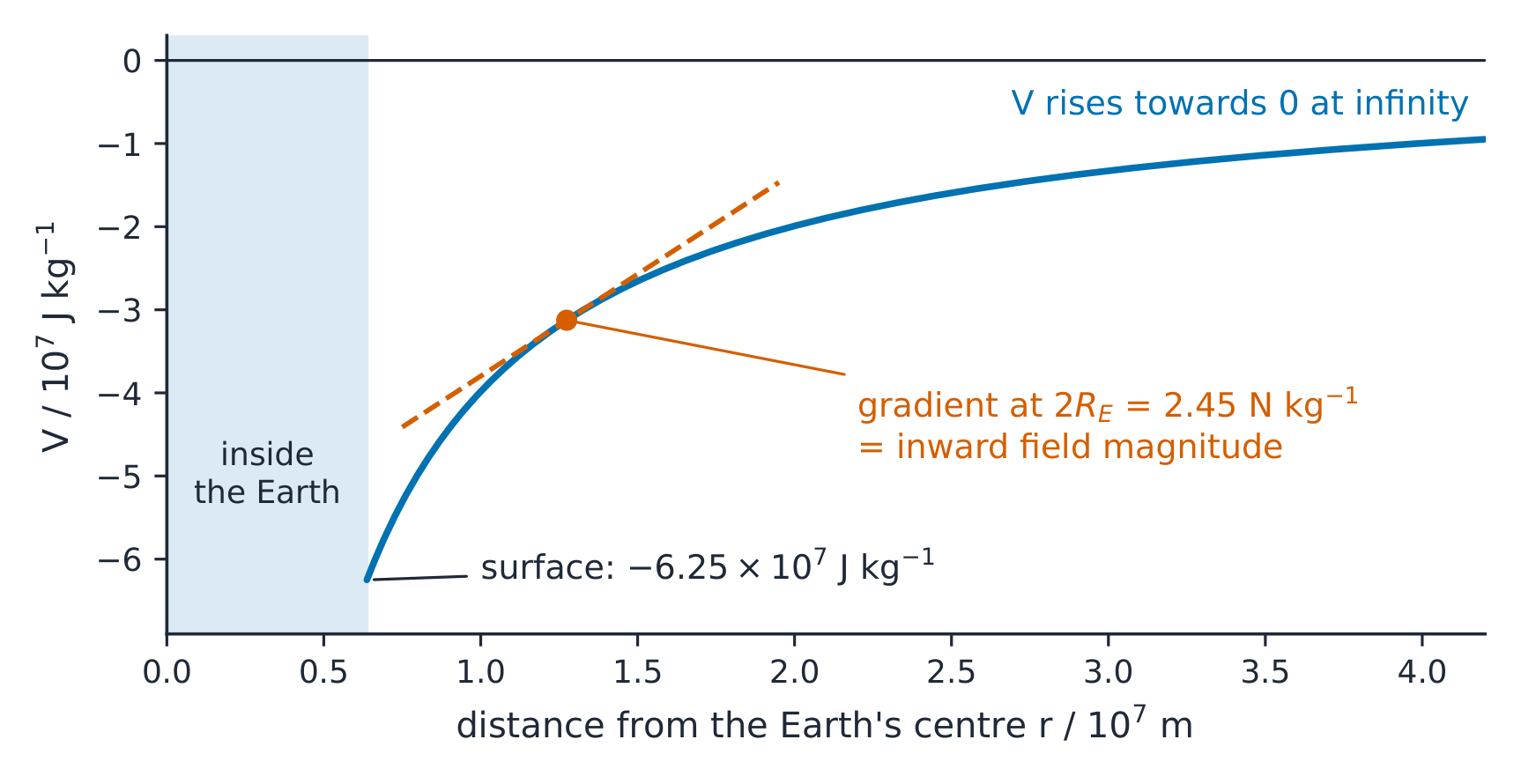
With outward r positive, potential rises from −6.251 × 10⁷ to −6.155 × 10⁷ J/kg over 100 km. Find average signed radial field component.
Dificuldade 2/5 · Moedas 140 + pequeno bônus na primeira conclusão hoje
Mean gᵣ = −ΔV/Δr = −(.096 × 10⁷)/100000 = −9.6 N/kg, directed inward. Its magnitude is +9.6 N/kg; a finite interval gives an average.
AHL: infer work and direction from equipotentials
- An equipotential joins points at the same V. Around an isolated spherical source these surfaces are concentric spheres, shown as circles in a section; near a small surface region they are approximately planes. Field lines meet them normally because a field component along an equipotential would do work while potential remained unchanged.
- Moving a mass along an equipotential changes gravitational potential energy by zero, so gravity does no work on that motion. An external motor could still change its kinetic energy; zero gravitational work is not a claim that no work by any agent is possible. Equal potential steps lie closer together where field magnitude is larger. In the figure V₀ is the positive magnitude of surface potential, so −.8V₀ lies outside the more negative surface −V₀.
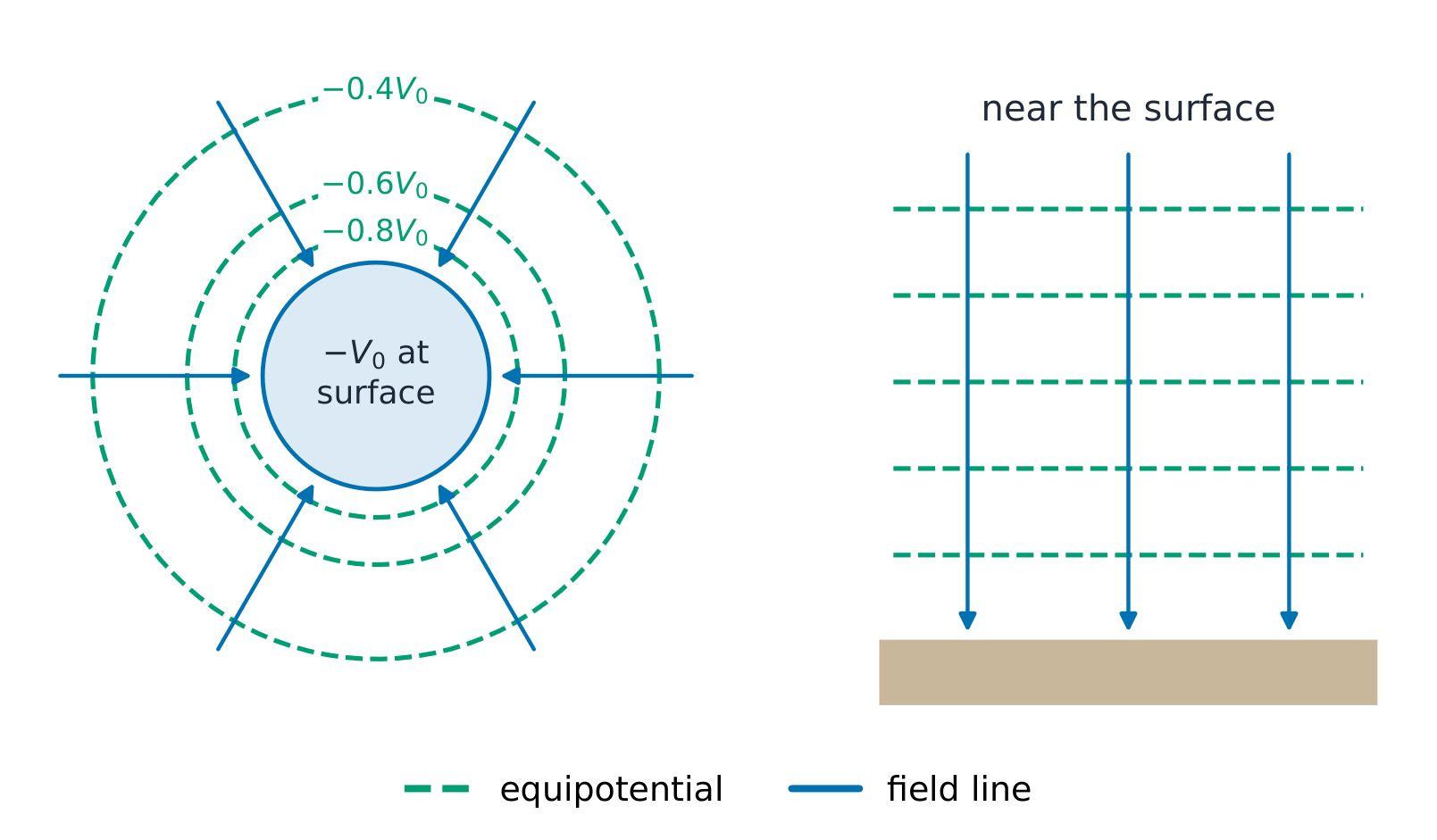
A mass moves along an equipotential while a motor speeds it up. Which statement is correct?
Dificuldade 1/5 · Moedas 100 + pequeno bônus na primeira conclusão hoje
ΔU = mΔV = 0 fixes gravitational work at zero, not total work by all forces. External work can change K without changing potential.
AHL: compare circular speed with escape speed
- Circular force balance gives v_circ = √(GM/r). An ideal escape threshold follows from ½mv² − GMm/r = 0, giving v_esc = √(2GM/r) = √2 v_circ at the same radius. For the model 400 km Earth orbit, circular speed is about 7.67 km/s, while the escape threshold there is about 10.85 km/s. Escape does not mean reaching a nearby radius where gravity suddenly becomes zero.
- For a spherical Moon with M = 7.35 × 10²² kg and R = 1.74 × 10⁶ m, Vsurface ≈ −2.82 × 10⁶ J/kg and v_esc ≈ 2.37 km/s. The ideal threshold is independent of small escaping mass, but a viable trajectory must avoid the body. Atmosphere, central rotation, thrust duration and other bodies are neglected; an inward launch into the surface is not a successful escape simply because its energy meets the threshold.
For a spherical Moon with M = 7.35 × 10²² kg and R = 1.74 × 10⁶ m, use G = 6.67 × 10⁻¹¹ to find ideal surface escape speed in km/s.
Dificuldade 2/5 · Moedas 140 + pequeno bônus na primeira conclusão hoje
v_esc = √(2GM/R) ≈ 2.37 km/s. The trajectory must avoid collision; atmosphere, rotation and other bodies are neglected.
AHL: balance the three energies of a circular satellite
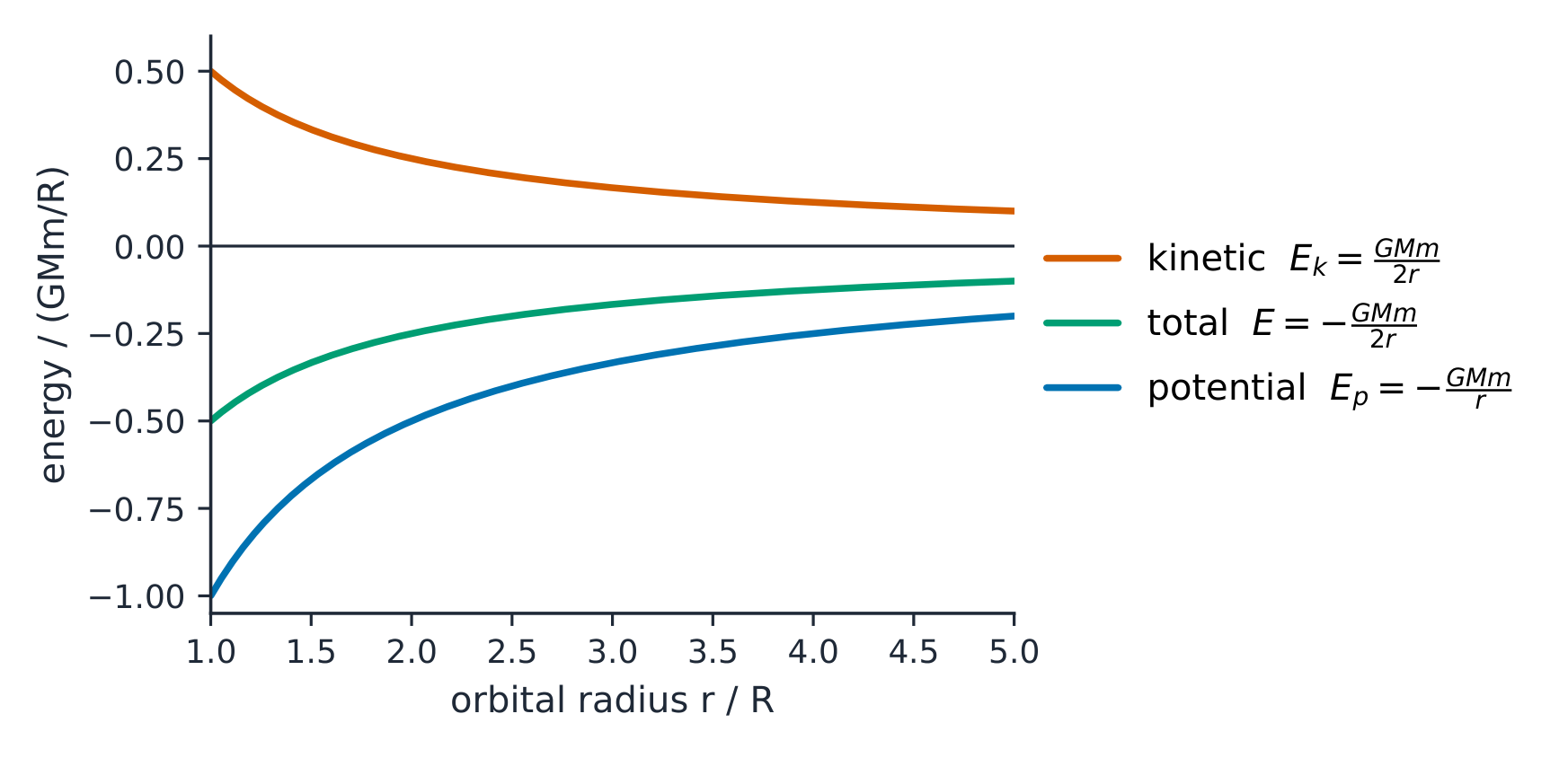
- For a small satellite in a circular orbit, K = GMm/(2r), U = −GMm/r and E = −GMm/(2r). Thus U = −2K and E = −K. The plotted energy scale divides by GMm/R, and the horizontal coordinate is r/R: at r = R, normalized K is +.5, U is −1 and E is −.5. Negative total energy indicates binding, while the positive kinetic energy remains entirely ordinary.
- For an invented 1,000 kg satellite with Earth constants, increasing circular radius from 7.0 × 10⁶ to 1.4 × 10⁷ m gives ΔK ≈ −1.42 × 10¹⁰ J, ΔU ≈ +2.84 × 10¹⁰ J and ΔE ≈ +1.42 × 10¹⁰ J. A higher circular orbit is slower yet has more total mechanical energy. The required satellite energy change is not the same as fuel energy: a real transfer has propulsion efficiency, exhaust and a non-circular transfer path to consider.
An invented 1000 kg satellite changes circular radius from 7.0 × 10⁶ to 1.4 × 10⁷ m around Earth. Use G = 6.67 × 10⁻¹¹ and M = 5.97 × 10²⁴ kg. Find total mechanical-energy increase in GJ.
Dificuldade 2/5 · Moedas 140 + pequeno bônus na primeira conclusão hoje
For a circular orbit E = −GMm/(2r). Hence ΔE = (GMm/2)(1/rᵢ − 1/rf) = [(6.67 × 10⁻¹¹)(5.97 × 10²⁴)(1000)/2][1/(7.0 × 10⁶) − 1/(1.4 × 10⁷)] = +1.42214 × 10¹⁰ J = +14.22 GJ. Since K = −E and U = 2E in each circular state, ΔK = −14.22 GJ and ΔU = +28.44 GJ. This energy difference is not total fuel consumption.
AHL: compare launch, orbit transfer and escape endpoints
- A model 1,000 kg payload initially at rest on a non-rotating Earth has E_i ≈ −6.25 × 10¹⁰ J. In the 400 km circular orbit its E_f ≈ −2.94 × 10¹⁰ J, so its minimum mechanical-energy increase is about 3.31 × 10¹⁰ J. Only about 3.69 × 10⁹ J is the potential-energy rise; most of the increase supplies orbital kinetic energy.
- From a 7.0 × 10⁶ m circular orbit, reaching infinity with zero final speed requires increasing E from about −2.84 × 10¹⁰ J to zero. It does not require supplying the full magnitude of U again because the satellite already has kinetic energy. At each step write K + U for both endpoints and state the zero convention. An escape speed, an added speed and an energy input are different requested quantities.
An invented 1000 kg payload starts at rest on a non-rotating Earth and enters a circular orbit at altitude 400 km. Use G = 6.67 × 10⁻¹¹, M = 5.97 × 10²⁴ kg and R = 6.37 × 10⁶ m. Find its ideal mechanical-energy increase in GJ.
Dificuldade 2/5 · Moedas 140 + pequeno bônus na primeira conclusão hoje
Final centre radius is r = R + h = 6.77 × 10⁶ m. Initially Eᵢ = −GMm/R = −62.5116 GJ because Kᵢ = 0. Finally Ef = −GMm/(2r) = −29.4091 GJ for a circular orbit. Thus ΔE = −29.4091 − (−62.5116) = +33.1025 GJ ≈ 33.10 GJ. The potential-energy increase alone is GMm(1/R − 1/r) = 3.69 GJ; the rest supplies orbital kinetic energy.
AHL: distinguish instantaneous drag from slow orbital decay
- Drag acts against a satellite's motion relative to the surrounding air and initially brakes it. Under weak drag, a sequence of nearly circular states can slowly move to smaller r. Across that sequence E becomes more negative, U decreases and K increases because K = −E for each ideal circular state. Gravity converts some lost potential energy into kinetic energy during the descent, while mechanical energy is dissipated through the satellite–atmosphere interaction.
- This is a gradual orbit-evolution statement, not an assertion that friction directly accelerates the satellite or that every stage of re-entry is circular. NASA's orbit-maintenance account describes atmosphere-driven descent and subsequent gravitational speeding up. State the weak-drag, near-circular approximation when using the energy ratios, and distinguish it from a brief braking impulse at one fixed position.
Explain how to calculate and test gravitational fields and circular orbits from a stated mass, radius and altitude.
A sound answer connects geometry and force to the calculated field or orbit, with its approximation stated.
How can lower-orbit speed increase during slow drag-driven decay while drag opposes motion?
Dificuldade 1/5 · Moedas 100 + pequeno bônus na primeira conclusão hoje
The circular energy relations compare slowly evolving states. They do not reverse drag’s direction or give an exact instantaneous account of a strong re-entry event.