Spectral shifts: a low-speed astronomical estimate
Introduzido| English | Significado |
|---|---|
| redshift/ˈredʃɪft/ | desvio para o vermelho |
| rest wavelength/rest ˈweɪvleŋθ/ | comprimento de onda em repouso |
What would explain this observation?
- A recognizable spectral line appears at a longer wavelength in a distant source. Its shift can provide evidence of recession along the line of sight.
Build the model
- Relative source-observer motion changes observed frequency or wavelength.
- For light at a relative speed much smaller than c, the magnitude of the fractional wavelength shift is approximately v/c.
- Recession corresponds to longer wavelength, and approach to shorter wavelength.
- redshift 红移: Shift of an identified line toward longer wavelength.
- rest wavelength 静止波长: Wavelength of the line measured with no relative source motion.

What does an identified line shifting to a longer wavelength suggest in the stated model?
Dificuldade 1/5 · Moedas 100 + pequeno bônus na primeira conclusão hoje
A known line found at a longer wavelength is redshifted, which in this model means the source is receding along the line of sight. The speed of light is constant, and a shifted line still has a nonzero frequency.
Match each technical term to its precise meaning.
Dificuldade 2/5 · Moedas 140 + pequeno bônus na primeira conclusão hoje
Use the definitions to distinguish related quantities and processes.
Choose evidence that can test it
- Compare a identified line with its laboratory rest wavelength.
- Use z = (observed−rest)/rest, then v approximately cz in the stated low-speed model.
- Do not apply this approximation without checking the regime or treating a cosmological redshift as a simple exact velocity.
In the lab: Use attributed spectra with calibration and line identification. Compare several lines for a consistent shift. State uncertainty and distinguish relative line-of-sight motion from an unmeasured transverse component.
Which two habits make the investigation or model in this case more defensible?
Dificuldade 2/5 · Moedas 140 + pequeno bônus na primeira conclusão hoje
Stating the conditions and assumptions lets others repeat the work exactly, and recording the supporting evidence lets them check the conclusion. Hiding disagreeing results removes the evidence that could challenge a wrong conclusion, and one measurement can never establish a wider claim.
Work from known quantities
- Known: a 500 nm rest line is observed at 501 nm. z = (501−500)/500 = 0.002.
- With c=3.0×10⁸ m/s, v approximately 6.0×10⁵ m/s away.
- The sound-source denominator formula is not the required SL light approximation.
Your turn: A 600 nm rest line is observed at 601.2 nm. Find z=(observed−rest)/rest.
Shift the wavelength, keep light speed fixed
A 500 nm rest line observed at 501 nm gives z = 0.002 and an approximate radial velocity of 600000 m/s away. Compare identified lines, approach, recession and zero shift.
A 600 nm rest line is observed at 601.2 nm. Find z=(observed−rest)/rest.
Dificuldade 2/5 · Moedas 140 + pequeno bônus na primeira conclusão hoje
The result is 0.002 . Known: rest 600 nm; observed 601.2 nm. Use z = (observed - rest)/rest. z = (601.2 - 600)/600 = 0.002. Positive z is a redshift; at low speeds v is approximately cz.
Check the conclusion and its limits
- The approximate shift relation does not show that light travels faster from an approaching source.
- A single unidentified line cannot safely establish a redshift.
Not true: An observed redshift means light speed increased. Light speed in vacuum is the same for all observers. Redshift is a change in observed wavelength from relative motion (or expanding space), not light travelling faster or slower.
- Relative source-observer motion changes observed frequency or wavelength.
- Compare a identified line with its laboratory rest wavelength.
- Watch for: the approximate shift relation does not show that light travels faster from an approaching source.
An observed redshift means light speed increased.
Dificuldade 1/5 · Moedas 100 + pequeno bônus na primeira conclusão hoje
Light speed in vacuum is the same for all observers. Redshift is a change in observed wavelength from relative motion (or expanding space), not light travelling faster or slower.
Shift of an identified line toward longer wavelength: write the technical term.
Dificuldade 1/5 · Moedas 100 + pequeno bônus na primeira conclusão hoje
redshift means Shift of an identified line toward longer wavelength.
Write from the data: find the redshift
- A 400 nm rest line is observed at 401.6 nm.
- Find z. Redshift does not mean the speed of light increased.
A 400 nm rest line is observed at 401.6 nm. What is z, and why does a redshift not mean the speed of light increased?
z = (λobs − λ₀)/λ₀ = (401.6 − 400)/400 = 1.6/400 = 0.004. The ratio is dimensionless; a longer wavelength does not change the vacuum light speed.
A spectral line has rest wavelength 400 nm and observed wavelength 401.6 nm. What is its redshift z?
Dificuldade 1/5 · Moedas 100 + pequeno bônus na primeira conclusão hoje
First find Δλ = 401.6 − 400 = 1.6 nm. Then z = Δλ/λ₀ = 1.6/400 = 0.004. Other options — 0.002 (the lesson shift from 600 nm to 601.2 nm); 1.6 nm (the wavelength change).
Distinguish emitted frequency from the frequency received
- A steady siren does not need to change its own oscillation frequency for a passing listener to hear a change of pitch. Source motion changes the separation of emitted sound wavefronts in the medium; observer motion changes the rate of meeting them. In a uniform stationary medium, the sound speed is set by that medium, rather than being added to the source speed.
- The light examples below use invented spectra and a low-speed Doppler model, with c = 3.00 × 10⁸ m/s. Electromagnetic waves need no material medium, and light in vacuum has the same speed c for inertial observers. Do not insert c into a classical sound-source equation to obtain a general light relation. The observed shift changes frequency and wavelength consistently with c = fλ, rather than changing light speed.
Read a moving-source wavefront diagram
- Each circular sound wavefront is centred on the source position when that front was emitted. A source moving right advances between emissions, so its successive circles have different centres. Ahead of a subsonic source, fronts are crowded: the wavelength in the medium is shorter and a stationary observer receives crests more frequently. Behind it the spacing is larger and the received frequency is lower.
- The dots marking old source positions are not stationary wave sources continuing to emit. Nor does the faster-looking sequence ahead mean each wavefront travels faster. Distinguish the moving source from the independently expanding fronts, and identify the observer's position before assigning approach or recession. These diagrams represent ideal mechanical-wave geometry, rather than a relativistically complete drawing of light from a fast source.
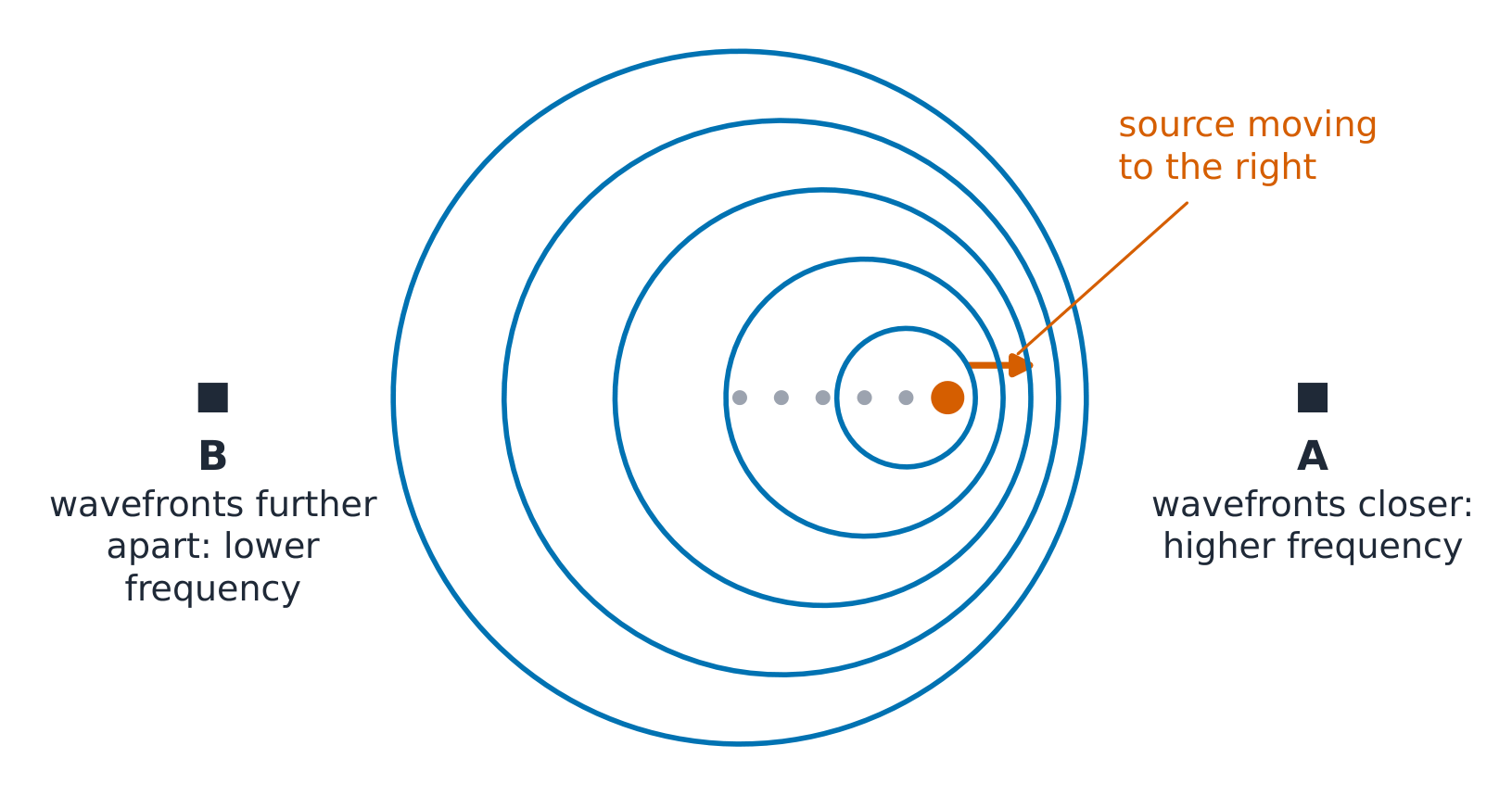
A subsonic sound source moves through stationary uniform air. Which statement explains a higher frequency received by a stationary observer ahead?
Dificuldade 1/5 · Moedas 100 + pequeno bônus na primeira conclusão hoje
Use front spacing and the medium wave speed separately. Source motion advances each emission point, giving shorter spacing ahead without changing the propagation speed.
Read a passing-source graph with the right horizontal variable
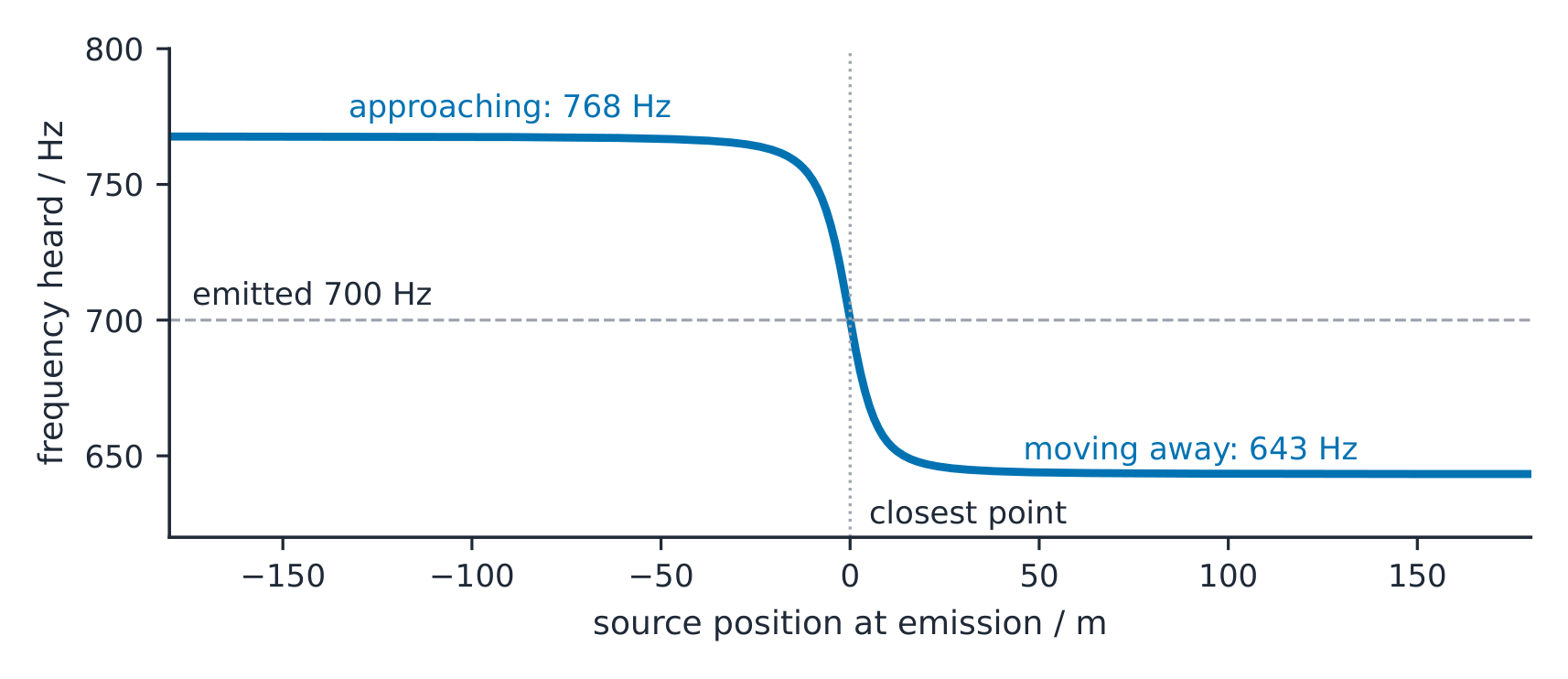
- In the invented model a 700 Hz source moves along a straight road at 30 m/s, with a listener 8 m to one side and sound speed 340 m/s. Far along the approaching part of the road the received frequency is about 768 Hz; far along the receding part it is about 643 Hz. Around passage it falls rapidly but continuously because the line-of-sight component changes continuously at this finite offset.
- The horizontal axis gives the source position when the received sound was emitted. Zero is its closest emission point. That sound reaches the observer after a travel time, so do not label this horizontal coordinate as the time when the listener is physically alongside the source. Frequency variation and loudness variation are separate observations; neither is evidence that the sound speed changed. Use recordings or models, rather than demonstrating near moving traffic.
Define signed redshift from a securely identified line
- Write λ₀ for the laboratory rest wavelength and λobs for the observed wavelength. Redshift is $z=\dfrac{\lambda_{\rm obs}-\lambda_0}{\lambda_0}$. Positive z means the line is at longer wavelength; negative z means shorter wavelength, called blueshift. Redshift can describe a line outside the visible region too: it does not mean the whole source must look red to the eye.
- An invented 500.0 nm line observed at 501.0 nm has shift +1.0 nm and z = +.0020. The ratio is dimensionless because both wavelengths use the same unit. The denominator is the rest value, rather than the observed value or the wavelength change. Convert units if they differ, but there is no need to convert both nanometre measurements to metres before taking their ratio.
An invented identified 500.0 nm rest line is observed at 499.5 nm. Find signed redshift z.
Dificuldade 2/5 · Moedas 140 + pequeno bônus na primeira conclusão hoje
z = (499.5 − 500.0)/500.0 = −.0010. A blueshift is a negative signed wavelength ratio, not a negative light speed.
Estimate radial velocity and state its direction
- In the low-speed Doppler model, signed radial velocity is approximately vᵣ = cz, positive for recession. The preceding z = +.0020 gives vᵣ ≈ +600,000 m/s, or 600 km/s away. Its speed-to-light-speed ratio is .0020, consistent with the assumed small ratio. A negative answer describes approach, rather than an impossible negative speed.
- For a 656.3 nm rest line observed at 659.0 nm, z = 2.7/656.3 ≈ .004114 and vᵣ ≈ 1.234 × 10⁶ m/s, about 1.2 × 10⁶ m/s away at two significant figures. Keep unrounded intermediate values. Report this as radial velocity in the stated model, rather than the total three-dimensional velocity or an exact relativistic measurement.
An invented 656.3 nm rest line is observed at 659.0 nm. Use c = 3.00 × 10⁸ m/s and the low-speed Doppler model. Find signed radial velocity in km/s.
Dificuldade 2/5 · Moedas 140 + pequeno bônus na primeira conclusão hoje
Δλ = 659.0 − 656.3 = 2.7 nm. Then z = 2.7/656.3 ≈ 0.004114 and vᵣ ≈ cz = 3.00 × 10⁸ × (2.7/656.3) = 1.23419 × 10⁶ m/s = 1234.19 km/s away. Use the rest denominator and report the radial component rather than full space velocity.
Keep wavelength and frequency shifts consistent
- Since c = fλ, longer observed wavelength corresponds to lower observed frequency. For small shifts, Δf/f₀ ≈ −Δλ/λ₀: signed changes have opposite signs. Their fractional magnitudes are approximately equal only when the shift is small. The exact frequency ratio follows from fobs/f₀ = λ₀/λobs, even before choosing a velocity model.
- An invented 100 MHz transmission from a source receding radially at 7.5 km/s has a first-order frequency decrease of 100 × 10⁶ × 7,500/(3.00 × 10⁸) = 2,500 Hz. The predicted received frequency is approximately 99.9975 MHz. Do not add the shift for recession or confuse a 2.5 kHz change with a received frequency of only 2.5 kHz. A reflected radar signal involves two interactions; it is not the same as this one-way transmission.
An invented source recedes radially at 7.5 km/s and transmits at 100 MHz. Use c = 3.00 × 10⁸ m/s in the first-order light model. Find the magnitude of the received frequency decrease.
Dificuldade 2/5 · Moedas 140 + pequeno bônus na primeira conclusão hoje
|Δf| ≈ f₀|vᵣ|/c = 100 × 10⁶ × 7500/(3.00 × 10⁸) = 2500 Hz. The received frequency is approximately 99.9975 MHz, not 2500 Hz.
Work a blueshift without losing the sign or units
- In an invented example a star approaches radially at 30 km/s. This is vᵣ = −30,000 m/s and z ≈ −.000100. A 589.0 nm rest line is therefore observed at about 589.0 × (1 − .000100) = 588.9411 nm, or 588.94 nm at the chosen reporting precision. The decrease is .0589 nm; it is not a 58.9 nm decrease caused by overlooking the kilometre conversion.
- More generally, a measured wavelength below rest gives an approaching radial component in this model. A zero first-order shift only constrains that radial component: transverse motion can still exist. At relativistic speeds even purely transverse light motion can contribute a shift through time dilation, so the statement that perpendicular motion can never give any Doppler shift is too broad.
An invented star approaches radially at 30 km/s. For a 589.0 nm rest line and c = 3.00 × 10⁸ m/s, estimate observed wavelength to five significant figures.
Dificuldade 2/5 · Moedas 140 + pequeno bônus na primeira conclusão hoje
z ≈ −.000100, so λobs ≈ 589.0(1 − .000100) = 588.9411 nm. Approach shortens wavelength and raises frequency at unchanged c. Report 588.94 nm; retain enough digits to show the small shift.
A source has zero first-order light Doppler shift along our line of sight. What can be concluded?
Dificuldade 1/5 · Moedas 100 + pequeno bônus na primeira conclusão hoje
The first-order radial approximation does not determine full velocity. Transverse relativistic effects are beyond that approximation, so a zero first-order result is not a universal no-motion result.
Test several lines for one fractional shift
- Identify a line pattern before calculating velocity. In the illustrative spectra the dark features shift together by a common fraction of their rest wavelengths; the white dotted lines retain the rest positions. The shifts are exaggerated for visibility and the drawn pattern is a teaching comparison, not an observation of a named star or galaxy. Equal fractional changes do not mean equal changes in nanometres.
- Invented rest lines at 500.0 and 600.0 nm observed at 500.5 and 600.6 nm each give z = .0010, supporting a common shift. If both instead changed by +.5 nm, the fractional shifts would be .0010 and .000833, which disagree unless explained by measurement uncertainty or another effect. A single unidentified feature near 600 nm cannot give a unique velocity because its rest wavelength is unknown.
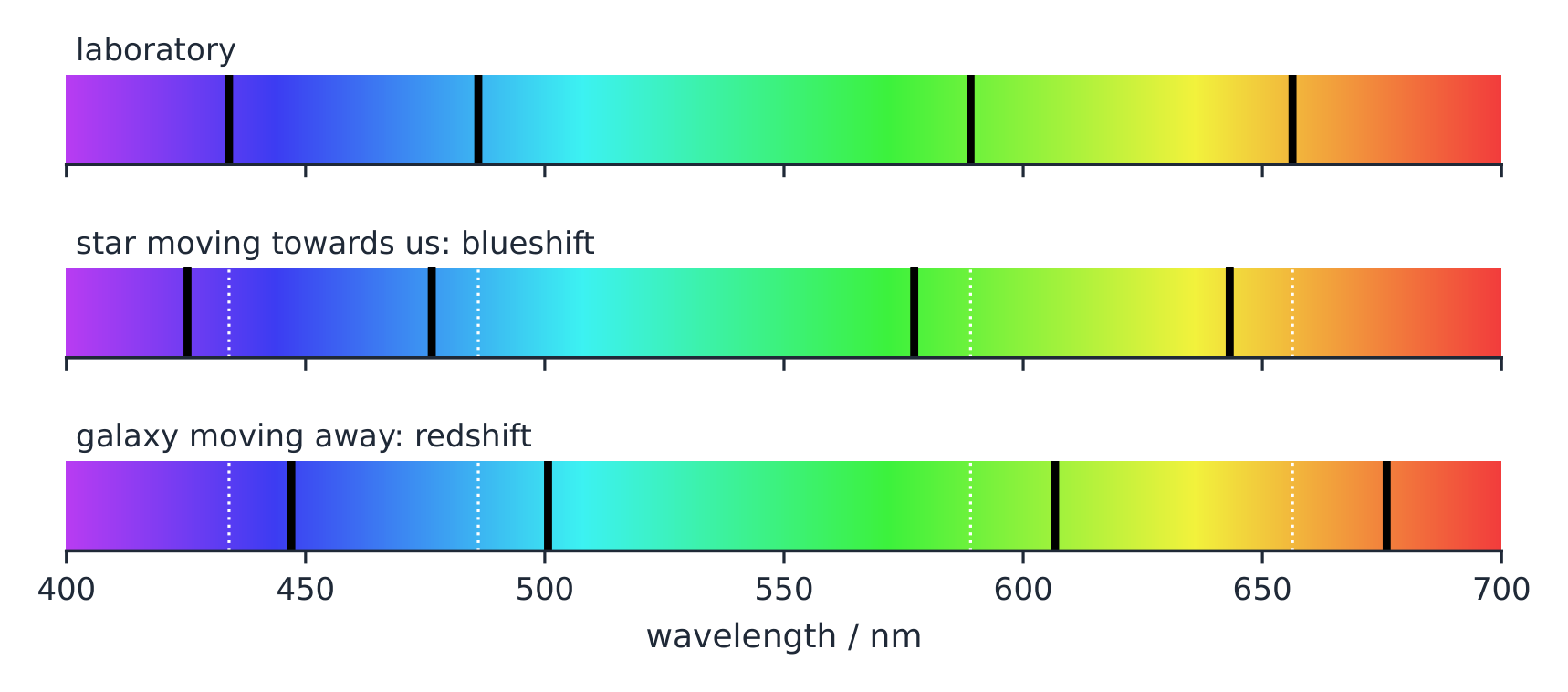
Which invented pair supports a single fractional wavelength shift?
Dificuldade 1/5 · Moedas 100 + pequeno bônus na primeira conclusão hoje
The first pair gives z = .0010 for each line. Equal absolute shifts are not generally equal fractional shifts; line identification and wavelength calibration remain necessary.
Quantify uncertainty and check the wavelength scale
- For an invented rest line at 500.0 nm, suppose the measured shift is +.20 ± .02 nm. Treat rest wavelength and c as exact in this exercise. Then z = .000400 ± .000040 and vᵣ ≈ 120,000 ± 12,000 m/s, or 120 ± 12 km/s. The shift has 10% relative uncertainty, which transfers to the model velocity. Dividing .02 by the full observed wavelength and calling that the relative velocity uncertainty would use the wrong measured quantity.
- In a real spectrum, uncertainty can also enter through line identification, calibration, blends, broadening and the laboratory value. Measure several isolated lines and compare residuals against their uncertainties. An incorrect wavelength zero point can imitate a small shift. Record the reference frame used: the observer's own motion can contribute to the measured radial velocity. Repeated measurements should test a claim rather than simply duplicate a chosen answer.
An invented 500.0 nm rest line has measured shift +.20 ± .02 nm. Treat rest wavelength and c = 3.00 × 10⁸ m/s as exact. Find the absolute uncertainty in radial velocity in km/s.
Dificuldade 2/5 · Moedas 140 + pequeno bônus na primeira conclusão hoje
δv = c δλ/λ₀ = 3.00 × 10⁸ × .02/500 = 12000 m/s = 12 km/s. Velocity is 120 ± 12 km/s, retaining the 10% shift uncertainty.
Interpret rotation and orbital patterns as projected motion
- Opposite sides of a rotating galaxy can have opposite radial rotational components relative to its mean shift. Both sides may still be redshifted overall if the galaxy's mean recession dominates. In an invented example, opposite sides at +210 and +150 km/s relative to the observer have mean +180 km/s and projected rotation components ±30 km/s, not rotation speed 180 km/s.
- Inclination is needed to turn a projected rotation component into a full rotation speed; face-on rotation gives little such radial signal. An unresolved rotating star may show broadened lines rather than two resolved sides. Repeating stellar line shifts can support an orbital model, as described in NASA's spectroscopy account, but their interpretation also needs a reference frame, sampling and a model rather than one isolated spectrum.
In an invented rotating system, opposite sides have radial velocities +210 and +150 km/s relative to the observer. Find the magnitude of the projected rotational component about their mean.
Dificuldade 2/5 · Moedas 140 + pequeno bônus na primeira conclusão hoje
Their mean is +180 km/s. The deviations are ±30 km/s, so projected rotation speed is 30 km/s. Inclination is needed for full rotation speed; both observed sides can remain redshifted.
Separate a measured redshift from its physical explanation
- z describes a wavelength ratio; the equation vᵣ ≈ cz adds a low-speed Doppler interpretation. If a rest line at 500 nm is observed at 750 nm, z = .50 is a valid measured ratio, but inserting it into the small-speed equation does not establish an exact speed .50c. Use the appropriate relativistic or cosmological model when the regime requires it.
- Large-scale galaxy redshift also reflects the expansion of space during light travel, while local source motion can contribute. NASA distinguishes this cosmological explanation from local Doppler motion. A redshift alone is therefore not proof of one unique cause or a measurement of a source's full velocity through space. State the adopted model and its limits beside a numerical result.
An identified rest line at 500 nm is observed at 750 nm. What follows?
Dificuldade 1/5 · Moedas 100 + pequeno bônus na primeira conclusão hoje
The wavelength ratio is valid but the small-speed assumption is not. A velocity interpretation needs the appropriate relativistic or cosmological model, and c stays fixed in vacuum.
Which statement correctly limits a galaxy-redshift interpretation?
Dificuldade 1/5 · Moedas 100 + pequeno bônus na primeira conclusão hoje
A spectral ratio is an observation; interpreting its cause requires a model. NASA distinguishes cosmological stretching from local Doppler motion, and neither gives transverse velocity from one radial shift.
Test the complete light-shift explanation
- Start with a securely identified rest pattern, compute signed z using the rest denominator, and check more than one line. In the small-speed Doppler model obtain vᵣ ≈ cz, convert units and interpret sign. Compare the inferred ratio with the approximation's regime and propagate the stated measurement uncertainty. Check the reciprocal relation between frequency and wavelength rather than giving them shifts of the same sign.
- Explain what remains unmeasured: transverse velocity, inclination or a different redshift contribution can prevent a unique three-dimensional interpretation. Describe wavefront spacing for a sound source without changing sound speed, and distinguish emission geometry from reception timing in the passing-source model. Write an account from evidence to model to result before looking at the answer.
Explain how to infer and test a low-speed radial velocity from a spectrum, including direction, uncertainty and model limits.
Connect the identified observation to an explicit physical model before interpreting the calculated value.