English literary extract and oral development
Introduzido| English | Significado |
|---|---|
| literary extract/ˈlɪtərəri ˈekstrækt/ | A short passage taken from a longer literary work. |
| imagery/ˈɪmɪdʒri/ | Descriptive language that creates sensory impressions in the reader's mind. |
| metaphor/ˈmetəfɔː/ | metaphor |
"Show me the glint of light", 1886
- In 1886 Anton Chekhov advised his brother on writing: do not simply say the moon is shining; show its light glinting on a piece of broken glass. Readers believe what they can see.
- Writers rarely name feelings. At HL, your individual oral is based on a literary extract 文学选段, and you must explain how it shows feeling and meaning without stating them.
Showing, not telling
- Telling states a feeling: "Ana was nervous." Showing gives the evidence: "Ana folded and unfolded the ticket until it tore."
- Look for actions, dialogue, setting and objects that carry emotion. Then name the feeling yourself and explain the clue.
Classify each sentence.
Dificuldade 2/5 · Moedas 140 + pequeno bônus na primeira conclusão hoje
Showing gives evidence for the reader to interpret.
"Her hands shook as she opened the letter, and she read the first line three times." What feeling is shown?
Dificuldade 1/5 · Moedas 100 + pequeno bônus na primeira conclusão hoje
Shaking hands and rereading suggest worry about the letter's news.
Dialogue and contradiction
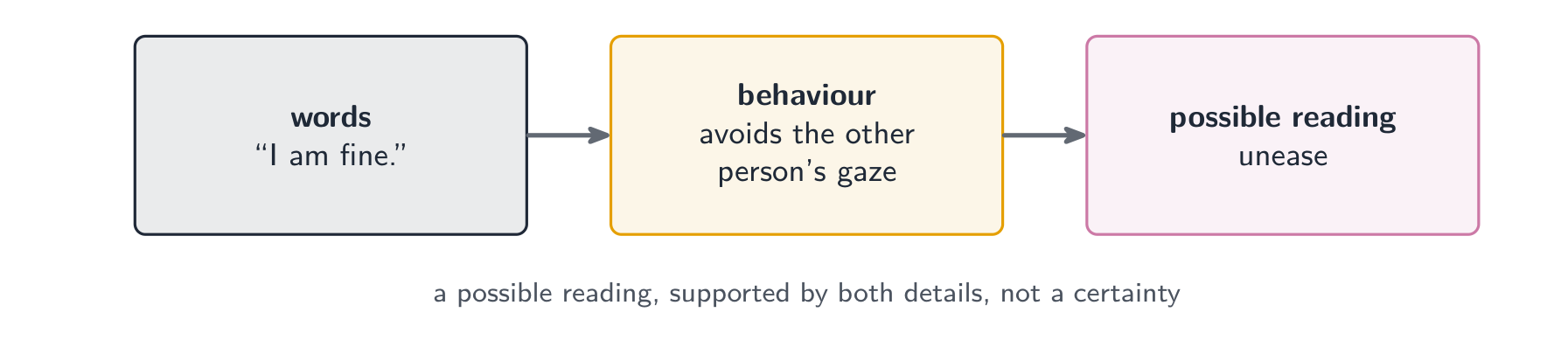
- Characters often say one thing and show another. "I am fine," said while avoiding someone's eyes, suggests the opposite.
- The gap between words and actions is where much of a story's meaning lies. Point to both and explain the effect.
"I am really happy for you," he said, looking at the floor. What does the contrast suggest?
Dificuldade 1/5 · Moedas 100 + pequeno bônus na primeira conclusão hoje
Avoiding eye contact contradicts his words.
Worked example: reading an extract
Extract: "'It doesn't matter,' Grandpa said. He turned back to the window and kept rubbing the same spot on the glass long after it was clean." What does the extract suggest?
- Words: "It doesn't matter" claims indifference.
- Actions: turning away avoids eye contact; rubbing an already-clean spot is a repeated, pointless action that suggests distraction or hidden pain.
- Interpretation: it does matter to him — he is hurt or sad but hides it. The contrast between speech and action shows his feeling more strongly than naming it would.
In the worked example, Grandpa's actions support his claim that "it doesn't matter".
Dificuldade 1/5 · Moedas 100 + pequeno bônus na primeira conclusão hoje
Turning away and rubbing a clean spot suggest it matters a great deal.
Literary features
- Imagery 意象 appeals to the senses; a metaphor 隐喻 compares without "like" or "as"; repetition stresses an idea; short sentences can build tension.
- Do not just name a feature: explain what it shows and how it affects the reader.
Match each example to the literary feature.
Dificuldade 2/5 · Moedas 140 + pequeno bônus na primeira conclusão hoje
Name the feature, then explain its effect.
Building the oral
- Structure: a short context for the extract, two or three points about how it creates meaning, each supported by a brief quotation, then a link to the work as a whole and a theme.
- Speak, do not read. Notes with key words and quotations help you sound natural and keep to time.
Put the parts of the oral in order.
Dificuldade 3/5 · Moedas 200 + pequeno bônus na primeira conclusão hoje
Context, analysis, then the wider link.
Naming a literary device is not analysis. "There is a metaphor in line 4" earns little. Say what the metaphor compares, what it suggests about the character or situation, and how the reader feels — that is analysis.
"There is a simile in line 3" is a complete analysis.
Dificuldade 1/5 · Moedas 100 + pequeno bônus na primeira conclusão hoje
Analysis explains what the simile shows and its effect.
Writers show feelings through actions, dialogue, setting and objects. Look for gaps between what characters say and what they do, name the implied feeling, and explain each clue and its effect. In the oral, support each point with a short quotation and link it to the whole work.
Extract: "Mother set the table for four, as she always did, then stood looking at the empty chair." Explain what is implied and how.
Feeling, evidence, explanation.