Spanish routine, time and purposeful messages
Introduzido| English | Significado |
|---|---|
| a las | às |
| reflexive verbs | verbs used with a pronoun such as me or se for actions people do to themselves, like levantarse |
| message/ˈmesɪdʒ/ | A short note left for someone who is away. |
| biblioteca | biblioteca |
Lunch at two, dinner at ten
- In 1940 Spain moved its clocks one hour forward to match Germany, and it has used Central European Time ever since — although it lies west of London. The sun rises and sets late, so Spaniards often eat lunch around 14:00 and dinner around 21:00 or later.
- Telling the time and describing your routine is how you share a day with someone — and how you notice that a "normal" day differs between cultures.
Spain has used Central European Time since 1940, even though it lies west of London.
Dificuldade 1/5 · Moedas 100 + pequeno bônus na primeira conclusão hoje
That is one reason meals are late by the clock.
Telling the time
- ¿Qué hora es? — "What time is it?" Es la una. (1:00) Son las cuatro. (4:00) Son las cuatro y media. (4:30) Son las cinco menos cuarto. (4:45)
- At a time: a las ocho — "at eight o'clock". Days have no capital letter: el lunes, el jueves.
Match each time to Spanish.
Dificuldade 2/5 · Moedas 140 + pequeno bônus na primeira conclusão hoje
Es for one o'clock; son for the rest.
Daily routine
- Reflexive verbs 反身动词 describe things you do to yourself: me levanto (I get up), me ducho (I shower), me acuesto (I go to bed).
- Present tense of regular verbs: estudio, como, vivo (I study, eat, live). Link actions with primero, luego, después, por la tarde.
How do you say "I get up at seven"?
Dificuldade 1/5 · Moedas 100 + pequeno bônus na primeira conclusão hoje
Reflexive verb with me, and a las for "at".
Put this routine in order.
Dificuldade 3/5 · Moedas 200 + pequeno bônus na primeira conclusão hoje
Sequence words organise the routine.
A message the reader can use
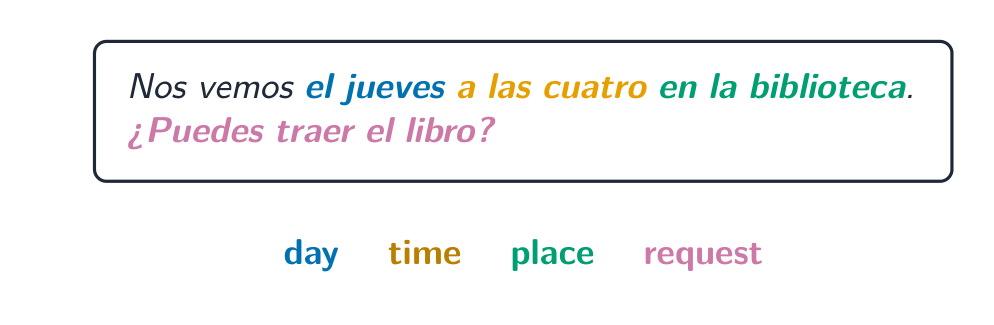
- A useful message 留言 tells the reader the day, the time, the place and what you want.
- El jueves a las cuatro en la biblioteca. ¿Puedes traer el libro? — everything the reader needs to act.
What should a useful message include?
Dificuldade 2/5 · Moedas 140 + pequeno bônus na primeira conclusão hoje
Also the request.
Worked example: writing a note to a friend
Task: write a short message to your friend Lucía to arrange to study together.
- Greeting and purpose: ¡Hola, Lucía! ¿Quieres estudiar conmigo para el examen?
- Day, time, place: El sábado a las diez y media en la biblioteca del centro.
- Request and closing: ¿Puedes traer tus apuntes de historia? ¡Hasta el sábado! Wei — the text type (an informal message) uses tú forms, a greeting and a short sign-off.
Which form suits a message to a friend?
Dificuldade 1/5 · Moedas 100 + pequeno bônus na primeira conclusão hoje
Informal tú forms suit a friend.
Comparing routines
- Compare your routine with a Spanish one: En China comemos a las doce, pero en España comen a las dos.
- Use pero (but) and también (also) to compare.
Do not write Es las cuatro. Use es only for one o'clock (es la una); every other hour is plural: son las cuatro. And reflexive verbs need their pronoun: me levanto, not levanto.
Es las cuatro is correct for 4:00.
Dificuldade 1/5 · Moedas 100 + pequeno bônus na primeira conclusão hoje
Use son las cuatro.
Tell the time with es la una and son las …, and a las … for "at". Describe routine with reflexive verbs and sequence words. A useful message gives day, time, place and request in the right register.
Write a short message in Spanish inviting a friend to the cinema, with day, time, place and a request.
Day, time, place, request.