A global issue across literary and non-literary work
Introduzido| English | Significado |
|---|---|
| global issue/ˈɡləʊbl ˈɪʃuː/ | An issue affecting people or environments across national boundaries and requiring attention at an international scale. |
A style guide drops a label, 2013
- In April 2013 the Associated Press, whose stylebook guides thousands of newsrooms, told journalists to stop using "illegal immigrant". Labels, it said, should describe actions — "living in the country illegally" — not people.
- One word in a style guide changed how millions of news readers saw a group. How language labels people is a global issue 全球性议题 you can trace across literary and non-literary texts.
What did the AP Stylebook change in 2013?
Dificuldade 1/5 · Moedas 100 + pequeno bônus na primeira conclusão hoje
Labels should describe actions, not people.
Narrowing the issue
- The individual oral (15 minutes: 10 of analysis and 5 of questions) examines one global issue through an extract from a literary work and an extract from a non-literary body of work.
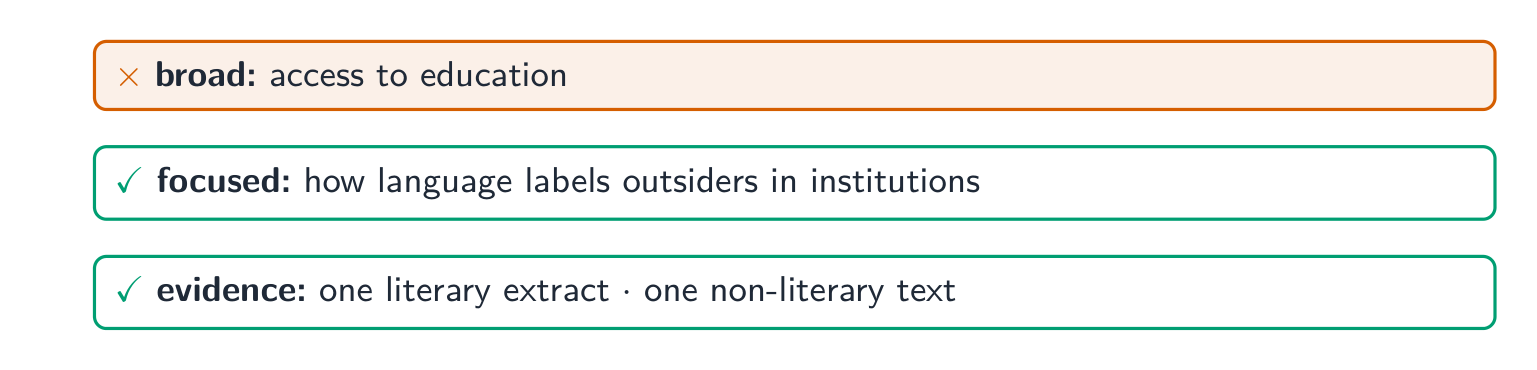
- A broad field like "access to education" is not yet an issue you can analyse. Narrow it to something language does: "how institutions use language to label outsiders".
How many minutes of prepared analysis does the individual oral include?
Dificuldade 2/5 · Moedas 140 + pequeno bônus na primeira conclusão hoje
10 minutes of analysis and 5 of questions.
Which is a focused global issue?
Dificuldade 1/5 · Moedas 100 + pequeno bônus na primeira conclusão hoje
A focused issue states what language does to people.
The literary extract
- In Dickens's Oliver Twist (1838), the workhouse board treats hungry boys as a problem to be managed. When Oliver asks for more food, a board member predicts, "That boy will be hung."
- The institution's language turns a child's request into a crime and labels him before he has done anything.
What does the board's prediction "That boy will be hung" do?
Dificuldade 1/5 · Moedas 100 + pequeno bônus na primeira conclusão hoje
The institution's language criminalises a request.
Worked example: linking two texts
Issue: how institutions use language to label outsiders.
- Literary: Oliver Twist — the board's words ("that boy", "will be hung") replace Oliver's name with a category and a future punishment.
- Non-literary: the AP Stylebook entry of 2013 — it argues that "illegal" should describe an action, not a person, because a label fixes identity.
- Link: both show that naming a person by a category makes harsh treatment seem normal. Dickens dramatises the effect; the stylebook tries to prevent it.
The literary and non-literary extracts should be linked by the same global issue.
Dificuldade 1/5 · Moedas 100 + pequeno bônus na primeira conclusão hoje
The comparison is what reveals the issue.
Choosing extracts
- Each extract should be about 40 lines and rich in features you can analyse: labels, pronouns, who speaks, who is spoken about.
- Use the wider work or body of work to show the extract is typical, not a one-off.
Structuring the oral
- Introduce the issue and thesis; analyse the literary extract and the wider work; analyse the non-literary extract and its wider body of work; conclude with what the comparison shows about the issue.
- Spend roughly equal time on both texts.
Order the structure of the oral.
Dificuldade 3/5 · Moedas 200 + pequeno bônus na primeira conclusão hoje
Give both texts roughly equal time.
An issue is not a topic. "Immigration" or "education" is a topic. A global issue states what happens to people and how language is involved, so that your analysis has something to prove.
"Immigration" on its own is a global issue ready for the oral.
Dificuldade 1/5 · Moedas 100 + pequeno bônus na primeira conclusão hoje
It is a topic; an issue states what happens and how language is involved.
Narrow a broad field into a focused global issue about language. Analyse one literary and one non-literary extract — labels, voices and consequences — link them to their wider works, give both equal time, and conclude with what the comparison reveals.
Propose a focused global issue and name one literary and one non-literary text for it.
Issue, two texts, link.