English non-literary analysis
Introduzido| English | Significado |
|---|---|
| non-literary analysis | analysis of how a non-literary text, such as an advert, article or speech, uses language and visual features to shape a reader's response |
| audience/ˈɔːdɪəns/ | The people a text is meant for. |
| purpose/ˈpɜːpəs/ | The aim or intended result of an action or communication. |
| visual features | the images, size, position, colour and layout of a text |
| urgency/ˈɜːdʒənsi/ | the feeling that something must be done quickly |
| tone/təʊn/ | The attitude conveyed by a speaker's or writer's choice of words and expression. |
A small car in white space, 1959
- In 1959 the agency Doyle Dane Bernbach launched Volkswagen's "Think Small" advert in the United States. Most car adverts showed big cars filling the page; this one showed a tiny Beetle in a sea of white space, with a short, plain caption.
- The layout made smallness look confident and honest. Non-literary analysis 非文学文本分析 asks how words, images and layout together shape a reader's response.
What made Volkswagen's 1959 "Think Small" advert stand out?
Dificuldade 1/5 · Moedas 100 + pequeno bônus na primeira conclusão hoje
The layout made smallness look confident.
Audience and purpose
- Start with the audience 受众 (who is addressed) and purpose 目的 (what the text wants them to do or believe). "Think Small" addressed Americans used to big cars; its purpose was to make a small foreign car desirable.
- Every feature you analyse should connect back to audience and purpose.
Match each term to its meaning.
Dificuldade 2/5 · Moedas 140 + pequeno bônus na primeira conclusão hoje
Every feature connects back to audience and purpose.
Words and layout
- Analyse language features — imperatives, pronouns, numbers, time limits — together with visual features 视觉元素: size, position, colour, white space.
- A time limit in words plus a large countdown in the layout creates urgency 紧迫感.
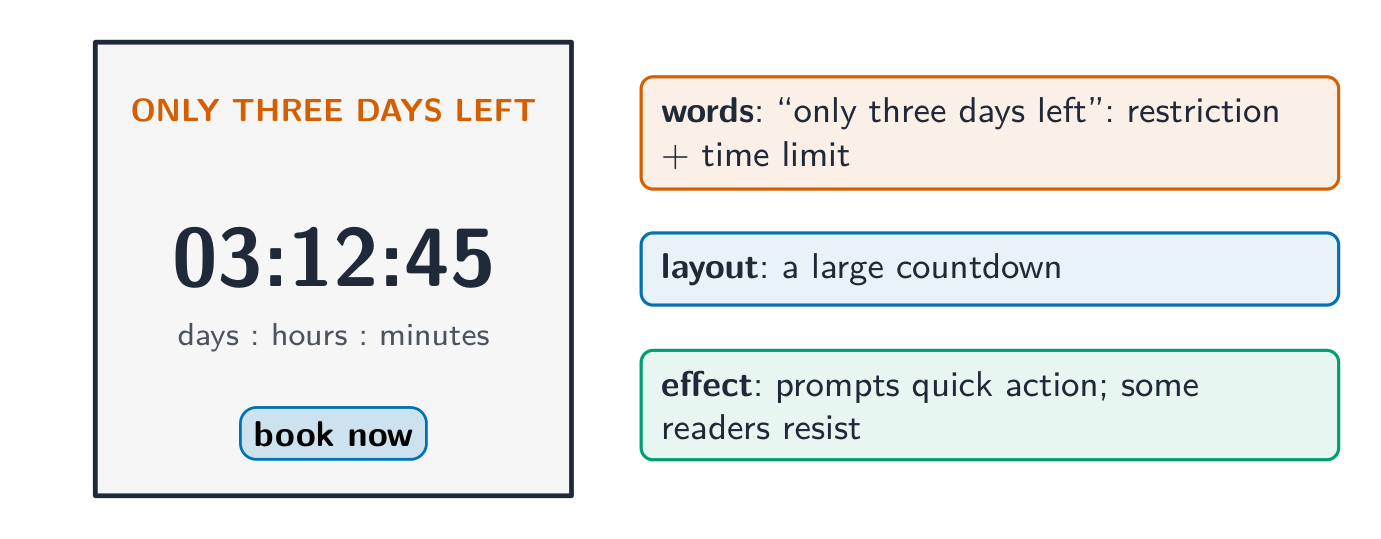
Which features create urgency?
Dificuldade 2/5 · Moedas 140 + pequeno bônus na primeira conclusão hoje
Restriction and deadlines create urgency.
Worked example: a sale advert
Text: a phone shop poster reads "Only three days left!" above a huge red countdown, "03 : 14 : 22", and a smaller line, "Prices this low won't come back."
- Words: "only" restricts and "three days left" sets a deadline; "won't come back" adds fear of missing out.
- Layout: the countdown is the largest, brightest element, so the deadline is seen before the product.
- Effect and limit: the text pushes readers to act quickly instead of comparing prices. Some readers resist — repeated "last chance" sales teach them that the deadline is a tactic.
In the worked example, what does the size of the countdown do?
Dificuldade 1/5 · Moedas 100 + pequeno bônus na primeira conclusão hoje
The largest element is seen first.
A strong analysis can note that some readers resist the text's persuasion.
Dificuldade 1/5 · Moedas 100 + pequeno bônus na primeira conclusão hoje
Noticing limits shows critical reading.
Tone and positioning
- Tone 语气 is the attitude the text takes: friendly, urgent, authoritative, ironic. Pronouns like "you" and "we" position the reader as a friend or a member of a group.
- "Think Small" used a self-mocking tone ("ugly", "small") that made the brand seem honest.
What does the pronoun "we" often do in a non-literary text?
Dificuldade 1/5 · Moedas 100 + pequeno bônus na primeira conclusão hoje
Pronouns position the reader.
Writing the analysis
- Paper 1 gives you an unseen non-literary text and a guiding question. Build a thesis about how the text achieves its purpose, then analyse features as evidence.
- Embed short quotations and name visual features precisely: "the countdown dominates the top third".
Do not list features without effects. "The advert uses red, a picture and a slogan" earns little. Say how each feature works on the audience and serves the purpose, and notice where readers might resist.
"The advert uses red, a picture and a slogan" is strong analysis.
Dificuldade 1/5 · Moedas 100 + pequeno bônus na primeira conclusão hoje
Features need effects linked to purpose.
Non-literary analysis connects language and visual features to audience and purpose. Analyse words and layout together, describe tone and how the reader is positioned, build a thesis, and explain effects — including the limits of the text's persuasion.
Analyse a charity poster that shows a thin child's face above the words "You can change her life today. Text GIVE to 70070."
Audience, purpose, features, effects.