Causation, change and comparative essays
Introduzido| English | Significado |
|---|---|
| trigger | The immediate event that set something off. |
| long-term causes | conditions that built up over years or decades and made an event likely |
| short-term causes | events shortly before an event that triggered it or made it happen when it did |
| continuity/kɒntɪˈnjuːɪti/ | continuidade |
| thesis/ˈθiːsɪs/ | The main claim that an essay or argument develops and supports. |
| essay/ˈeseɪ/ | A structured piece of writing that argues an answer to a question. |
A wrong turn in Sarajevo, 28 June 1914
- Archduke Franz Ferdinand's driver took a wrong turn and stopped right beside Gavrilo Princip, a 19-year-old Bosnian Serb nationalist, who shot the archduke and his wife. Five weeks later Europe was at war.
- Did one wrong turn cause the First World War? Historians separate the trigger 导火索 from the deeper causes — and argue about which mattered most.
Kinds of causes
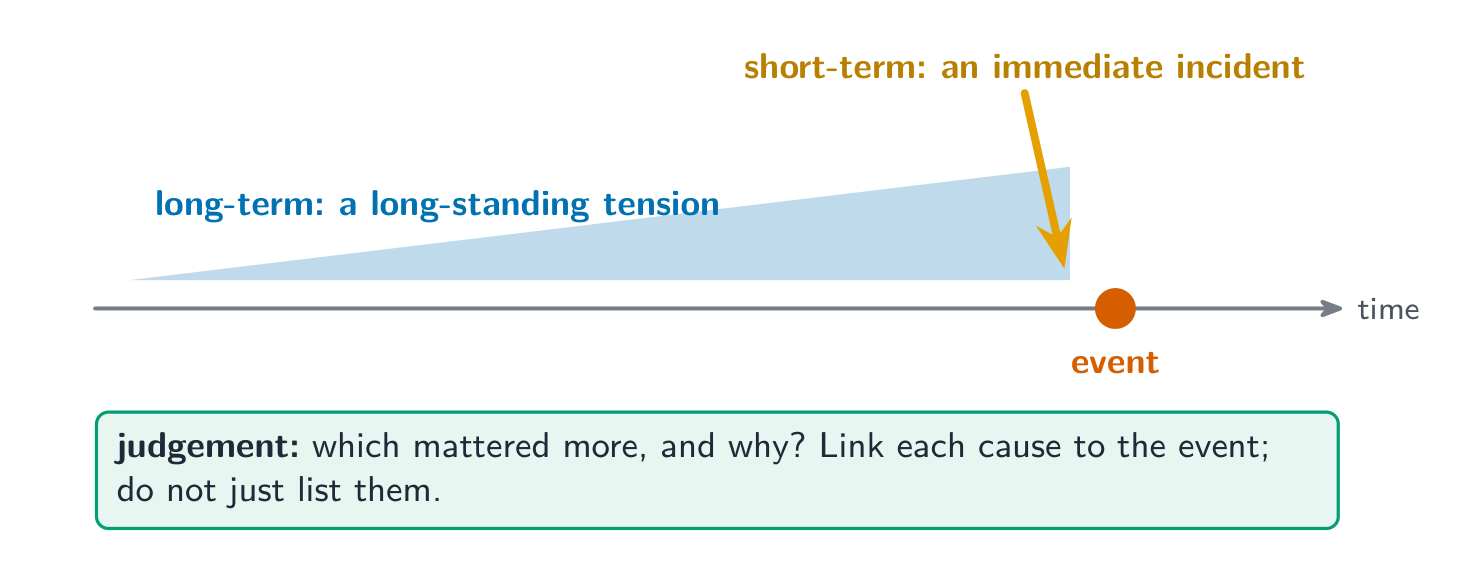
- Long-term causes 长期原因 build up over years: the alliance system, the arms race, nationalism and imperial rivalry. Short-term causes 短期原因 come just before: the July Crisis and Germany's "blank cheque" to Austria-Hungary.
- The trigger is the event that sets things off. Without long-term tensions, an assassination might have stayed a local crisis.
Classify each cause of the First World War.
Dificuldade 2/5 · Moedas 140 + pequeno bônus na primeira conclusão hoje
Long-term causes build over years; the trigger sets events off.
What is a trigger?
Dificuldade 1/5 · Moedas 100 + pequeno bônus na primeira conclusão hoje
A trigger may be important but is not always the main cause.
Change and continuity
- History questions also ask what changed and what stayed the same. After 1918 four empires collapsed (change), but nationalist tensions in the Balkans remained (continuity).
- Judge the extent of change: was it fast or slow, deep or on the surface, for whom?
Classify each statement about Europe after 1918.
Dificuldade 2/5 · Moedas 140 + pequeno bônus na primeira conclusão hoje
Questions about change also ask what stayed the same.
Worked example: weighing causes
"The assassination of Franz Ferdinand was the main cause of the First World War." To what extent do you agree?
- Thesis: the assassination was the trigger, but the alliance system turned a regional crisis into a European war, so it was the more important cause.
- Paragraph 1 (the trigger): without the assassination, there was no July Crisis in 1914; it gave Austria-Hungary a reason to attack Serbia.
- Paragraph 2 (alliances): Russia backed Serbia, Germany backed Austria-Hungary, France was allied to Russia, and Germany's plan to attack France through Belgium brought in Britain. Judgement: the alliances explain why a local quarrel became a world war within a week.
Which is the strongest thesis for "Was the assassination the main cause of the war?"
Dificuldade 1/5 · Moedas 100 + pequeno bônus na primeira conclusão hoje
It answers the question and gives a reasoned judgement.
Comparative essays
- IB Paper 2 often asks you to compare examples from two regions — for example, the causes of two wars or the rise of two single-party states. Compare point by point, not one case then the other.
- For each point, show the similarity or difference and explain why it exists.
In a comparative essay, it is best to describe the first case fully and then the second case fully.
Dificuldade 1/5 · Moedas 100 + pequeno bônus na primeira conclusão hoje
Compare point by point so similarities and differences are explained.
Building an argument
- An essay 论文 starts with a clear thesis 论点 that answers the question. Each paragraph makes one argument, supports it with precise evidence (names, dates, numbers) and explains how it answers the question.
- End with a judgement that weighs the arguments, not a summary of everything.
Put the parts of a strong paragraph in order.
Dificuldade 3/5 · Moedas 200 + pequeno bônus na primeira conclusão hoje
Point, evidence, explanation, link.
Listing causes is not explaining them. "There were four causes: militarism, alliances, imperialism and nationalism" earns little. Explain how each cause led to war, link them together, and judge which mattered most and why.
Naming four causes of a war is enough to explain why it happened.
Dificuldade 1/5 · Moedas 100 + pequeno bônus na primeira conclusão hoje
You must explain how causes led to war and judge their importance.
Separate the trigger from short-term and long-term causes, and judge their relative importance. Measure change against continuity. In essays, state a thesis, argue one point per paragraph with precise evidence, compare point by point, and end with a weighed judgement.
Write a thesis and one paragraph on whether nationalism was the main cause of the First World War.
Practise thesis plus one full paragraph.