Environmental economics: costs beyond the market price
Introduzido| English | Significado |
|---|---|
| externality/ekˈstɜːnælɪti/ | externalidade |
| social cost/ˈsəʊʃl kɒst/ | custo social |
| strong sustainability | The view that critical natural capital must be kept because nothing can replace it. |
| weak sustainability | The view that natural capital can be replaced by human-made capital of equal value. |
| public good/ˈpʌblɪk ɡʊd/ | A good that is non-rival in consumption and non-excludable. |
| pigouvian tax/pɪˈɡuːvɪən tæks/ | A tax set equal to the external cost of an activity, so the polluter pays for the harm. |
| carbon tax | A charge on fossil fuels or emissions according to the carbon dioxide they release. |
| grain for Green | A Chinese programme paying farmers to return sloping or degraded cropland to forest or grass. |
| eco-compensation | Chinese payments from those who benefit from an ecosystem to those who protect it. |
| contingent valuation | A survey method that asks people what they would pay for an unpriced environmental good. |
| willingness to pay/ˈwɪlɪŋnəs tə peɪ/ | The most a person would give up to obtain or keep an environmental good. |
| information/ˌɪnfəˈmeɪʃn/ | Data or communicated content that conveys meaning or reduces uncertainty. |
| cost-benefit analysis/kɒst ˈbenɪfɪt əˈnæləsɪs/ | Comparing a project's total costs and benefits, expressed in money, to judge whether it is worthwhile. |
| discount rate/ˈdɪskaʊnt reɪt/ | The interest rate used to convert a future amount into its present value. |
| social cost of carbon | social cost of carbon |
| decoupling | Economic growth continuing while resource use or emissions stay level or fall. |
| environmental law | environmental law |
| green growth | Economic growth that aims to use fewer resources and cause less environmental harm. |
| degrowth | A planned reduction in production and consumption in wealthy economies to stay within ecological limits. |
What would explain this observation?
- A cheap product can impose waste or pollution costs on people who did not buy it. Its market price may omit part of its environmental cost.
Build the model
- An externality 外部性 is a cost or benefit affecting a third party that is not fully reflected in a transaction.
- Environmental economics examines incentives and valuation, including instruments such as taxes, subsidies and tradable permits.
- Ecological economics also questions growth assumptions and emphasizes ecological limits and relationships between the economy and its supporting systems.
- externality: A transaction effect on a third party not fully reflected in its price.
- social cost 社会成本: Private cost plus external cost within the stated model.

What should accompany a single estimated social-cost total?
Dificuldade 1/5 · Moedas 100 + pequeno bônus na primeira conclusão hoje
A single total hides its assumptions. The system boundary, how damages were valued, and who bears the costs decide whether the number is meaningful; an invoice covers only private cost.
Match each technical term to its precise meaning.
Dificuldade 2/5 · Moedas 140 + pequeno bônus na primeira conclusão hoje
Use the definitions to distinguish related quantities and processes.
Choose evidence that can test it
- In a simplified model, marginal social cost equals marginal private cost plus marginal external cost.
- A pollution charge can alter incentives, but selecting a charge requires evidence and a stated objective.
- Monetary totals do not by themselves settle distribution, irreversibility, uncertainty or whether a service can be substituted.
In the lab: Construct a transparent table with a common currency, time period and system boundary. Separate measured expenditure from estimated environmental damage. Compare at least two valuation assumptions, identify who pays and who benefits, and consider a non-monetary indicator such as habitat condition. Label these as classroom scenarios rather than forecasts.
Which two habits make the investigation or model in this case more defensible?
Dificuldade 2/5 · Moedas 140 + pequeno bônus na primeira conclusão hoje
Stating the conditions and assumptions lets others repeat the work exactly, and recording the supporting evidence lets them check the conclusion. Hiding disagreeing results removes the evidence that could challenge a wrong conclusion, and one measurement can never establish a wider claim.
Work from known quantities
- Known: producing one item costs the producer 8 units, while the scenario estimates an external cost of 3 units.
- Social cost is 11 units per item.
- For 200 items, private cost is 1,600 units and estimated external cost is 600 units, giving 2,200 units total under this model.
- If external damage is estimated at 1–5 units per item, the social-cost range is 1,800–2,600 units.
Your turn: Private cost is 6 units per item and external cost is 2 units. Calculate social cost for 50 items.
Private cost is 6 units per item and external cost is 2 units. Calculate social cost for 50 items.
Dificuldade 2/5 · Moedas 140 + pequeno bônus na primeira conclusão hoje
The result is 400 cost units. Known: private 6 units per item; external 2 units per item; 50 items. Social cost per item = 6 + 2 = 8 units. Total = 8 x 50 = 400 cost units. The external share is 100 units of that total.
Check the conclusion and its limits
- A money value is an assumption-dependent estimate, not a measurement of intrinsic ecological value.
- A policy that lowers total cost can still place a disproportionate burden on a vulnerable group.
Not true: The cheapest market price necessarily identifies the smallest total environmental cost. Market price reflects private costs. External costs - pollution, health damage - fall on others and are absent from the price, so the cheapest market option can carry the largest total cost.
- An externality is a cost or benefit affecting a third party that is not fully reflected in a transaction.
- In a simplified model, marginal social cost equals marginal private cost plus marginal external cost.
- Watch for: A money value is an assumption-dependent estimate, not a measurement of intrinsic ecological value.
The cheapest market price necessarily identifies the smallest total environmental cost.
Dificuldade 1/5 · Moedas 100 + pequeno bônus na primeira conclusão hoje
Market price reflects private costs. External costs - pollution, health damage - fall on others and are absent from the price, so the cheapest market option can carry the largest total cost.
A transaction effect on a third party not fully reflected in its price: write the technical term.
Dificuldade 1/5 · Moedas 100 + pequeno bônus na primeira conclusão hoje
externality means A transaction effect on a third party not fully reflected in its price.
Write from the data: find the social cost
- Private cost is 5 units per item and the estimated external cost is 4 units. The scenario covers 100 items.
- Find the total social cost. The cheapest market price can omit external costs.
Private cost is 5 units per item and the estimated external cost is 4 units. What is the total social cost for 100 items, and why can the cheapest market price still be a poor environmental choice?
Social cost adds the estimated external cost to the private cost. Price and total environmental cost are different.
What is the total social cost for 100 items?
Dificuldade 1/5 · Moedas 100 + pequeno bônus na primeira conclusão hoje
5 plus 4 is 9 per item, and 9 times 100 is 900. The item count is not the cost. Other options — 5 units (the private cost of one item); 100 units (the number of items).
Compare two economic emphases
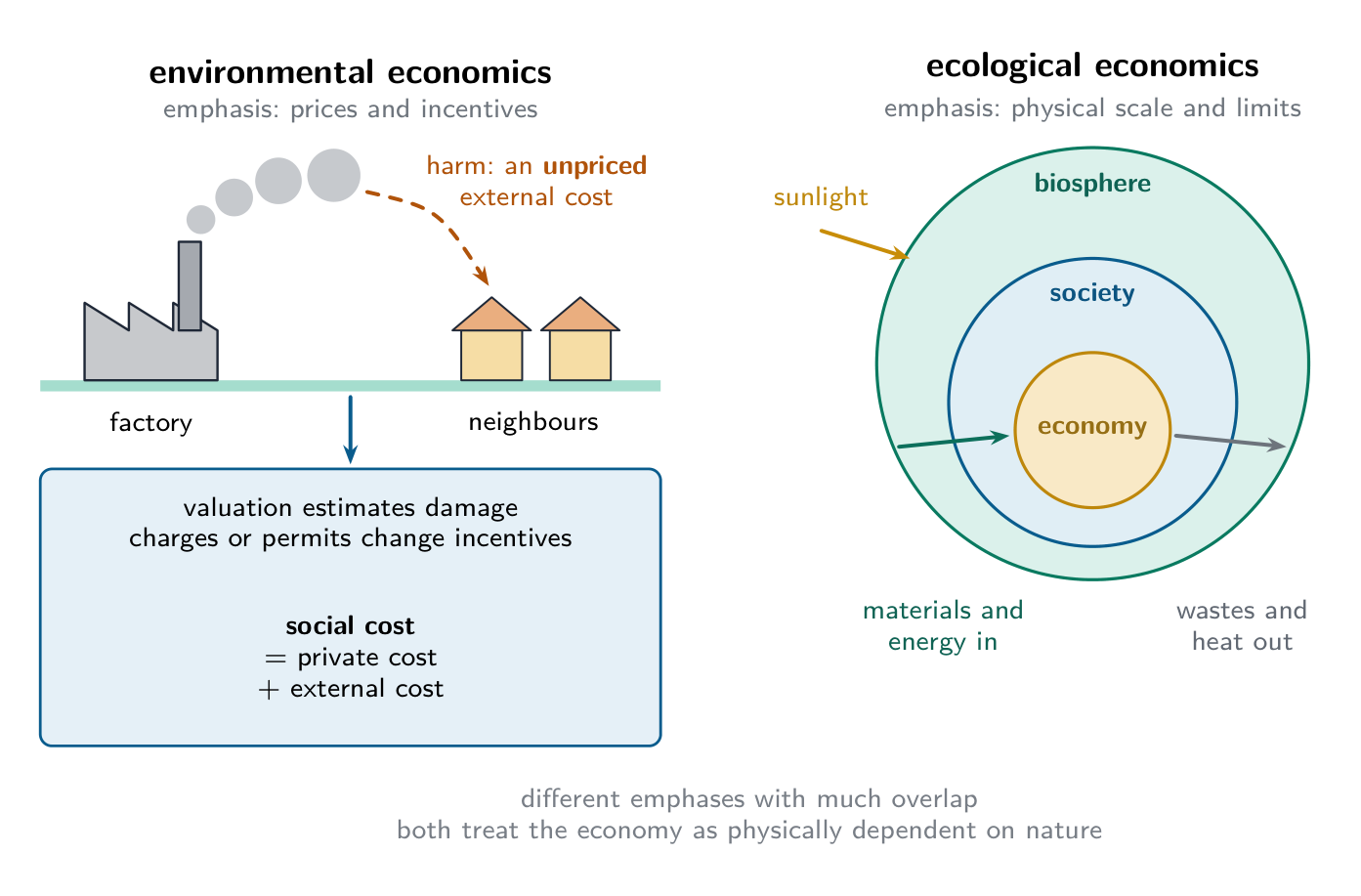
- Environmental economics often studies incentives, externalities and non-market valuation; ecological economics emphasizes biophysical scale, distribution and limits.
- The fields overlap. Do not claim environmental economists think the biosphere physically sits inside the economy or that every member supports one growth policy.
What is a defensible comparison?
Dificuldade 1/5 · Moedas 100 + pequeno bônus na primeira conclusão hoje
Compare questions and assumptions rather than turning disciplines into rigid opposites.
Distinguish weak and strong sustainability 强可持续性
- Weak sustainability 弱可持续性 allows substitution among forms of capital under a stated aggregate measure. Strong sustainability protects critical functions that cannot be adequately replaced.
- A school can have great social benefits but cannot itself provide all the water, habitat or carbon functions of a lost forest. Assess specific functions and limits.
Does a new building automatically replace every forest function?
Dificuldade 1/5 · Moedas 100 + pequeno bônus na primeira conclusão hoje
A money total alone does not establish functional substitution.
Identify an externality
- An externality is an effect on a third party not fully reflected in a transaction. Smoke damage can be negative; pollinator habitat benefiting neighbours can be positive.
- Private costs fall on the decision-maker; external costs fall outside the transaction. A low selling price need not represent low social or environmental cost.
Which is a negative externality?
Dificuldade 1/5 · Moedas 100 + pequeno bônus na primeira conclusão hoje
The distinction concerns costs omitted from the transaction, not simply any production cost.
Separate public goods 公共物品 and common resources
- A public good is non-rival and difficult or costly to exclude people from; stable climate and clean-air quality illustrate relevant features.
- A common-pool resource is rival while exclusion is difficult. Fish removed by one user are unavailable to another; effective community governance can prevent open-access outcomes.
Is every shared fishery necessarily unregulated open access?
Dificuldade 1/5 · Moedas 100 + pequeno bônus na primeira conclusão hoje
Resource properties and management arrangements are distinct.
Keep air quality distinct from waste capacity
- One person enjoying clean-air quality does not normally use up that enjoyment for another. The atmosphere’s capacity to receive pollution without harm is finite.
- Calling air quality a public good does not license unlimited emissions. Free-riding can undermine voluntary provision, so institutions and collective funding matter.
Does the public-good label mean unlimited pollution can be absorbed safely?
Dificuldade 1/5 · Moedas 100 + pequeno bônus na primeira conclusão hoje
Distinguish the environmental benefit from pressure on the physical system.
Calculate social cost consistently
- In an invented constant per-item example, private cost 8 and external cost 3 give social cost 11. For 200 items, totals are 1600,600 and 2200 units.
- Totals and marginal costs are different quantities. If external damage per item varies, estimate the effect of the next item rather than treating an average as its marginal cost.
What is total social cost for 200 items under the stated constant-cost model?
Dificuldade 1/5 · Moedas 100 + pequeno bônus na primeira conclusão hoje
Multiply the compatible per-item private and external amounts by 200.
Read the marginal-cost diagram
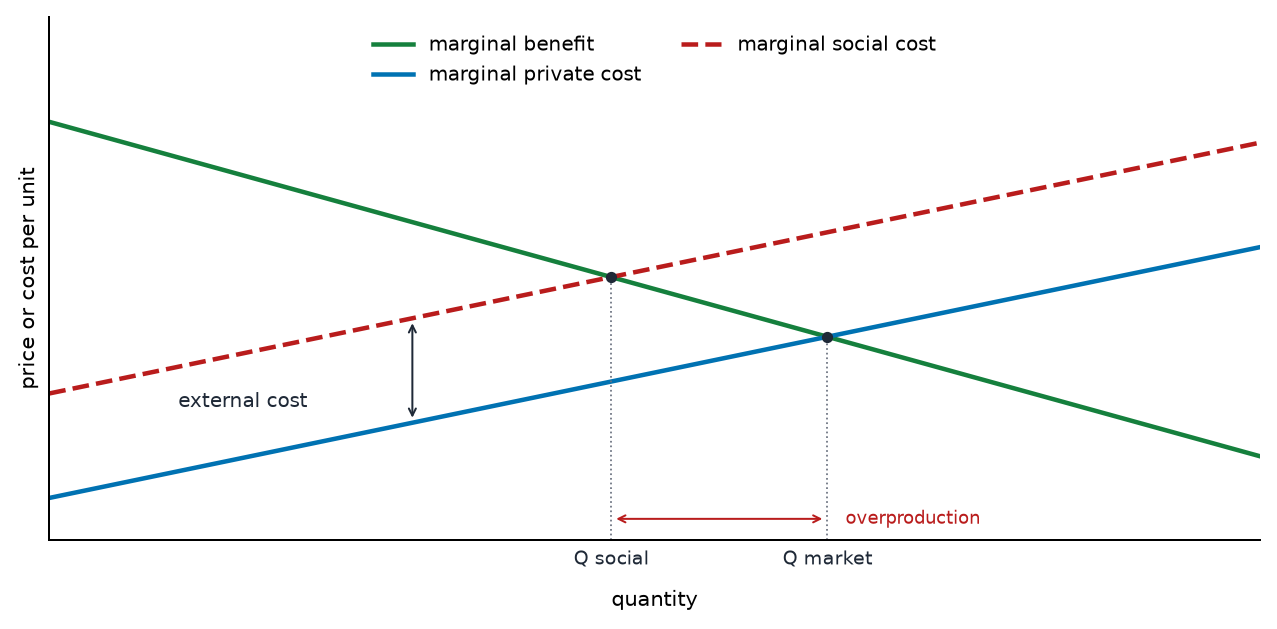
- In the simplified competitive diagram, demand is marginal benefit and supply is marginal private cost. Marginal social cost includes external damage.
- With no external benefits, market output exceeds the model’s social optimum: some extra units cost society more than their marginal benefit. These assumptions define the result.
Where is the model’s social optimum?
Dificuldade 1/5 · Moedas 100 + pequeno bônus na primeira conclusão hoje
The diagram compares marginal effects of additional output under stated assumptions.
Choose a corrective tax carefully
- A Pigouvian tax 庇古税 equals marginal external damage at the target output in the simple model. With constant external damage 5 per extra item, a 5-unit tax matches it.
- Estimating damage, coverage, monitoring, distribution and behavioural response is difficult. A real tax rate is not automatically an exact measure of social damage.
Does any tax labelled environmental necessarily equal marginal damage?
Dificuldade 1/5 · Moedas 100 + pequeno bônus na primeira conclusão hoje
Instrument design requires evidence and assumptions rather than a label.
Compare price and quantity instruments
- A carbon tax 碳税 fixes a specified charge while emissions responses vary. A well-enforced absolute cap constrains covered quantity while allowance prices may vary.
- Banking, offsets, exemptions, monitoring and compliance rules affect outcomes. An intensity benchmark linked to output is not automatically a fixed absolute cap.
Which variable does an ideal absolute cap constrain?
Dificuldade 1/5 · Moedas 100 + pequeno bônus na primeira conclusão hoje
Identify the coverage and design rather than treating all trading schemes as identical.
Use China’s dated trading example
- China’s national trading began in 2021; the environment ministry’s 2025 report documents extension to steel, cement and aluminium smelting.
- That report describes intensity-based allocation linked to production benchmarks. Date the rules and distinguish them from the simplified fixed-cap classroom model.
What is the key design distinction?
Dificuldade 1/5 · Moedas 100 + pequeno bônus na primeira conclusão hoje
Read allocation, coverage and period before predicting the quantity outcome.
Calculate lower-cost abatement
- Invented factories A and B can cut at 20 and 80 yuan per tonne respectively, with constant costs and enough feasible cuts at A. A total reduction 100 tonnes is required.
- Equal cuts 50 each cost 1000+4000=5000 yuan. All 100 cuts at A cost 2000 yuan; the same reduction uses fewer abatement resources.
What is the real abatement-cost saving?
Dificuldade 1/5 · Moedas 100 + pequeno bônus na primeira conclusão hoje
Compare 5000 with 2000 under the assumptions; payments between firms are separate transfers.
Find the abatement-cost saving from 5000 yuan with equal cuts to 2000 yuan with efficient trading.
Dificuldade 2/5 · Moedas 140 + pequeno bônus na primeira conclusão hoje
5000−2000=3000 yuan; permit payments transfer between firms.
Separate permit transfers from resource costs
- If each firm receives 50 allowances and A cuts all 100 tonnes, it can sell 50 allowances to B. At 50 yuan each the transfer is 2500 yuan.
- A spends 2000 on abatement and receives 2500; B pays 2500. The transfer cancels when both firms are added, leaving total abatement cost 2000.
Should the 2500-yuan permit payment be added again as a social resource cost?
Dificuldade 1/5 · Moedas 100 + pequeno bônus na primeira conclusão hoje
Distinguish who pays from resources used; other administrative costs could still matter.
Check where the pollution remains
- Low-cost trading can meet a total target while emissions stay concentrated near B. Local exposure, co-pollutants and vulnerability can differ.
- Combine total-target efficiency with appropriate local standards and justice evidence. A cheaper total is not automatically fairer for every community.
Can lower total abatement cost coexist with unequal local exposure?
Dificuldade 1/5 · Moedas 100 + pequeno bônus na primeira conclusão hoje
Evaluate both the aggregate and the locations of benefits and burdens.
Evaluate ecosystem-service payments
- Payments can reward actions that maintain forests, water quality or other services. China’s Grain for Green 退耕还林 and Xin’an River eco-compensation 生态补偿 provide named examples.
- Test additionality, permanence, leakage, monitoring, participation and land rights. Payment for an action is not proof the intended service improved because of it.
What does additionality ask?
Dificuldade 1/5 · Moedas 100 + pequeno bônus na primeira conclusão hoje
A counterfactual is needed to assess the extra environmental effect.
Test a plastic-bag policy claim
- England introduced a charge in 2015 and counted bag sales at major retailers fell greatly over subsequent years. Later charge and coverage changes matter.
- Counted bags, all plastic waste and lifecycle harm are different indicators. Substitution, reuse and other retailer policies affect interpretation.
Does a 95%fall in counted bags prove 95%less total environmental harm?
Dificuldade 1/5 · Moedas 100 + pequeno bônus na primeira conclusão hoje
Use the policy’s measured indicator without generalising it to every impact.
Classify economic values
- Direct use includes fishing or visits; indirect use includes flood protection; option value preserves future possible uses.
- Existence and bequest values concern knowing something exists and passing it on. They are not the same as cash sales or an intrinsic ethical value.
Which is bequest value?
Dificuldade 1/5 · Moedas 100 + pequeno bônus na primeira conclusão hoje
Separate types of use/non-use value and ethical worth.
Choose valuation evidence
- Market prices can value some outputs; travel costs can help infer recreation value; hedonic analysis examines price differences linked to amenities.
- Contingent valuation 条件价值评估 asks stated willingness to pay 支付意愿. All methods need careful boundaries, sampling and assumptions; correlation in property prices does not isolate one cause automatically.
Which method uses a survey of stated willingness to pay?
Dificuldade 1/5 · Moedas 100 + pequeno bônus na primeira conclusão hoje
A stated-preference estimate is not an observed market transaction.
Evaluate willingness to pay
- Income, question wording, information 信息 and strategic or hypothetical responses can alter stated values. A low ability to pay does not mean a community’s interests are unimportant.
- Avoid counting the same benefit twice across property values, visitor spending and survey totals. Report non-monetary ecological indicators and rights as well as money.
What is a risk when adding overlapping value estimates?
Dificuldade 1/5 · Moedas 100 + pequeno bônus na primeira conclusão hoje
Check the accounting boundary and overlap before adding totals.
Use environmental accounting carefully
- Environmental accounting tracks natural stocks, depletion and services in physical and sometimes monetary terms. GEP and GDP have different purposes and boundaries.
- A global ecosystem-services estimate is not cash income or a number that can simply be added toGDP. Methods and overlap affect interpretation.
Can an estimated ecosystem-service flow simply be added toGDP?
Dificuldade 1/5 · Moedas 100 + pequeno bônus na primeira conclusão hoje
An estimate can inform decisions without being an additive national-accounting total.
Compare costs and benefits over time
- A cost-benefit analysis 成本效益分析 needs a baseline, time horizon, compatible units, a stated discount rate 贴现率 and sensitivity analysis. Include maintenance and avoided damages, not just construction cost.
- Distribution, rights, uncertainty and irreversible losses may require other decision criteria. Positive net monetised benefit does not prove everyone benefits or a project is permitted.
What should accompany an aggregate monetary result?
Dificuldade 1/5 · Moedas 100 + pequeno bônus na primeira conclusão hoje
Monetary aggregation is one form of evidence, not a complete decision rule.
Calculate present value
- Present value equals future value divided by(1+r)raised to elapsed years, with compatible real or nominal amounts and rates.
- Invented damage 1 million yuan in 100 years has present value about 369 711 yuan at 1%, but about 7604 yuan at 5%. Discounting changes today’s comparison, not physical future harm.
What happens when the discount rate rises in this example?
Dificuldade 1/5 · Moedas 100 + pequeno bônus na primeira conclusão hoje
A discount-rate assumption changes the present weighting of a future amount.
Explain discounting and ethics
- Rates can reflect time preference, expected consumption change and risk assumptions. How future people and poorer groups count also raises ethical questions.
- Compare several rates and irreversible outcomes instead of treating one number as a neutral natural constant. High discounting can reduce the weight of distant harms greatly.
Does a low present value prove distant harm is physically small?
Dificuldade 1/5 · Moedas 100 + pequeno bônus na primeira conclusão hoje
Present value and physical consequence are different concepts.
Interpret the social cost of carbon 碳的社会成本
- The social cost of carbon estimates damage from an extra tonne; it differs from a tax rate and an allowance market price.
- The EPA 2023 report’s 190 figure is in 2020 US dollars for 2020 CO₂ emissions under its 2% near-term rate case. It is a dated model estimate, not a current universal price.
What must be stated with a social-cost estimate?
Dificuldade 1/5 · Moedas 100 + pequeno bônus na primeira conclusão hoje
Different concepts and assumptions prevent a simple timeless price comparison.
Define GDP without double counting
- GDP measures domestic final production or value added during a period, with accounting conventions for some non-market activity. Do not add every intermediate sale again.
- Cleanup and health spending can add measured activity even when damage reduces wellbeing. GDP does not directly measure distribution, ecological condition or much unpaid household work.
Why exclude intermediate sales when adding final output?
Dificuldade 1/5 · Moedas 100 + pequeno bônus na primeira conclusão hoje
Final-output and value-added methods avoid double counting.
Read decoupling 脱钩 with a boundary
- Relative decoupling means a specified pressure grows more slowly than GDP; absolute decoupling means it falls while GDP grows.
- State the period, pressure and geography. Territorial emissions exclude imported production emissions; one falling indicator does not prove every global pressure falls.
Which would demonstrate absolute decoupling for one stated pressure?
Dificuldade 1/5 · Moedas 100 + pequeno bônus na primeira conclusão hoje
Distinguish absolute totals from ratios and define the accounting boundary.
Calculate a rebound example
- Invented energy per service falls 20%, giving multiplier 0.8, while service use rises 25%, giving multiplier 1.25. Total multiplier=1.00.
- If use rises only 10%, multiplier 0.8×1.1=0.88: total energy falls 12%. Rebound can remove some, all or sometimes more than efficiency savings; it is not always complete.
What is total energy change in the 25%extra-use example?
Dificuldade 1/5 · Moedas 100 + pequeno bônus na primeira conclusão hoje
Multiply changes in efficiency and activity instead of adding percentage differences.
Energy per service multiplier 0.8 and service-use multiplier 1.1: find percentage energy reduction.
Dificuldade 2/5 · Moedas 140 + pequeno bônus na primeira conclusão hoje
0.8×1.1=0.88, so 1−0.88=0.12, a 12%reduction.
Treat the Kuznets curve as a hypothesis
- An inverted-U relationship between income and some pollutants has been proposed and observed in some contexts. It depends on institutions, technology, trade and the pollutant.
- Do not assume income growth automatically repairs climate, habitat or biodiversity damage. A pattern in one territorial pollutant is not a universal environmental law 环境法.
What is a sound use of the Kuznets idea?
Dificuldade 1/5 · Moedas 100 + pequeno bônus na primeira conclusão hoje
A hypothesis requires evidence and boundaries.
Compare growth and limits proposals
- Green growth 绿色增长 emphasizes innovation and reduced impacts alongside economic growth; steady-state approaches emphasize sustainable physical throughput and quality.
- Degrowth 去增长 arguments focus on reducing excessive throughput and consumption, especially in affluent economies, with distribution and wellbeing goals. These are policy perspectives, not identical forecasts.
What must an evaluation compare?
Dificuldade 1/5 · Moedas 100 + pequeno bônus na primeira conclusão hoje
Separate physical scale, measured wellbeing and the assumptions behind growth claims.
Use the doughnut as a framework
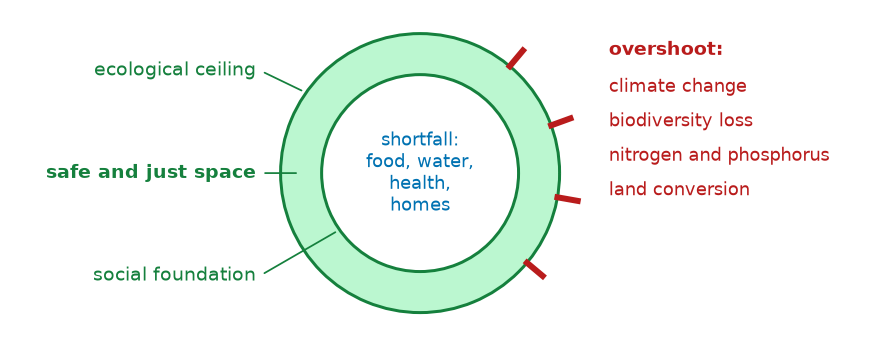
- The social foundation represents basic needs; the ecological ceiling represents biophysical limits. The safe and just space lies between shortfall and overshoot.
- Amsterdam’s 2020–2025 circular strategy applied the framework. A schematic ring is not a measured current assessment and adoption does not prove every target was met.
What is the aim of the doughnut framework?
Dificuldade 1/5 · Moedas 100 + pequeno bônus na primeira conclusão hoje
The framework connects social and ecological goals without making a claim of automatic achievement.
Test green claims and reach a judgement
- Greenwashing is misleading environmental presentation relative to evidence. Check the baseline, boundary, lifecycle, verified outcome and omitted harms.
- Combine prices, legal limits, institutions and ethical reasoning where appropriate. Explain who pays, what changes and what evidence could challenge your conclusion.
Which makes an environmental claim stronger?
Dificuldade 1/5 · Moedas 100 + pequeno bônus na primeira conclusão hoje
Evaluate actual evidence rather than treating marketing as performance.