Economic inquiry and choices
Introduzido| English | Significado |
|---|---|
| scarce/skeəs/ | In short supply compared with what people want. |
| opportunity cost/ɒpəˈtjuːnɪti kɒst/ | Custo de oportunidade |
| factors of production/ˈfæktəz ɒv prəˈdʌkʃn/ | The inputs used to produce goods and services: land, labour, capital and enterprise. |
| production possibilities curve/prəˈdʌkʃn ˌpɒsəˈbɪlɪtiz kɜːv/ | A curve showing the maximum attainable combinations of two outputs using given resources and technology efficiently. |
| market economy/ˈmɑːkɪt ɪˈkɒnəmi/ | An economy in which prices and resource allocation are largely determined by buyers and sellers through markets. |
| planned economy/plænd ɪˈkɒnəmi/ | An economy in which the state decides what is produced. |
| models/ˈmɒdlz/ | A simplified representation of a system used to explain, analyse or predict its behaviour. |
| ceteris paribus/ˈsetərɪs ˈpærɪbəs/ | Holding every other factor unchanged while one factor is studied. |
| normative/ˈnɔːmətɪv/ | Normativo |
A licence to own a car, Singapore 1990
- In 1990 Singapore capped the number of cars and began auctioning a Certificate of Entitlement (COE) for each new one. In 2023 a COE for a large car sold for over S$140,000 — more than the car.
- Land and road space are scarce 稀缺的: there is not enough for everyone who wants them. Economics studies how societies choose who gets scarce resources.
Scarcity, choice and opportunity cost
- Human wants are unlimited but the factors of production 生产要素 — land, labour, capital and enterprise — are limited, so every choice gives something up.
- The opportunity cost 机会成本 of a choice is the next best alternative given up. A road lane for cars is a lane not used for buses or bicycles.
Match each resource to its factor of production.
Dificuldade 2/5 · Moedas 140 + pequeno bônus na primeira conclusão hoje
Capital is a made resource used to produce other goods; enterprise organises the others and takes the risk.
Mei chooses to study for an evening instead of working a shift paying ¥200 or going to a concert. She would have preferred the shift to the concert. What is the opportunity cost?
Dificuldade 1/5 · Moedas 100 + pequeno bônus na primeira conclusão hoje
Opportunity cost is the single next best alternative, which was the shift.
The production possibilities curve
- A production possibilities curve 生产可能性曲线 (PPC) shows the maximum combinations of two goods an economy can make with all its resources. Points inside it mean unused resources; points outside are unreachable today.
- In the figure the same workers can make 20 desks or 40 chairs, so every extra desk costs 2 chairs — a straight line, because the workers are equally good at both.
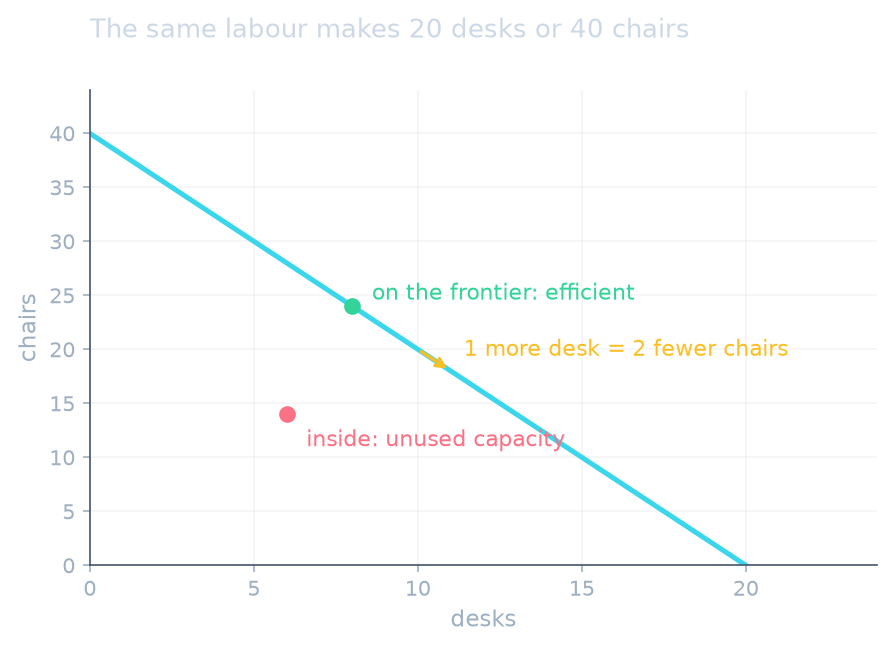
An economy produces at a point inside its PPC. What does this show?
Dificuldade 1/5 · Moedas 100 + pequeno bônus na primeira conclusão hoje
Inside the curve, more of both goods could be made by using idle resources.
Worked example: reading opportunity cost
An economy can make (0 tonnes of rice, 100 machines), (20, 90), (40, 70) or (60, 40). Find the opportunity cost of each extra 20 tonnes of rice.
- 0 → 20 rice: machines fall from 100 to 90, so 20 tonnes cost 10 machines (0.5 machines per tonne).
- 20 → 40 and 40 → 60: 20 machines, then 30 machines (1.0 and 1.5 per tonne).
- Conclusion: unlike the desks and chairs, the opportunity cost rises, because the workers and land moved last are the ones least suited to farming. Rising opportunity cost makes a PPC bow outwards.
Moving from (30 food, 50 tools) to (40 food, 35 tools), what is the opportunity cost of one extra unit of food, in tools?
Dificuldade 2/5 · Moedas 140 + pequeno bônus na primeira conclusão hoje
10 more food costs 15 tools, so each unit costs 1.5 tools.
Growth and shifts
- Economic growth shifts the PPC outwards: more or better resources (investment, education, migration) or better technology.
- A disaster, war or emigration can shift it inwards. A recession moves the economy to a point inside the curve without changing the curve itself.
Which would shift a country's PPC outwards?
Dificuldade 2/5 · Moedas 140 + pequeno bônus na primeira conclusão hoje
Better technology and more capital increase what can be made. A recession moves inside the curve; an earthquake shifts it in.
Who decides? Economic systems
- In a market economy 市场经济, prices set by buyers and sellers ration goods; in a planned economy 计划经济, the state decides what is made. Real economies are mixed.
- China's reforms after 1978 moved from planning towards markets, and output grew about 9 % a year for three decades. Singapore's COE is a market auction inside a government limit.
Singapore's COE system is purely a planned economy, because the government sets the number of cars.
Dificuldade 1/5 · Moedas 100 + pequeno bônus na primeira conclusão hoje
The state sets the quantity, but the price is found by a market auction — a mixed approach.
Thinking like an economist
- Economists build simplified models 模型, holding other things constant (ceteris paribus 其他条件不变), and test them against evidence.
- Positive statements can be tested ("the COE price rose 20 %"); normative statements are value judgements ("car ownership should be cheaper"). IB answers use both, but keep them apart.
Classify each statement.
Dificuldade 2/5 · Moedas 140 + pequeno bônus na primeira conclusão hoje
A positive statement can be tested with evidence, even if it turns out false.
"Opportunity cost is the money price" is wrong. The opportunity cost of a free university place is still the wage you give up by not working, and of a COE it is everything else S$140,000 could buy. It is the best alternative given up, whether or not money changes hands.
Scarcity forces choice, and every choice has an opportunity cost. The PPC shows the limits of production, rising opportunity cost and growth when it shifts out. Markets, planners or a mix decide what is made, and economists test simplified models with evidence while separating positive from normative claims.
Using a PPC, explain why a country might choose to produce more capital goods now, even though people have fewer consumer goods.
Use the diagram and both time periods.