Researching impacts and implications
Introduzido| English | Significado |
|---|---|
| inquiry/ɪnˈkwaɪəri/ | investigação |
| inquiry question | A focused question that guides an investigation and can be answered with evidence. |
| primary sources | First-hand evidence, such as interviews, surveys, observations or original records. |
| secondary sources | Sources that report on or analyse first-hand evidence, such as articles and studies. |
87 million profiles, 2018
- In March 2018 newspapers revealed that Cambridge Analytica had harvested data from up to 87 million Facebook users through a personality-quiz app that only about 270 000 people installed. Their friends' data came too.
- Journalists proved this with documents, a whistle-blower and the app's own code. The IB inquiry asks you to investigate a digital system the same way — with a narrow question and real evidence.
A focused inquiry question
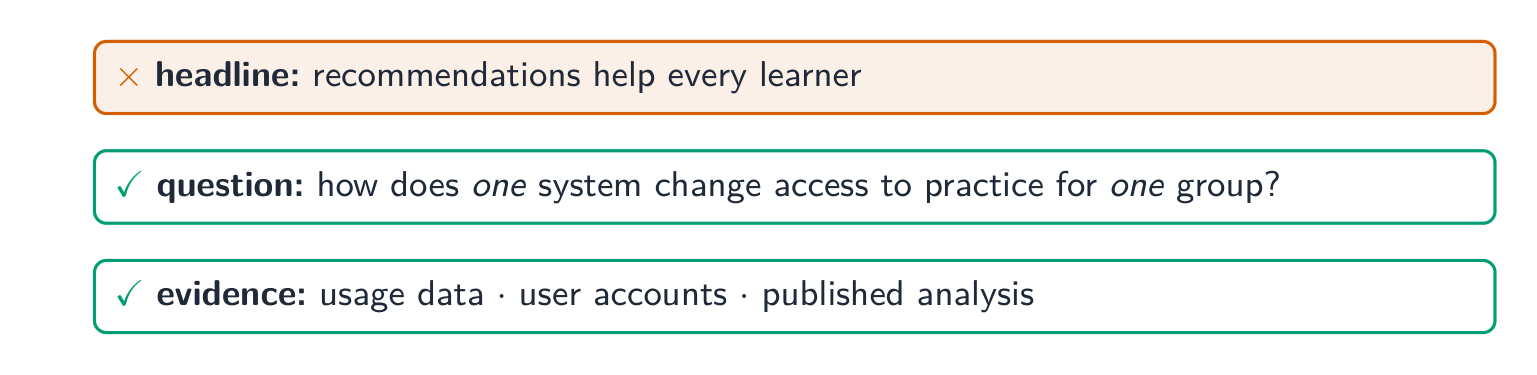
- A strong inquiry question 探究问题 names one digital system, one group or place, and one impact: "How has the school's learning app changed access to practice for students without home internet?"
- A headline claim — "recommendations help every learner" — is too broad to test. Narrow it until you can gather evidence in a few weeks.
Which is the best inquiry question?
Dificuldade 1/5 · Moedas 100 + pequeno bônus na primeira conclusão hoje
It names one system, one group and one impact, so evidence can be gathered.
About 270 000 people installed the quiz app, but data from up to 87 million users was collected. Roughly how many profiles were collected per install?
Dificuldade 2/5 · Moedas 140 + pequeno bônus na primeira conclusão hoje
$\dfrac{87\,000\,000}{270\,000} \approx 322$ — mostly friends who never used the app.
Gathering sources
- Primary sources 一手资料: your own interviews, surveys and observations, or system data you are allowed to use. Secondary sources 二手资料: news reports, research papers, company statements.
- Use several kinds, so each checks the others: usage figures show what happened, interviews explain why.
Classify each source.
Dificuldade 2/5 · Moedas 140 + pequeno bônus na primeira conclusão hoje
Primary sources are first-hand evidence you gather or original records.
Worked example: evaluating a source
Source: a learning-app company's press release says "Students using our recommendations improved scores by 18 %". Evaluate it.
- Origin and purpose: written by the company to sell the product, so it highlights good results.
- Value: it gives a specific claim and figure you can test.
- Limitation: it does not say which students, compared with whom, or over what period; students who used it most may already have been more motivated. Check it against independent research and your own school's data.
What is the main limitation of a company's press release about its own app?
Dificuldade 1/5 · Moedas 100 + pequeno bônus na primeira conclusão hoje
Purpose affects what the source chooses to say.
How could you test the claim "users improved scores by 18 %"?
Dificuldade 2/5 · Moedas 140 + pequeno bônus na primeira conclusão hoje
Comparison and independent evidence test the claim; repeating it does not.
Analysing with concepts
- Use a course concept to give the analysis a direction: access depends on space and systems; who decides depends on power; fairness depends on values and ethics.
- Connect claims to evidence in every paragraph, and explain impacts on different stakeholders — students, teachers, parents, the company.
Research ethics
- Ask permission before interviewing, explain how you will use the answers, and anonymise people. Do not collect more personal data than you need.
- Note the limits of your own evidence: a survey of ten friends is not a whole school.
It is acceptable to quote a classmate's interview by name without asking them.
Dificuldade 1/5 · Moedas 100 + pequeno bônus na primeira conclusão hoje
Ask permission and anonymise participants unless they agree otherwise.
"More sources make a better inquiry" is wrong. Twenty news articles repeating the same press release add nothing. A few well-chosen sources of different kinds — data, a first-hand account, an independent study — that test each other are worth far more.
An inquiry with twenty news articles is always stronger than one with four varied sources.
Dificuldade 1/5 · Moedas 100 + pequeno bônus na primeira conclusão hoje
Variety and independence matter more than number.
Narrow the inquiry to one system, one group and one impact. Combine primary and secondary sources, evaluate each by origin, purpose, value and limitation, and analyse with a course concept. Collect data ethically and state the limits of your evidence.
Turn the headline "Social media harms teenagers" into an inquiry question and list three sources you would use.
Narrow first, then choose sources that test each other.