Amounts, equations and limiting reagents
Introduzido| English | Significado |
|---|---|
| limiting reagent/ˈlɪmɪtɪŋ rɪˈeɪdʒənt/ | reagente limitante |
| mole/məʊl/ | mol |
| solution/səˈluːʃn/ | A homogeneous mixture in which one or more solutes are dissolved in a solvent. |
| formula unit | The simplest ratio of ions in an ionic compound, such as NaCl. |
| relative atomic mass/ˈrelətɪv əˈtɒmɪk mæs/ | The weighted mean mass of an element's atoms relative to one twelfth of the mass of a carbon-12 atom. |
| relative formula mass/ˈrelətɪv ˈfɔːmjʊlə mæs/ | The sum of the relative atomic masses in one formula unit. |
| empirical formula/emˈpɪrɪkl ˈfɔːmjʊlə/ | A formula showing the simplest whole-number ratio of atoms of each element in a compound. |
| molecular formula/məˈlekjʊlə ˈfɔːmjʊlə/ | A formula showing the actual numbers of atoms of each element in one molecule. |
| standard solution/ˈstændəd səˈluːʃn/ | A solution of accurately known concentration. |
| solute/ˈsɒljuːt/ | A substance dissolved in a solvent to form a solution. |
| molar volume | The volume of one mole of gas, 22.7 dm³ at STP. |
| theoretical yield/θɪəˈretɪkl jiːld/ | theoretical yield |
| limiting reactant/ˈlɪmɪtɪŋ rɪˈæktənt/ | The reactant that is used up first and therefore limits the amount of product formed. |
| stoichiometry/ˌstəʊɪkɪˈɒmətri/ | The quantitative relationships between reactants and products specified by a balanced chemical equation. |
| atom economy/ˈætəm ɪˈkɒnəmi/ | The mass of the desired product as a percentage of the total mass of all products. |
What would explain this observation?
- The smallest mass of reactant is not necessarily the limiting reagent 限量试剂. The balanced equation compares particle amounts, not grams directly.
Build the model
- The mole 摩尔 measures amount of substance.
- Use molar mass to convert mass into amount.
- Balanced equation coefficients give mole ratios; they do not give equal masses.
- mole: The SI unit of amount of substance.
- limiting reagent: The reactant that limits the possible product amount.

Which step comes first in a reacting-mass calculation?
Dificuldade 1/5 · Moedas 100 + pequeno bônus na primeira conclusão hoje
A reacting-mass calculation starts from the balanced equation, because only the equation gives the mole ratio, and masses must be converted to amounts before the ratio applies. Comparing masses directly or assuming 1:1 skips the chemistry.
Match each technical term to its precise meaning.
Dificuldade 2/5 · Moedas 140 + pequeno bônus na primeira conclusão hoje
Use the definitions to distinguish related quantities and processes.
Choose evidence that can test it
- Calculate the amount available for each reactant and divide by its coefficient.
- The smaller ratio limits the reaction.
- Use that reactant to calculate the maximum product before comparing actual yield.
In the lab: Write the balanced equation first, include units in molar masses, then convert each given mass or solution volume into amount. Convert cubic centimetres to cubic decimetres before using concentration in moles per cubic decimetre.
Which two habits make the investigation or model in this case more defensible?
Dificuldade 2/5 · Moedas 140 + pequeno bônus na primeira conclusão hoje
Stating the conditions and assumptions lets others repeat the work exactly, and recording the supporting evidence lets them check the conclusion. Hiding disagreeing results removes the evidence that could challenge a wrong conclusion, and one measurement can never establish a wider claim.
Work from known quantities
- Known: 2.0 g of Mg reacts with excess acid.
- Use amount = mass/molar mass.
- With molar mass Mg = 24.0 g per mole, amount Mg = 2.0/24.0 = 0.0833 mol.
- In Mg + 2HCl → MgCl2 + H2, amount H2 = amount Mg = 0.0833 mol.
Your turn: Calculate amount in 5.0 g of a substance with molar mass 100 g per mole.
Moles set the reaction endpoint
$n_A/a\quad\text{compared with}\quad n_B/b$
Convert mass into moles, compare amounts divided by equation coefficients, and track what is used, formed and left. Changing starting amounts can change the limiting reactant.
Calculate amount in 5.0 g of a substance with molar mass 100 g per mole.
Dificuldade 2/5 · Moedas 140 + pequeno bônus na primeira conclusão hoje
The result is 0.05 mol. Known: mass 5.0 g; molar mass 100 g per mole. Use amount = mass / molar mass. Amount = 5.0/100 = 0.05 mol. The balanced equation then converts this amount into amounts of other species.
Check the conclusion and its limits
- Excess acid means acid does not limit the stated calculation.
- A coefficient of 2 before HCl does not double the hydrogen amount.
Not true: Balanced equation coefficients always give reactant mass ratios. Coefficients give ratios of amounts in moles, not masses. Because each substance has a different molar mass, a 2:1 mole ratio is generally not a 2:1 mass ratio.
- The mole measures amount of substance.
- Calculate the amount available for each reactant and divide by its coefficient.
- Watch for: excess acid means acid does not limit the stated calculation.
Coefficients give ratios of amounts in moles, not masses.
Dificuldade 1/5 · Moedas 100 + pequeno bônus na primeira conclusão hoje
True. Coefficients give ratios of amounts in moles, not masses. Because each substance has a different molar mass, a 2:1 mole ratio is generally not a 2:1 mass ratio.
The SI unit of amount of substance: write the technical term.
Dificuldade 1/5 · Moedas 100 + pequeno bônus na primeira conclusão hoje
mole means The SI unit of amount of substance.
Write from the data: find the amount
- A sample has mass 12.0 g and molar mass 40 g per mole.
- Find the amount. A mole ratio from an equation is not a mass ratio.
A sample has mass 12.0 g and molar mass 40 g per mole. What is the amount, and why is a 2 to 1 mole ratio not a 2 to 1 mass ratio?
Amount is mass divided by molar mass. Masses follow only after each amount is multiplied by its own molar mass.
A sample has mass 12.0 g and molar mass 40 g/mol. What amount of substance does it contain?
Dificuldade 1/5 · Moedas 100 + pequeno bônus na primeira conclusão hoje
12.0 divided by 40 is 0.30 mol. The gram values are not mole counts. Other options — 12.0 mol (the mass read as an amount); 40 mol (the molar mass read as an amount).
S1.4: Separate an exact definition from a rounded constant
- One mole contains exactly 6.02214076 × 10²³ specified elementary entities. Nₐ has units mol⁻¹; the course value 6.02 × 10²³ mol⁻¹ is a rounded approximation, not the exact defining number.
- Amount n is measured in mol, while N is a count: N = nNₐ. An entity can be an atom, molecule, ion, electron or specified group. State what is being counted before converting a mass into a particle count.
Is 6.02×10²³ the exact defining count in a mole?
Dificuldade 1/5 · Moedas 100 + pequeno bônus na primeira conclusão hoje
A rounded calculation constant and an exact definition are different.
S1.4: Name the elementary entity
- One mole of water molecules contains two moles of hydrogen atoms and one mole of oxygen atoms, hence three moles of atoms in total. The count changes when the specified entity changes.
- For ionic sodium chloride, formula units 化学式单位 express the 1:1 ionic ratio; isolated NaCl molecules are not the appropriate model for its ionic crystal. Equal amounts of different specified entities have equal counts but need not have equal masses.
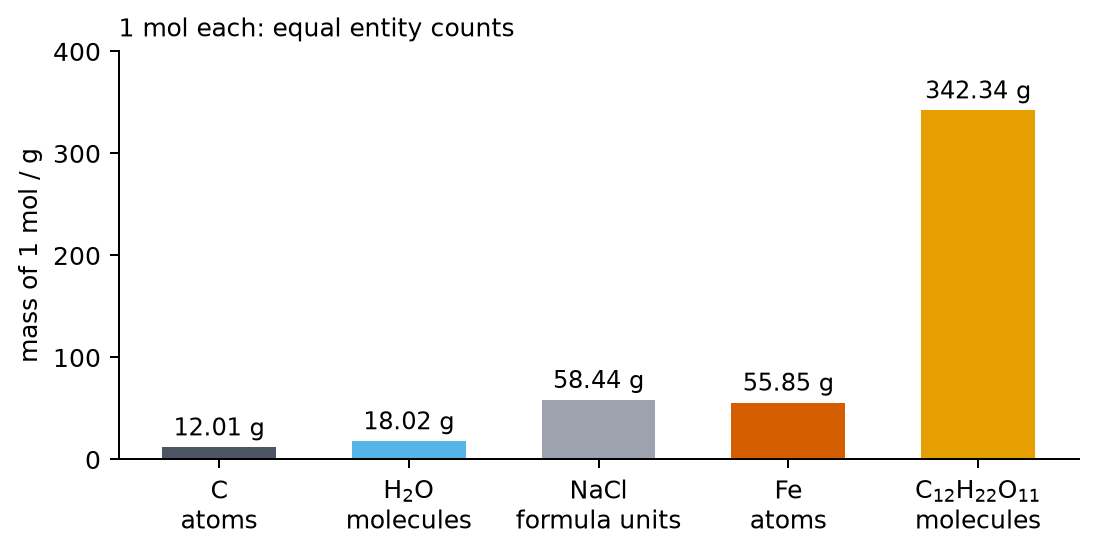
Does one mole of water molecules contain only one mole of atoms in total?
Dificuldade 1/5 · Moedas 100 + pequeno bônus na primeira conclusão hoje
Use the chemical formula to count the constituents per entity.
S1.4: Count ions from formula units
- Assuming complete dissociation,0.200 mol CaCl₂ gives 0.200 mol Ca²⁺ and 0.400 mol Cl⁻. Adding these gives 0.600 mol ions, rather than 0.200 mol total ions.
- Specify complete dissociation when using the stoichiometric ion count; association or incomplete dissociation can change the free-particle count. A formula unit is a composition ratio, not already the sum of all constituent ions.
How much total ion amount follows from 0.200 mol fully dissociated CaCl₂?
Dificuldade 1/5 · Moedas 100 + pequeno bônus na primeira conclusão hoje
Complete dissociation is CaCl₂ → Ca²⁺ + 2Cl⁻. From 0.200 mol salt, n(Ca²⁺) = 0.200 mol and n(Cl⁻) = 2 × 0.200 = 0.400 mol. Total ion amount = 0.200 + 0.400 = 0.600 mol.
Find total ion amount from 0.200 mol completely dissociated CaCl₂.
Dificuldade 2/5 · Moedas 140 + pequeno bônus na primeira conclusão hoje
0.200+2×0.200=0.600 mol ions.
S1.4: Distinguish relative mass and molar mass
- Relative atomic mass 相对原子质量 is a dimensionless weighted mean on the carbon-12 reference scale. Relative formula mass 相对式量 adds the relative atomic masses in the formula, including brackets and subscripts.
- For CaCO₃,40.08+12.01+3 × 16.00 = 100.09. At course precision, molar mass has the corresponding numerical value 100.09 g/mol; it is a different quantity with a mass-per-amount unit.
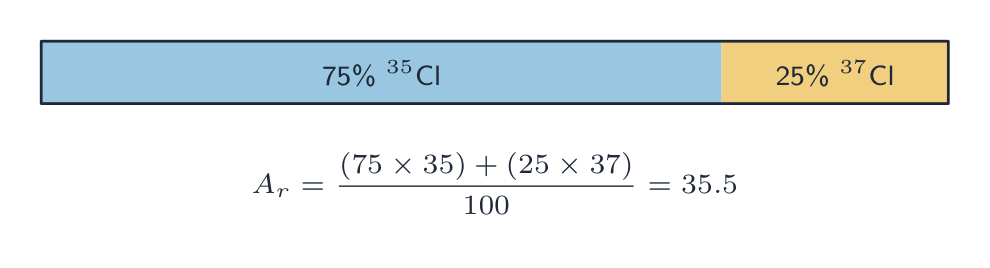
Which quantity has units g/mol?
Dificuldade 1/5 · Moedas 100 + pequeno bônus na primeira conclusão hoje
Relative mass is a ratio; molar mass converts grams and moles.
S1.4: Check a bracketed formula
- Ca(OH)₂ contains one Ca, two O and two H atoms per formula unit. Its molar mass is 40.08+2 × (16.00+1.01) = 74.10 g/mol using the stated course values.
- NH₄NO₃ contains two nitrogen atoms, four hydrogen atoms and three oxygen atoms. A subscript applies to the preceding symbol or bracketed group; do not silently distribute it across unrelated parts of a formula.
How many oxygen atoms occur in one Ca(OH)₂ formula unit?
Dificuldade 1/5 · Moedas 100 + pequeno bônus na primeira conclusão hoje
The outside subscript multiplies the complete bracketed group.
S1.4: Route mass through amount
- Use n = m/M with matching units, then N = nNₐ. For 4.4 g CO₂, M = 44.01 g/mol gives n = 0.0999773…mol, not a count of 0.0999773 molecules.
- Using rounded course Nₐ, N = 6.018632… × 10²² molecules, reported 6.0 × 10²² to two significant figures. Keep guard digits in the intermediate amount and label the final entity.
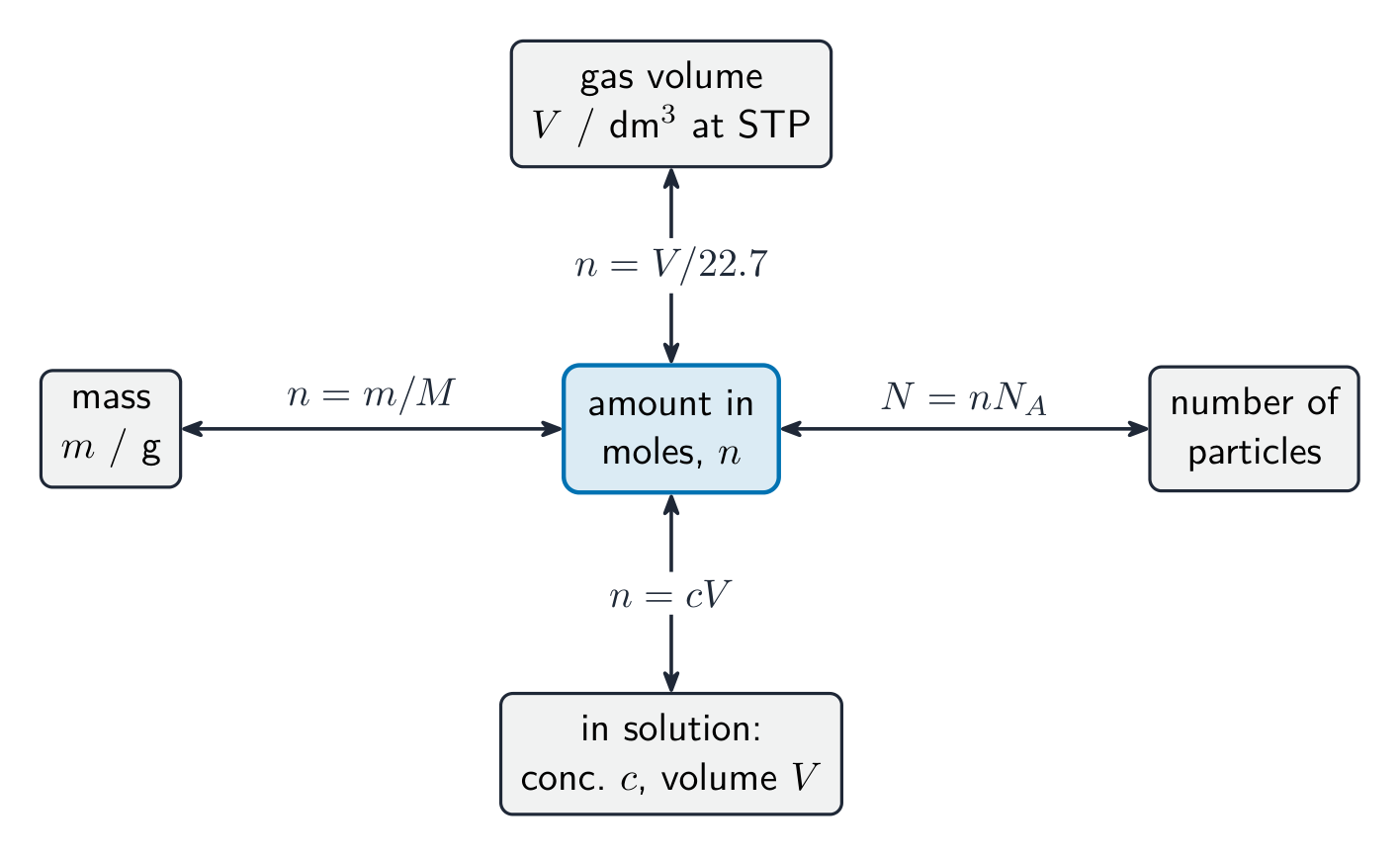
What quantity is obtained by dividing grams by g/mol?
Dificuldade 1/5 · Moedas 100 + pequeno bônus na primeira conclusão hoje
Units provide an independent route check.
For 4.4 g CO₂, M=44.01 g/mol,Nₐ=6.02×10²³, find coefficient a in N=a×10²² molecules.
Dificuldade 2/5 · Moedas 140 + pequeno bônus na primeira conclusão hoje
First convert mass to amount: n = m/M = 4.4/44.01 = 0.09997728… mol CO₂. Then N = nNₐ = (4.4/44.01) × 6.02 × 10²³ = 6.018632… × 10²² molecules. Thus coefficient a = 6.018632…, or 6.0 at the two- significant-figure mass precision.
S1.4: Work the reverse mass route
- A supplied 3.01 × 10²³ oxygen molecules divided by course Nₐ = 6.02 × 10²³ mol⁻¹ gives 0.500 mol O₂. Multiply by 32.00 g/mol to get 16.0 g.
- Do not use 16.00 g/mol for an O₂ molecule: that value refers to oxygen atoms. The entity and formula determine which molar mass belongs in the conversion.
Which molar mass belongs to O₂ in this course calculation?
Dificuldade 1/5 · Moedas 100 + pequeno bônus na primeira conclusão hoje
A molecule has two oxygen atoms.
S1.4: Calculate mass percentage
- For Fe₂O₃, the iron contribution is 2 × 55.85 = 111.70 and total relative formula mass is 159.70. Iron percentage = 111.70/159.70 × 100 = 69.9436…%, reported 69.9%.
- The denominator is the mass of the whole specified compound, not just its oxygen or metal part. Percent atom counts and mass percentages are different because the atoms have different masses.
Does two iron atoms out of five total atoms imply 40% iron by mass?
Dificuldade 1/5 · Moedas 100 + pequeno bônus na primeira conclusão hoje
Weight each element by its relative atomic mass.
Find iron mass percentage in Fe₂O₃ using Fe 55.85 and O 16.00.
Dificuldade 2/5 · Moedas 140 + pequeno bônus na primeira conclusão hoje
In one mole Fe₂O₃, iron mass = 2 × 55.85 = 111.70 g. Total mass = 111.70 + 3 × 16.00 = 159.70 g. Iron percentage = iron mass/total mass × 100 = 111.70/159.70 × 100 = 69.9436…%.
S1.4: Convert composition to an empirical ratio
- An empirical formula 实验式 gives the simplest whole-number atom ratio. With percentage data, a 100 g basis makes the numerical percentages masses in grams; divide each by its relative atomic mass.
- Then divide every amount by the smallest to obtain a ratio. A carbon/hydrogen ratio 1:2 gives CH₂, but a mass ratio 1:2 would not imply the same atom ratio because carbon and hydrogen atoms have different masses.
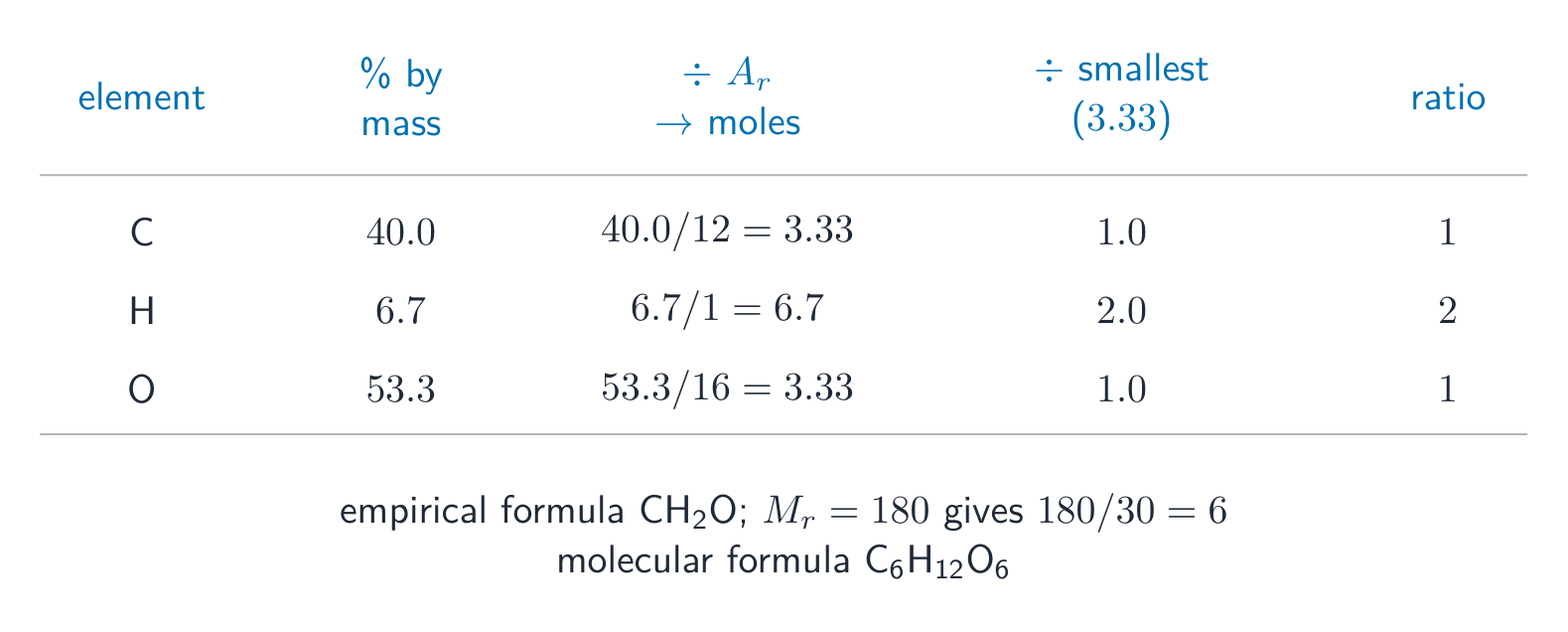
May raw mass percentages be read directly as atom-number subscripts?
Dificuldade 1/5 · Moedas 100 + pequeno bônus na primeira conclusão hoje
Moles, not grams, give the atom ratio.
S1.4: Recognize simple fractions carefully
- A normalized amount ratio 1:1.5 is not rounded directly to 1:2. Multiply both entries by 2 to obtain 2:3. Ratios near thirds or quarters may require multiplying every entry by 3 or 4.
- Use the precision and uncertainty of the measured composition. A value 1.49 may support 1.5 within uncertainty, but forcing a clearly inconsistent value into a convenient integer can conceal contamination or a wrong assumption.
How should an exact 1:1.5 ratio be made whole-number?
Dificuldade 1/5 · Moedas 100 + pequeno bônus na primeira conclusão hoje
Scale the entire ratio; do not change its proportions.
S1.4: Recover a molecular formula 分子式
- The molecular formula is a whole-number multiple of an empirical formula for a molecular substance. With empirical CH₂ of relative mass 14.03 and supplied molecular relative mass 56.12, the multiplier is 56.12/14.03 = 4.
- The molecular formula is C₄H₈. Composition alone would not give this multiplier or a unique structure; several molecules can share an empirical formula or even a molecular formula.
Can CH₂ alone establish a unique molecular formula and structure?
Dificuldade 1/5 · Moedas 100 + pequeno bônus na primeira conclusão hoje
Separate composition ratio, molecule size and structure.
S1.4: Infer hydrate water using unrounded amounts
- In an invented CuSO₄ hydrate result, initial 2.50 g leaves 1.60 g anhydrous salt: water loss 0.90 g. With supplied molar masses 18.02 and 159.62 g/mol, the mole ratio is (0.90/18.02) / (1.60/159.62) = 4.98259….
- That ratio is consistent with x = 5 at the supplied precision, not an exact measurement of 4.98259 water molecules per formula unit. Calculate the ratio from unrounded amounts before interpreting a simple whole-number formula.
Which ratio gives water of crystallization x?
Dificuldade 1/5 · Moedas 100 + pequeno bônus na primeira conclusão hoje
Convert both masses to amounts before comparing their ratio.
A 2.50 g hydrate leaves 1.60 g unchanged anhydrous salt after complete dehydration. Assume only water is lost. Use M(water) = 18.02 and M(anhydrous salt) = 159.62 g/mol. Calculate the unrounded water/salt mole ratio.
Dificuldade 2/5 · Moedas 140 + pequeno bônus na primeira conclusão hoje
Water mass = 2.50 − 1.60 = 0.90 g. Convert each mass to amount: n(water) = 0.90/18.02 = 0.0499445… mol and n(salt) = 1.60/159.62 = 0.0100238… mol. Ratio = n(water)/n(salt) = 4.98258879…, consistent with five waters per formula unit at the supplied precision.
S1.4: Evaluate the hydrate assumptions
- Inferring water content assumes the lost mass is water and the residue is the unchanged anhydrous salt. Incomplete dehydration makes apparent water loss too small; spitting or decomposition can make it too large.
- Follow an approved protocol and compare repeated cooled masses after safe heating to constant mass. Colour change alone does not prove complete drying, and constant mass alone cannot exclude every decomposition or contamination problem.
Does a white appearance alone prove complete dehydration without decomposition?
Dificuldade 1/5 · Moedas 100 + pequeno bônus na primeira conclusão hoje
An observation supports a model only with the necessary conditions.
S1.4: Use final solution volume
- Molar concentration is c = n/V with the volume of the final solution. Use dm³ with mol/dm³; 250 cm³ = 0.250 dm³. Mass concentration in g/dm³ equals molar concentration times molar mass.
- For 5.85 g NaCl made up to 250 cm³, c = 5.85/58.44/0.250 = 0.4004107…mol/dm³, reported 0.400. Mass concentration is 5.85/0.250 = 23.4 g/dm³.
Which volume belongs in concentration of a prepared solution?
Dificuldade 1/5 · Moedas 100 + pequeno bônus na primeira conclusão hoje
A volume of water added is not automatically the final solution volume.
Find unrounded molar concentration for 5.85 g NaCl, M 58.44 g/mol, final 250 cm³solution.
Dificuldade 2/5 · Moedas 140 + pequeno bônus na primeira conclusão hoje
Amount n = m/M = 5.85/58.44 = 0.1001026694… mol. Convert the final volume: 250 cm³ = 0.250 dm³. Then c = n/V = (5.85/58.44)/0.250 = 0.4004106776… mol/dm³.
S1.4: Prepare a standard solution 标准溶液
- A standard solution has accurately known concentration. Use suitable known-purity material, weigh accurately, dissolve in less than final volume, and transfer quantitatively with rinsings into a volumetric flask.
- At the appropriate calibration temperature, set the meniscus to the mark at eye level, stopper and mix thoroughly. The stated amount must reach the flask; incomplete transfer and an incorrect final volume change the actual concentration.
Why rinse the dissolving vessel into the volumetric flask?
Dificuldade 1/5 · Moedas 100 + pequeno bônus na primeira conclusão hoje
Quantitative transfer preserves the intended amount.
S1.4: Conserve solute 溶质 in a dilution
- For simple dilution without reaction or solute loss, n is conserved and c₁V₁ = c₂V₂. A 10.0 cm³ aliquot at 0.500 mol/dm³ contains 0.00500 mol.
- Making it up to 250 cm³ final solution gives c₂ = 0.00500/0.250 = 0.0200 mol/dm³. Adding 250 cm³ water is a different instruction; liquid volumes need not simply add. Follow the approved procedure for the actual reagent.
Does making a solution up to 250 cm³mean adding 250 cm³water?
Dificuldade 1/5 · Moedas 100 + pequeno bônus na primeira conclusão hoje
Read whether the volume is an aliquot, solvent added or final solution.
Find concentration from 10.0 cm³at 0.500 mol/dm³made up to 250 cm³.
Dificuldade 2/5 · Moedas 140 + pequeno bônus na primeira conclusão hoje
The aliquot volume is 10.0 cm³ = 0.0100 dm³. Its solute amount is n = c₁V₁ = 0.500 × 0.0100 = 0.00500 mol. Dilution preserves this amount in a final 0.250 dm³, so c₂ = n/V₂ = 0.00500/0.250 = 0.0200 mol/dm³.
S1.4: Follow a serial dilution
- For an invented 0.200 mol/dm³ stock, transfer 10.0 cm³ and make up to 100.0 cm³: concentration becomes 0.0200 mol/dm³. Transfer 10.0 cm³ of that diluted solution and make up to 250.0 cm³.
- The final concentration is 0.200 × (10.0/100.0) × (10.0/250.0) = 0.000800 mol/dm³. Each step transfers only the solute in its aliquot; do not treat the whole first flask’s solute as though all of it entered the second flask.
What is conserved across each simple dilution?
Dificuldade 1/5 · Moedas 100 + pequeno bônus na primeira conclusão hoje
Track each transfer separately before multiplying dilution fractions.
Stock 0.200 mol/dm³is diluted 10.0 to 100.0 cm³, then 10.0 of that to 250.0 cm³. Find final concentration.
Dificuldade 2/5 · Moedas 140 + pequeno bônus na primeira conclusão hoje
For each dilution c₂ = c₁V₁/V₂. First concentration = 0.200 × 10.0/100.0 = 0.0200 mol/dm³. The second transfer uses only 10.0 cm³ of that solution: final concentration = 0.0200 × 10.0/250.0 = 0.000800 mol/dm³.
S1.4: State Avogadro’s model conditions
- Equal volumes of ideal gases at common temperature and pressure contain equal amounts and equal particle counts, independent of chemical identity. The relevant particles may be atoms or molecules.
- Negligible particle volume and neglected attractions underlie the ideal model. Real gases can depart from it, especially where density or attractions matter; equal amount alone does not fix volume without specifying temperature and pressure.
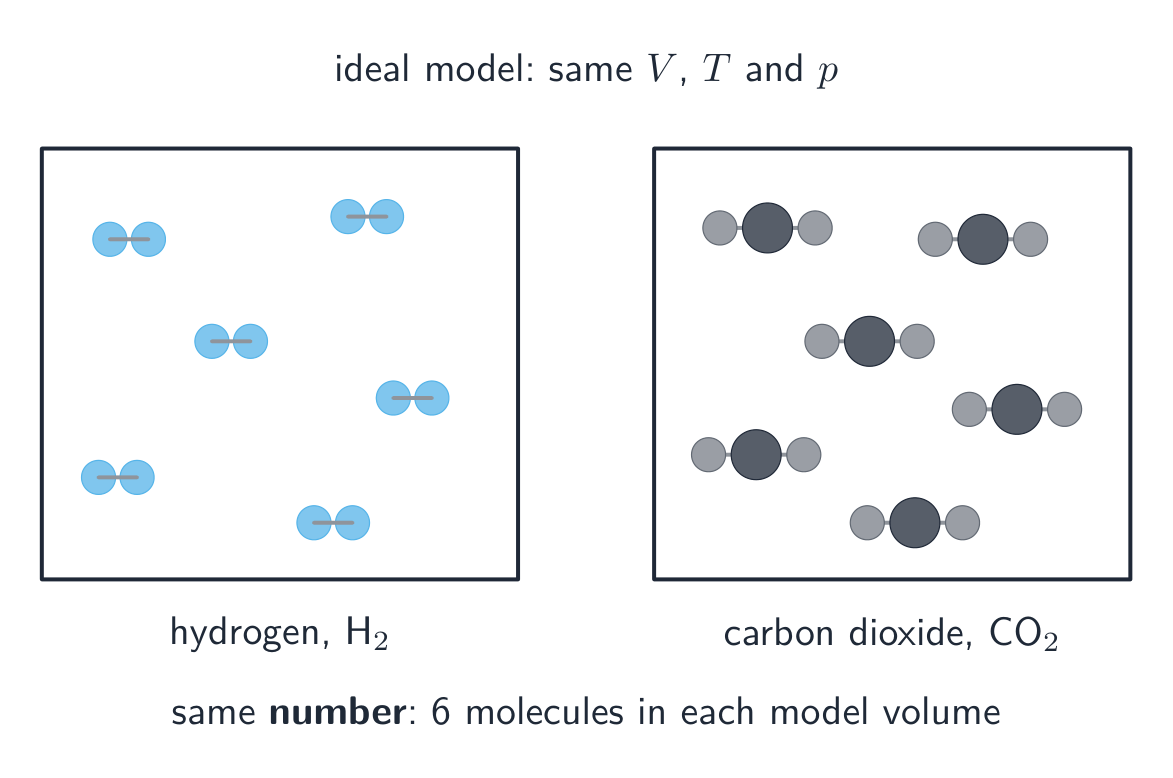
Do equal ideal-gas volumes need common T and p before equal counts follow?
Dificuldade 1/5 · Moedas 100 + pequeno bônus na primeira conclusão hoje
Keep the conditions attached to the proportionality.
S1.4: Use a molar volume 摩尔体积 at its conditions
- The booklet ideal-gas molar volume 22.7 dm³/mol applies at its stated STP, approximately 273 K and 100 kPa. Use n = V/Vₘwith compatible volume units.
- It is not a universal room-temperature molar volume. At other conditions use a suitable supplied molar volume or the ideal-gas equation with the correct pressure/temperature reference; unit 05 teaches that calculation in full.
Can 22.7 dm³/mol be used unchanged at any temperature and pressure?
Dificuldade 1/5 · Moedas 100 + pequeno bônus na primeira conclusão hoje
A molar volume is conditional on the physical state and conditions.
S1.4: Bound a reacting-gas volume ratio
- For complete methane combustion, one mole methane requires two moles oxygen and forms one mole carbon dioxide. Thus 20 cm³ CH₄ requires 40 cm³ O₂ and forms 20 cm³ CO₂ when dry ideal gases are compared at common T,p.
- Reaction extent, excess reactant and phases matter. Condensed liquid water is excluded from a dry gas count after cooling; hot or wet water vapour cannot simply be declared absent. A balanced coefficient is not a guaranteed actual collected volume.
Can hot water vapour always be omitted merely because a cooled equation labels water liquid?
Dificuldade 1/5 · Moedas 100 + pequeno bônus na primeira conclusão hoje
The physical collection conditions determine what is included.
S1.4: Check units and evidence before reporting
- An amount in mol, count of specified entities, mass in g and concentration in mol/dm³ are different results. Check the unit route and whether the question asks for all atoms, molecules, formula units or individual ions.
- For a calculated simple formula or concentration, retain intermediate precision and report to the data’s justified precision. In an experiment, purity, complete reaction, transfer losses and calibrated volumes can limit how closely the ideal calculation describes the sample.
Does a numerically tidy integer ratio by itself prove the experimental assumptions?
Dificuldade 1/5 · Moedas 100 + pequeno bônus na primeira conclusão hoje
Use calculations and measurement evidence together.
R2.1: Balance identities and charge
- A coefficient multiplies the whole chemical formula. Balance propane combustion as C₃H₈ + 5O₂ → 3CO₂ + 4H₂O: three carbons, eight hydrogens and ten oxygens occur on each side. Changing a subscript changes the substance, so H₂O₂ is not an alternative way of balancing H₂O.
- Ionic equations also conserve net charge: Ca²⁺(aq) + CO₃²⁻(aq) → CaCO₃(s) has zero charge on each side. For an ordinary chemical reaction in a closed system, include all substances in the mass balance. Gas escaping from an open flask lowers the measured flask-plus-contents mass without destroying atoms.
Which change balances an equation without changing chemical identities?
Dificuldade 1/5 · Moedas 100 + pequeno bônus na primeira conclusão hoje
Subscripts specify the compound; coefficients specify amounts.
R2.1: Build the mass amount ratio bridge
- The balanced equation gives ratios of entities or amounts in mol, not grams. For 2Mg + O₂ → 2MgO, Mg:MgO is 2:2 or 1:1. Use n=m/M, apply the ratio, then m=nM for the desired substance. M carries mass-per-mole units; a relative atomic or formula mass is dimensionless.
- For 4.86 g Mg with supplied M(Mg)=24.31 g/mol and M(MgO)=40.31 g/mol, use (4.86/24.31)×40.31=8.0587… g, reported as 8.06 g. The displayed 0.200 mol is rounded; retain unrounded values while calculating the next step.
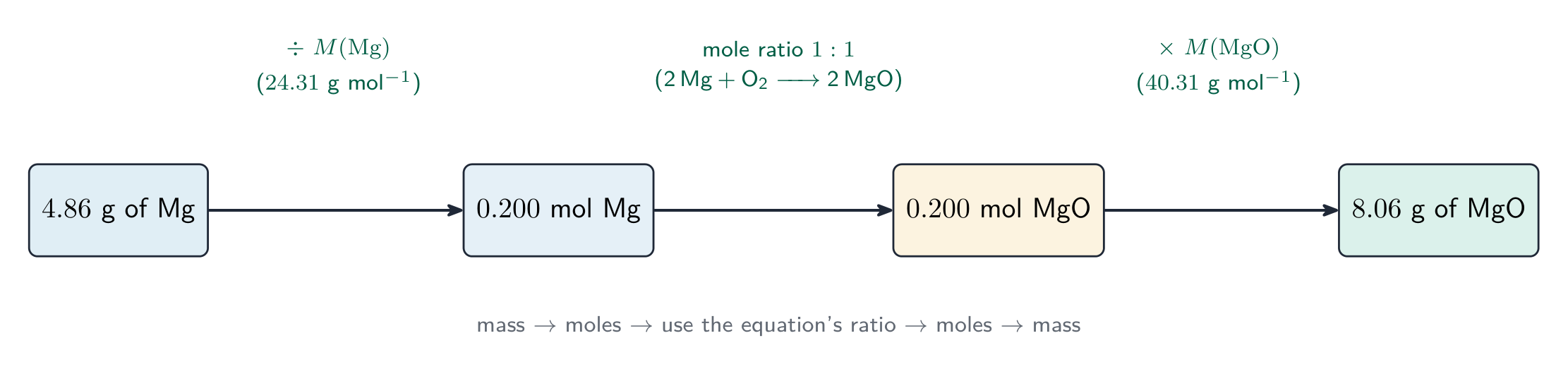
Does a 1:1 mole ratio imply equal masses of Mg and MgO?
Dificuldade 1/5 · Moedas 100 + pequeno bônus na primeira conclusão hoje
Converting an amount to mass requires the molar mass of that particular substance.
R2.1: Retain precision through a multistep calculation
- For 11.0 g propane, use M=44.11 g/mol. The balanced combustion equation consumes five moles oxygen per mole propane. Oxygen amount is 5×11.0/44.11=1.24688… mol; multiplying by 32.00 g/mol gives 39.9002… g, reported as 39.9 g.
- Rounding the oxygen amount to 1.25 mol before multiplying produces 40.0 g instead. A rounded value written for explanation need not replace the calculator value. Check that displayed multiplication and the reported result actually agree at the stated precision.
Which route preserves intermediate precision?
Dificuldade 1/5 · Moedas 100 + pequeno bônus na primeira conclusão hoje
Retain guard digits until the last result.
Give the mass of O₂ in g needed for 11.0 g propane: C₃H₈+5O₂→3CO₂+4H₂O; M(propane)=44.11 and M(O₂)=32.00 g/mol.
Dificuldade 2/5 · Moedas 140 + pequeno bônus na primeira conclusão hoje
Convert propane mass to amount: n(C₃H₈) = 11.0/44.11 = 0.2493765586… mol. The balanced equation needs five moles O₂ per mole propane, giving n(O₂) = 5 × 0.2493765586… = 1.246882793… mol. Oxygen mass = 1.246882793… × 32.00 = 39.9002… g, or 39.9 g. Retain unrounded values between steps; multiplying the propane mass directly by five would confuse mole and mass ratios.
R2.1: Compare hot gas volumes with explicit phases
- In an invented ideal-gas case, 40.0 cm³ H₂ and 30.0 cm³ O₂ react completely at 400 K and 100 kPa, with water remaining gaseous. From 2H₂ + O₂ → 2H₂O, 40.0 cm³ H₂ uses 20.0 cm³ O₂ and forms 40.0 cm³ steam at those same conditions.
- Hydrogen limits, leaving 10.0 cm³ oxygen. Total final gas volume is 50.0 cm³ at the original temperature and pressure. Cooling can change both gas volume and whether water condenses. A coefficient ratio alone does not justify counting hot steam as absent or comparing volumes at different temperatures.
An ideal mixture of 40.0 cm³ H₂ and 30.0 cm³ O₂ reacts completely: 2H₂ + O₂ → 2H₂O. All volumes are compared at 400 K and 100 kPa, with water remaining as steam. What is the final total gas volume?
Dificuldade 1/5 · Moedas 100 + pequeno bônus na primeira conclusão hoje
At common temperature and pressure, volumes follow the coefficients. Hydrogen consumes 40.0/2 = 20.0 cm³ O₂, leaving 30.0 − 20.0 = 10.0 cm³ O₂. The 2:2 H₂:H₂O ratio gives 40.0 cm³ steam. Final gas volume = 40.0 + 10.0 = 50.0 cm³.
An ideal-gas mixture contains 40.0 cm³ H₂ and 30.0 cm³ O₂, each measured at 400 K and 100 kPa. After complete reaction, find total gas volume in cm³ at those same conditions, with water remaining as steam.
Dificuldade 2/5 · Moedas 140 + pequeno bônus na primeira conclusão hoje
Use 2H₂ + O₂ → 2H₂O. At the same temperature and pressure, gas volumes follow the coefficient ratios. The 40.0 cm³ H₂ consumes 20.0 cm³ O₂, so hydrogen limits and 30.0 − 20.0 = 10.0 cm³ O₂ remains. The reaction forms 40.0 cm³ steam. Final total = 40.0 + 10.0 = 50.0 cm³. Counting only residual oxygen would incorrectly omit the gaseous water.
R2.1: Find the limiting reaction amount
- Divide each available amount by its coefficient. For 2Al + 3Cl₂ → 2AlCl₃, supplied masses 5.40 g Al and 14.2 g Cl₂ give about 0.200 mol of each. The ratios are about 0.100 and 0.0667, so chlorine limits. Equal starting mole amounts do not mean a stoichiometric mixture.
- Product amount is (14.2/70.90)×2/3=0.133521… mol. With supplied M(AlCl₃)=133.33 g/mol, theory predicts 17.8024… g, reported as 17.8 g. This assumes the indicated product and complete reaction; it is not an experimental guarantee.
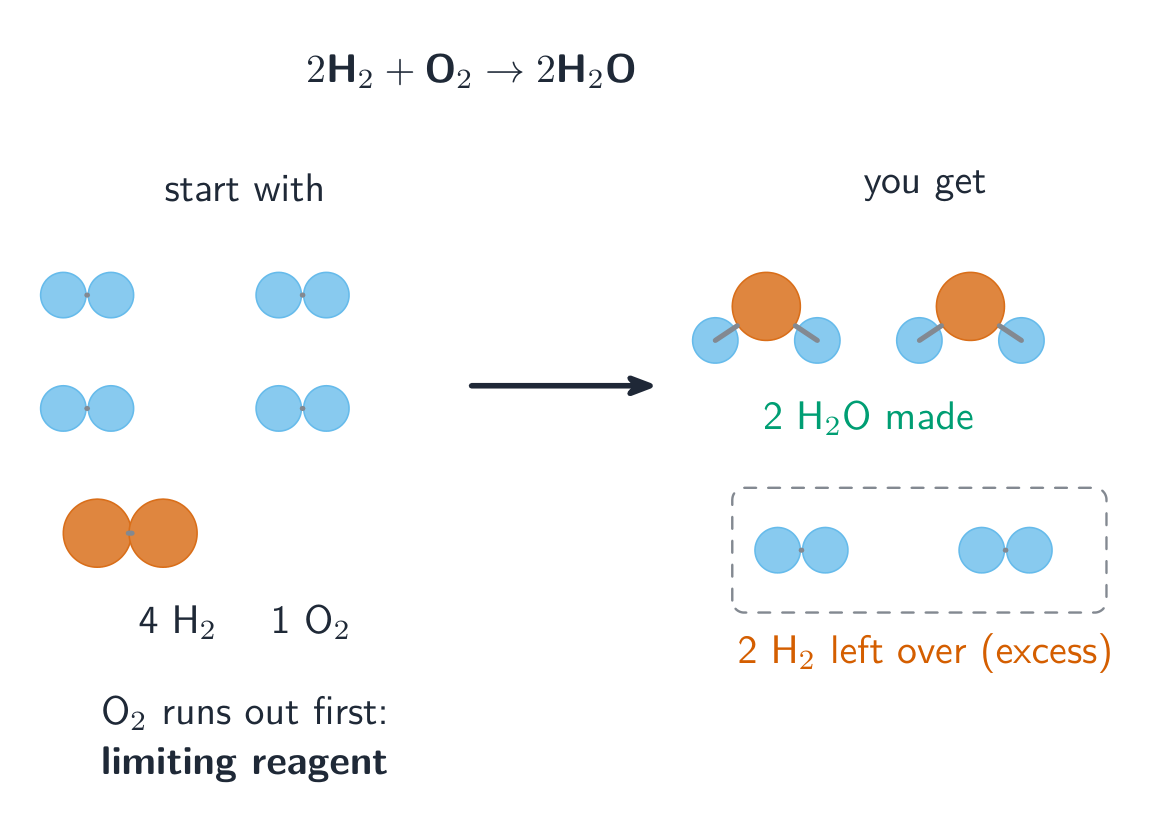
For 2Al + 3Cl₂ → 2AlCl₃, 0.200 mol Al and 0.200 mol Cl₂ are available. Which reactant limits?
Dificuldade 1/5 · Moedas 100 + pequeno bônus na primeira conclusão hoje
Compare amount/coefficient: Al gives 0.200/2 = 0.100 mol of reaction; Cl₂ gives 0.200/3 = 0.0667 mol. The smaller value belongs to Cl₂, so chlorine limits despite equal starting amounts.
R2.1: Calculate what remains of the excess
- In that aluminium/chlorine case, 0.133521… mol Al is consumed. Initially 5.40/26.98=0.200148… mol Al was present, so about 0.0666 mol remains. Multiplying by 26.98 gives approximately 1.80 g excess aluminium.
- Subtract amounts of the same species: initial Al minus consumed Al. Subtracting 14.2 g chlorine from 5.40 g aluminium compares different substances and has no meaning as a leftover mass. Use the balanced ratio before subtracting the excess.
Which subtraction finds leftover aluminium?
Dificuldade 1/5 · Moedas 100 + pequeno bônus na primeira conclusão hoje
The two terms must refer to the same chemical species.
R2.1: Solve a solution mixture with the combined volume
- Invented data: mix 25.0 cm³ CaCl₂ at 0.120 mol/dm³ with 40.0 cm³ Na₂CO₃ at 0.0500 mol/dm³. Calcium amount is 0.00300 mol; carbonate is 0.00200 mol. Their 1:1 precipitation produces 0.00200 mol CaCO₃, so carbonate limits.
- At supplied M(CaCO₃)=100.09 g/mol the dry solid mass is 0.200 g. Remaining Ca²⁺ is 0.00100 mol. Assuming additive volumes, quantitative precipitation and negligible dissolved solid, its concentration is 0.00100/0.0650=0.0154 mol/dm³. Spectator ions remain dissolved.
Mix 25.0 cm³ calcium chloride solution with 40.0 cm³ sodium carbonate solution. After precipitation, some Ca²⁺ remains dissolved. Assuming additive volumes and negligible solid volume, which volume belongs in its concentration calculation?
Dificuldade 1/5 · Moedas 100 + pequeno bônus na primeira conclusão hoje
The remaining Ca²⁺ occupies the mixed solution. Final volume = 25.0 + 40.0 = 65.0 cm³ = 0.0650 dm³. Use c = n(remaining Ca²⁺)/0.0650 when concentration is in mol/dm³.
R2.1: Separate actual yield from theoretical yield 理论产量
- Theoretical yield follows from the limiting reactant 限量反应物 and balanced equation. Percentage yield is actual desired product divided by theoretical desired product, multiplied by 100. Collecting 14.2 g AlCl₃ against theory 17.8024… g gives 79.8%. Compare the same named product on both sides.
- Incomplete reaction, side reactions and isolation losses can reduce a pure product yield. Apparent yield above 100% may indicate retained solvent, impurities or incorrect stoichiometry 化学计量. Wet or mixed solids are not a valid measurement of pure desired product mass; a value above 100% does not mean atoms were created.
What can explain an apparent product yield above 100%?
Dificuldade 1/5 · Moedas 100 + pequeno bônus na primeira conclusão hoje
Check purity, drying and the theoretical calculation.
R2.1: Weight every atom economy 原子经济性 coefficient
- Atom economy uses the balanced equation: coefficient-weighted mass of the desired product divided by the total stoichiometric reactant mass, times 100. Hydration C₂H₄ + H₂O → C₂H₅OH puts all reactant atoms in ethanol, giving 100% for that equation.
- Fermentation C₆H₁₂O₆ → 2C₂H₅OH + 2CO₂ gives 2×46.08/180.18×100=51.1% for ethanol with the supplied masses. Omitting the coefficient two would halve the answer. Atom economy does not include every solvent, energy input or experimental loss; assess those separately.
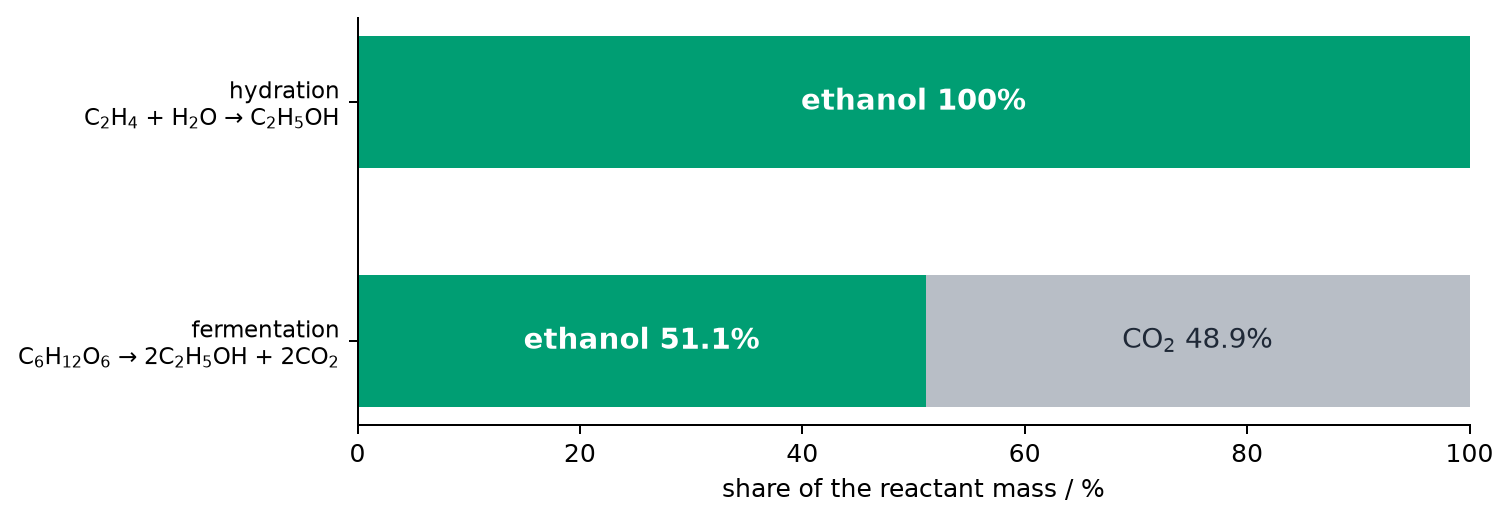
For fermentation C₆H₁₂O₆ → 2C₂H₅OH + 2CO₂, ethanol is the desired product and M(ethanol) = 46.08 g/mol. Which coefficient-weighted product mass belongs in the atom-economy numerator?
Dificuldade 1/5 · Moedas 100 + pequeno bônus na primeira conclusão hoje
The equation produces two moles ethanol per mole glucose. Desired-product mass per equation amount = 2 × 46.08 = 92.16 g. Using only 46.08 g would omit the product coefficient and halve the calculated atom economy.
R2.1: Infer purity only under justified assumptions
- An invented 1.25 g limestone sample produces 0.227 dm³ dry CO₂ at STP with excess acid. Assume only CaCO₃ produces gas and collection/reaction are complete. With 22.7 dm³/mol at 273.15 K and 100 kPa, the gas amount is 0.0100 mol, equal to the reacting CaCO₃ amount.
- At 100.09 g/mol this corresponds to 1.0009 g CaCO₃, so purity is 1.0009/1.25×100=80.1%. Lost CO₂ would make the inferred purity too low. For wet gas, the total pressure includes water vapour; use CO₂ partial pressure if supplied. A gas-based purity result is conditional on its reaction and collection model.
How does CO₂ escaping before measurement affect this inferred purity?
Dificuldade 1/5 · Moedas 100 + pequeno bônus na primeira conclusão hoje
Less measured CO₂ implies less inferred reacting carbonate.
Find CaCO₃ percentage purity for 1.25 g limestone yielding 0.227 dm³ dry CO₂ at STP. Use 22.7 dm³/mol and M(CaCO₃) = 100.09 g/mol. Assume only CaCO₃ produces CO₂, with excess acid and complete reaction and collection.
Dificuldade 2/5 · Moedas 140 + pequeno bônus na primeira conclusão hoje
Gas amount = 0.227/22.7 = 0.0100 mol CO₂. Each mole of CaCO₃ produces one mole CO₂ with excess acid, so CaCO₃ amount is also 0.0100 mol. Its mass is 0.0100 × 100.09 = 1.0009 g. Purity = 1.0009/1.25 × 100 = 80.072%, or 80.1%. This inference needs the stated gas source and complete collection; lost CO₂ would underestimate purity.