Titration and a defensible concentration
Introduzido| English | Significado |
|---|---|
| titre/ˈtɪtə/ | volume da titulação |
| titration/taɪˈtreɪʃn/ | A method of finding an unknown concentration by measuring the volume needed to react with a solution of known concentration. |
| equivalence point/ɪˈkwɪvələns pɔɪnt/ | ponto de equivalência |
| neutralization/ˌnjuːtrəlaɪˈzeɪʃn/ | The reaction of an acid with a base to form a salt and water. |
| coefficient/ˌkəʊɪˈfɪʃənt/ | A numerical or constant factor multiplying a term in an expression. |
| standard solution/ˈstændəd səˈluːʃn/ | A solution of accurately known concentration. |
| proton/ˈprəʊtɒn/ | A positively charged subatomic particle found in an atom's nucleus. |
| Brønsted–Lowry acid | A proton (H⁺) donor. |
| amphiprotic | Able both to donate and to accept a proton, like water. |
| strong acid/strɒŋ ˈæsɪd/ | An acid that essentially completely ionises in aqueous solution at the concentrations being considered. |
| weak acid/wiːk ˈæsɪd/ | An acid that only partially ionises in aqueous solution. |
What would explain this observation?
- A burette reading is not the delivered volume. The titre 滴定体积 is the difference between final and initial readings, and both readings have uncertainty.
Build the model
- A titration measures the amount of one solution needed to react with a known amount of another.
- The equation gives the mole ratio.
- An indicator endpoint approximates the equivalence point 化学计量点 when a suitable indicator is used.
- titre: The volume delivered between two burette readings.
- equivalence point: The point of stoichiometric reaction completion.

Why rinse the pipette with the solution it will transfer?
Dificuldade 1/5 · Moedas 100 + pequeno bônus na primeira conclusão hoje
Water left in the pipette would dilute the solution being transferred, so fewer moles are delivered than intended. Rinsing with the solution itself means what remains in the pipette has the right concentration.
Match each technical term to its precise meaning.
Dificuldade 2/5 · Moedas 140 + pequeno bônus na primeira conclusão hoje
Use the definitions to distinguish related quantities and processes.
Choose evidence that can test it
- Calculate the known amount first, apply the stoichiometric ratio, then divide by the unknown solution volume in cubic decimetres.
- Use concordant titres as required by the school method and report the accepted values.
In the lab: Rinse the burette with its solution and the pipette with the solution it transfers. Rinse the flask with distilled water. Add titrant slowly near the endpoint, swirl, and read the meniscus at eye level. Use a white tile and appropriate eye protection.
Which two habits make the investigation or model in this case more defensible?
Dificuldade 2/5 · Moedas 140 + pequeno bônus na primeira conclusão hoje
Stating the conditions and assumptions lets others repeat the work exactly, and recording the supporting evidence lets them check the conclusion. Hiding disagreeing results removes the evidence that could challenge a wrong conclusion, and one measurement can never establish a wider claim.
Work from known quantities
- Known: 25.0 cubic centimetres of acid reacts 1:1 with 20.0 cubic centimetres of 0.100 mol per cubic decimetre alkali. n = cV = 0.100×0.0200 = 0.00200 mol.
- Acid amount is 0.00200 mol. c = n/V = 0.00200/0.0250 = 0.0800 mol per cubic decimetre.
Your turn: Burette readings are 1.40 and 23.65 cubic centimetres. Calculate titre.
Readings, mole ratio and the original concentration
$V_{titre}=V_f-V_i,\quad n=cV$
Use both burette readings and the equation ratio. Added water dilutes the flask sample but leaves its solute amount unchanged.
Burette readings are 1.40 and 23.65 cubic centimetres. Calculate titre.
Dificuldade 2/5 · Moedas 140 + pequeno bônus na primeira conclusão hoje
The result is 22.25 cm³. Known: burette readings 1.40 and 23.65 cubic centimetres. Titre = final - initial = 23.65 - 1.40 = 22.25 cubic centimetres. Subtracting the initial reading means the burette need not start at zero.
Check the conclusion and its limits
- Adding distilled water to the flask changes volume but not the transferred amount of analyte.
- Do not average a rough titre with carefully measured concordant values.
Not true: A flask must be rinsed with analyte to avoid dilution of its mole amount. The pipette delivers a fixed AMOUNT of analyte into the flask; extra water in the flask changes the volume but not the moles present, and the titration measures moles. Rinsing the flask with analyte would add unknown extra moles and spoil the result.
- A titration measures the amount of one solution needed to react with a known amount of another.
- Calculate the known amount first, apply the stoichiometric ratio, then divide by the unknown solution volume in cubic decimetres.
- Watch for: adding distilled water to the flask changes volume but not the transferred amount of analyte.
Write from the data given
- Burette readings are 0.85 and 21.35 cubic centimetres.
- Find the titre. Extra water in the flask does not change the amount delivered by the pipette.
The pipette delivers a fixed AMOUNT of analyte into the flask; extra water in the flask changes the volume but not the moles present, and the titration measures moles.
Dificuldade 1/5 · Moedas 100 + pequeno bônus na primeira conclusão hoje
True. The pipette delivers a fixed AMOUNT of analyte into the flask; extra water in the flask changes the volume but not the moles present, and the titration measures moles. Rinsing the flask with analyte would add unknown extra moles and spoil the result.
The volume delivered between two burette readings: write the technical term.
Dificuldade 1/5 · Moedas 100 + pequeno bônus na primeira conclusão hoje
titre means The volume delivered between two burette readings.
Burette readings are 0.85 and 21.35 cubic centimetres. What is the titre, and why does extra water in the flask not change the analyte amount?
Titre is the final burette reading minus the initial reading. The pipette, not the flask rinse, sets the analyte amount.
Initial burette reading is 0.85 cm³ and final reading is 21.35 cm³. What is the titre?
Dificuldade 1/5 · Moedas 100 + pequeno bônus na primeira conclusão hoje
In the written case, 21.35 − 0.85 = 20.50 cubic centimetres. The earlier Your turn uses different readings, 1.40 and 23.65, and gives 22.25; do not substitute that separate case.
R2.1: Distinguish an endpoint from equivalence
- The equivalence condition is defined by the balanced reaction amounts. An indicator endpoint is an observed change used to stop delivery. A suitable indicator changes near equivalence; a repeatable colour alone does not establish that the inferred concentration is accurate.
- For H₂SO₄ + 2NaOH → Na₂SO₄ + 2H₂O, one mole acid reacts with two moles alkali in complete neutralization 中和. Equal acid and alkali volumes need not mean equal concentrations, and equal mole amounts are not the stoichiometric mixture for this equation.
What defines the equivalence condition?
Dificuldade 1/5 · Moedas 100 + pequeno bônus na primeira conclusão hoje
Use the equation ratio, rather than an arbitrary volume equality.
R2.1: Deliver a calibrated volume with finite uncertainty
- A volumetric pipette delivers a specified calibrated volume, not an exact uncertainty-free amount. Rinse it with the solution it will transfer so residual water does not dilute that portion. Follow the pipette type: do not force out a residual tip volume unless its design instructs that procedure.
- Rinse the conical flask with distilled water. Extra water there changes concentration and total volume but not the amount already transferred by the pipette. Rinsing the flask with analyte adds an unknown extra amount, undermining the calculation.
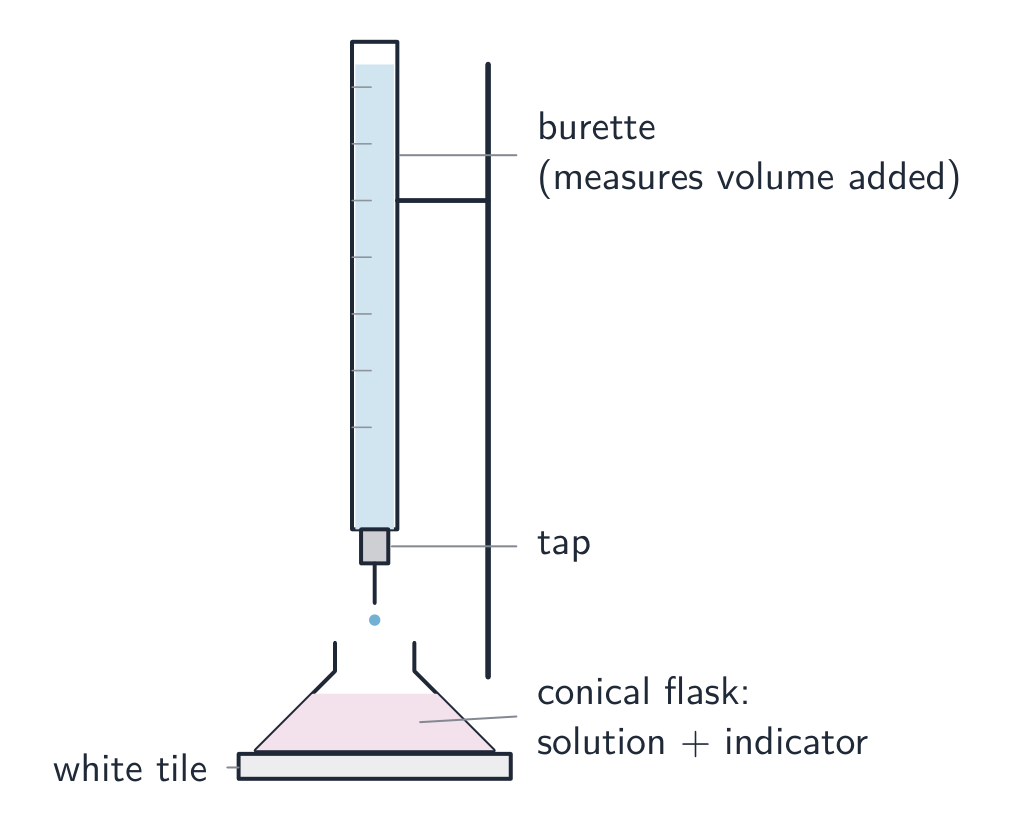
Why can distilled water remain in the conical flask?
Dificuldade 1/5 · Moedas 100 + pequeno bônus na primeira conclusão hoje
Titration stoichiometry concerns amounts, not the flask concentration alone.
R2.1: Read a delivered volume by subtraction
- A burette scale records a reading, not directly the delivered titre. For initial 22.10 and final 43.65 cm³, delivery is 21.55 cm³. The initial reading need not be zero. Read the meniscus at eye level to avoid parallax; for a clear aqueous solution use its bottom.
- Use the scale and stated uncertainty of the instrument. A common 0.1 cm³ graduated burette can be estimated to 0.05 cm³, but this is not a universal resolution for every device. Record both readings and their units before subtracting.
What titre follows from 22.10 and 43.65 cm³ readings?
Dificuldade 1/5 · Moedas 100 + pequeno bônus na primeira conclusão hoje
Titre = final burette reading − initial reading = 43.65 − 22.10 = 21.55 cm³. Subtract both readings rather than using the final reading alone.
Initial burette reading 22.10 and final reading 43.65 cm³: give the titre in cm³.
Dificuldade 2/5 · Moedas 140 + pequeno bônus na primeira conclusão hoje
The titre is the volume delivered, found by subtracting the initial burette reading from the final reading: 43.65 − 22.10 = 21.55 cm³. The final reading alone is not the delivered volume. Record both readings and their difference to the stated precision.
R2.1: Select concordant runs under a stated protocol
- Suppose careful titres are 21.55, 21.45 and 21.50 cm³, following a rough run of 22.10. For this school method, accept a careful set whose range is no more than 0.10 cm³. The three careful runs meet the stated criterion and average to 21.50 cm³.
- Exclude the rough run used to locate the approximate endpoint. A concordance tolerance belongs to the stated procedure and apparatus; it is not a universal definition. Close repeated results show precision under the procedure, while shared endpoint or calibration bias may still impair accuracy.
A rough titre is 22.10 cm³; careful titres are 21.55, 21.45 and 21.50 cm³. Accept careful runs whose range is at most 0.10 cm³, excluding the rough run. Which mean is appropriate?
Dificuldade 1/5 · Moedas 100 + pequeno bônus na primeira conclusão hoje
The careful range is 21.55 − 21.45 = 0.10 cm³, meeting the stated criterion. Mean = (21.55 + 21.45 + 21.50)/3 = 21.50 cm³. Exclude the rough 22.10 cm³ run used to locate the endpoint.
R2.1: Apply the acid alkali coefficient 系数 before concentration
- For the supplied case, 25.00 cm³ NaOH requires 21.50 cm³ of 0.100 mol/dm³ H₂SO₄. Acid amount is 0.100×0.02150=0.002150 mol. From H₂SO₄ + 2NaOH → Na₂SO₄ + 2H₂O, NaOH amount is 0.004300 mol.
- Divide by the pipetted alkali volume 0.02500 dm³: concentration is 0.172 mol/dm³. Dividing by the acid titre at this last step would describe the wrong solution. Label each amount and volume rather than using two unlabeled numbers in a memorized formula.
25.00 cm³ NaOH needs 21.50 cm³ of 0.100 mol/dm³ H₂SO₄ for complete neutralization: H₂SO₄ + 2NaOH → Na₂SO₄ + 2H₂O. What is the NaOH concentration?
Dificuldade 1/5 · Moedas 100 + pequeno bônus na primeira conclusão hoje
Acid amount n = cV = 0.100 × 0.02150 = 0.002150 mol. The 1:2 acid:alkali ratio gives 0.004300 mol NaOH. Divide by NaOH volume 0.02500 dm³: c = 0.004300/0.02500 = 0.172 mol/dm³.
25.00 cm³ NaOH needs 21.50 cm³ of 0.100 mol/dm³ H₂SO₄ in complete neutralization. Give NaOH concentration in mol/dm³.
Dificuldade 2/5 · Moedas 140 + pequeno bônus na primeira conclusão hoje
Complete neutralization follows H₂SO₄ + 2NaOH → Na₂SO₄ + 2H₂O. Acid amount = 0.100 × (21.50/1000) = 0.002150 mol. Twice this amount of NaOH reacts, giving 0.004300 mol in 25.00 cm³ = 0.02500 dm³. Therefore NaOH concentration = 0.004300/0.02500 = 0.172 mol/dm³. The 2:1 coefficient ratio is essential.
R2.1: Scale an aliquot back to its prepared solution
- In an original invented case, a sample is dissolved and made up to 250.0 cm³. A 25.00 cm³ aliquot needs 0.00200 mol titrant in a 1:1 reaction, so that aliquot contains 0.00200 mol analyte. The whole prepared solution contains 250.0/25.00=10.0 such portions.
- Total sample amount is therefore 0.0200 mol. If inferring an original stock concentration from a prior tenfold dilution, multiply the diluted concentration by ten. Distinguish this concentration factor from scaling an aliquot amount; applying the same preparation factor twice would overestimate the original sample.
A 25.00 cm³ aliquot of a well-mixed prepared solution contains 0.00200 mol analyte. How much analyte was in the full 250.0 cm³ prepared solution before sampling?
Dificuldade 1/5 · Moedas 100 + pequeno bônus na primeira conclusão hoje
The full volume contains 250.0/25.00 = 10.00 aliquot volumes. Total analyte amount = 0.00200 × 10.00 = 0.0200 mol. Apply this volume factor once; it scales amount rather than creating solute during dilution.
A 25.00 cm³ aliquot contains 0.00200 mol analyte. Give the amount in the full 250.0 cm³ prepared solution in mol.
Dificuldade 2/5 · Moedas 140 + pequeno bônus na primeira conclusão hoje
The full prepared volume is 250.0/25.00 = 10.00 aliquot volumes. For a well-mixed solution, amount scales with volume at the same concentration: 0.00200 × 10.00 = 0.0200 mol in the full solution. Taking an aliquot samples a fraction of the solution; dilution during preparation changes concentration without creating extra analyte.
R2.1: Estimate uncertainty in a difference
- If each burette reading has stated maximum uncertainty 0.05 cm³, adding the absolute uncertainties gives maximum titre uncertainty 0.10 cm³. Relative to 21.50 cm³, this is 0.10/21.50×100≈0.47%. Do not use just one reading uncertainty for a two-reading difference.
- This is a maximum-bound method, not the same quantity as a statistical standard error from repetitions. A concentration calculation can also depend on pipette and standard-solution 标准溶液 uncertainties. Repetition does not automatically remove calibration bias or indicator error.
What maximum titre uncertainty follows from two 0.05 cm³ reading uncertainties?
Dificuldade 1/5 · Moedas 100 + pequeno bônus na primeira conclusão hoje
For the stated maximum-bound method, add the two absolute reading uncertainties: 0.05 + 0.05 = 0.10 cm³. The uncertainty magnitudes do not subtract when the readings subtract.
R2.1: Trace an air bubble to the inferred result
- Check that the burette tip is full before starting, and remove the filling funnel before taking readings. If an initially air-filled tip fills during delivery, some apparent burette volume goes into the tip instead of the flask. The recorded delivery can exceed what actually reaches the analyte.
- When known titrant is used to infer analyte amount, that excessively large apparent titre can overestimate the inferred amount. State this setup when giving the direction: merely saying an air bubble causes error gives no causal explanation. Add slowly near the endpoint, swirl and use a white tile to judge a suitable indicator change.
In this setup, what does filling an initially empty tip during delivery tend to do?
Dificuldade 1/5 · Moedas 100 + pequeno bônus na primeira conclusão hoje
Some apparent volume fills the tip instead of reacting in the flask.
R2.1: Explain precision and accuracy separately
- An unsuitable indicator may give consistently similar endpoints at a volume different from stoichiometric equivalence. A miscalibrated instrument can also produce close repeated readings. Concordant titres are useful evidence of repeatability, but they do not alone validate every assumption.
- Evaluate a result by linking the source of error to a quantity and then to the calculated concentration. For example, residual water diluting a known burette solution means more volume may be needed; using the undiluted stated concentration can then overestimate analyte amount. Identify a specific correction and the assumption it addresses.
Do concordant titres alone prove an accurate concentration?
Dificuldade 1/5 · Moedas 100 + pequeno bônus na primeira conclusão hoje
Separate repeatability from agreement with the correct value.
R3.1: Follow the proton 质子 rather than the familiar name
- A Brønsted–Lowry acid 布朗斯特-劳里酸 donates a proton and a base accepts one. In HCl + H₂O → H₃O⁺ + Cl⁻, HCl is the donor and water the acceptor. In NH₃ + H₂O ⇌ NH₄⁺ + OH⁻, water is the donor and ammonia the acceptor. The role belongs to the particular reaction.
- H⁺(aq) represents a hydrated proton, often written H₃O⁺. Ammonia and water use available lone pairs to accept the proton. The general definition is proton acceptance; do not replace it with the claim that every acid–base reaction under every chemical definition must involve protons.
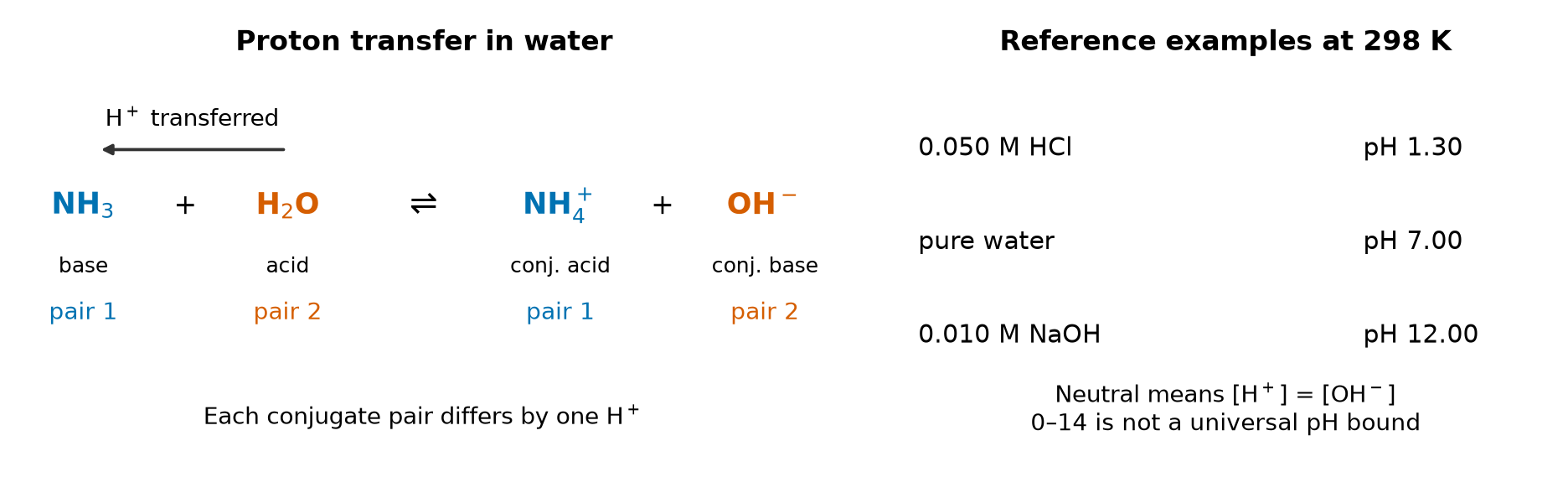
Which species donates the proton when ammonia reacts with water?
Dificuldade 1/5 · Moedas 100 + pequeno bônus na primeira conclusão hoje
Water loses H⁺ to become OH⁻ in this equation.
R3.1: Pair species that differ by one proton
- NH₃/NH₄⁺ and H₂O/OH⁻ are conjugate pairs. Partners differ by one H⁺ and one unit of charge. NH₃ and H₂O react with each other here, but they are not a conjugate pair. Identify what remains after the named acid loses its proton.
- For NH₄⁺ the conjugate base is NH₃; for HCO₃⁻ it is CO₃²⁻. The conjugate acid of HCO₃⁻ is H₂CO₃. Removing H⁺ makes the charge one unit more negative; adding it makes the charge one unit more positive.
What is the conjugate base of HCO₃⁻?
Dificuldade 1/5 · Moedas 100 + pequeno bônus na primeira conclusão hoje
Both the hydrogen count and charge must change correctly.
R3.1: Show both amphiprotic 两性的 roles with equations
- An amphiprotic species can donate or accept a proton. HCO₃⁻ + H₂O ⇌ CO₃²⁻ + H₃O⁺ shows acid behaviour. HCO₃⁻ + H₂O ⇌ H₂CO₃ + OH⁻ shows base behaviour. Each conserves atoms and total charge. Water is another amphiprotic example.
- The formula alone does not select which role dominates in a given mixture. Identify the other proton donor or acceptor and the equilibrium involved. H₂PO₄⁻ and HSO₄⁻ can also participate as amphiprotic species in appropriate reactions.
What evidence demonstrates amphiprotic behaviour?
Dificuldade 1/5 · Moedas 100 + pequeno bônus na primeira conclusão hoje
Both possible roles are required.
R3.1: Distinguish a base from an alkali
- A base neutralizes an acid; an alkali produces an alkaline aqueous solution. CuO is a basic oxide but is not a soluble alkali. Aqueous ammonia is an alkali because NH₃ accepts H⁺ from water, producing OH⁻, even though its formula contains no OH group.
- NH₃ + HCl → NH₄Cl forms a salt without forming water. Likewise CH₃NH₂ + HCl → CH₃NH₃Cl. The shortcut acid + base → salt + water describes hydroxide or oxide neutralization, not every proton-transfer base.
Does ammonia neutralization by HCl require water as a product?
Dificuldade 1/5 · Moedas 100 + pequeno bônus na primeira conclusão hoje
Proton acceptance by ammonia directly forms NH₄⁺.
R3.1: Calculate pH and read its logarithmic meaning
- For the dilute concentration model, pH = −log₁₀[H⁺] with concentration numerical values in mol/dm³. Supplied [H⁺]0.050 gives pH 1.30. A pH decrease of one corresponds to a tenfold increase in hydrogen-ion activity, approximated here by concentration.
- Conversely pH 3.40 gives [H⁺] = $10^{-3.40}$≈4.0 × 10⁻⁴ mol/dm³. On ordinary linear axes, pH against [H⁺] is a decreasing logarithmic curve, not a straight line. pH 0–14 is a familiar dilute-water range, not a universal bound.
What concentration factor corresponds to a pH fall from 3 to 2 in the dilute model?
Dificuldade 1/5 · Moedas 100 + pequeno bônus na primeira conclusão hoje
In the dilute model, [H⁺] ≈ 10^(−pH). The ratio after a fall from pH 3 to pH 2 is 10^(−2)/10^(−3) = 10, so hydrogen-ion concentration increases tenfold.
R3.1: Match pH measurement to the required precision
- Universal indicator is a mixture whose colour gives an approximate pH using its chart. Coloured samples and lighting can interfere. It normally cannot establish a difference of 0.05 pH unit. A probe gives a numerical reading but does not guarantee accuracy merely by displaying decimal places.
- Calibrate with suitable standard buffers, rinse between samples, allow stabilization and control or account for temperature. For calculated pH, decimal places usually reflect significant figures in the supplied concentration; this reporting convention does not improve experimental calibration.
Which method can support a small pH difference if properly calibrated?
Dificuldade 1/5 · Moedas 100 + pequeno bônus na primeira conclusão hoje
Measurement resolution and accuracy must support the stated comparison.
R3.1: Use ion equality to define neutral water
- Kw = [H⁺][OH⁻] and depends on temperature. At 298 K use the supplied 1.00 × 10⁻¹⁴. Neutrality means [H⁺] = [OH⁻]; acidic solutions have more H⁺ and alkaline solutions more OH⁻. Neutral pH 7.00 follows only for that Kw.
- At a stated temperature with Kw 4.00 × 10⁻¹⁴, neutral [H⁺] = sqrt(Kw) = 2.00 × 10⁻⁷ mol/dm³, giving pH 6.70. The solution is still neutral. Heating can increase water ionization because the process is endothermic; pH below seven alone does not classify every temperature.
Is water with equal H⁺ and OH⁻ concentrations acidic merely because its pH is 6.70?
Dificuldade 1/5 · Moedas 100 + pequeno bônus na primeira conclusão hoje
Kw changes with temperature.
At the stated temperature Kw 4.00e−14. Give the neutral pH.
Dificuldade 2/5 · Moedas 140 + pequeno bônus na primeira conclusão hoje
Neutrality means [H⁺] = [OH⁻], so each concentration is √Kw = √(4.00 × 10⁻¹⁴) = 2.00 × 10⁻⁷ mol/dm³. Therefore neutral pH = −log₁₀(2.00 × 10⁻⁷) = 6.69897… , about 6.70. Equivalently it is half of pKw = 13.39794… . Neutral pH depends on temperature through Kw; it is not always seven.
R3.1: Count ions before calculating strong acid 强酸 or alkali pH
- At concentrations well above the water contribution, a fully ionized monoprotic strong acid supplies approximately one H⁺ per acid formula unit. HCl 0.0025 mol/dm³ therefore gives pH 2.60. Fully dissociated NaOH supplies one OH⁻ per formula unit; dissolved Ba(OH)₂ supplies two.
- At 298 K, KOH 0.050 mol/dm³ gives [H⁺] = 10⁻¹⁴/0.050 = 2.0 × 10⁻¹³ and pH 12.70. State the temperature and formula stoichiometry. Extremely dilute solutions require consideration of water itself; the shortcut must not predict acidic pH for pure strong alkali.
How many OH⁻ ions does each dissolved Ba(OH)₂ formula unit supply on complete dissociation?
Dificuldade 1/5 · Moedas 100 + pequeno bônus na primeira conclusão hoje
The subscript two belongs to the entire hydroxide group.
At 298 K, supplied 0.050 mol/dm³ KOH fully dissociates. Give pH with Kw 1.00e−14.
Dificuldade 2/5 · Moedas 140 + pequeno bônus na primeira conclusão hoje
Complete dissociation gives [OH⁻] = 0.050 mol/dm³ in this model. Thus pOH = −log₁₀(0.050) = 1.30103… . At 298 K the supplied Kw gives pKw = 14.00, so pH = 14.00 − 1.30103… = 12.69897… , about 12.70. Taking the negative logarithm of hydroxide gives pOH first, not pH.
R3.1: Separate strength from concentration
- Strong acids such as HCl and HNO₃ ionize essentially completely in dilute water. Weak acids 弱酸 such as ethanoic acid ionize partly; ammonia and amines are weak bases. Sulfuric acid has a strong first ionization, but treating both protons as fully dissociated at every concentration is too broad.
- Concentration is amount per volume, while strength describes equilibrium ionization. A dilute strong acid can have higher pH than a concentrated weak acid. Conjugate acid/base strength is inverse at a fixed temperature and solvent, and proton-transfer equilibria favour the weaker acid and base.
Can a dilute strong acid have higher pH than a concentrated weak acid?
Dificuldade 1/5 · Moedas 100 + pequeno bônus na primeira conclusão hoje
Keep equilibrium strength and amount per volume separate.
R3.1: Compare acids with controlled conditions
- At the same 0.10 mol/dm³ concentration and temperature, HCl has lower pH and generally higher conductivity than ethanoic acid. With comparable magnesium surface it often has a faster initial gas-production rate. The signals depend on mobile ions, reaction conditions and apparatus.
- Equal volumes of those monoprotic acids contain equal acid amounts. With excess magnesium, complete reaction and equal gas conditions, they can give the same final hydrogen amount. Weak acid continues ionizing as H⁺ is consumed. A slower initial rate does not mean fewer total neutralizable protons.
Why can equal amounts of these monoprotic acids need equal hydroxide amounts?
Dificuldade 1/5 · Moedas 100 + pequeno bônus na primeira conclusão hoje
Equilibrium can shift as the reaction consumes an ionized product.
R3.1: Balance neutralization and name the salt
- CuO + 2HCl → CuCl₂ + H₂O and Na₂CO₃ + 2HCl → 2NaCl + H₂O + CO₂ each need two protons per oxide or carbonate unit. NaHCO₃ + HCl → NaCl + H₂O + CO₂ needs only one. Use the formula and charge balance rather than copying one coefficient pattern.
- For CH₃COOH + NaOH → CH₃COONa + H₂O, the parent acid of sodium ethanoate is ethanoic acid. Ammonium nitrate can be made from nitric acid and ammonia. A salt is not necessarily neutral in solution; parent identities help explain hydrolysis at higher level.
What parent base can form ammonium nitrate with nitric acid?
Dificuldade 1/5 · Moedas 100 + pequeno bônus na primeira conclusão hoje
Ammonia gains a proton to form the ammonium ion.
R3.1: Isolate a soluble salt without unwanted excess
- For a soluble salt made from acid and an insoluble basic oxide, add oxide until some remains, filter off that excess, concentrate the filtrate carefully and allow crystals to form. Wash and dry appropriately. Unfiltered excess solid would contaminate the product.
- When both reactants are soluble, establish the reacting amounts by titration, then repeat those amounts without indicator before concentrating. Otherwise excess soluble reactant or indicator can remain in the crystals. Evaporating all hydrated salts to complete dryness is not a universal preparation rule.
Why filter after adding excess insoluble oxide to an acid?
Dificuldade 1/5 · Moedas 100 + pequeno bônus na primeira conclusão hoje
Ordinary filtration separates insoluble particles rather than dissolved ions.
R3.1: Read a strong strong titration with its conditions
- For an invented ideal titration, 25.0 cm³ 0.100 mol/dm³ HCl receives 0.100 mol/dm³ NaOH at 298 K. It starts at pH 1.00 and reaches equivalence at 25.0 cm³ with pH 7.00. Equal stoichiometric amounts, not universally equal volumes, define equivalence.
- The steep region depends on concentration and addition size; one drop does not produce a universal pH jump in every titration. Record smaller volume increments near equivalence, mix and wait for stable readings. Beyond equivalence, use excess OH⁻ and the total mixed volume if calculating pH.
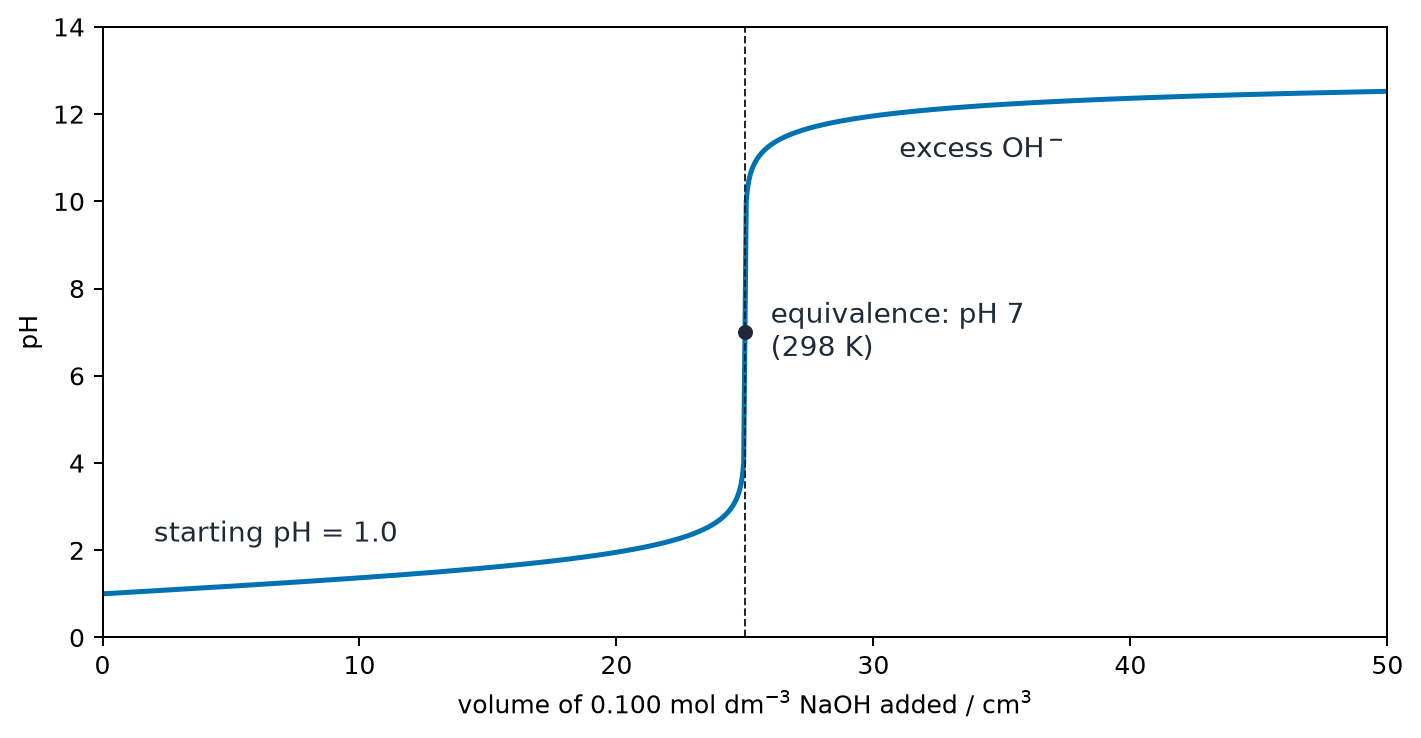
What determines the equivalence point?
Dificuldade 1/5 · Moedas 100 + pequeno bônus na primeira conclusão hoje
Volumes imply the right amounts only with the appropriate concentrations and coefficients.
AHL R3.1: Connect pOH with the stated Kw
- pOH = −log₁₀[OH⁻]. Taking logarithms of Kw = [H⁺][OH⁻] gives pH + pOH = pKw. At 298 K with Kw 1.00 × 10⁻¹⁴, pKw 14.00, so NaOH 0.010 mol/dm³ has pOH 2.00 and pH 12.00.
- At another temperature, replace 14.00 by that temperature’s pKw. For conjugate pairs, KaKb = Kw because the acid/base concentration factors cancel when their two equilibrium expressions are multiplied. The conjugate partner matters: an arbitrary acid and base do not have this product.
When is KaKb = Kw valid for the named acid and base?
Dificuldade 1/5 · Moedas 100 + pequeno bônus na primeira conclusão hoje
The cancellation requires the same HA/A⁻ pair.
Ammonia has pKb 4.75 at 298 K with pKw 14.00. Give pKa of NH₄⁺.
Dificuldade 2/5 · Moedas 140 + pequeno bônus na primeira conclusão hoje
For a conjugate acid–base pair at the same temperature, Ka × Kb = Kw. Taking negative base-ten logarithms gives pKa + pKb = pKw. Therefore pKa(NH₄⁺) = 14.00 − 4.75 = 9.25. Use the ammonium/ammonia conjugate pair and the supplied temperature, rather than combining constants from unrelated acids and bases.
AHL R3.1: Interpret dissociation constants and their logarithms
- For HA ⇌ H⁺ + A⁻, Ka = [H⁺][A⁻]/[HA]. For B + H₂O ⇌ BH⁺ + OH⁻, Kb = [BH⁺][OH⁻]/[B]. Pure solvent water is omitted. Larger Ka means stronger acid and smaller pKa, with analogous reasoning for Kb and pKb.
- pKa = −log₁₀Ka and pKb = −log₁₀Kb. Ammonia pKb 4.75 gives its conjugate acid NH₄⁺ pKa 9.25 at 298 K. Do not pair ammonia’s pKb with the pKa of an unrelated acid or confuse the smaller logarithmic number with smaller strength.
Which acid is stronger under the same conditions: pKa 3.75 or 4.76?
Dificuldade 1/5 · Moedas 100 + pequeno bônus na primeira conclusão hoje
The minus sign reverses the numerical strength ordering.
AHL R3.1: Check the weak acid concentration assumptions
- For a weak acid with no substantial other source of H⁺ or A⁻, neglect water and let [H⁺]≈[A⁻] = x. Remaining HA is c−x. If x is small compared with c, Ka≈x²/c. These assumptions do not describe an acid/salt buffer, which already contains appreciable A⁻.
- For supplied c 0.100 mol/dm³ and Ka 1.74 × 10⁻⁵, x≈sqrt(Kac) = 0.00132 and pH 2.88. Estimated ionization 1.3% supports small depletion. For a weak base use OH⁻≈sqrt(Kbc) and convert using Kw. Verify every relevant assumption rather than relying on the small constant alone.
Why is [H⁺] = [A⁻] unsuitable for an acid/salt buffer?
Dificuldade 1/5 · Moedas 100 + pequeno bônus na primeira conclusão hoje
The sources of the conjugate ion must be included.
AHL R3.1: Test a shortcut against the required accuracy
- For supplied methanoic acid c 0.050 mol/dm³ and pKa 3.75, Ka≈1.78 × 10⁻⁴. The unchanged-acid shortcut gives H⁺ 0.00298 and pH 2.53. Estimated depletion is about 5.96%, so it is not negligible for a tight-accuracy result.
- A supplied numerical concentration check gives H⁺ 0.002894 mol/dm³ and pH 2.54. The quadratic method is not required for this syllabus exercise: assess the shortcut using depletion and the supplied check. Report approximate results honestly; a generic 5% rule is a useful heuristic rather than a universal measurement tolerance.
What does the estimated 5.96% depletion tell you?
Dificuldade 1/5 · Moedas 100 + pequeno bônus na primeira conclusão hoje
The omitted depletion is large enough to affect the precision sought.
AHL R3.1: Use the remaining acid when inferring Ka
- For supplied initial weak acid 0.0500 mol/dm³ and pH 3.10, set x = $10^{-3.10}$≈0.000794. Remaining HA is 0.0500−x. Ka = x²/(0.0500−x)≈1.28 × 10⁻⁵ and pKa 4.89. Here the equilibrium concentration follows directly from measured pH.
- Using 0.0500 in the denominator instead gives an approximate 1.26 × 10⁻⁵ and pKa 4.90. The difference comes from the depletion assumption, not two different definitions. Finite precision in measured pH also limits the warranted significant figures.
A monoprotic weak acid initially has concentration 0.0500 mol/dm³ and measured pH 3.10. With no other significant source of H⁺ or A⁻ and negligible water ionization, which denominator retains acid depletion in Ka = x²/[HA]?
Dificuldade 1/5 · Moedas 100 + pequeno bônus na primeira conclusão hoje
From pH, x = [H⁺] = 10^(−3.10) = 0.000794328… mol/dm³. Each dissociated HA supplies one H⁺, so remaining [HA] = 0.0500 − x = 0.04920567… mol/dm³. Use this remaining concentration in the denominator.
A monoprotic weak acid initially has concentration 0.0500 mol/dm³ and measured pH 3.10. Assume no other significant source of H⁺ or A⁻ and neglect water ionization. Retain acid depletion; give Ka as a coefficient of 10⁻⁵.
Dificuldade 2/5 · Moedas 140 + pequeno bônus na primeira conclusão hoje
From pH 3.10, x = [H⁺] = 10^(−3.10) = 0.000794328… mol/dm³. For the stated monoprotic weak-acid model, [A⁻] ≈ x and remaining [HA] = 0.0500 − x. Therefore Ka = x²/(0.0500 − x) = 1.28228… × 10⁻⁵. Enter the requested coefficient 1.28. Keeping the depleted acid concentration satisfies the question’s instruction.
AHL R3.1: Write hydrolysis instead of labelling every salt neutral
- Ethanoate accepts a proton: CH₃COO⁻ + H₂O ⇌ CH₃COOH + OH⁻, making its sodium salt alkaline. Ammonium donates one: NH₄⁺ + H₂O ⇌ NH₃ + H₃O⁺, making NH₄Cl acidic. KNO₃ is approximately neutral under the dilute model.
- Carbonate produces OH⁻ through CO₃²⁻ + H₂O ⇌ HCO₃⁻ + OH⁻. Hydrogencarbonate is amphiprotic: compare its acid and base constants. With supplied Ka 1 = 4.3 × 10⁻⁷ and Ka 2 = 4.7 × 10⁻¹¹, its Kb = Kw/Ka 1≈2.3 × 10⁻⁸ exceeds Ka 2, so base behaviour dominates. If both salt ions hydrolyse, compare both contributions.
Why is a hydrogen-containing anion not automatically acidic?
Dificuldade 1/5 · Moedas 100 + pequeno bônus na primeira conclusão hoje
Amphiprotic species can participate in both directions.
AHL R3.1: Read the weak acid strong base curve
- A weak acid starts at higher pH than an equally concentrated strong acid. Before equivalence, HA and newly formed A⁻ make a buffer. Near half-equivalence, approximately equal component amounts give pH≈pKa. Equivalence is alkaline at 298 K because A⁻ hydrolyses.
- For the supplied 0.100 M ethanoic-acid titration, equivalence is near pH 8.7. Half-equivalence estimates pKa under the buffer/activity assumptions; it is not an exact universal identity at arbitrarily low concentration. Identify the starting solution and titrant before describing whether a curve rises or falls.
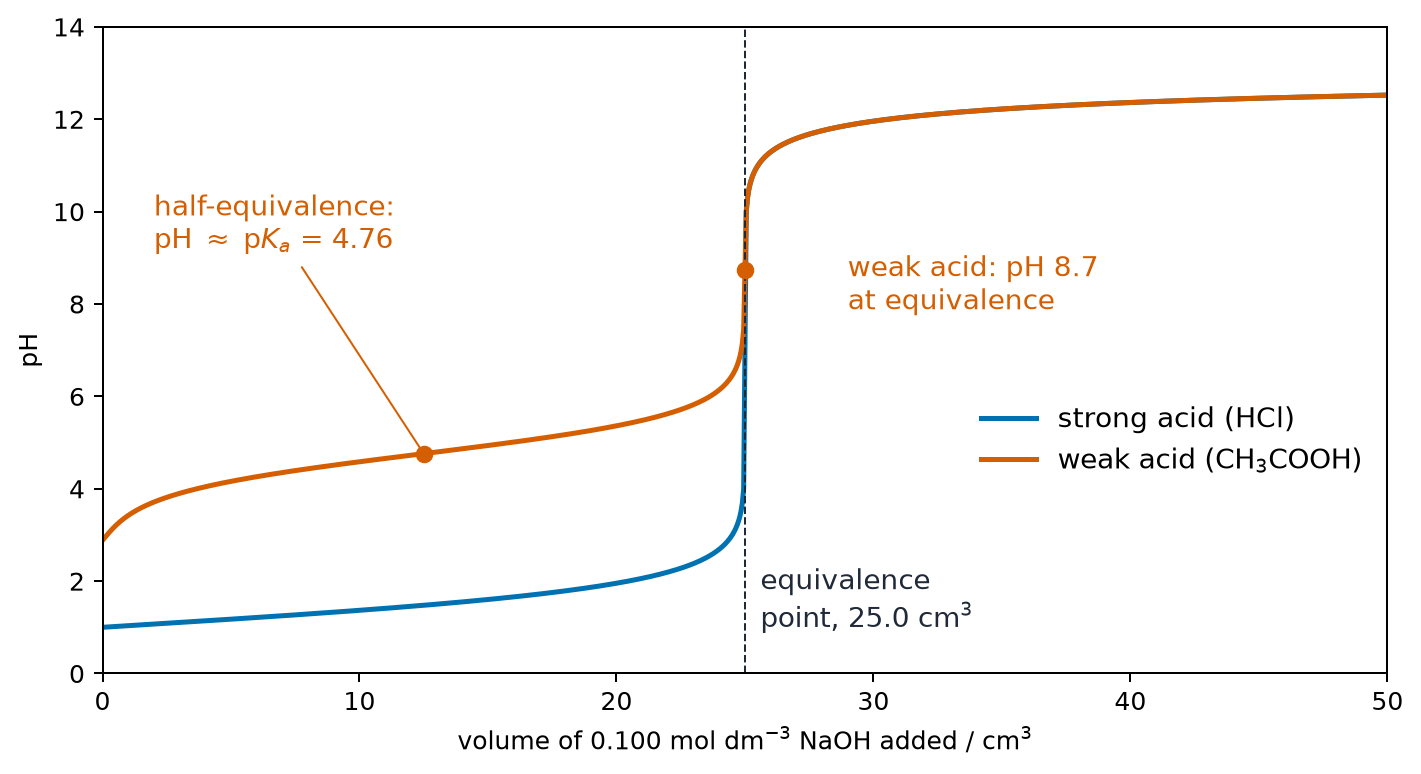
Why is the weak-acid strong-base equivalence solution alkaline?
Dificuldade 1/5 · Moedas 100 + pequeno bônus na primeira conclusão hoje
Stoichiometric equivalence can still leave a hydrolysing salt.
AHL R3.1: Include the weak base and weak weak combinations
- When HCl titrates NH₃, the curve starts alkaline and falls. The NH₃/NH₄⁺ buffer region occurs before equivalence. At half-equivalence pOH≈pKb, or pH≈pKa of NH₄⁺. Its equivalence solution is acidic because NH₄⁺ hydrolyses.
- A weak acid titrated with a weak base generally gives a less pronounced change near equivalence. Both constants influence the equivalence pH; it is not universally 7. A colour indicator may lack a sufficiently sharp endpoint. The computed plots use supplied ideal concentration-model constants, not measured experiments.
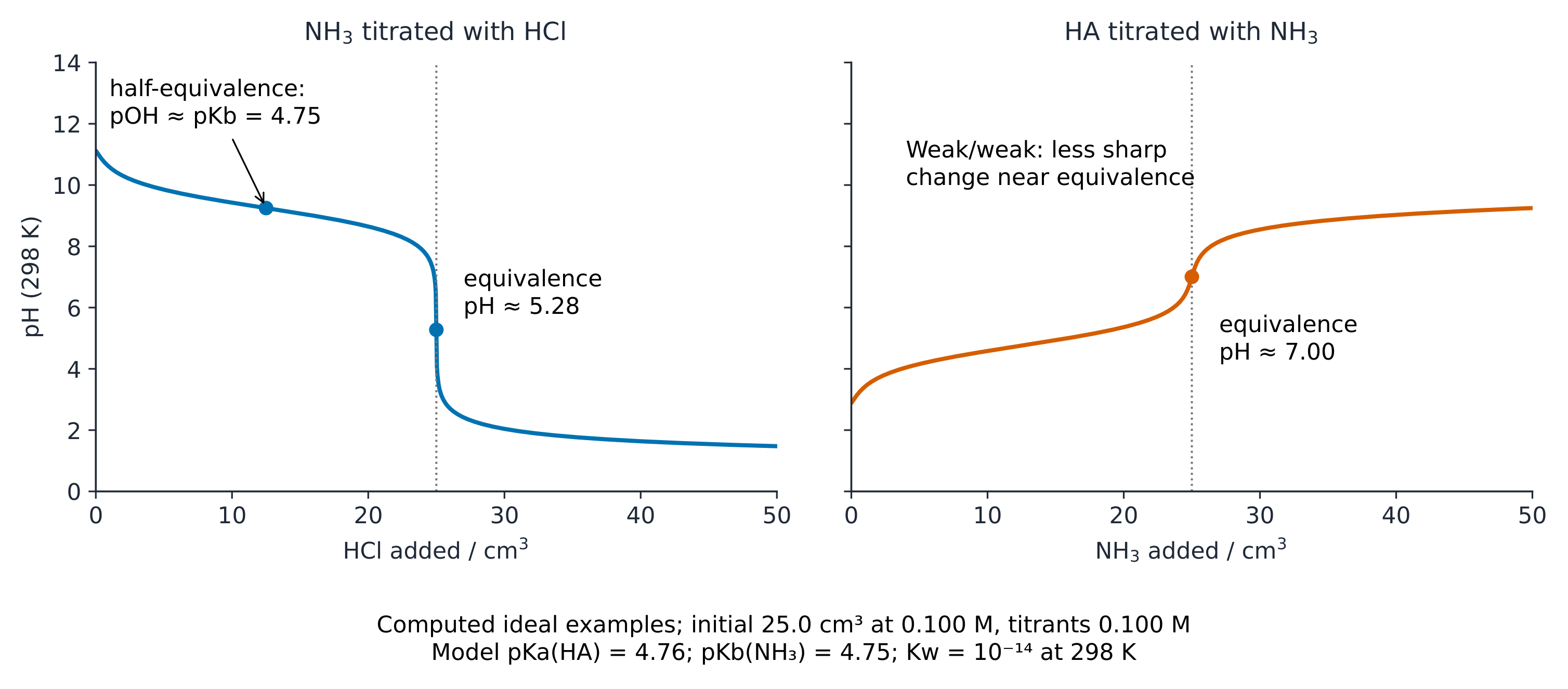
What approximate relation applies at half-equivalence for NH₃ titrated by HCl?
Dificuldade 1/5 · Moedas 100 + pequeno bônus na primeira conclusão hoje
The base equilibrium relates OH⁻ to the base/conjugate-acid ratio.
AHL R3.1: Use indicator equilibrium to explain colour
- For HIn ⇌ H⁺ + In⁻, increasing H⁺ favours HIn, while removal of H⁺ by added alkali favours In⁻. The two conjugate forms have different colours. Equal form concentrations give the midpoint colour near pKa.
- A practical endpoint is the chosen observed colour criterion, not necessarily exact equality of the two forms. Equivalence is defined independently by reacting amounts. Select an indicator range inside the actual steep region near equivalence, using the concentration and salt hydrolysis rather than memorizing one indicator for every reaction name.
Must an operational colour endpoint occur at exactly equal indicator-form concentrations?
Dificuldade 1/5 · Moedas 100 + pequeno bônus na primeira conclusão hoje
Colour detection and stoichiometry describe different conditions.
AHL R3.1: Explain two directions of buffer action
- A buffer contains appreciable weak acid and conjugate base, or weak base and conjugate acid, relative to small added amounts. A⁻ removes H⁺ to form HA; HA removes OH⁻ to form A⁻ and water. NH₃/NH₄⁺ can buffer through the analogous reactions.
- pH≈pKa + log₁₀([A⁻]/[HA]) follows from the acid equilibrium under the buffer approximation. Equal components give pH≈pKa. Supplied pKa 4.76 with A⁻ 0.10 and HA 0.20 mol/dm³ gives pH 4.46. The pH changes slightly on additions; it is not held exactly fixed.
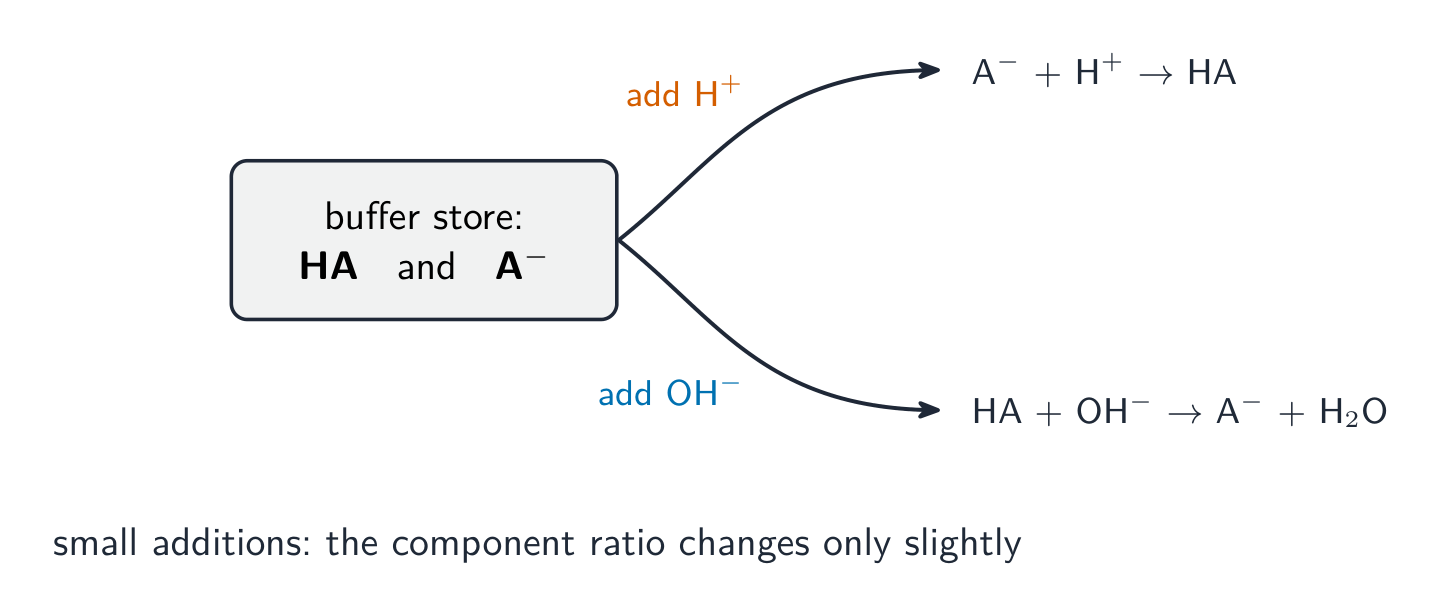
Which component primarily removes a small added H⁺ amount from an HA/A⁻ buffer?
Dificuldade 1/5 · Moedas 100 + pequeno bônus na primeira conclusão hoje
The conjugate base accepts the added proton.
AHL R3.1: React strong acid before recalculating buffer pH
- For an invented 1.00 dm³ buffer initially HA 0.100 mol, A⁻ 0.100 mol and pKa 4.76, add 0.0100 mol HCl with negligible volume change. A⁻ falls to 0.0900 mol and HA rises to 0.110 mol. Then pH≈4.76 + log(0.0900/0.110) = 4.67.
- Adding 0.0100 mol NaOH to the initial buffer instead gives HA 0.0900 and A⁻ 0.110 mol, so pH 4.85. For an NH₃/NH₄⁺ buffer, added acid consumes NH₃ and forms NH₄⁺. First do stoichiometry, then use the remaining component ratio; do not put the original amounts into the buffer equation after changing them.
An HA/A⁻ buffer initially has 0.100 mol HA and 0.100 mol A⁻. Add 0.0100 mol HCl, which reacts completely with A⁻. Which component amounts belong in the buffer ratio afterwards?
Dificuldade 1/5 · Moedas 100 + pequeno bônus na primeira conclusão hoje
Neutralization is A⁻ + H⁺ → HA. Remaining A⁻ = 0.100 − 0.0100 = 0.0900 mol; HA = 0.100 + 0.0100 = 0.110 mol. Use these changed amounts in n(A⁻)/n(HA), since the shared solution volume cancels.
HA/A⁻ initially 0.100/0.100 mol, pKa 4.76. Add 0.0100 mol HCl with negligible volume change. Give pH.
Dificuldade 2/5 · Moedas 140 + pequeno bônus na primeira conclusão hoje
React the strong acid first: A⁻ + H⁺ → HA. The added 0.0100 mol HCl changes A⁻ from 0.100 to 0.0900 mol and HA from 0.100 to 0.110 mol. Both buffer components remain. With the same solution volume cancelling in their ratio, pH ≈ pKa + log₁₀(nA⁻/nHA) = 4.76 + log₁₀(0.0900/0.110) = 4.67285… , about 4.67.
AHL R3.1: Recognize reserve exhaustion and dilution limits
- Add 0.150 mol HCl to that initial 1.00 dm³ HA/A⁻ buffer. All 0.100 mol A⁻ is consumed and 0.0500 mol excess strong acid remains. At the stated unchanged volume, [H⁺]≈0.0500 mol/dm³, pH 1.30. A negative buffer-component amount in a shortcut is physically impossible.
- Moderate ideal dilution approximately preserves the ratio and pH while components dominate water ionization. Extreme dilution and real activity changes can alter pH. Capacity per fixed comparison volume decreases on dilution; the whole enlarged batch still contains approximately the same total component moles. Specify which capacity is being compared.
Does ideal dilution remove the original batch’s weak-acid and conjugate-base moles?
Dificuldade 1/5 · Moedas 100 + pequeno bônus na primeira conclusão hoje
Distinguish concentration per volume from the amount in the whole batch.
The initial 1.00 dm³ buffer has 0.100 mol A⁻. Add 0.150 mol HCl with negligible volume change. Neglect hydrogen ions from the remaining weak acid. Give approximate pH.
Dificuldade 2/5 · Moedas 140 + pequeno bônus na primeira conclusão hoje
A⁻ neutralizes H⁺ in a 1:1 ratio. The initial 0.100 mol A⁻ consumes only 0.100 of the 0.150 mol HCl added, leaving 0.0500 mol strong-acid excess. In approximately 1.00 dm³, [H⁺] ≈ 0.0500 mol/dm³ under the stated approximation. Thus pH ≈ −log₁₀(0.0500) = 1.30103… , about 1.30. The buffer formula cannot be used after its A⁻ component has been exhausted.