Calorimetry and chemical energy
Introduzido| English | Significado |
|---|---|
| enthalpy change/enˈθælpi tʃeɪndʒ/ | Variação de entalpia |
| exothermic/eɡzəˈðɜːmɪk/ | Exotérmico |
| average bond enthalpy | The mean energy to break one mole of a bond, averaged over many compounds. |
| Born–Haber cycle/bɔːn ˈheɪbə ˈsaɪkl/ | An energy cycle used to calculate lattice enthalpy from other measured enthalpies. |
What would explain this observation?
- A cup warms when two solutions react. The temperature rise measures energy transferred to the surroundings; it does not directly equal the enthalpy change 焓变.
Build the model
- Exothermic 放热的 reactions transfer energy to surroundings.
- Endothermic reactions take energy from surroundings.
- Bond breaking requires energy; bond formation releases energy.
- exothermic: Transferring energy to the surroundings.
- enthalpy change: Heat change at constant pressure for a stated process.

Which process requires energy?
Dificuldade 1/5 · Moedas 100 + pequeno bônus na primeira conclusão hoje
Breaking a bond always requires energy input to separate the atoms; forming a bond releases energy. A reaction is exothermic overall only when the energy released in bond formation exceeds the energy taken in for bond breaking.
Match each technical term to its precise meaning.
Dificuldade 2/5 · Moedas 140 + pequeno bônus na primeira conclusão hoje
Use the definitions to distinguish related quantities and processes.
Choose evidence that can test it
- Use energy transferred = mass × specific heat capacity × temperature change.
- Convert joules to kilojoules before dividing by reaction amount.
- An exothermic molar enthalpy change has a negative sign.
In the lab: Use insulation and a lid, measure starting temperatures consistently, stir, and record a temperature-time series. Estimate the reaction temperature from an appropriate extrapolation rather than ignoring cooling during measurement.
Which two habits make the investigation or model in this case more defensible?
Dificuldade 2/5 · Moedas 140 + pequeno bônus na primeira conclusão hoje
Stating the conditions and assumptions lets others repeat the work exactly, and recording the supporting evidence lets them check the conclusion. Hiding disagreeing results removes the evidence that could challenge a wrong conclusion, and one measurement can never establish a wider claim.
Work from known quantities
- Known: 100 g solution rises by 5.0 °C; specific heat capacity is 4.18 J per gram per degree. q = mcΔT. q = 100 × 4.18 × 5.0 = 2,090 J = 2.09 kJ.
- If 0.050 mol reacts, ΔH = -q/n = -2.09/0.050 = -41.8 kJ per mole.
Your turn: 50 g water rises 4 °C. Use c = 4.2 J per gram per degree to find q.
Solution and reaction: opposite heat changes
$q_{solution}=mc\Delta T,\quad q_{reaction}=-q_{solution}$
Connect opposite heat changes in the solution and reaction, using the page’s worked quantities to turn a temperature change into an energy estimate.
50 g water rises 4 °C. Use c = 4.2 J per gram per degree to find q.
Dificuldade 2/5 · Moedas 140 + pequeno bônus na primeira conclusão hoje
The result is 840 J. Known: 50 g of water; temperature rise 4 degrees C; c = 4.2 J per gram per degree. Use q = mc x temperature change. q = 50 x 4.2 x 4 = 840 J. This is the energy gained by the water; heat losses mean the reaction released at least this much.
Check the conclusion and its limits
- Heat loss usually lowers the observed temperature rise.
- The solution gaining heat and the reaction losing heat have opposite signs.
Not true: Bond breaking releases energy. Bond breaking is endothermic - it requires energy. Bond forming releases energy. Confusing the two reverses the sign of every energy calculation.
- Exothermic reactions transfer energy to surroundings.
- Use energy transferred = mass × specific heat capacity × temperature change.
- Watch for: heat loss usually lowers the observed temperature rise.
Bond breaking is endothermic - it requires energy.
Dificuldade 1/5 · Moedas 100 + pequeno bônus na primeira conclusão hoje
True. Bond breaking is endothermic - it requires energy. Bond forming releases energy. Confusing the two reverses the sign of every energy calculation.
Transferring energy to the surroundings: write the technical term.
Dificuldade 1/5 · Moedas 100 + pequeno bônus na primeira conclusão hoje
exothermic means Transferring energy to the surroundings.
60 g of solution rises by 3 degrees and c is 4.2 J per gram per degree. 0.020 mol reacts. What is q, what is the enthalpy change per mole, and what does bond breaking do?
Solution heat gain q = mcΔT = 60 × 4.2 × 3 = 756 J = 0.756 kJ. Under negligible cup and room heat exchange, reaction heat is −0.756 kJ. Thus ΔH = q(reaction)/n = −0.756/0.020 = −37.8 kJ/mol. Bond breaking requires energy; bond formation releases it.
In the written case, 60 g of solution warms by 3 K with specific heat capacity 4.2 joules per gram per kelvin. What is its heat gain?
Dificuldade 1/5 · Moedas 100 + pequeno bônus na primeira conclusão hoje
60 × 4.2 × 3 = 756 J. This uses the written case, not the earlier 50 g, 4 K example (840 J).
Write from energy conserved in a reacting cup
- In the original practice case, 60 g of solution warms by 3 K with specific heat capacity 4.2 joules per gram per kelvin. Its heat gain is $60\times4.2\times3=756$ J. For 0.020 mol reacting, the reaction enthalpy estimate is $-0.756/0.020=-37.8$ kilojoules per mole. The minus sign belongs to the reaction, because the solution gains heat.
- The following original, invented cases develop Reactivity 1.1 at the same level for SL and HL. Decide what absorbs heat, what amount reacts and what the evidence supports. Do not choose a sign merely because a familiar chemical name appears.
Separate heat, temperature and chemical change
- Temperature describes a thermal state; heat is energy transferred because of a temperature difference. Two samples can start at the same temperature yet need different energy transfers for the same rise: with the same specific heat capacity, twice the mass needs twice the heat. A thermometer reading is not an energy measurement by itself.
- Treat the chemical reaction as the system and the solution plus cup as its thermal surroundings. The solution can contain reacting particles while absorbing energy released by their reaction. At constant pressure, with only pressure-volume work, the heat gained by the reacting system equals its enthalpy change. Energy is transferred, not created.
Read the endpoint levels before the peak
- On an invented energy profile, reactants are at 80 kJ, products at 30 kJ and the peak at 140 kJ for one stated reaction amount. The reaction change is $30-80=-50$ kJ, whereas the forward activation barrier is $140-80=60$ kJ. Reversing the reaction gives a change of +50 kJ and a barrier of $140-30=110$ kJ.
- The horizontal coordinate represents progress along a pathway, not elapsed time. Lower product energy does not mean an immediate reaction: a barrier can still prevent a rapid change. Bond breaking requires energy and bond formation releases it; the balance of both processes determines the overall sign. A catalyst changes the pathway, not the endpoint difference.
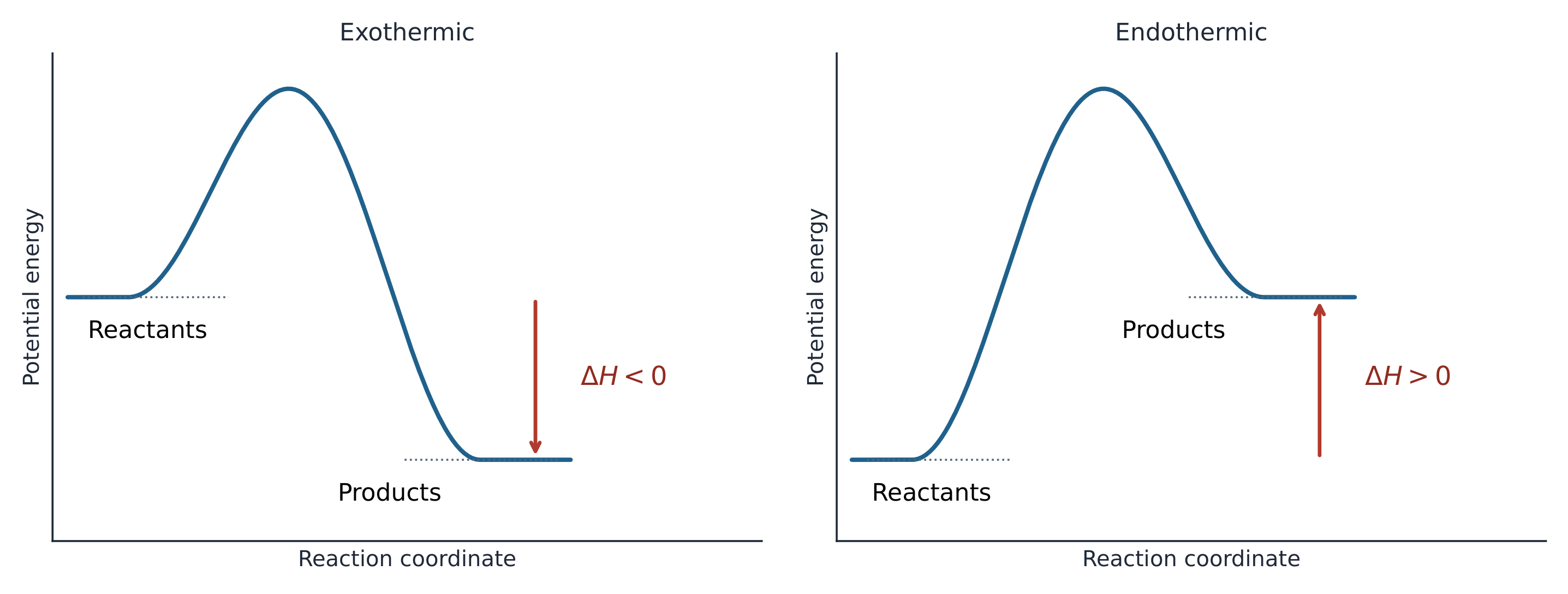
Invented profile: reactants 80 kJ, products 30 kJ and peak 140 kJ for the stated reaction amount. What is the forward enthalpy change?
Dificuldade 2/5 · Moedas 140 + pequeno bônus na primeira conclusão hoje
Subtract reactant energy from product energy: 30 − 80 = −50 kJ. The forward barrier is 140 − 80 = 60 kJ, a different quantity.
Keep the signed temperature change
- Use $q=mc\Delta T$, with $\Delta T=T_{\mathrm{final}}-T_{\mathrm{initial}}$. Here $q$ is the energy gained by the measured material. A rise gives positive solution heat; a fall gives negative solution heat. A temperature difference of 1 degree Celsius equals 1 kelvin: adding 273 to a difference is incorrect.
- For a negligible cup heat capacity and negligible exchange with the room, $q_{\mathrm{reaction}}=-q_{\mathrm{solution}}$. Divide reaction heat in kilojoules by the appropriate reacting amount to obtain a molar enthalpy change. Report the basis of “per mole”; it might mean a mole of fuel burned, water formed or reaction as written.
Find the limiting amount before dividing
- Mix 25.0 cubic centimetres of acid at $2.00\ \dfrac{\mathrm{mol}}{\mathrm{dm}^3}$ with 40.0 cubic centimetres of alkali at $1.00\ \dfrac{\mathrm{mol}}{\mathrm{dm}^3}$. Assume a 1:1 neutralization. Acid amount is $2.00\times0.0250=0.0500$ mol; alkali amount is $1.00\times0.0400=0.0400$ mol. Alkali limits, so 0.0400 mol of water forms, leaving acid in excess.
- With density $1.00\ \dfrac{\mathrm{g}}{\mathrm{cm}^3}$, the heated solution mass is $25.0+40.0=65.0$ g. A 7.0 K rise and specific heat capacity 4.18 joules per gram per kelvin give $q=65.0\times4.18\times7.0=1901.9$ J. Thus $\Delta H=-1.9019/0.0400\approx-48\ \dfrac{\mathrm{kJ}}{\mathrm{mol}}$. Dividing by all the acid would count material that did not react.
For the 25.0 cubic centimetres of 2.00 mol per cubic decimetre acid and 40.0 cubic centimetres of 1.00 mol per cubic decimetre alkali, a 1:1 reaction releases 1.9019 kJ. Find its molar enthalpy change, before rounding.
Dificuldade 2/5 · Moedas 140 + pequeno bônus na primeira conclusão hoje
Use n = cV with volumes in dm³: acid amount = 2.00 × 0.0250 = 0.0500 mol; alkali amount = 1.00 × 0.0400 = 0.0400 mol. For the 1:1 reaction, alkali limits. Reaction heat is −1.9019 kJ, so ΔH = q(reaction)/n = −1.9019/0.0400 = −47.5475 kJ/mol, approximately −48 at the temperature-change precision.
A cooling solution gives the opposite sign
- Dissolve 4.00 g of an invented salt of molar mass $80.0\ \dfrac{\mathrm{g}}{\mathrm{mol}}$ in 100.0 g water. The amount is 0.0500 mol. Include the salt in the solution mass, 104.0 g, and assume the same specific heat capacity as water. From 22.0 to 18.5 degrees Celsius, $\Delta T=-3.5$ K, not +3.5 K.
- Solution heat is $104.0\times4.18\times(-3.5)=-1521.52$ J. The dissolution gains $+1.52152$ kJ, so its molar enthalpy estimate is approximately $+30\ \dfrac{\mathrm{kJ}}{\mathrm{mol}}$. The plus sign follows the energy balance. Salt dissolution is not always endothermic; another salt or different stated conditions could give a different result.
Under the insulated-cup assumptions, a solution losing heat during dissolution means the dissolving process has a positive enthalpy change.
Dificuldade 1/5 · Moedas 100 + pequeno bônus na primeira conclusão hoje
The solution heat is negative and the reaction heat has the opposite sign. This identifies an endothermic process under the stated energy-balance assumptions.
Include the cup when its heat capacity matters
- A calorimeter heat capacity tells us the energy needed per kelvin for the whole cup assembly. Unlike specific heat capacity, it needs no further mass factor. If the solution and cup change temperature together, $q_{\mathrm{surroundings}}=(mc+C_{\mathrm{cal}})\Delta T$. This still assumes negligible energy exchange with the room during the measurement.
- For 100.0 g solution, specific heat capacity 4.18 joules per gram per kelvin, cup heat capacity 32.0 joules per kelvin and a 5.00 K rise, the surroundings gain $(418+32.0)5.00=2250$ J. For 0.0500 mol reacting, $\Delta H=-45.0\ \dfrac{\mathrm{kJ}}{\mathrm{mol}}$. Omitting the cup gives -41.8 instead: the exothermic magnitude is underestimated.
100.0 g solution has specific heat capacity 4.18 joules per gram per kelvin. The cup heat capacity is 32.0 joules per kelvin. Both warm by 5.00 K while 0.0500 mol reacts. Find the molar enthalpy estimate.
Dificuldade 2/5 · Moedas 140 + pequeno bônus na primeira conclusão hoje
Surroundings gain (100.0 × 4.18 + 32.0) × 5.00 = 2250 J. Reaction heat is −2.250 kJ, so −2.250/0.0500 = −45.0 kJ per mole. Do not multiply the cup heat capacity by solution mass.
Correct cooling with a justified model
- Record temperatures before mixing and at regular times afterwards; stir consistently and use insulation and a lid. For a fast reaction, extrapolate a suitable post-reaction cooling trend back to the mixing time to estimate the temperature before appreciable cooling. The highest measured point alone can miss energy transferred while readings were being taken.
- An invented 80.0 g solution starts at 20.0 degrees Celsius, reaches a measured 25.4 and has an extrapolated value of 26.0. At specific heat capacity 4.20 joules per gram per kelvin, raw heat is 1814.4 J; corrected heat is 2016 J. Correction increases the estimate by 201.6 J. A slow reaction continuing during “cooling” would undermine this extrapolation model.
Separate the uncertainty estimate from the bias
- Suppose the two temperature readings each have a stated maximum uncertainty of 0.2 K. Adding absolute uncertainties gives a maximum estimate of 0.4 K for their difference. For a 6.0 K rise, the percentage contribution is $0.4/6.0\times100\approx6.7\%$. This maximum method is different from calculating a statistical standard error from repeated trials.
- If mass and reacting amount have maximum percentage uncertainties of 0.5% and 1.0%, adding contributions gives about 8.2% for the enthalpy magnitude, treating specific heat capacity as exact within the chosen model. Heat leaking out is a separate bias; repetitions do not automatically remove it. A quoted uncertainty does not prove that every model assumption is valid.
State what the enthalpy value describes
- Standard pressure is 100 kPa; a temperature must also be specified, commonly 298 K in tables. Standard does not mean zero degrees Celsius. State symbols matter: forming liquid water and forming water vapour are different processes. A cup experiment does not automatically justify a standard-state symbol beside its result.
- An enthalpy change belongs to the equation as written. Reversing the equation reverses the sign; doubling all coefficients doubles the heat change for that reaction amount. Distinguish these equation changes from a larger experimental sample: doubling the reacting amount doubles heat under the same conditions, but leaves the molar value unchanged.
Test a new case and explain the assumptions
- An invented 120 g solution warms by 2.5 K with specific heat capacity 4.0 joules per gram per kelvin; 0.030 mol reacts. Calculate solution heat before reading on: $120\times4.0\times2.5=1200$ J. The reaction estimate is $-1.200/0.030=-40\ \dfrac{\mathrm{kJ}}{\mathrm{mol}}$. With a 24 joules per kelvin cup, include another $24\times2.5=60$ J: the estimate becomes -42 kilojoules per mole.
- Explain a result in the order measured temperature change, heated mass, energy balance, reacting amount, then limitations. Name the bias and its direction under your assumptions: heat lost by a warming mixture usually reduces the measured rise and gives a less negative enthalpy estimate. “Human error” alone does not identify a mechanism or an improvement.
A warming mixture loses heat while its temperature is being measured. Explain the direction of bias in the exothermic molar enthalpy estimate, one improvement, and one assumption the improvement still needs.
A method evaluation needs a physical bias, its effect on the calculated result, and a justified improvement.
R1.2: Explain the energy balance across all bonds
- Breaking a covalent bond separates bonded atoms and requires energy input. Bond formation releases energy. An exothermic reaction therefore releases more energy on forming product bonds than it absorbs on breaking reactant bonds. Count both the bond energies and the numbers of bonds. Calling every individual product bond stronger is not a sufficient explanation.
- A route through isolated gaseous atoms is a useful calculation model. It does not claim that a flame first makes a container full of isolated atoms. Nor does a negative reaction enthalpy show that the reaction will be rapid: activation barriers and reaction conditions still matter.
Does an exothermic reaction release energy by breaking its reactant bonds?
Dificuldade 1/5 · Moedas 100 + pequeno bônus na primeira conclusão hoje
Compare both energy totals, rather than assigning release to bond breaking.
R1.2: Define the gas phase average
- Bond enthalpy 平均键焓 refers to dissociation of one mole of bonds in gaseous species. For H₂(g) → 2H(g), a supplied value of + 436 kJ/mol is an input, not a heat release. The average C–H value used in calculations represents a mean across different molecular environments. It is not a guarantee that all C–H bonds require exactly that energy.
- For a stated equation, estimate reaction enthalpy as the sum of bond energies broken minus the sum formed. A table may distinguish the C = O bond in carbon dioxide from a general carbonyl value; use the supplied relevant entry. Keep the equation and physical states beside the calculation.
Which process matches the +436 kJ/mol H–H dissociation value?
Dificuldade 1/5 · Moedas 100 + pequeno bônus na primeira conclusão hoje
The defining bond-dissociation process uses gaseous species.
R1.2: Count methane and oxygen before subtracting
- For CH₄(g) + 2O₂(g) → CO₂(g) + 2H₂O(g), break four C–H and two O = O bonds. Form two C = O bonds and four O–H bonds. The two in front of water multiplies every bond in that molecule; do not count only two O–H bonds overall.
- With supplied C–H 414, O = O 498, C = O in CO₂ 804 and O–H 463 kJ/mol, input is 4×414 + 2×498 = 2652; output magnitude is 2×804 + 4×463 = 3460. Thus ΔH = 2652−3460 = −808 kJ per mole of methane. The negative sign records a net release.
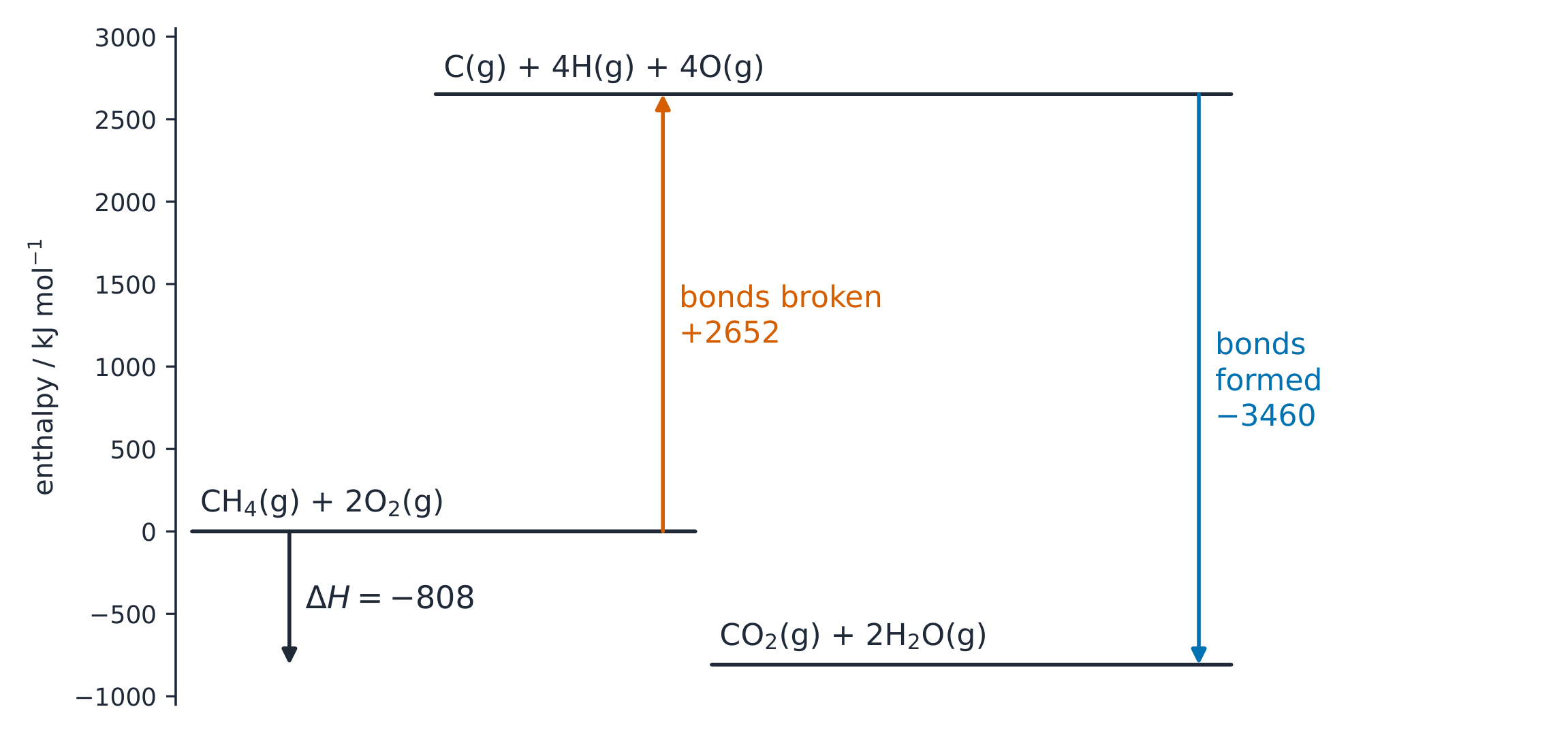
For CH₄(g) + 2O₂(g) → CO₂(g) + 2H₂O(g), how many O–H bonds are formed per equation as written?
Dificuldade 1/5 · Moedas 100 + pequeno bônus na primeira conclusão hoje
Each H₂O contains two O–H bonds, and the product coefficient is two. Total O–H bonds formed = 2 × 2 = 4 per equation amount; the coefficient multiplies every bond in each molecule.
Use H–H 436, Cl–Cl 242 and H–Cl 431 kJ/mol. Give ΔH for H₂(g)+Cl₂(g)→2HCl(g) in kJ/mol.
Dificuldade 2/5 · Moedas 140 + pequeno bônus na primeira conclusão hoje
Break one H–H and one Cl–Cl bond: energy input = 436 + 242 = 678 kJ/mol. Form two H–Cl bonds: released magnitude = 2 × 431 = 862 kJ/mol. Broken minus formed gives ΔH = 678 − 862 = −184 kJ/mol for the equation as written. The factor of two belongs to the two product bonds.
R1.2: Cancel only after the full inventory
- For ethene hydrogenation, CH₂ = CH₂ + H₂ → CH₃–CH₃, a full average-bond route breaks C = C, four C–H and H–H, then forms C–C and six C–H. With 614, 414, 436 and 346 kJ/mol for the relevant types, the totals are 2706 and 2830, giving −124 kJ/mol.
- Four matching average C–H contributions cancel algebraically. The shorter calculation is 614 + 436−346−2×414 = −124. A double bond becoming a single bond requires subtracting the new single-bond contribution as well as including the additional hydrogen bonds. This cancellation belongs to the average-bond model, not a proven mechanism.
For ethene hydrogenation CH₂=CH₂ + H₂ → CH₃–CH₃, which shortcut represents the complete average-bond inventory?
Dificuldade 1/5 · Moedas 100 + pequeno bônus na primeira conclusão hoje
Cancel the four matching average C–H contributions on both sides.
R1.2: Correct the product phase explicitly
- The gas-product estimate −808 kJ/mol of methane omits condensation if the required product is liquid water. Using a supplied condensation enthalpy −44 kJ per mole of water, add 2H₂O(g) → 2H₂O(l), with change −88 kJ. The liquid-product estimate is −896 kJ/mol.
- This corrected estimate is still based on averages. It need not equal the measured value of approximately −890 kJ/mol under the stated reference conditions. If a liquid reactant instead needs vaporizing before bond dissociation, include the positive vaporization step on that side of the route. Identify the actual phase change rather than automatically adding or subtracting 44.
What is the liquid-product estimate from −808 plus two condensation steps of −44?
Dificuldade 1/5 · Moedas 100 + pequeno bônus na primeira conclusão hoje
The gas-product estimate is −808 kJ per mole of methane and forms two moles water vapour. Condensation adds 2 × (−44) = −88 kJ. Therefore the liquid-product estimate is −808 − 88 = −896 kJ/mol.
Starting with the −808 kJ/mol gas estimate, add two condensation steps of −44 kJ/mol. Give the liquid-product estimate.
Dificuldade 2/5 · Moedas 140 + pequeno bônus na primeira conclusão hoje
The gas-product estimate forms two moles of water vapour per mole of methane. Condensing each mole contributes −44 kJ, so the extra change is 2 × (−44) = −88 kJ. Add it to the gas route: −808 − 88 = −896 kJ/mol. The corrected average-bond estimate is not an exact measured combustion value.
R1.2: Use identical endpoints in Hess law
- Enthalpy is a state function: its change depends on the initial and final states, not the chosen route between them. Specify substances, amounts, phases and conditions. A diagram showing alternative reactions is not a time axis and need not describe the reaction mechanism.
- For the same starting and final states, the sum along an indirect route equals the direct change. Reverse a reaction to reverse its sign; multiply all its coefficients to multiply its enthalpy change. These operations allow equations to add and unwanted species to cancel, just like algebra with conserved atoms.
Can H₂O(l) cancel H₂O(g) in a Hess sum without an additional step?
Dificuldade 1/5 · Moedas 100 + pequeno bônus na primeira conclusão hoje
Physical state is part of the specified endpoint.
R1.2: Solve the carbon monoxide cycle
- Supplied rounded changes are C(s) + O₂(g) → CO₂(g), −394 kJ, and CO(g) + ½O₂(g) → CO₂(g), −283 kJ. To obtain C(s) + ½O₂(g) → CO(g), keep the first equation and reverse the second. Carbon dioxide cancels and the remaining oxygen is half a mole.
- The change is −394 + 283 = −111 kJ for the target equation. In the balanced diagram, both top states include enough oxygen to finish with one CO₂. The horizontal and downward arrows are alternative routes; their drawn lengths do not define reaction duration.
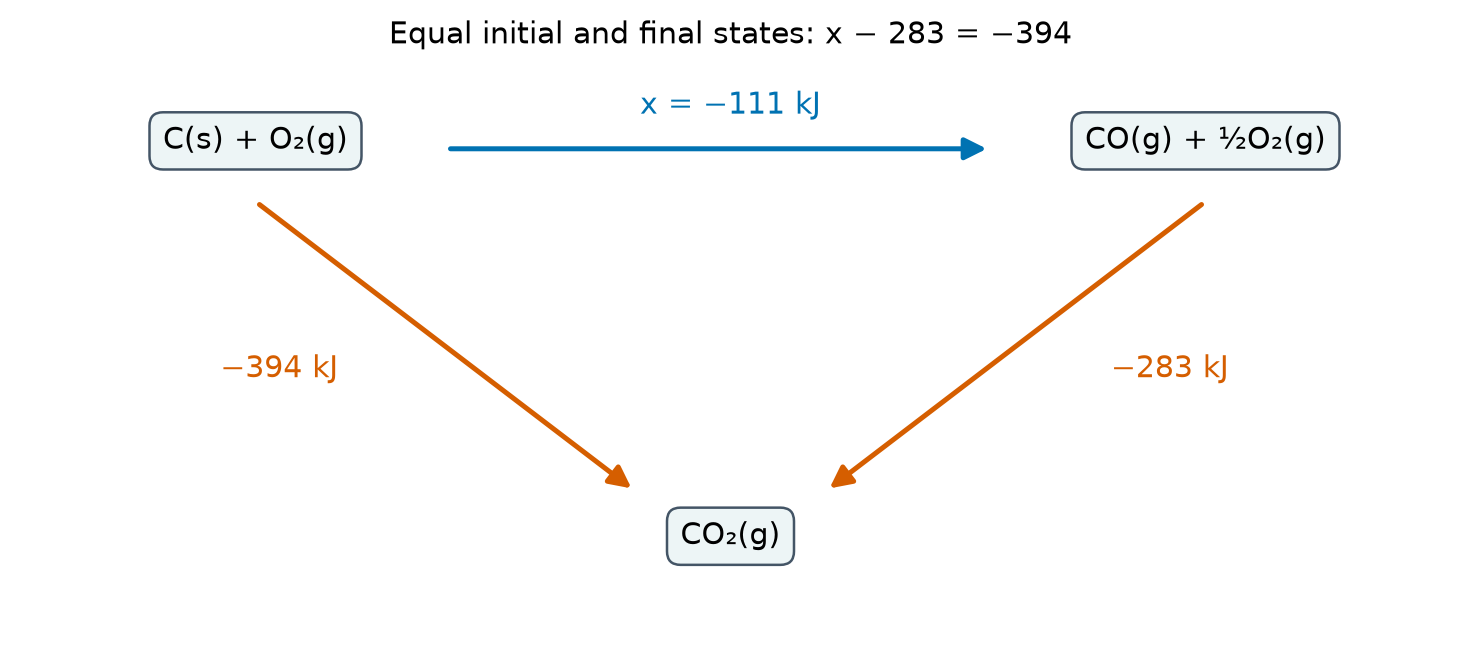
CO(g) + ½O₂(g) → CO₂(g) has ΔH = −283 kJ for the equation as written. Which enthalpy change applies when this equation is reversed in a Hess sum?
Dificuldade 1/5 · Moedas 100 + pequeno bônus na primeira conclusão hoje
Reversing gives CO₂(g) → CO(g) + ½O₂(g). Reverse the sign as well: ΔH(reverse) = −ΔH(forward) = −(−283) = +283 kJ, with unchanged magnitude.
Given C→CO₂ −394 and CO→CO₂ −283 kJ for matched equations, give C→CO in kJ.
Dificuldade 2/5 · Moedas 140 + pequeno bônus na primeira conclusão hoje
Keep C(s) + O₂(g) → CO₂(g), with −394 kJ. Reverse CO(g) + ½O₂(g) → CO₂(g), making CO₂(g) → CO(g) + ½O₂(g), with +283 kJ. Adding cancels CO₂ and leaves C(s) + ½O₂(g) → CO(g). Therefore ΔH = −394 + 283 = −111 kJ for that target equation. Reversing a route changes its sign.
R1.2: Multiply and reverse a three equation sum
- To obtain 2C(s) + H₂(g) → C₂H₂(g), use twice carbon combustion at −394 kJ, hydrogen combustion to liquid water at −286 kJ, and reverse ethyne combustion at −1301 kJ. The sum is 2(−394)−286 + 1301 = + 227 kJ.
- Check species as well as numbers: 2CO₂, one H₂O(l) and 2.5O₂ cancel. A correct arithmetic sum with an incorrect chemical target is not a valid Hess solution. Retain states while writing the equations, especially when combustion data refer to liquid water.
A Hess sum targets 2C(s) + H₂(g) → C₂H₂(g). Given C₂H₂(g) + 2½O₂(g) → 2CO₂(g) + H₂O(l), ΔH = −1301 kJ, what operation puts ethyne on the required side?
Dificuldade 1/5 · Moedas 100 + pequeno bônus na primeira conclusão hoje
Put the target product on the correct side before adding equations.
R1.2: Distinguish a reaction equation from a sample
- For 2H₂(g) + O₂(g) → 2H₂O(l), a supplied change of −572 kJ refers to the reaction amount as written. Forming one mole of water corresponds to −286 kJ. Reversing and doubling the original consumes four moles of water and requires + 1144 kJ.
- Forming 0.250 mol water under the same conditions transfers −71.5 kJ for the reaction, so its surroundings receive 71.5 kJ under the simple energy balance. Increasing the sample increases total heat; it does not automatically change the molar enthalpy. Always state what the mole basis counts.
What heat is released when 0.250 mol water forms with −286 kJ per mole of water?
Dificuldade 1/5 · Moedas 100 + pequeno bônus na primeira conclusão hoje
The supplied value is already per mole of water. Reaction heat = nΔH = 0.250 × (−286) = −71.5 kJ. Thus 71.5 kJ is released to the surroundings; no further division by two is needed.
For formation of two moles of water at −572 kJ, give the heat change for decomposition of four moles in kJ.
Dificuldade 2/5 · Moedas 140 + pequeno bônus na primeira conclusão hoje
The given formation equation produces two moles of water with −572 kJ. Reverse it to decompose two moles: +572 kJ. Double every coefficient to decompose four moles: 2 × 572 = +1144 kJ. This positive change requires energy; changing the amount multiplies the heat, while reversing the direction changes its sign.
R1.2: Infer a missing bond value with a stated model
- For the illustrative gas-phase reaction CH₃Cl + H₂ → CH₄ + HCl, suppose ΔH = −70 kJ/mol. Use supplied C–H 414, H–H 436 and H–Cl 431 kJ/mol. After cancelling three matching average C–H contributions, the equation is −70 = D(C–Cl) + 436−414−431.
- Thus D(C–Cl) = 339 kJ/mol within this supplied model. Rearranging must leave a positive bond-breaking energy here. The inference uses assumed average values and a stated reaction change, so do not report it as an exact experimentally isolated bond dissociation measurement.
For CH₃Cl(g) + H₂(g) → CH₄(g) + HCl(g), ΔH = −70 kJ/mol. Use H–H 436, C–H 414 and H–Cl 431 kJ/mol. What estimated C–Cl bond enthalpy follows from the average-bond model?
Dificuldade 1/5 · Moedas 100 + pequeno bônus na primeira conclusão hoje
Cancel three unchanged average C–H contributions. Broken minus formed gives −70 = D(C–Cl) + 436 − 414 − 431 = D(C–Cl) − 409. Therefore D(C–Cl) = −70 + 409 = +339 kJ/mol. A bond-breaking energy remains positive even though the net reaction is exothermic.
For CH₃Cl(g) + H₂(g) → CH₄(g) + HCl(g), use illustrative ΔH = −70 kJ/mol and bond values H–H 436, C–H 414 and H–Cl 431 kJ/mol. Find D(C–Cl) in kJ/mol.
Dificuldade 2/5 · Moedas 140 + pequeno bônus na primeira conclusão hoje
For CH₃Cl(g) + H₂(g) → CH₄(g) + HCl(g), cancel three matching average C–H contributions. The remaining broken bonds are C–Cl and H–H; formed bonds are one C–H and one H–Cl. Thus −70 = D(C–Cl) + 436 − 414 − 431 = D(C–Cl) − 409. Rearranging gives D(C–Cl) = −70 + 409 = 339 kJ/mol within the supplied average-bond model.
R1.2: Start an indirect route at the requested state
- In an invented dataset at fixed conditions, A → B is + 35 kJ and A → C is −80 kJ for the same amount. B → C must start by reversing the first process: B → A is −35 kJ. Adding A → C gives −115 kJ. The reverse C → B is + 115 kJ.
- A catalyst cannot change either endpoint difference, though it may offer another route with a lower activation barrier. Before calculating, trace every arrow from the requested start to finish. A formula such as products minus reactants is meaningful only for the specified kind of tabulated data.
What is B→C for A→B +35 and A→C −80 kJ?
Dificuldade 1/5 · Moedas 100 + pequeno bônus na primeira conclusão hoje
To begin at B, reverse A → B: B → A has change −35 kJ. Add A → C at −80 kJ, so B → C is −35 + (−80) = −115 kJ.
AHL R1.2: Define formation on a one mole basis
- Standard formation enthalpy belongs to forming exactly one mole of a substance from its elements in their reference states, at standard pressure and a stated temperature. Standard pressure is 100 kPa; tables commonly specify 298 K. This is not a rule that every experiment occurs at zero degrees Celsius.
- For ethanol(l), use 2C(s,graphite) + 3H₂(g) + ½O₂(g) → C₂H₅OH(l). Fractional oxygen is correct because the product amount is one mole. A combustion equation instead consumes one mole of the fuel, completely oxidized to stated products and phases.
Which product amount defines a formation enthalpy?
Dificuldade 1/5 · Moedas 100 + pequeno bônus na primeira conclusão hoje
The one-mole basis defines which process the tabulated value describes.
AHL R1.2: Keep reference states distinct
- An element in its selected reference state has zero standard formation enthalpy by convention. At 298 K, graphite is the carbon reference form; diamond has a different enthalpy and does not receive zero merely because it is carbon. The convention does not mean an element contains no energy.
- A compound may have positive or negative formation enthalpy. Distinguish formation enthalpy, absolute energy and stability under actual reaction conditions. Ordinary elemental oxygen O₂(g) and isolated O(g) are different species; the latter requires atomization energy relative to the molecular reference.
Does diamond automatically have zero standard formation enthalpy at 298 K?
Dificuldade 1/5 · Moedas 100 + pequeno bônus na primeira conclusão hoje
The reference specifies both the element and its physical/allotropic state.
AHL R1.2: Use formation products minus reactants
- Formation data give reaction enthalpy as the coefficient-weighted sum for products minus that for reactants. For ethanol combustion, use ethanol(l) −278, CO₂(g) −394 and H₂O(l) −286 kJ/mol; reference O₂(g) contributes zero. The equation forms two CO₂ and three H₂O.
- Calculate [2(−394) + 3(−286)]−[−278] = −1368 kJ per mole ethanol. The subtraction of a negative reactant value adds 278. For a different water phase, use its appropriate formation datum instead of silently reusing the liquid value.
For C₂H₅OH(l) + 3O₂(g) → 2CO₂(g) + 3H₂O(l), formation enthalpies are CO₂(g) −394 and H₂O(l) −286 kJ/mol. Which coefficient-weighted product sum is correct?
Dificuldade 1/5 · Moedas 100 + pequeno bônus na primeira conclusão hoje
Multiply each product formation enthalpy by its coefficient: 2 × (−394) + 3 × (−286) = −788 − 858 = −1646 kJ per equation amount. This is the product sum; the full reaction enthalpy also subtracts the reactant formation sum.
AHL R1.2: Reverse the rule for combustion data
- When both sides can be taken to identical complete-combustion products, the initial route burns the reactants and the competing route first performs the target reaction then burns its products. Therefore target enthalpy is combustion sum for reactants minus combustion sum for products. Ensure the final products and states match.
- For C(graphite) + 2H₂(g) → CH₄(g), supplied combustion values −394, −286 and −890 give −394 + 2(−286)−(−890) = −76 kJ/mol. Reusing the formation-data order would give the wrong sign; derive the subtraction from the arrows if uncertain.
Which order is appropriate for a matched combustion cycle?
Dificuldade 1/5 · Moedas 100 + pequeno bônus na primeira conclusão hoje
Both routes must reach the same combustion products.
AHL R1.2: Read atomic and ionic arrows
- A Born–Haber cycle 玻恩-哈伯循环 links elemental reference states, gaseous atoms, gaseous ions and an ionic solid. Atomization forms one mole of gaseous atoms: ½Cl₂(g) → Cl(g) uses half a mole of Cl–Cl bond dissociation. Ionization removes electrons from gaseous species; electron gain adds them.
- IB lattice enthalpy here means positive dissociation of the solid to separated gaseous ions. The reverse lattice-formation step is negative with equal magnitude. Independently determined data may themselves rely on indirect measurements or models; a cycle does not imply every step is directly measurable.
Which equation defines lattice dissociation for NaCl?
Dificuldade 1/5 · Moedas 100 + pequeno bônus na primeira conclusão hoje
Gaseous ions and dissolved ions are different endpoint states.
AHL R1.2: Solve sodium chloride with signed data
- Use supplied Na atomization + 107, Cl atomization + 121, Na first IE + 496 and Cl electron gain −349 kJ/mol. From the elemental reference states, the gaseous ions lie at 107 + 121 + 496−349 = + 375 kJ per mole of NaCl. The solid lies at −411 by the formation datum.
- The upward separation from solid to ions is 375−(−411) = + 786 kJ/mol. Equivalently, formation gives −411 = 375−L. The reverse lattice-formation arrow is −786. Nearby values from a separate reference set need not match exactly: use consistent supplied data and definitions.
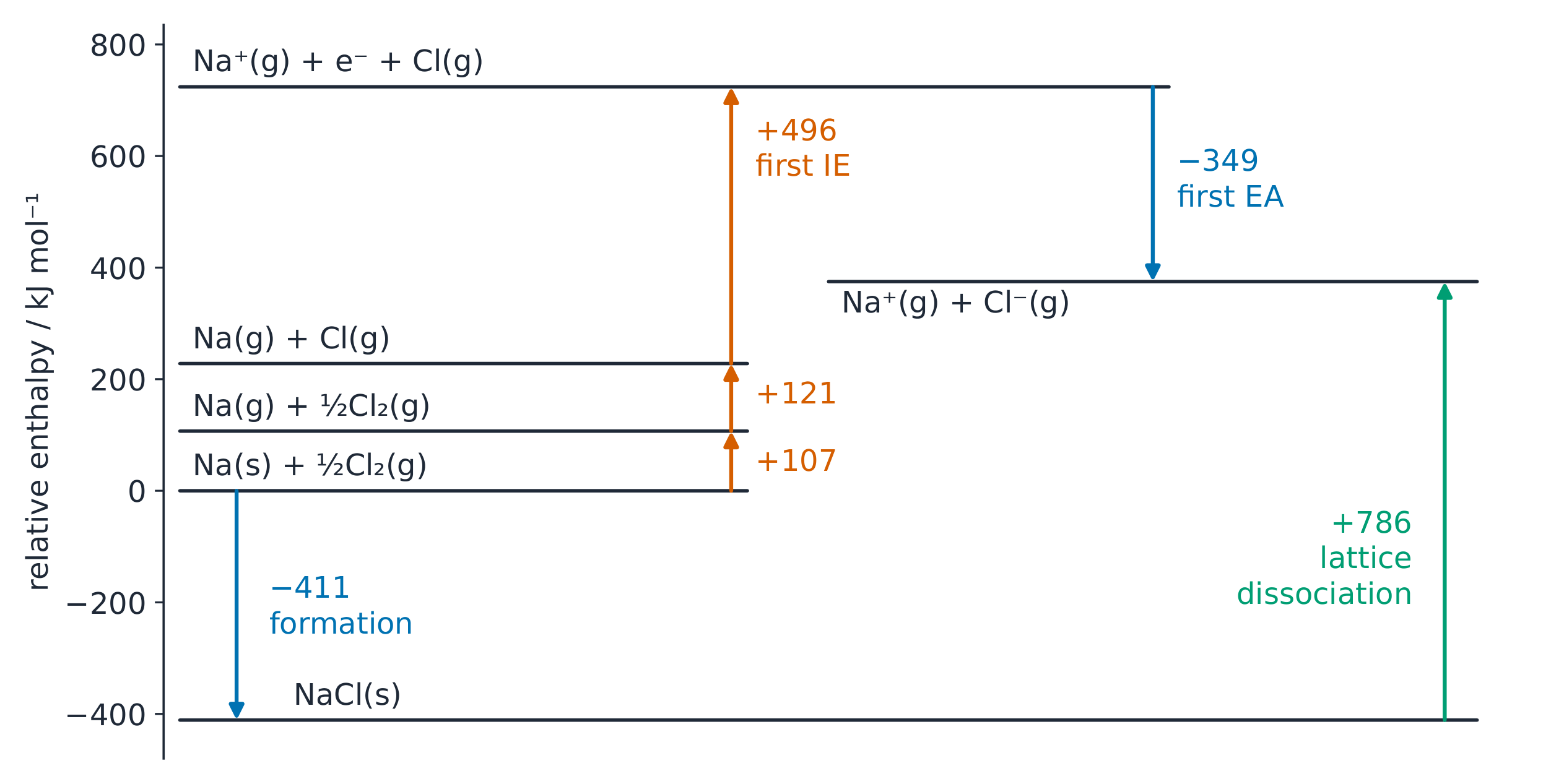
What positive lattice dissociation follows from gaseous ions at +375 and solid at −411?
Dificuldade 1/5 · Moedas 100 + pequeno bônus na primeira conclusão hoje
Lattice dissociation goes from solid at −411 to gaseous ions at +375 kJ/mol on the same reference scale. Final minus initial gives 375 − (−411) = +786 kJ/mol. The reverse formation process has the opposite sign.
For gaseous NaCl ions at +375 and NaCl(s) at −411 kJ/mol, give the positive lattice-dissociation enthalpy.
Dificuldade 2/5 · Moedas 140 + pequeno bônus na primeira conclusão hoje
The gaseous Na⁺ and Cl⁻ pair is +375 kJ/mol relative to the same elemental reference states; NaCl(s) is −411 kJ/mol. Lattice dissociation goes from solid to gaseous ions, so final minus initial is 375 − (−411) = +786 kJ/mol. Lattice formation is the reverse step, −786 kJ/mol. Adding 375 + (−786) recovers the formation datum −411.
AHL R1.2: Check the electron affinity convention
- Here Cl(g) + e⁻ → Cl⁻(g) has a negative enthalpy when energy is released. Some tables call the positive energy released the electron affinity instead. Read the defining equation and convert the convention before substituting; the physical direction has not changed.
- For O⁻(g) + e⁻ → O²⁻(g), the second electron-gain enthalpy is positive because adding an electron against an existing negative charge requires energy. The first and second steps are different processes. A positive second step does not prevent stable MgO: lattice formation contributes a much larger release.
Is the second electron-gain step for oxygen necessarily exothermic because the first is?
Dificuldade 1/5 · Moedas 100 + pequeno bônus na primeira conclusão hoje
Account for repulsion from the pre-existing negative charge.
AHL R1.2: Balance the divalent cycle quantitatively
- Supplied rounded teaching data for MgO are Mg atomization + 148, O₂ dissociation + 498, Mg IE₁ + 738, IE₂ + 1451, oxygen electron-gain steps −141 and + 798, and formation −602 kJ/mol. One mole of oxygen atoms costs 498/2 = 249. Both Mg ionizations and both oxygen gains are required.
- The gaseous-ion route costs 148 + 249 + 738 + 1451−141 + 798 = 3243 kJ/mol. Formation gives −602 = 3243−L, so L = + 3845 kJ/mol. There is no extra factor of two on oxygen atomization: one MgO contains one O atom, though that atom gains two electrons.
For MgO, supplied gaseous-ion steps relative to the elements are +148 +249 +738 +1451 −141 +798 kJ/mol, and formation of MgO(s) is −602 kJ/mol. What is the positive lattice-dissociation enthalpy?
Dificuldade 1/5 · Moedas 100 + pequeno bônus na primeira conclusão hoje
The gaseous-ion level is 148 + 249 + 738 + 1451 − 141 + 798 = 3243 kJ/mol. Dissociation goes from solid at −602 to gaseous ions at +3243, so ΔH = 3243 − (−602) = +3845 kJ/mol. Include both Mg ionizations and both oxygen electron-gain steps.
For the supplied MgO teaching data, the gaseous-ion route is +3243 and formation is −602 kJ/mol. Give the positive lattice dissociation.
Dificuldade 2/5 · Moedas 140 + pequeno bônus na primeira conclusão hoje
The supplied atomization, ionization and electron-gain steps put Mg²⁺(g) + O²⁻(g) at +3243 kJ/mol relative to the elements. MgO(s) lies at −602 kJ/mol. Dissociation from solid to those ions requires 3243 − (−602) = +3845 kJ/mol. Check the reverse route: 3243 − 3845 = −602. Using only one magnesium ionization would omit a required step.
AHL R1.2: Explain lattice trends without replacing the calculation
- Greater ionic charge and smaller ion separation generally strengthen electrostatic attraction, so small doubly charged ions can have a much larger lattice-dissociation magnitude than singly charged pairs. The sign still follows the defined direction: stable-lattice separation is endothermic.
- Use this comparison as a reasonableness check, not a numerical substitute for a cycle. Interpret supplied arrows and determine missing values with atom and charge balance. The current guide does not assess constructing a complete Born–Haber cycle from memory; understanding what its steps mean remains essential.
Can a charge/radius trend alone determine an exact lattice enthalpy?
Dificuldade 1/5 · Moedas 100 + pequeno bônus na primeira conclusão hoje
A qualitative electrostatic trend is not a calibrated numerical energy.