Disease transmission and immune response
Introduzido| English | Significado |
|---|---|
| pathogen/ˈpæθədʒn/ | patógeno |
| antigen/ˈæntɪdʒen/ | antígeno |
What would explain this observation?
- An antibiotic may help against a bacterial infection but fail against a viral illness. Treatment depends on the causal organism and the evidence supporting diagnosis.
Build the model
- Pathogens 病原体 cause infectious disease.
- Physical barriers, phagocytosis and specific immune responses reduce infection.
- Antibodies bind particular antigens 抗原.
- Vaccination exposes the immune system to antigen safely enough to develop memory.
- pathogen: An agent that causes disease.
- antigen: A structure recognized by a specific immune response.

What explains the spread of antibiotic resistance?
Dificuldade 1/5 · Moedas 100 + pequeno bônus na primeira conclusão hoje
Resistance spreads because resistant variants survive antibiotic treatment and reproduce, so their proportion rises; this is selection acting on existing variation. Bacteria do not change their genes deliberately, and antibiotics have no effect that turns viruses into bacteria.
Match each technical term to its precise meaning.
Dificuldade 2/5 · Moedas 140 + pequeno bônus na primeira conclusão hoje
Use the definitions to distinguish related quantities and processes.
Choose evidence that can test it
- After vaccination, memory cells can support a faster secondary response.
- Antibiotic resistance arises through heritable variation and selection; an individual bacterium does not choose to become resistant because it needs to survive.
In the lab: Use published infection data to compare rates per equal population size. Distinguish prevalence at a time from new cases over a period. In school, use safe simulations or approved cultures rather than collecting unknown pathogens.
Which two habits make the investigation or model in this case more defensible?
Dificuldade 2/5 · Moedas 140 + pequeno bônus na primeira conclusão hoje
Stating the conditions and assumptions lets others repeat the work exactly, and recording the supporting evidence lets them check the conclusion. Hiding disagreeing results removes the evidence that could challenge a wrong conclusion, and one measurement can never establish a wider claim.
Work from known quantities
- Known: 18 cases occur in 900 people.
- Rate per 1,000 = cases / population × 1,000.
- Rate = 18/900 × 1,000 = 20 cases per 1,000.
- A second group with 10 cases in 250 people has 40 per 1,000, even though it has fewer cases.
Your turn: 12 cases occur among 600 people. Find cases per 1,000 people.
Fewer cases can still mean a higher case proportion
Compare the lesson's 18 cases among 900 people with 10 among 250. Standardize both denominators to 1,000, then double A's case count and population together to see why its proportion stays unchanged.
12 cases occur among 600 people. Find cases per 1,000 people.
Dificuldade 2/5 · Moedas 140 + pequeno bônus na primeira conclusão hoje
The result is 20 . Known: 12 cases among 600 people. Use rate per 1,000 = cases / population x 1,000. Rate = 12/600 x 1,000 = 20 cases per 1,000 people. Rates per equal population size allow a fair comparison between groups of different size.
Check the conclusion and its limits
- Antibiotics do not act on viruses in the same way they act on bacteria.
- A vaccine is not an immediate cure for an established infection.
Not true: Every antibiotic is effective against every viral infection. Antibiotics act on bacterial structures and processes that viruses do not have, so they cannot cure a viral infection. Using them against viruses adds selection pressure for resistance without benefit.
- Pathogens cause infectious disease.
- After vaccination, memory cells can support a faster secondary response.
- Watch for: antibiotics do not act on viruses in the same way they act on bacteria.
Every antibiotic is effective against every viral infection.
Dificuldade 1/5 · Moedas 100 + pequeno bônus na primeira conclusão hoje
Antibiotics act on bacterial structures and processes that viruses do not have, so they cannot cure a viral infection. Using them against viruses adds selection pressure for resistance without benefit.
An agent that causes disease: write the technical term.
Dificuldade 1/5 · Moedas 100 + pequeno bônus na primeira conclusão hoje
pathogen means An agent that causes disease.
Write from the data given
- 18 cases occur among 400 people.
- Find cases per 1,000 people. Antibiotics do not treat viral infections.
18 cases occur among 400 people. How many cases is that per 1,000 people, and why is an antibiotic not a treatment for a viral infection?
Cases per 1,000 = cases / population × 1,000. Here 18/400 = 0.045, then 0.045 × 1,000 = 45 cases per 1,000 people. Antibiotics act on bacterial targets that viruses lack.
The SL written case counts 18 cases among 400 people. How many cases is that per 1,000 people?
Dificuldade 1/5 · Moedas 100 + pequeno bônus na primeira conclusão hoje
18 divided by 400 is 0.045, and 0.045 times 1000 is 45. Other options — 20 (the lesson example's result for 12 cases among 600 people); 18 (the number of cases).
Distinguish a pathogen from an infection outcome
- A pathogen causes disease. Pathogenic bacteria are prokaryotic cells; pathogenic fungi and protists are eukaryotic cells; viruses are acellular and replicate through hosts. Most microorganisms are not pathogens. Infection can be present without obvious disease, while association with illness alone does not establish its cause.
- Entry, establishment and harmful effects are different stages. A control that blocks entry need not work by killing an agent already inside. Identify the organism or agent, its route and the outcome measured before comparing immune responses, treatments or infection statistics.
Connect physical and chemical barriers
- Intact skin limits entry through a closely packed, tough surface; damage can open a route. Airway mucus traps particles, and cilia move it towards removal. Tears and saliva wash surfaces and contain antimicrobial components such as lysozyme; stomach acidity inhibits many swallowed organisms. No barrier guarantees destruction of every pathogen.
- Historical comparisons tested routes before all mechanisms were known: Semmelweis examined childbed-fever deaths and hand disinfection; Snow compared cholera mortality with water supply. The reasoning connects a changed exposure with an outcome, while checking comparison groups and alternative explanations rather than treating a famous name as proof.
Trace clotting without turning blood cells into fibrin
- At vessel damage, platelets adhere, activate and recruit others into a plug. Platelets are cell fragments, distinct from red cells and antibodies. They also support clotting-factor reactions that amplify a localized response.
- In the simplified final cascade, prothrombin becomes thrombin; thrombin catalyses conversion of soluble fibrinogen into insoluble fibrin. The mesh reinforces the plug and traps cells, limiting blood loss and pathogen entry. Platelets and red cells do not become fibrin; the cascade must be controlled to avoid obstructing normal circulation.
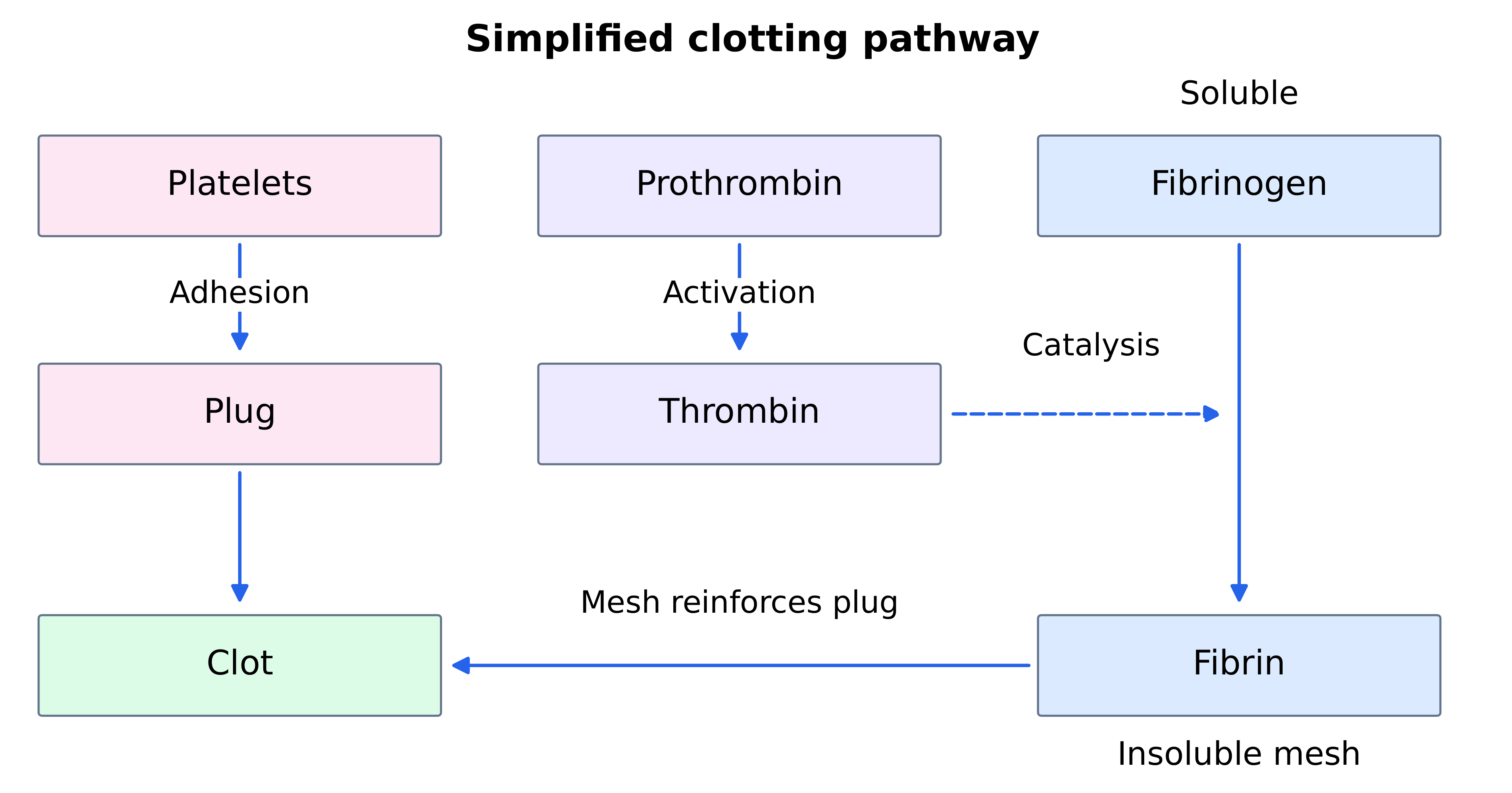
Which sequence correctly describes the simplified final clotting reactions?
Dificuldade 1/5 · Moedas 100 + pequeno bônus na primeira conclusão hoje
Thrombin is the enzyme; fibrinogen is the soluble precursor and fibrin forms the reinforcing mesh. Platelets support a plug and reactions without turning into fibrin.
Follow phagocytosis into an enclosed compartment
- A phagocyte can leave a small blood vessel, move through tissues, recognize an appropriate target and surround it with membrane. The enclosed material enters a vesicle; lysosomal enzymes digest it within the cell, separated from the rest of the cytoplasm.
- Innate recognition responds to broad microbial or damage features without requiring prior exposure to that exact antigen. Adaptive responses select cells with more specific receptors and can generate memory. The systems cooperate: suitable antigen-presenting cells help activate helper T cells. A phagocyte is neither a red cell nor a secreted antibody.
Keep antigens, receptors and antibodies distinct
- An antigen is a molecular structure recognized by a specific antibody or immune receptor. It need not be an entire organism or necessarily harmful: normal self components, including blood-cell surface antigens, can be recognized. Compatibility and context matter, rather than “antigen” simply meaning any foreign poison.
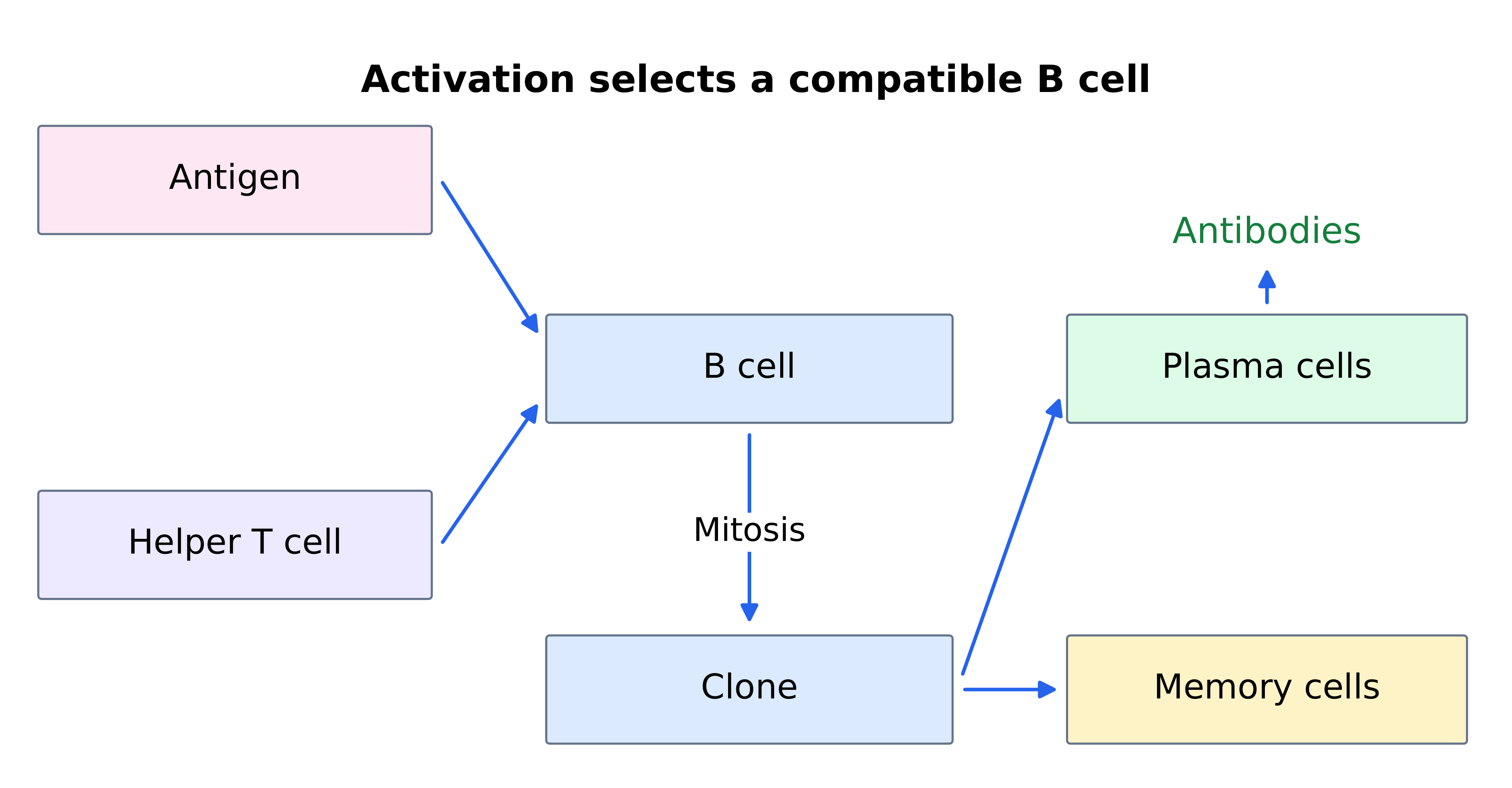
- Many lymphocyte clones already carry different receptor specificities before exposure. A matching target helps select a compatible clone; it does not teach a randomly chosen receptor to redesign itself. Antibodies are binding proteins made by cells, not living cells that multiply by mitosis.
Explain cooperating clones and their descendants
- In a typical protein-antigen response, a compatible B cell binds and takes up antigen, then displays antigen-derived material. Appropriate helper T-cell recognition and signals support activation; antigen-presenting cells also help activate helper T cells. Not every B cell is activated, and not all immune responses use an identical route.
- Selected cells divide by mitosis in clonal expansion. Plasma-cell descendants secrete many antibodies with the relevant binding specificity; memory populations can persist. Blood and lymph transport cells, while lymphoid tissues such as lymph nodes bring cells and antigen together. Binding can neutralize a target or help other mechanisms remove it.
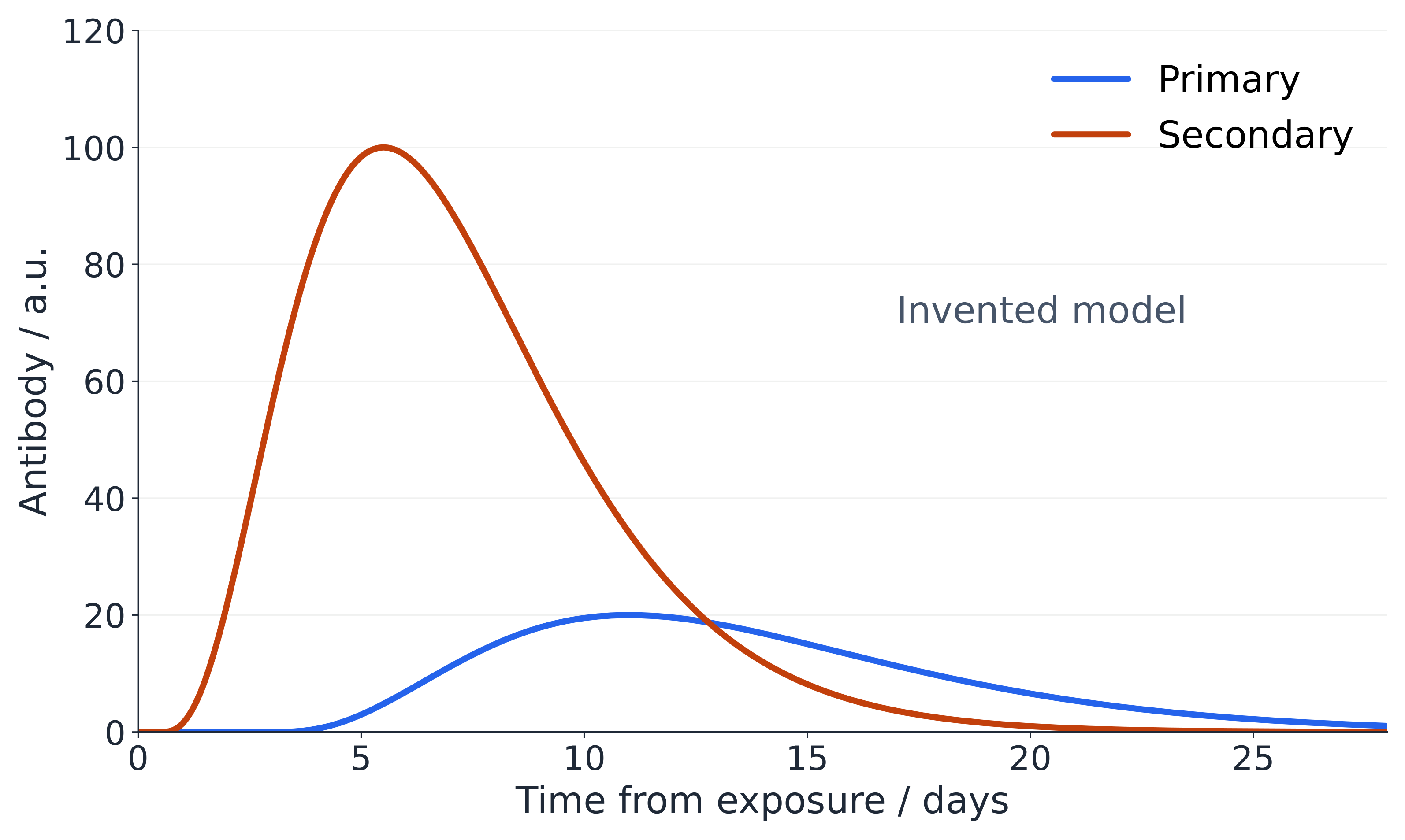
Interpret immune memory through timing and peak size
- In a separate invented numerical comparison using the same detection rule, a primary antibody response exceeds the threshold after six days and peaks at 20 units; a later response exceeds it after two days and peaks at 100. The peak is fivefold, a 400% increase; the detection delay is four days shorter, a 66.7% decrease.
- Faster activation and expansion of memory populations help explain the secondary response. Use the supplied detection times for the calculation; the schematic curves below do not show that threshold. The first detected point is not necessarily the first antibody molecule made. Antigen change, waning protection and infection site can limit protection: memory does not guarantee lifelong prevention of every infection, and different cold viruses need not be the same challenge.
In an invented comparison using one detection rule, response delay falls from six days to two. Find percentage decrease relative to six days.
Dificuldade 2/5 · Moedas 140 + pequeno bônus na primeira conclusão hoje
(6 − 2)/6 × 100 = 66.666…%, about 66.7%. A first detected response is not necessarily the first antibody molecule produced.
Explain HIV through its target and transmission route
- HIV damages CD4 helper T cells and can weaken immune coordination, including effective B-cell help. HIV infection is distinct from AIDS, the advanced syndrome of severe immune damage. Effective antiretroviral treatment can suppress replication and preserve immune function; rapid progression is not inevitable. NIH explains the distinction.
- CDC describes transmission through appropriate infectious fluids reaching susceptible tissue or blood, including sexual exposure, contaminated injection equipment, pregnancy, birth or breastfeeding. Ordinary touching, shared classroom air and mosquitoes do not transmit HIV. Explain a biological route without stigmatizing people or assuming mere proximity is exposure.
Match antibiotics to cellular targets
- Antibiotics can inhibit bacterial cell-wall synthesis, bacterial ribosome function or other bacterial processes. Viruses lack those bacterial targets, so the same mechanism does not treat a viral infection. Treating a secondary bacterial infection during a viral illness does not mean the drug directly kills the virus.
- A clear zone in an approved bacterial-disc test shows inhibited growth under those conditions, not a proven safe medicine for people. Control organism, inoculum, medium, disc dose, incubation and measurement; use suitable controls and repeats. Discovery also needs mechanism, toxicity and effectiveness evidence, while resistance to several drugs can accumulate through different genes or mechanisms.
Track resistance as both a count and a fraction
- In an invented population, 100 of 10,000 bacteria are resistant: 1%. After exposure, 50 resistant and 99 susceptible cells remain. The resistant fraction is 50/149, about 33.6%, although the resistant count has fallen from 100 to 50. Differential survival changes composition; later reproduction can expand survivors.
- Mutation and acquired resistance genes supply heritable variation; antibiotic exposure selects among variants rather than making bacteria choose a useful mutation. A greater fraction is not automatically a greater absolute count. Appropriate use and infection prevention can reduce selection and spread without guaranteeing that resistance never evolves.
An invented post-exposure population has 50 resistant and 99 susceptible bacteria. Find percentage resistant among survivors.
Dificuldade 2/5 · Moedas 140 + pequeno bônus na primeira conclusão hoje
50/(50 + 99) × 100 ≈ 33.6%. Use all survivors as denominator. The resistant count may have fallen even while its fraction rises.
Separate an animal reservoir from a vector and a human route
- A zoonosis can pass naturally between other vertebrate animals and humans. Cattle-associated Mycobacterium bovis can infect people, including through contaminated unpasteurized dairy products; it differs from mainly human-associated M. tuberculosis. Rabies virus can enter through an infected mammal's saliva in a bite. CDC gives the bovine-TB distinction.
- For Japanese encephalitis, Culex mosquitoes transmit virus maintained among pigs and water birds; humans generally do not sustain the mosquito cycle. WHO describes that cycle. An animal origin need not mean every later infection comes directly from an animal. Animal-virus relatives of SARS-CoV-2 alone cannot identify its precise first spillover route or prove a named intermediate host.
Connect vaccination with memory and a defined outcome
- Vaccines present chosen antigens or instructions for making one, supporting specific activation, expansion and memory without requiring the natural disease. Types include weakened or inactivated pathogens, purified components and nucleic-acid approaches. Making one antigen from mRNA does not amount to producing a whole reproducing virus; boosters can strengthen or renew responses.
- Define protection against infection, severe disease or transmission separately. A benefit against one is not automatically the same against the others. Evaluation needs comparable groups, clear outcomes, follow-up and assessment of harms as well as benefits; low risk does not mean zero adverse effects, and an early media claim is not a complete study.
Compare absolute risk with relative protection
- In an invented comparison with equal follow-up, 80 of 1,000 unvaccinated participants and 20 of 1,000 vaccinated participants develop the stated outcome. Risks are 8% and 2%, the risk ratio is 0.25 and the relative reduction is 75%. The absolute difference is six percentage points, not 75 percentage points.
- These calculations alone do not prove comparable exposure or causal protection. Randomization or appropriate adjustment, complete follow-up, reliable case detection and uncertainty estimates strengthen inference. State the measured endpoint: a severe-disease risk reduction cannot simply be inserted as protection against transmission.
In an invented equal-follow-up comparison, defined-outcome risks are 8% in an unvaccinated group and 2% in a vaccinated group. Calculate relative risk reduction as a percentage.
Dificuldade 2/5 · Moedas 140 + pequeno bônus na primeira conclusão hoje
(1 − 2/8) × 100 = 75%. The absolute difference is six percentage points. Study design and measured endpoint still matter.
State the assumptions of a herd-immunity model
- Herd immunity concerns indirect protection when immunity reduces transmission. In a uniformly mixing teaching model, R-zero is the average secondary-case number in an otherwise susceptible population, and p is the fraction completely protected against contributing to transmission. If R-zero is four, p = 0.80 gives R = 0.8; p = 0.60 gives R = 1.6.
- The immune boundary is 1 minus the reciprocal of R-zero: 75% here. At exactly 75%, R equals one; average decline requires a greater fraction under these assumptions. R below one does not mean no new case can occur. Severity and transmissibility are different properties.
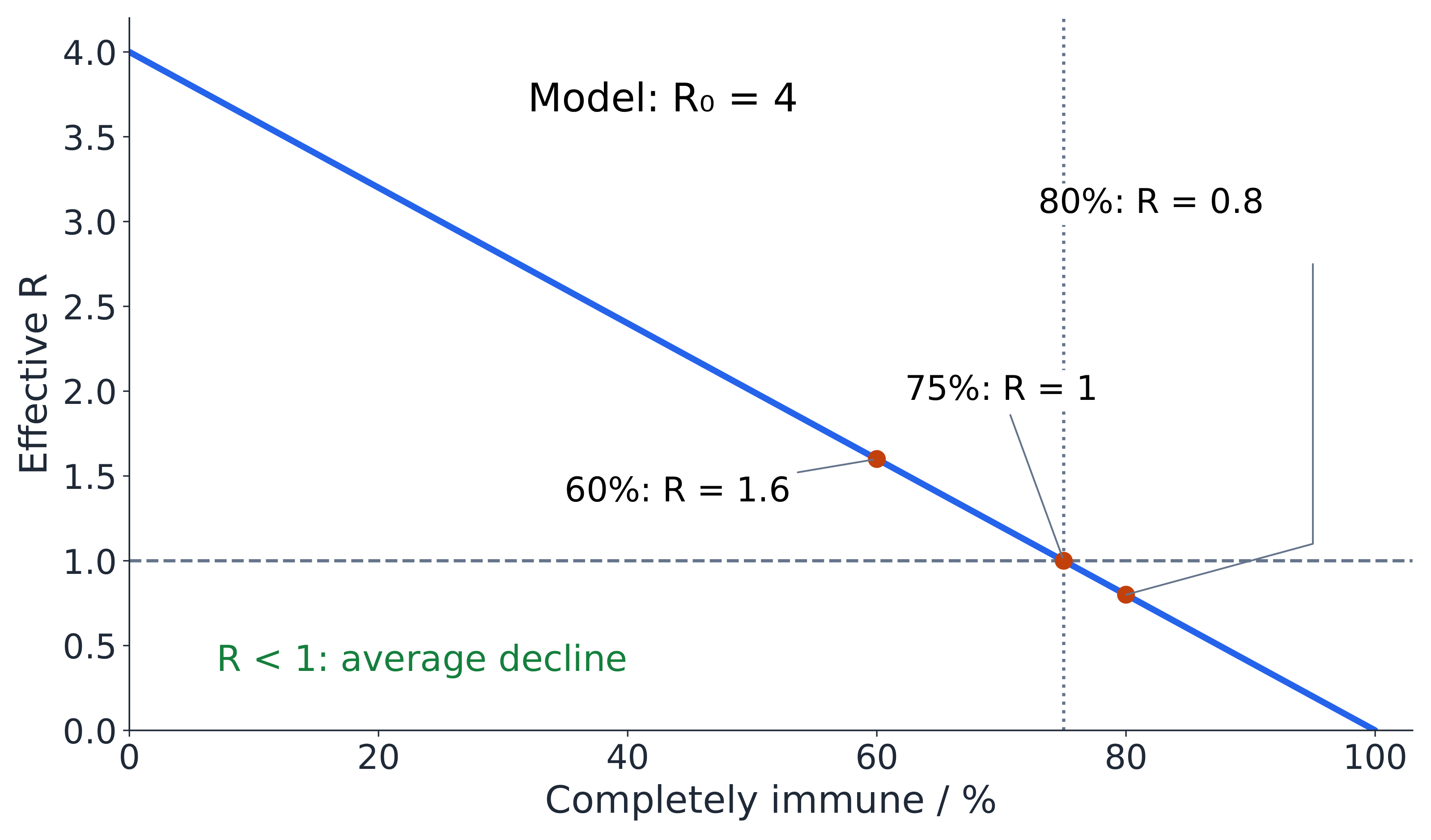
In the uniformly mixing teaching model R = R-zero × (1 − p), R-zero is four and p = 0.80 is complete protection against contributing to transmission. Find R.
Dificuldade 2/5 · Moedas 140 + pequeno bônus na primeira conclusão hoje
4 × (1 − 0.80) = 0.8. This is below one, so average chains decline under the assumptions; it does not guarantee zero cases.
Distinguish vaccination coverage from effective protection
- In a further simplified model, let v be vaccinated fraction and e protection against contributing to transmission, so p = ve. If R-zero is four and e = 0.90, the coverage boundary is 0.75/0.90, about 83.3%. Average decline requires coverage above this boundary, rather than exactly the boundary.
- Uniform mixing, otherwise susceptible people and stable protection are assumptions. Clustering, waning protection and variant differences can change outcomes. Do not treat coverage as automatically equal to immunity, or a model boundary as a universal practical guarantee. Use the endpoint relevant to transmission rather than substituting a severe-disease percentage.
Use the simplified model p = v × e. A complete-immunity boundary is p = 0.75 and transmission protection is e = 0.90. Find vaccination-coverage boundary v as a percentage.
Dificuldade 2/5 · Moedas 140 + pequeno bônus na primeira conclusão hoje
v = 0.75/0.90 = 0.83333…, or about 83.3%. At the exact boundary R = 1; decline requires greater coverage under the stated assumptions.
Name the denominator, time window and case definition
- Prevalence concerns existing cases at a stated time or period; incidence concerns new cases over a specified interval with a suitable at-risk or person-time denominator. A cumulative reported total is not the number currently ill. Counts can also differ because testing, detection and reporting change.
- In an invented monthly comparison, A has 24 new cases among 800 initially at-risk people, and B has 36 among 1,600: risks are 3% and 2.25%, or 30 and 22.5 per 1,000. A has fewer cases but a higher risk. The risk ratio A/B is about 1.33; the absolute difference is 0.75 percentage points.
Interpret historical reports in their actual units
- WHO situation report 1, published 21 January 2020 with data through 20 January, reported 282 confirmed cases globally; report 2, published the next day with data through 21 January, reported 314. The increase is 32, about 11.3% relative to 282. These historical reports do not count every infection acquired between their publication dates.
- CDC's historical US TB table gives annual 2022 and 2023 incidence rates of 2.5 and 2.9 per 100,000: 25 and 29 per million. The displayed difference is four per million per year. They are rounded TB-disease surveillance rates, not all latent infections or current prevalence. Compare equivalent definitions and periods before explaining a trend.
The cited historical TB table displays annual incidence of 2.5 cases per 100,000. Convert this displayed rate to cases per million people per year.
Dificuldade 2/5 · Moedas 140 + pequeno bônus na primeira conclusão hoje
One million is ten times 100,000, so 2.5 × 10 = 25 per million per year. This is annual TB-disease incidence, not the number of all latent infections.
Build an immune explanation and an evidence comparison
- Trace the relevant actors: platelets support sealing, phagocytes engulf, selected lymphocytes expand, plasma cells secrete binding proteins and memory supports later responses. Explain how HIV, bacterial resistance or antigen change affects a particular stage rather than saying every defence works identically.
- For data, label the outcome, denominator, period and uncertainty. Percentage change uses the initial value; a requested symmetric percentage difference may instead use the mean—state the convention. For invented totals 400 and 500, these give 25% and about 22.2% respectively. Use supplied data or safe contact-network simulations, not cultures of unknown pathogens.
Explain a faster secondary antibody response, then evaluate a claim that a 75% reduction in a vaccine study guarantees no infection once exactly 75% of people are vaccinated.
Mechanistic immune reasoning and population-risk arithmetic answer related but distinct questions. State each link and assumption.