Digestion, transport and health evidence
Introduzido| English | Significado |
|---|---|
| digestion/daɪˈdʒestʃn/ | digestion: digestão |
| absorption/əbˈsɔːpʃn/ | absorption: absorção |
What would explain this observation?
- Two foods can have the same mass but provide different nutrients. A health claim must distinguish the nutrient measured from the health outcome inferred.
Build the model
- Large insoluble food molecules are digested into smaller soluble molecules.
- Carbohydrases form sugars, proteases form amino acids, and lipases form fatty acids and glycerol.
- Bile emulsifies lipids and helps neutralize acidic stomach contents.
- digestion 消化: Breakdown of large food molecules.
- absorption 吸收: Movement of soluble products into the body.

Which statement about bile is correct?
Dificuldade 1/5 · Moedas 100 + pequeno bônus na primeira conclusão hoje
Bile is made in the liver and emulsifies lipids: it breaks large fat droplets into smaller ones, increasing the surface area for lipase. Bile is not an enzyme, so it is not a protease, and it digests nothing itself, so it cannot break nutrients into monomers.
Match each technical term to its precise meaning.
Dificuldade 2/5 · Moedas 140 + pequeno bônus na primeira conclusão hoje
Use the definitions to distinguish related quantities and processes.
Choose evidence that can test it
- Absorption moves soluble products into blood or lymph.
- Thin exchange surfaces and a large surface area shorten diffusion paths and increase transfer.
- Enzyme activity and transport are different processes.
In the lab: Use Benedict reagent with controlled heating for reducing sugars, iodine for starch, Biuret reagent for protein, and the ethanol emulsion test for lipids. Keep ethanol away from flames. Use positive and negative controls.
Smaller droplets, more surface, same lipid
Emulsification disperses lipid into smaller droplets. Compare equal total volumes to see why more surface is available for lipase, without treating bile as an enzyme.
Which two habits make the investigation or model in this case more defensible?
Dificuldade 2/5 · Moedas 140 + pequeno bônus na primeira conclusão hoje
Stating the conditions and assumptions lets others repeat the work exactly, and recording the supporting evidence lets them check the conclusion. Hiding disagreeing results removes the evidence that could challenge a wrong conclusion, and one measurement can never establish a wider claim.
Work from known quantities
- Known: 6 of 24 study participants report a condition.
- Proportion = cases / total.
- Percentage = 6/24 × 100 = 25%.
- The percentage describes this sample.
- It does not establish that one food caused the condition; confounders and how the sample was chosen matter.
Your turn: 9 of 36 participants report an outcome. Calculate the percentage.
9 of 36 participants report an outcome. Calculate the percentage.
Dificuldade 2/5 · Moedas 140 + pequeno bônus na primeira conclusão hoje
The result is 25 %. Known: 9 of 36 participants report the outcome. Use percentage = cases / total x 100. Percentage = 9/36 x 100 = 25%. This describes the sample only; it does not show that a food caused the outcome.
Check the conclusion and its limits
- Bile is not an enzyme.
- A positive food test identifies a component under the test conditions; it does not show that a food is healthy or unhealthy in every diet.
Not true: A correlation between diet and illness proves causation. A correlation shows that two measurements vary together; it does not prove one causes the other. A confounding variable, reverse causation or chance could explain the link, so a controlled comparison is needed before claiming causation.
- Large insoluble food molecules are digested into smaller soluble molecules.
- Absorption moves soluble products into blood or lymph.
- Watch for: bile is not an enzyme.
A correlation shows that two measurements vary together; it does not prove one causes the other.
Dificuldade 1/5 · Moedas 100 + pequeno bônus na primeira conclusão hoje
True. A correlation shows that two measurements vary together; it does not prove one causes the other. A confounding variable, reverse causation or chance could explain the link, so a controlled comparison is needed before claiming causation.
Breakdown of large food molecules: write the technical term.
Dificuldade 1/5 · Moedas 100 + pequeno bônus na primeira conclusão hoje
digestion means Breakdown of large food molecules.
Write from 18 percent of a sample
- 9 of 50 participants report an outcome.
- Find the percentage. A correlation does not prove that one factor caused the other.
9 of 50 participants report an outcome. What percentage is that, and why does a correlation between diet and illness not prove causation?
Percentage = outcome count / participants × 100 = 9/50 × 100 = 18%. This sample percentage alone does not prove a cause; a shared pattern can reflect other factors.
In the SL written case, 9 of 50 participants report an outcome. What percentage is that?
Dificuldade 1/5 · Moedas 100 + pequeno bônus na primeira conclusão hoje
9 divided by 50 is 0.18, so 18 percent reported the outcome. Other options — 25 percent (the lesson example's result for 9 of 36 participants); 9 (the number of reports).
Explain capillary exchange at two different scales
- A capillary has a narrow lumen and a one-cell-thick endothelial wall with a basement membrane, supporting short exchange distances. Branching supplies a large collective area. Some capillary types have fenestrations for fluid and small-solute exchange; these are not unrestricted passages for every blood cell.
- The combined cross-sectional area of a capillary bed is much larger than one capillary's area. At constant total flow, average velocity is flow divided by total area: increasing combined area fivefold reduces average velocity to one fifth. One narrow capillary does not imply rapid passage through the entire bed, and permeability and gradients still matter.
Define vessels by direction before oxygen content
- Arteries carry blood away from the heart and veins return it. Pulmonary arteries therefore remain arteries despite carrying relatively oxygen-poor blood; pulmonary veins return oxygenated blood. Compared at similar sizes, arteries usually have thicker muscle and elastic walls relative to their lumen, matching higher pulsatile pressures.
- Elastic stretch and recoil support arterial flow between beats. Compliant veins can be compressed by skeletal muscles; valves in many veins limit backflow rather than pumping by themselves. Not every vein has valves. Pressure gradients, breathing movements and the heart also contribute to return, so no single feature explains the entire circulation.
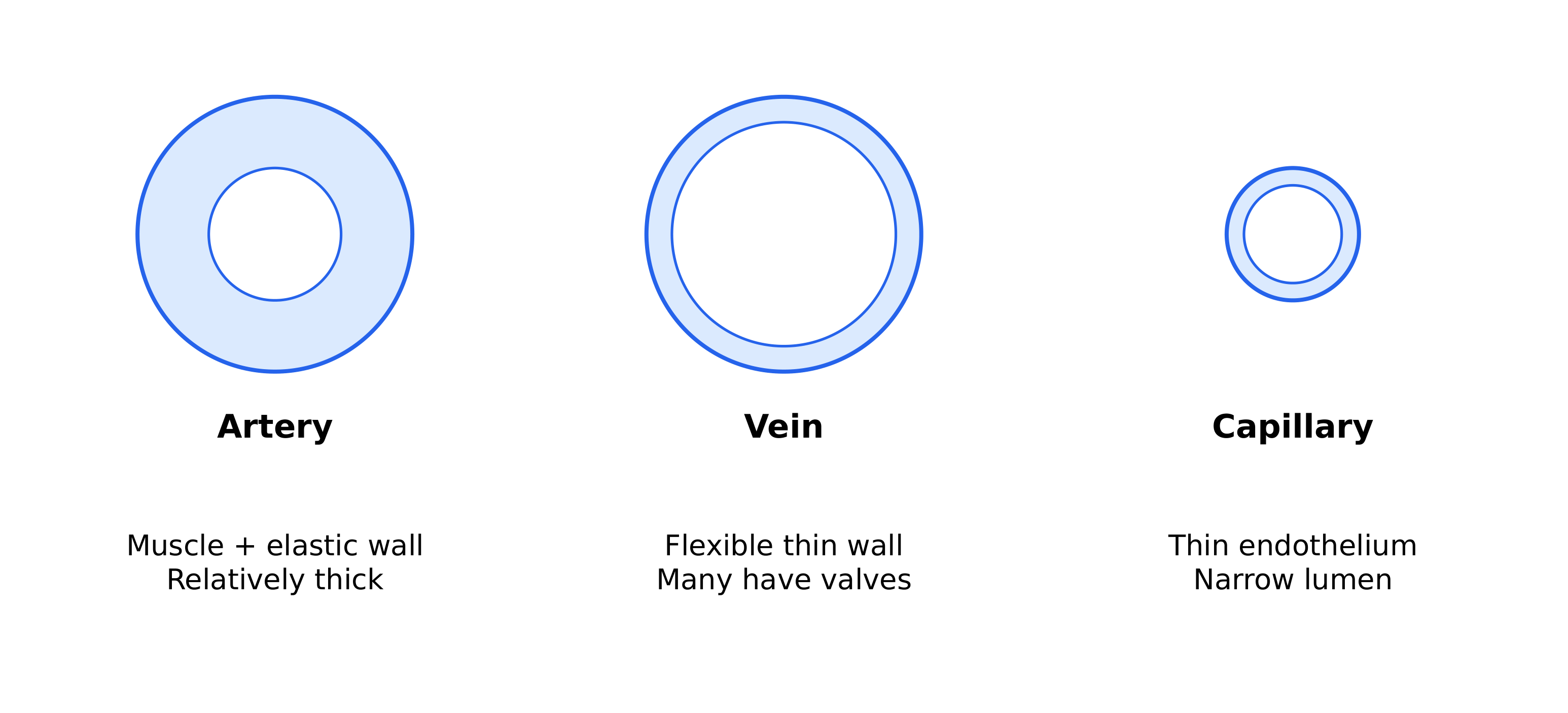
Use several clues to identify a vessel section
- In an invented matched comparison, A has wall thickness 0.30 mm and lumen diameter 1.20 mm, while B has 0.10 mm and 2.00 mm. Ratios are 0.25 and 0.05. A's greater wall-to-lumen ratio supports arterial identity when muscle and elastic-tissue evidence agree.
- Processing can collapse a vein and an oblique section can distort shape. A round lumen or diagram colour alone does not establish vessel type or oxygen content. Compare equivalent vessel sizes, usable scales, wall tissues and lumen shape together, and state the remaining uncertainty of a single section.
A matched vessel section has wall thickness 0.30 mm and lumen diameter 1.20 mm. Find wall thickness divided by lumen diameter.
Dificuldade 2/5 · Moedas 140 + pequeno bônus na primeira conclusão hoje
0.30/1.20 = 0.25. The ratio is dimensionless. A thicker relative wall supports arterial identification when other structural clues agree; shape, section angle and processing still matter.
Convert timed pulse counts and state the sample
- Invented counts of 18, 19 and 18 beats over separate 15-second intervals give 72, 76 and 72 beats per minute, averaging about 73.3. One missed beat changes a 15-second estimate by 4 beats per minute; over 60 seconds it changes the estimate by 1. Longer observation reduces that conversion error, though rate can genuinely change.
- A pulse is a travelling pressure wave associated with ventricular ejection, not a discrete blood packet. In approved voluntary resting measurements, keep posture, rest and timing comparable and follow the institution's method. Repeats from one person describe within-person variation, not independent people. Pulse alone does not provide stroke volume, pressure or cardiac output.
Invented counts in three separate 20-second intervals are 23, 24 and 25 beats. Find their mean estimated rate in beats per minute.
Dificuldade 2/5 · Moedas 140 + pequeno bônus na primeira conclusão hoje
Each interval is 20 seconds, so multiply by 60/20 = 3 to obtain 69, 72 and 75 beats per minute. Mean = (69 + 72 + 75)/3 = 72 beats per minute. One counting error in 20 seconds changes the estimate by 3 beats per minute. Repeated intervals from one person are not independent people.
Explain coronary supply through the muscle's needs
- Coronary arteries supply heart muscle with oxygen and nutrients; chamber blood cannot supply the thick wall adequately by diffusion alone. Plaque can narrow arteries, and plaque disruption can trigger a clot that obstructs flow. Reduced oxygen delivery limits aerobic ATP supply and contraction; prolonged severe deprivation can kill muscle.
- The NHLBI coronary account also distinguishes vessel-function problems from plaque-related disease. A biological mechanism helps interpret evidence but does not make every diet–outcome correlation causal. Keep the measured exposure, affected vessels and proposed mechanism distinct.
Compare risks with denominators and time periods
- In an invented ten-year cohort, outcomes occur in 30 of 600 exposed participants and 12 of 600 comparison participants. Risks are 5% and 2%; the difference is 3 percentage points and the risk ratio is 2.5. The ratio is not a 250-percentage-point difference or a certainty for any individual.
- Check sampling, age, smoking, activity, other exposures and loss to follow-up. Confounding can influence an association; a correlation coefficient does not remove it. A weak linear relationship also does not exclude every nonlinear or subgroup pattern. Stronger causal arguments combine suitable design, measurement, mechanism and alternative explanations.
Over the same invented ten-year period, outcomes occur in 30 of 600 exposed participants and 12 of 600 comparison participants. Find the exposure-group risk divided by the comparison risk.
Dificuldade 2/5 · Moedas 140 + pequeno bônus na primeira conclusão hoje
Exposed risk = 30/600 = 0.05 = 5%; comparison risk = 12/600 = 0.02 = 2%. Risk ratio = 0.05/0.02 = 2.5. Their difference is 5 − 2 = 3 percentage points, a different quantity. Neither calculation by itself establishes that exposure caused the outcome.
Connect digestion to absorption and transport
- Digestion breaks large food molecules into absorbable products; absorption moves those products across an epithelium into the body. Carbohydrases, proteases and lipases act on different substrates. Bile aids emulsification and intestinal conditions but is not an enzyme. Much dietary lipid enters intestinal lymph after packaging, while sugars and amino acids can enter blood.
- A controlled positive food test supports the presence of a component, not proof that the food causes a health outcome. Use appropriate positive and negative controls and approved methods. Molecule identification, membrane transport and population health evidence answer different questions; do not use a single positive test to claim a complete causal pathway.
Trace transpiration pull through a cohesive water column
- Evaporation from moist mesophyll walls and vapour loss through stomata create tension in remaining liquid. A cohesive water column transmits a pull through xylem toward the leaf; adhesion to hydrophilic walls contributes. This is not a leaf muscle pushing water upward or a vacuum above every leaf.
- Mature xylem vessel elements are dead and hollow, without cytoplasm or plasma membrane. Reduced end-wall obstruction permits flow; lignified walls resist collapse under tension; pits support lateral exchange through appropriate wall regions. Cavitation can interrupt conducting pathways, so continuity matters rather than being guaranteed under every condition.
Interpret negative pressure with a physical gradient
- In an invented comparison at the same height and solute conditions, root xylem is at −0.2 MPa and leaf xylem at −0.8 MPa. Leaf pressure is lower, and the pressure component favours movement toward the leaf. The difference in magnitude is 0.6 MPa, not 1.0 MPa.
- Real soil–plant–atmosphere movement follows water-potential differences, including pressure, solute and gravitational contributions. Negative numbers do not move upward by definition. Environmental energy supplies evaporation, while living tissues regulate conditions and routes. State the simplifications before interpreting a pressure comparison as a complete model of a tall plant.
At equal height and otherwise equal solute conditions, invented root and leaf xylem pressures are −0.2 and −0.8 MPa. Find the magnitude of their pressure difference.
Dificuldade 2/5 · Moedas 140 + pequeno bônus na primeira conclusão hoje
|−0.2 − (−0.8)| = 0.6 MPa. The leaf pressure is lower and this component favours movement toward the leaf. A complete real-plant explanation also considers gravity and other water-potential contributions.
Keep stem and root tissue plans distinct
- A representative young dicot stem has epidermis, cortex and bundles around central pith. Within a bundle, xylem faces inward and phloem outward, often with cambium between. A young dicot root instead has a central vascular cylinder, commonly star-shaped xylem with phloem between its arms; an endodermis surrounds that cylinder.
- Xylem conducts water and minerals and adds support; phloem transports organic solutes. Species, age and secondary growth can change appearance. Draw tissue regions and relative positions in a low-power plan, not every individual cell or sieve pore. Use the supplied specimen instead of imposing the stem's ring of bundles on every root.
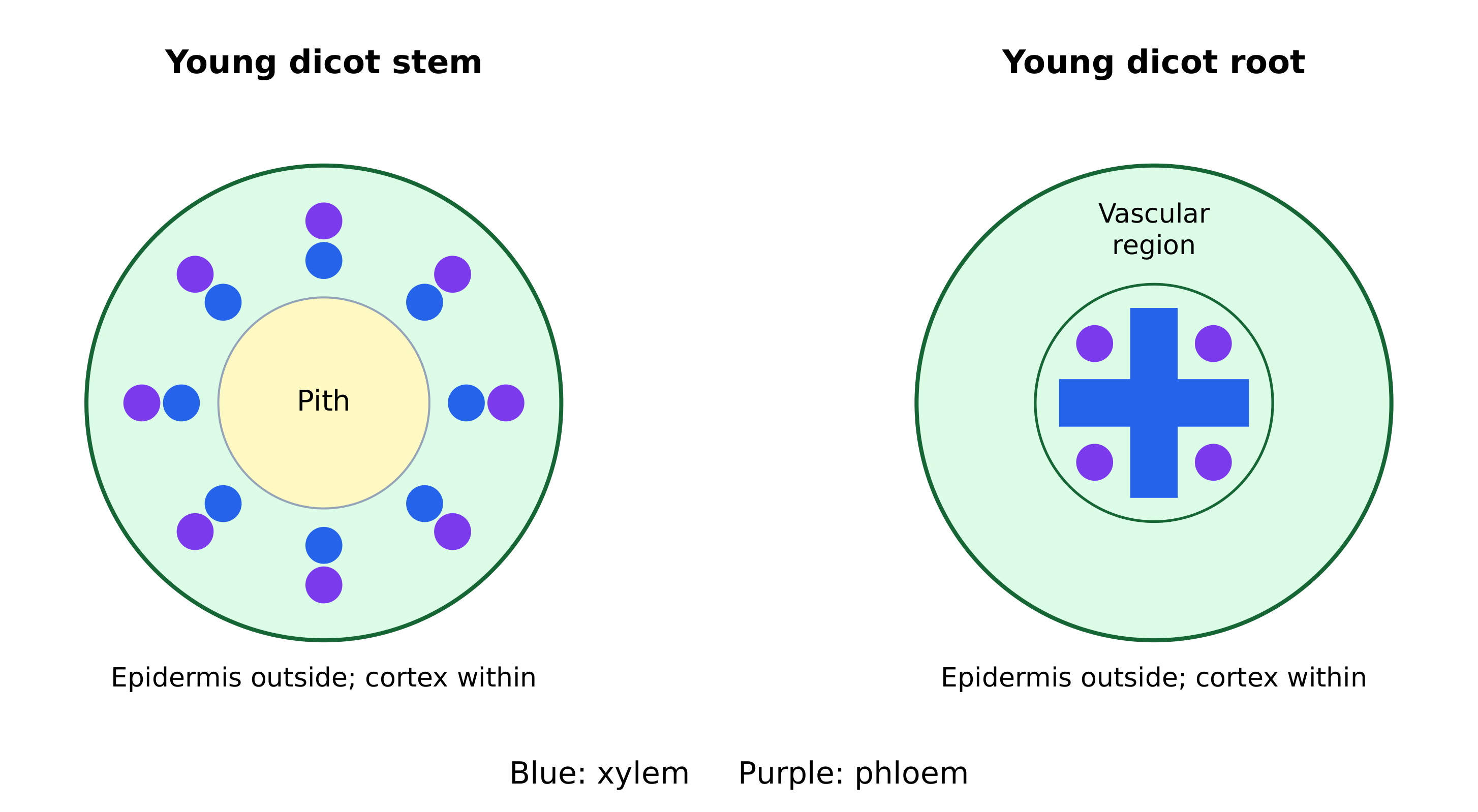
Calibrate a tissue image before measuring regions
- An invented 12 mm image represents a 0.60 mm stem, so magnification is $12/0.60=20$. A cortex region measuring 3.0 mm on that image represents $3.0/20=0.15$ mm, or 150 micrometres. Image and specimen dimensions must use the same units before division.
- Resizing changes a printed magnification value unless updated, while a scale bar resized with the image retains its relation to structures. Label the region actually measured and account for section orientation. A large xylem area in one static section is not itself a direct flow measurement under every physiological condition.
Distinguish bulk flow from crossing a membrane
- Blood, xylem sap and phloem sap can move together by pressure-driven bulk flow along a route. Individual substances then cross appropriate exchange barriers through diffusion or selective transport. A nutrient moving along a vessel is not being actively pumped across a membrane at every point along the vessel's length.
- In a structure–function answer, name the tissue, direction, driving force and exchange boundary. Use ratios and measured flows for their stated samples, then qualify the inference. Direction defines an artery; wall structure supports pressure; concentration and pressure conditions help explain transfer. These are connected but different pieces of evidence.
Evaluate the claim that a single vessel micrograph and one short pulse count establish a person’s cardiac output and the complete transport mechanism.
A strong conclusion stays within the measurements. Structural, rate, volume and mechanism evidence complement one another rather than being interchangeable.