Muscle contraction: filaments slide
Introduzido| English | Significado |
|---|---|
| sarcomere/ˈsɑːkəmɪə/ | sarcômero |
| cross-bridge/krɒs brɪdʒ/ | ligação cruzada |
What would explain this observation?
- A sarcomere 肌节 becomes shorter during contraction although its thick and thin filaments keep approximately the same length.
Build the model
- Actin and myosin interact in a sliding-filament mechanism.
- Calcium permits the interaction through regulatory proteins; ATP binding and hydrolysis support the cross-bridge 横桥 cycle.
- Skeletal muscles pull through tendons and work in coordinated groups.
- sarcomere: The repeating contractile unit between two Z lines.
- cross-bridge: A myosin-actin interaction during the contraction cycle.

What happens to thick-filament length during normal contraction?
Dificuldade 1/5 · Moedas 100 + pequeno bônus na primeira conclusão hoje
In the sliding-filament model the filaments slide past each other: thick and thin filament lengths stay essentially constant while the sarcomere shortens. The overlap changes, not the filaments.
Match each technical term to its precise meaning.
Dificuldade 2/5 · Moedas 140 + pequeno bônus na primeira conclusão hoje
Use the definitions to distinguish related quantities and processes.
Choose evidence that can test it
- During shortening, overlap increases.
- The A-band length stays approximately constant while I bands and the H zone become smaller.
- Movement at a joint also depends on tendon insertion, lever geometry and opposing muscle activity.
In the lab: Annotate two sarcomere diagrams at different lengths using the same scale. Track band widths separately from filament length. Use prepared models or existing images, not painful or maximal-exertion tasks.
Which two habits make the investigation or model in this case more defensible?
Dificuldade 2/5 · Moedas 140 + pequeno bônus na primeira conclusão hoje
Stating the conditions and assumptions lets others repeat the work exactly, and recording the supporting evidence lets them check the conclusion. Hiding disagreeing results removes the evidence that could challenge a wrong conclusion, and one measurement can never establish a wider claim.
Work from known quantities
- Known: sarcomere length changes from 2.5 to 2.0 micrometres.
- Percentage shortening = (2.5 − 2.0)/2.5 × 100 = 20%.
- This does not mean either filament shortened by 20%.
Your turn: A sarcomere shortens from 3.0 to 2.4 micrometres. Calculate percentage shortening.
Shorter sarcomere, unchanged filament lengths
Compare 2.5 μm with 2.0 μm: 20% shortening. Use the same scale to track Z lines, overlap, the fixed A-band span and the changing I regions and H zone in a schematic model.
A sarcomere shortens from 3.0 to 2.4 micrometres. Calculate percentage shortening.
Dificuldade 2/5 · Moedas 140 + pequeno bônus na primeira conclusão hoje
The result is 20 %. Known: sarcomere shortens from 3.0 to 2.4 micrometres. Use percentage shortening = (initial - final) / initial x 100. Shortening = (3.0 - 2.4)/3.0 x 100 = 20%. The filaments themselves did not shrink by 20%.
Check the conclusion and its limits
- ATP is required for myosin detachment as well as the continuing cycle.
- A muscle pulling harder does not mean all its fibres become shorter under every load.
Not true: Contracting muscle shortens by shrinking every actin filament. Contraction is sliding, not shrinking: actin and myosin filaments keep their length while their overlap increases. A filament that shortened would contradict the sliding-filament evidence.
- Actin and myosin interact in a sliding-filament mechanism.
- During shortening, overlap increases.
- Watch for: ATP is required for myosin detachment as well as the continuing cycle.
Contracting muscle shortens by shrinking every actin filament.
Dificuldade 1/5 · Moedas 100 + pequeno bônus na primeira conclusão hoje
Contraction is sliding, not shrinking: actin and myosin filaments keep their length while their overlap increases. A filament that shortened would contradict the sliding-filament evidence.
The repeating contractile unit between two Z lines: write the technical term.
Dificuldade 1/5 · Moedas 100 + pequeno bônus na primeira conclusão hoje
sarcomere means The repeating contractile unit between two Z lines.
Write from the data: find the shortening
- A sarcomere shortens from 2.0 to 1.5 micrometres.
- Find the percentage shortening. The filaments themselves do not shorten by that percentage.
A sarcomere shortens from 2.0 to 1.5 micrometres. What is the percentage shortening, and do the filaments themselves shorten by that percentage?
Shortening = initial − final = 2.0 − 1.5 = 0.5 micrometres. Percentage shortening = 0.5/2.0 × 100 = 25%, using initial length as the denominator.
The written case has a sarcomere changing from 2.0 to 1.5 micrometres. What is its percentage shortening?
Dificuldade 1/5 · Moedas 100 + pequeno bônus na primeira conclusão hoje
Shortening = 2.0 − 1.5 = 0.5 micrometres. Relative to initial length, 0.5/2.0 × 100 = 25%. Filament lengths stay about the same; increased overlap shortens the sarcomere.
AHL: Distinguish locomotion from other movement
- Locomotion moves an organism from one location to another. Paramecium caudatum swims by coordinated ciliary beating. A rooted English oak, Quercus robur, remains sessile while shoots change direction during growth and materials move within cells. Sessile does not mean motionless at every scale.
- Different tasks use different mechanisms: cilia push against water, growing tissues change shape and muscles develop tension. Chromosome movement and intracellular transport do not require skeletal muscle. State the scale, task and mechanism instead of treating “for movement” as a complete functional explanation.
AHL: Read a sarcomere between its Z lines
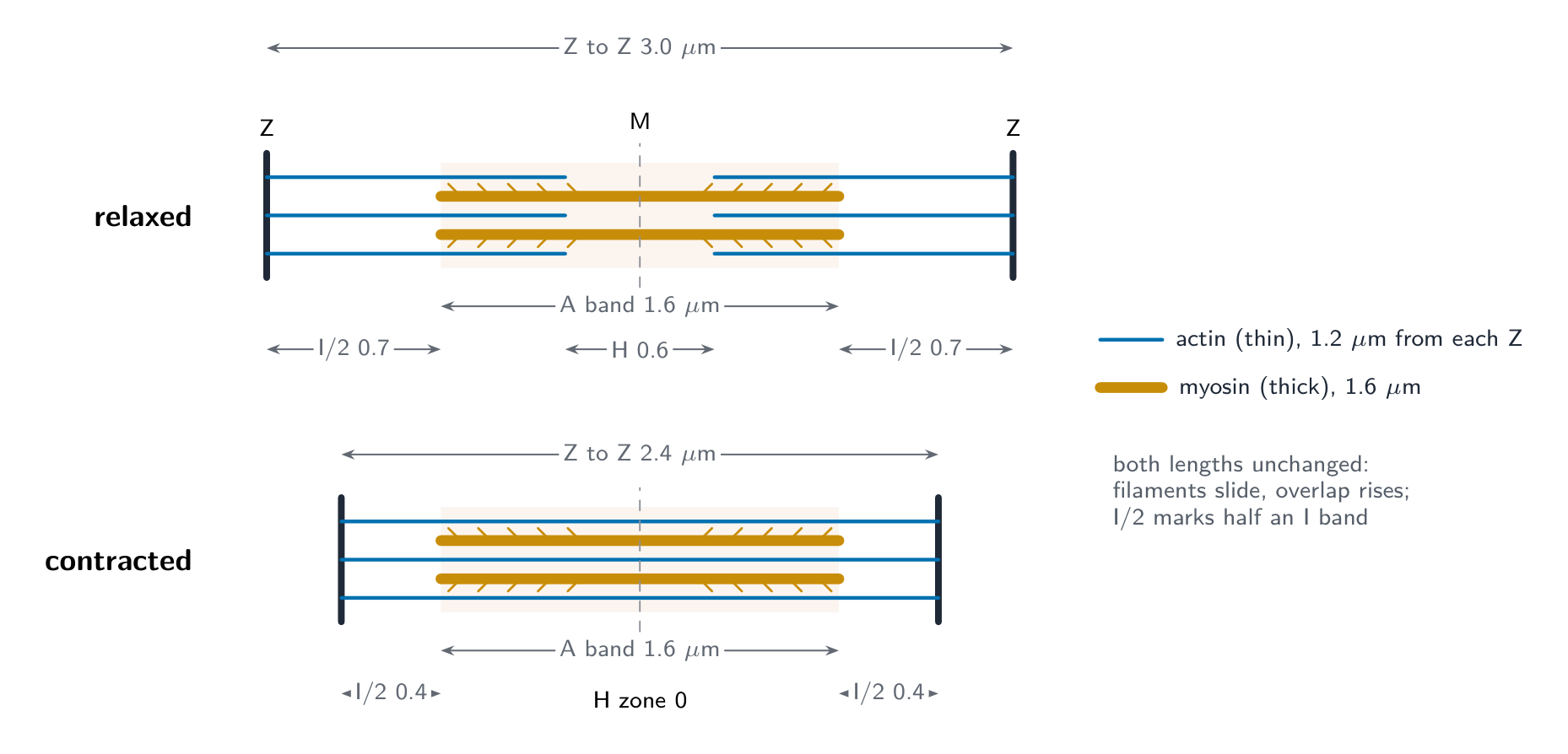
- Thin actin filaments attach toward Z lines and overlap central thick myosin filaments. Repeated myosin interactions can slide thin filaments relative to thick ones and bring Z lines closer. A band spans thick-filament length and stays approximately constant; I bands and the central H zone narrow as overlap increases.
- Each labelled I/2 end region is half an I band: a full I band straddles a Z line across adjacent sarcomeres. For identical repeating units, two 0.7 micrometre halves make a 1.4 micrometre band; two 0.4 halves make 0.8. The filaments keep their lengths, and the H zone can disappear as overlap increases.
AHL: Calculate shortening of the named structure
- In an invented model, sarcomere length changes from 3.0 to 2.4 micrometres. Shortening is $0.6/3.0\times100=20\%$. Thin filaments remain 1.2 micrometres long and thick filaments remain 1.6, so each filament's percentage shortening is zero. Sarcomere and filament length answer different questions.
- Compare calibrated images at the same scale and identify the same boundaries. A smaller image caused only by resizing is not biological contraction. A static pair supports a structural comparison but does not directly show ATP cycling, and active contraction can generate tension without overall shortening under a load.
AHL: In an invented model, a sarcomere changes from 3.0 to 2.4 micrometres while its thick filament stays 1.6 micrometres. What is the percentage shortening of the sarcomere?
Dificuldade 2/5 · Moedas 140 + pequeno bônus na primeira conclusão hoje
(3.0 − 2.4)/3.0 × 100 = 20%. Thick-filament shortening is zero; the A-band length stays approximately constant while overlap increases.
AHL: Separate calcium, ATP binding and ATP hydrolysis
- Excitation releases calcium from sarcoplasmic reticulum. Calcium binds troponin, shifting tropomyosin so myosin can interact with actin. An energized myosin head with ADP and phosphate attaches; strong binding and phosphate release are coupled to the power stroke, with ADP then released. Calcium permits access rather than supplying the stroke's energy.
- New ATP binding allows myosin detachment; ATP hydrolysis re-energizes and repositions the head. Energy-dependent calcium removal into the reticulum permits regulatory blocking to return. Loss of excitation does not instantly remove calcium or make relaxation free of energy-related processes. Heads cycle asynchronously rather than all occupying one stage together.
AHL: Which assignment of calcium and ATP roles fits the cross-bridge model?
Dificuldade 1/5 · Moedas 100 + pequeno bônus na primeira conclusão hoje
Regulation, detachment and re-energization are distinct steps. Energy-dependent calcium removal also contributes to restoring the relaxed regulatory state.
AHL: Distinguish passive recoil from antagonist pulling
- Titin stabilizes thick-filament position, resists excessive stretch and contributes passive restoring force after extension. Recoil depends on prior deformation; titin is not another myosin motor actively pushing bones apart. Reduced active tension and restoration of a joint's original position are different events.
- Skeletal muscles pull through tendons. An antagonist, an external load or elastic force can lengthen a less-active muscle and reverse movement. Flexors and extensors provide opposing actions; co-contraction can add stability, so one need not always switch off completely. A muscle does not reverse its pull by pushing its tendon forward.
AHL: Connect a motor neuron to its whole unit
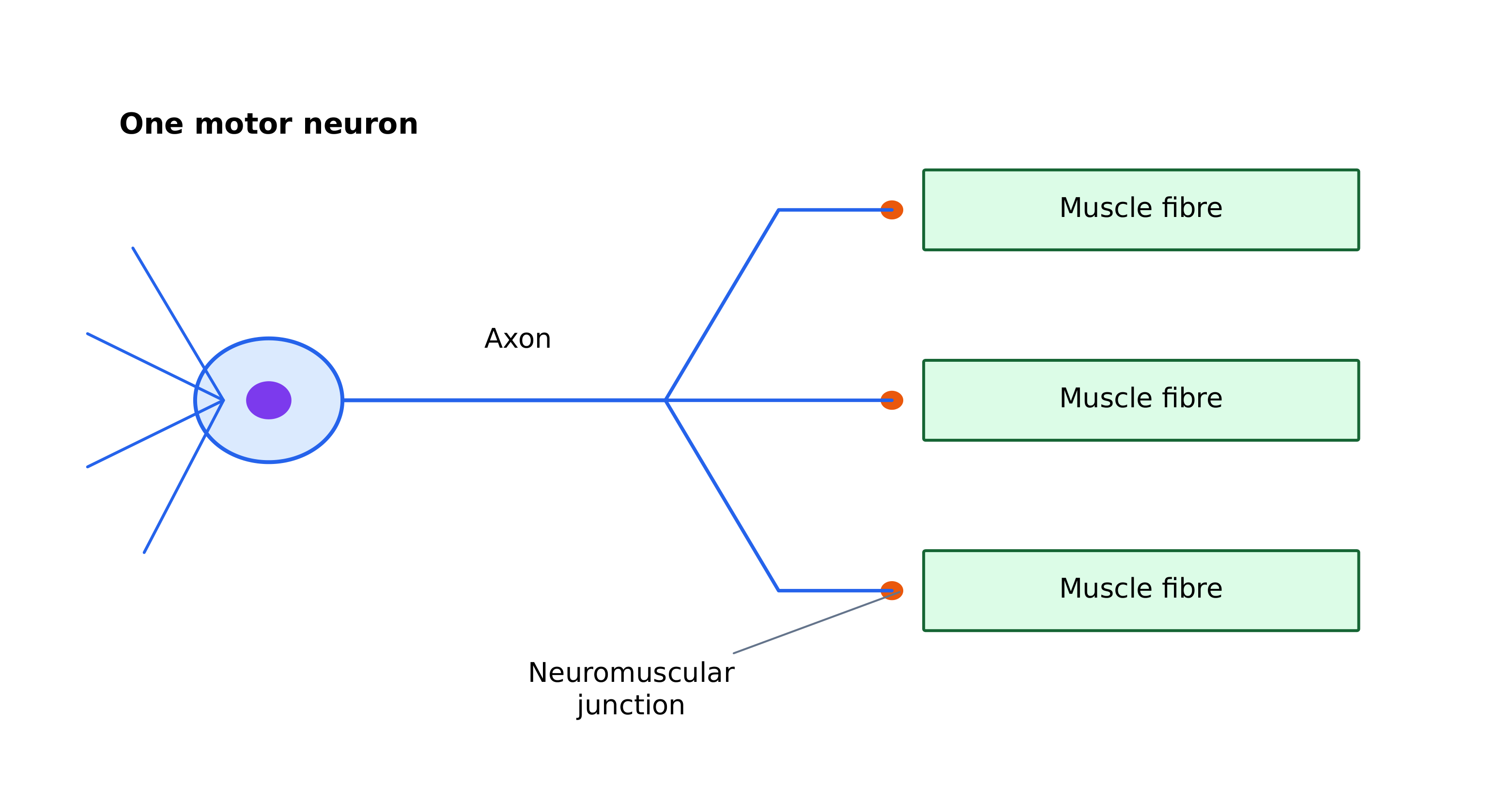
- A motor unit consists of one motor neuron and all muscle fibres it innervates. Axon branches form neuromuscular junctions, where acetylcholine acts across a gap on muscle membrane receptors. Muscle excitation then triggers calcium release. The neuron and muscle membranes do not merge.
- Recruiting additional units can increase force; stimulation frequency also affects overlapping tension responses. In an invented equal-force-per-fibre model, units with 4, 9 and 16 fibres give cumulative forces 4, 13 and 29 units. Small units permit finer increments, but real force also depends on fibre properties, length, load and activation.
AHL: Balance moments using perpendicular distances
- Vertebrate endoskeletons and arthropod exoskeletons both provide muscle anchorage and lever systems. At a model joint, load moment is force times its perpendicular distance to the pivot. A 20 N load at 0.25 m gives 5.0 newton metres. With muscle moment arm 0.025 m, static balancing tension is $5.0/0.025=200$ N when other moments are neglected.
- The full bone or tendon length is not automatically a perpendicular moment arm. Small effort arms can require force much greater than the external load while supporting displacement or speed advantages. Real limbs add their own weight and changing geometry; dynamic movement need not satisfy this simple static balance at every instant.
AHL: A 20 N load acts at perpendicular moment arm 0.25 m. The muscle moment arm is 0.025 m. Neglecting all other moments in static balance, find muscle tension.
Dificuldade 2/5 · Moedas 140 + pequeno bônus na primeira conclusão hoje
Load moment = 20 × 0.25 = 5.0 N metres. Muscle force = 5.0/0.025 = 200 N. Use perpendicular moment arms; real limbs add their own weight and dynamic forces.
AHL: Explain the hip as a supported mobile joint
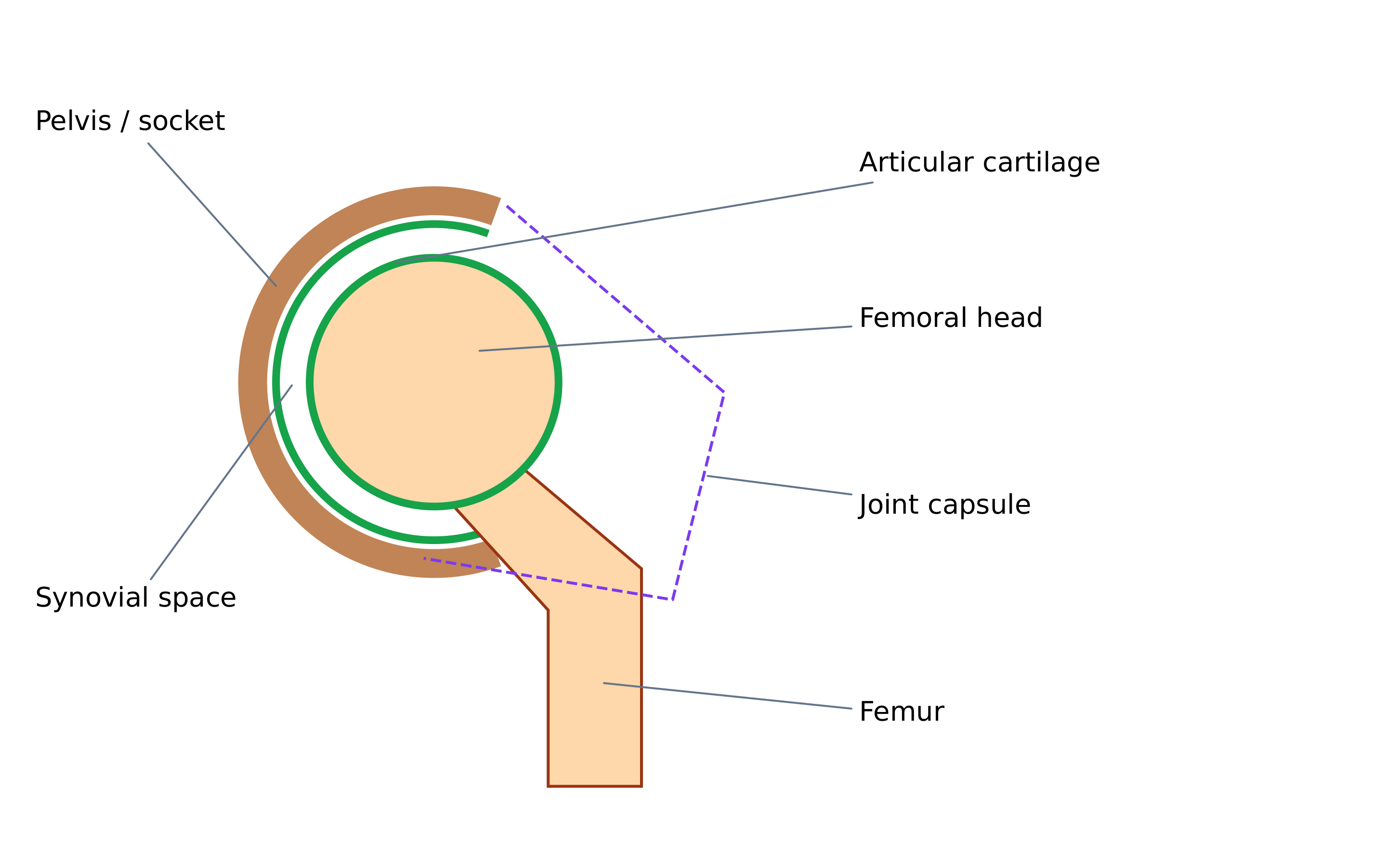
- The femoral head fits into the pelvis's acetabulum at a synovial ball-and-socket joint. Articular cartilage helps distribute contact loads and reduce friction; synovial fluid lubricates; the capsule encloses the joint. Ligaments connect skeletal parts and limit excessive movement, while tendons transmit muscle tension to bone.
- Muscle lines of action produce flexion/extension, abduction/adduction and rotation in defined directions. Multiplanar movement does not mean unrestricted motion in every direction. Name the reference position and movement plane before linking a muscle's pull to the resulting turning effect.
AHL: Keep angle conventions and planes consistent
- With invented measurements from a defined neutral position, 105 degrees flexion and 15 degrees opposite extension span a 120-degree arc in that plane. A 35-degree abduction plus 20-degree adduction spans 55 degrees in another plane; do not add them as one 175-degree joint range.
- An included image angle changing from 150 to 95 degrees changes by 55 degrees, not necessarily a final anatomical flexion angle of 95. Keep camera plane, joint centre and landmarks consistent and use comfortable approved movements or existing images. Repeat readings 54, 56 and 55 have mean 55 and range 2, but repeat spread does not establish absolute accuracy.
AHL: From one defined neutral position, invented hip flexion reaches 105 degrees and opposite extension reaches 15 degrees. Find their total arc in that plane.
Dificuldade 2/5 · Moedas 140 + pequeno bônus na primeira conclusão hoje
105 + 15 = 120 degrees. Do not add a separate abduction/adduction arc from another plane or assume an included image angle is the same as a final anatomical movement angle.
AHL: Link intercostal orientation with opposing actions
- External and internal intercostal layers have different orientations. In the simplified breathing comparison, external intercostal contraction raises ribs during inspiration; expiratory internal intercostal activity can draw them down in active expiration. Contraction can stretch an opposing system and store elastic energy associated with structures such as titin.
- Quiet expiration is largely relaxation and recoil, not forceful internal intercostal contraction every time. Neural control and diaphragm activity coordinate the system. Rib movement alters thoracic volume and pressure, moving air; this bulk ventilation is a separate step from oxygen diffusing across the exchange surface.
AHL: Compare locomotion benefits with its costs
- Dolphins can pursue prey, gazelles escape predators and male moths search for pheromone-emitting mates. Many humpback populations migrate between feeding and breeding areas; the NOAA account describes seasonal movement rather than one identical journey for every individual. Locomotion can connect resources and partners while consuming energy and increasing exposure to hazards.
- In an invented foraging model, route A supplies 120 food-energy units at travel cost 35, leaving 85; B supplies 150 at cost 80, leaving 70. Greater gross intake does not guarantee greater net gain. This model omits handling costs, nutrient balance and risk; it illustrates a trade-off rather than predicting every animal's optimal route.
AHL: Connect cetacean features to swimming and breathing
- A bottlenose dolphin has a streamlined body reducing drag, forelimb flippers supporting control and horizontal tail flukes driven up and down for propulsion. These are cetacean features, not an identical tail system in every marine mammal; seals and sea lions have different arrangements.
- A blowhole on the upper head provides an airway when the dolphin surfaces and closes during submergence. It does not extract dissolved oxygen while shut: the animal remains a lung-breathing mammal. Link each feature to drag, thrust, steering or access to air, and explain adaptation across generations rather than an individual choosing to acquire a new body form.
AHL: A class uses two muscle images and two joint photographs to claim that filaments shortened and an angle measurement is perfectly accurate. Evaluate the evidence.
Measurement conventions and alternative explanations matter at both molecular and whole-joint scales.