Biomolecule structure: bonds, polarity and function
Introduzido| English | Significado |
|---|---|
| peptide bond/ˈpeptaɪd bɒnd/ | ligação peptídica |
| hydrolysis/haɪˈdrɒləsɪs/ | hidrólise |
What would explain this observation?
- Starch, a triglyceride and a protein can all contain carbon, hydrogen and oxygen, yet their structures and functions differ. An element list alone does not identify a biomolecule.
Build the model
- Carbohydrates include monosaccharides and polymers joined by glycosidic bonds.
- A triglyceride has glycerol joined to three fatty acids by ester bonds.
- Proteins contain amino-acid residues joined by peptide bonds 肽键; side chains and folding contribute to their properties.
- These structures support storage, membrane or functional roles depending on the molecule.
- peptide bond: A covalent linkage between amino-acid residues.
- hydrolysis 水解: Breaking a linkage using water.

What distinguishes a triglyceride in this model?
Dificuldade 1/5 · Moedas 100 + pequeno bônus na primeira conclusão hoje
A triglyceride is one glycerol joined to three fatty acids by ester bonds formed in condensation reactions. Peptide bonds belong to proteins, and thymine marks DNA - neither describes a lipid.
Match each technical term to its precise meaning.
Dificuldade 2/5 · Moedas 140 + pequeno bônus na primeira conclusão hoje
Use the definitions to distinguish related quantities and processes.
Choose evidence that can test it
- Condensation forms a linkage with a small molecule such as water released in the simplified model; hydrolysis uses water to break such a linkage.
- Polymer sequence, branching, polarity and three-dimensional shape matter.
- Saturated fatty acids have no carbon-carbon double bond, while unsaturated fatty acids have at least one; this difference can influence packing under stated conditions.
In the lab: Use labelled molecular models and identify the actual linkage rather than memorizing shapes alone. Compare an attributed structure with the proposed function, mark polar and non-polar regions where justified, and distinguish a monomer from a residue within a polymer. Food tests provide evidence of chemical groups under specific conditions, not complete molecular structures.
Which two habits make the investigation or model in this case more defensible?
Dificuldade 2/5 · Moedas 140 + pequeno bônus na primeira conclusão hoje
Stating the conditions and assumptions lets others repeat the work exactly, and recording the supporting evidence lets them check the conclusion. Hiding disagreeing results removes the evidence that could challenge a wrong conclusion, and one measurement can never establish a wider claim.
Work from known quantities
- Known: a single unbranched peptide formed from 20 amino acids contains 19 peptide linkages.
- In a simplified condensation accounting model, forming these links releases 19 water molecules.
- A triglyceride formed from one glycerol and three fatty acids has three ester linkages and releases three waters in the corresponding model.
- These are linkage counts, not complete pathways in living cells.
Your turn: A single unbranched peptide contains 35 amino-acid residues. How many peptide bonds join them?
Linkages join units; hydrolysis uses water
Compare peptide, glycosidic and ester linkages. Count water released when units join, or used when a fully joined molecule is hydrolysed.
A single unbranched peptide contains 35 amino-acid residues. How many peptide bonds join them?
Dificuldade 2/5 · Moedas 140 + pequeno bônus na primeira conclusão hoje
The result is 34 bonds. Known: 35 amino-acid residues in one unbranched chain. Each bond joins two neighbours, so peptide bonds = residues - 1 = 35 - 1 = 34. Forming them by condensation releases the same count of water molecules in this model.
Check the conclusion and its limits
- Not every protein is an enzyme, and not every catalyst is a protein.
- Lipids are not all polymers of repeating monomers.
- A protein can lose function when its folding changes without every peptide bond being broken.
Not true: Every protein is an enzyme and every lipid is a repeating-monomer polymer. Many proteins catalyse reactions as enzymes, while collagen and haemoglobin illustrate other roles. Some RNA molecules also catalyse reactions, so a biological catalyst need not be a protein. Triglycerides contain glycerol and fatty acids rather than a repeating monomer chain.
- Carbohydrates include monosaccharides and polymers joined by glycosidic bonds.
- Condensation forms a linkage with a small molecule such as water released in the simplified model; hydrolysis uses water to break such a linkage.
- Watch for: not every protein is an enzyme, and not every catalyst is a protein.
Many proteins catalyse reactions as enzymes, while collagen and haemoglobin illustrate other roles.
Dificuldade 1/5 · Moedas 100 + pequeno bônus na primeira conclusão hoje
True. Many proteins catalyse reactions as enzymes, while collagen and haemoglobin illustrate other roles. Some RNA molecules also catalyse reactions, so a biological catalyst need not be a protein. Triglycerides contain glycerol and fatty acids rather than a repeating monomer chain.
A covalent linkage between amino-acid residues: write the technical term.
Dificuldade 1/5 · Moedas 100 + pequeno bônus na primeira conclusão hoje
peptide bond means A covalent linkage between amino-acid residues.
Write from 27 peptide bonds
- A single unbranched peptide has 28 amino-acid residues.
- Find the number of peptide bonds. Condensation releases water in the simplified model.
A single unbranched peptide has 28 amino-acid residues. How many peptide bonds join them, and what does condensation release in the simplified model?
28 residues in one chain have 27 links. A branched chain would need its own count.
The HL written case has one unbranched peptide of 28 residues. How many peptide bonds connect them?
Dificuldade 1/5 · Moedas 100 + pequeno bônus na primeira conclusão hoje
28 minus 1 is 27 peptide bonds. Other options — 34 peptide bonds (the earlier calculation's result for 35 residues); 19 peptide bonds (the lesson example's result for 20 amino acids).
Count carbon bonds and complete structures
- Carbon normally forms four covalent bonds in these biological compounds. A double bond counts as two: one double bond plus two single bonds gives four, while one double plus three singles would give five. Carbon skeletons can be chains, branches or rings with different attached groups.
- In a skeletal formula, an unlabelled corner or line end normally represents carbon, and carbon-bound hydrogens may be omitted. A labelled O is oxygen, not carbon. Inspect the actual bonds and groups: an element list cannot distinguish molecules that have different structures but contain the same elements.
Count links before counting water
- In the simplified condensation model, forming a linkage releases water; hydrolysis uses water to break it. Sugar residues have glycosidic links, amino-acid residues have peptide links, and nucleic-acid backbones have phosphodiester links. A triglyceride contains ester links but is not a long repeating-monomer polymer.
- One linear chain of 24 sugar residues has 23 glycosidic links. Complete hydrolysis uses 23 waters, but joining two existing 12-residue chains end to end makes only one new link. The initial chains already contain 11 + 11 links. This is molecular accounting, not a complete enzyme-mediated synthesis pathway.
A single linear chain contains 24 sugar residues. How many glycosidic links must be hydrolysed for complete separation into free monosaccharides?
Dificuldade 2/5 · Moedas 140 + pequeno bônus na primeira conclusão hoje
A linear chain of 24 residues has 24 − 1 = 23 connecting links. Complete hydrolysis uses 23 waters in the model. Joining two pre-existing 12-residue chains instead needs just one new link.
Count sugar carbons beyond the ring
- A pentose has five carbon atoms and a hexose six. A common glucose ring has five carbons and one oxygen in the ring, with the sixth carbon outside. A common ribose ring has four carbons and one oxygen inside, with its fifth carbon outside. Counting polygon corners alone can therefore give the wrong answer.
- Alpha- and beta-D-glucose differ at carbon 1. In the usual ring representation, the alpha C1 hydroxyl is opposite the C5 hydroxymethyl group; beta has them on the same side. Compare the relative positions, not merely “up” on the page. Rotating the whole drawing does not convert alpha into beta.
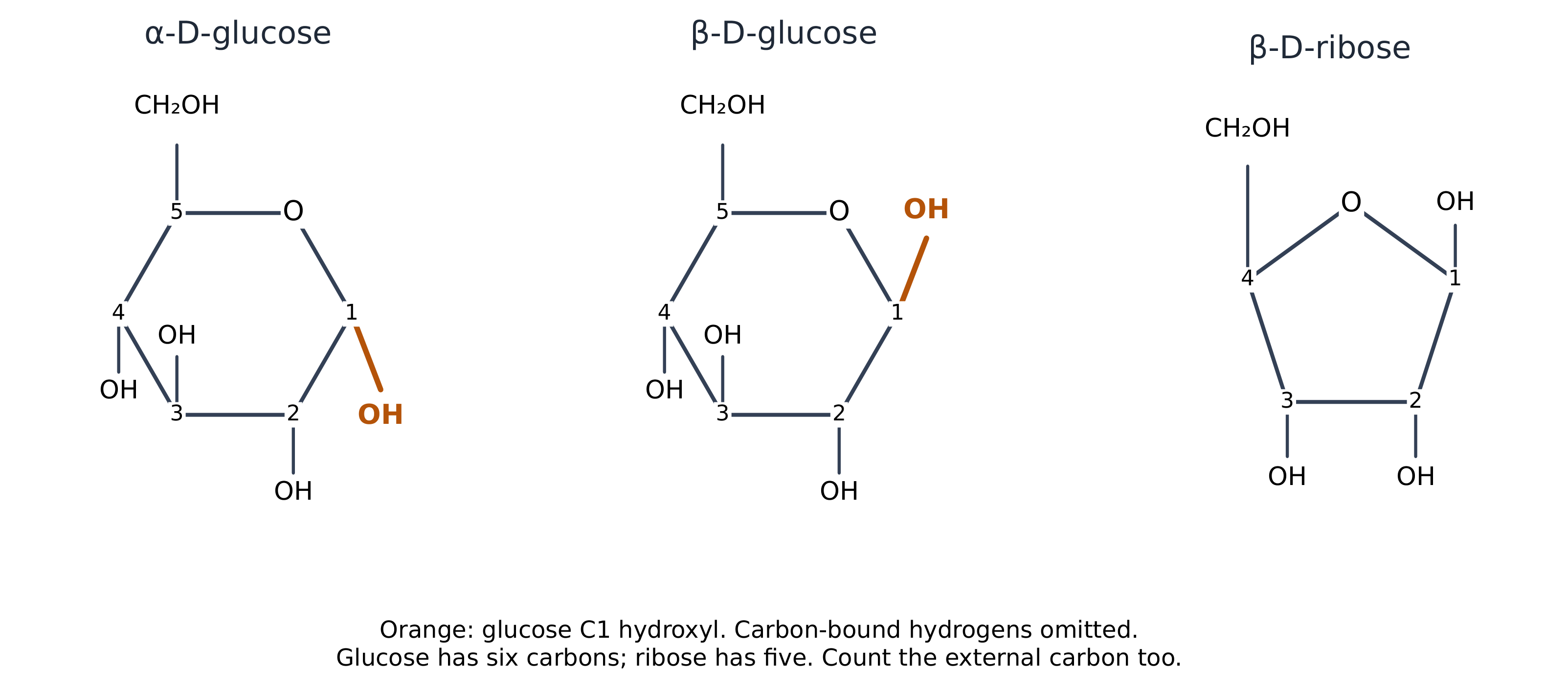
A sugar ring contains five carbon atoms and one oxygen, with one additional carbon outside the ring. Which conclusion follows?
Dificuldade 1/5 · Moedas 100 + pequeno bônus na primeira conclusão hoje
Count all carbon atoms, including the external carbon, and distinguish oxygen from carbon. Ring size alone does not give the total carbon count.
Connect glucose properties to transport and use
- Glucose has several hydroxyl groups that interact with water, supporting solubility and transport in aqueous fluids. It is sufficiently stable for controlled handling, while enzymes catalyse its metabolic reactions. Oxidation through respiration can support ATP production; simply dissolving glucose does not produce a useful burst of energy.
- Many separate dissolved glucose molecules contribute to osmotic effects. Combining many residues into a relatively insoluble storage polymer reduces the number of dissolved particles contributed by that store and helps retain it in a cell. It does not abolish every osmotic effect or stop all movement of water.
Compare glucose storage polymers
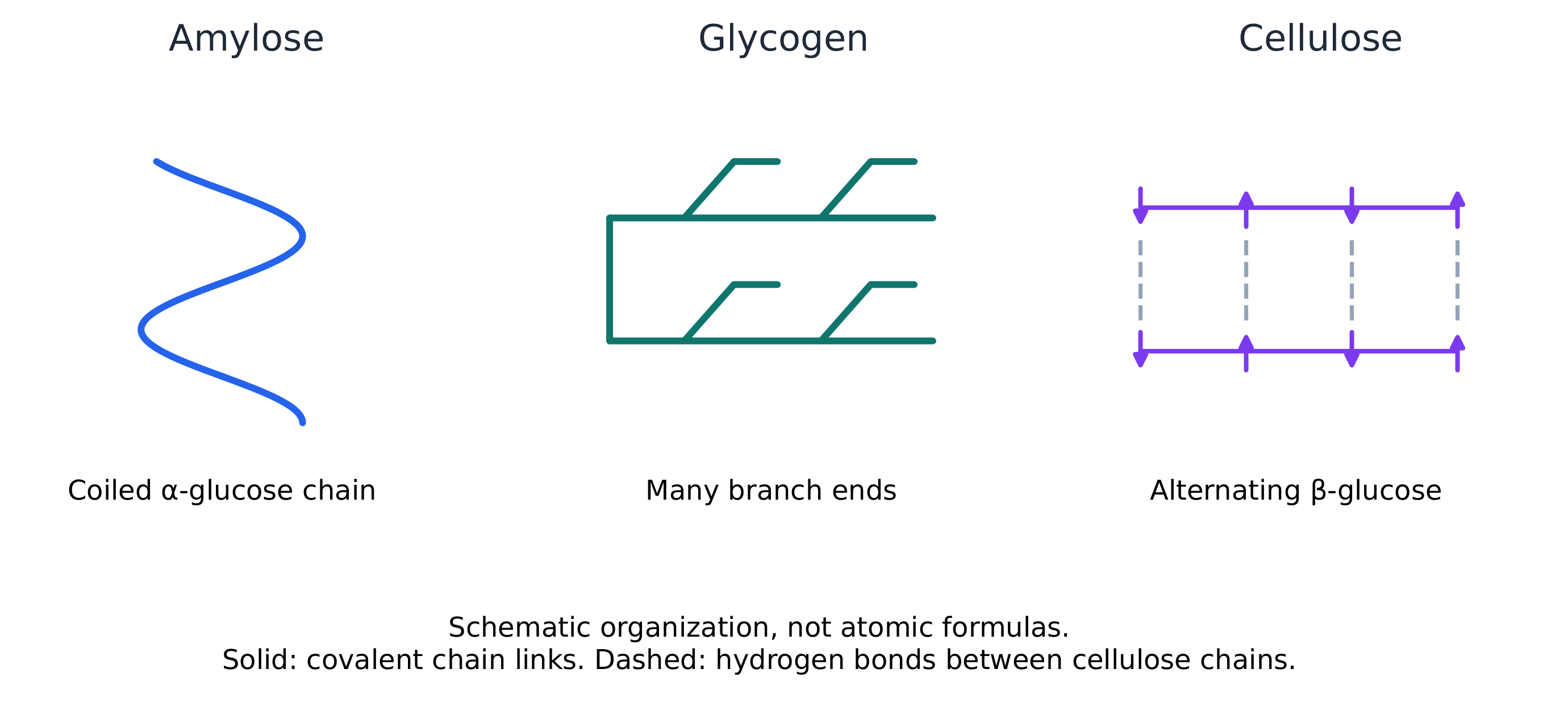
- Plant starch contains amylose, with mainly unbranched alpha-1,4 chains that coil, and amylopectin, which also has alpha-1,6 branch points. Animal and fungal glycogen is more highly branched. Coiling and branching support compact storage; relative insolubility helps retain granules rather than many dissolved glucose molecules.
- Branch ends provide sites for controlled addition or removal of residues. A branch point is where a side chain begins; it is not a free chain end. Hydrolysis can ultimately supply glucose for respiration, but enzymes and regulated cellular conditions control mobilization. The polymer does not decide when the organism needs energy.
Explain cellulose strength through two bond types
- Cellulose contains beta-glucose residues linked by beta-1,4 glycosidic bonds, with alternate residues oppositely oriented. Straight chains lie alongside one another in microfibrils. Covalent backbones and hydrogen bonding between neighbouring chains together support high tensile strength in plant cell walls.
- A glycosidic link within a chain is different from a hydrogen bond between chains. Humans produce enzymes that digest suitable starch links but do not produce cellulase to hydrolyse cellulose's beta-1,4 links. Same glucose building unit does not mean same enzyme specificity. A strong cell wall is also different from the selectively permeable membrane.
Relate surface carbohydrates to recognition
- Carbohydrate chains attached to proteins form glycoproteins; chains can also be attached to lipids. Exposed sugar arrangements can be recognized by specific binding molecules. A small change in a terminal sugar can change recognition without changing every component of the membrane.
- ABO blood-group antigens illustrate this structural specificity: A and B have different terminal carbohydrate modifications on surface molecules. Group O lacks those A and B modifications, but not every antigen or membrane carbohydrate. This is a molecular recognition example, rather than a complete rule for clinical transfusion decisions.
Distinguish storage lipids from membrane lipids
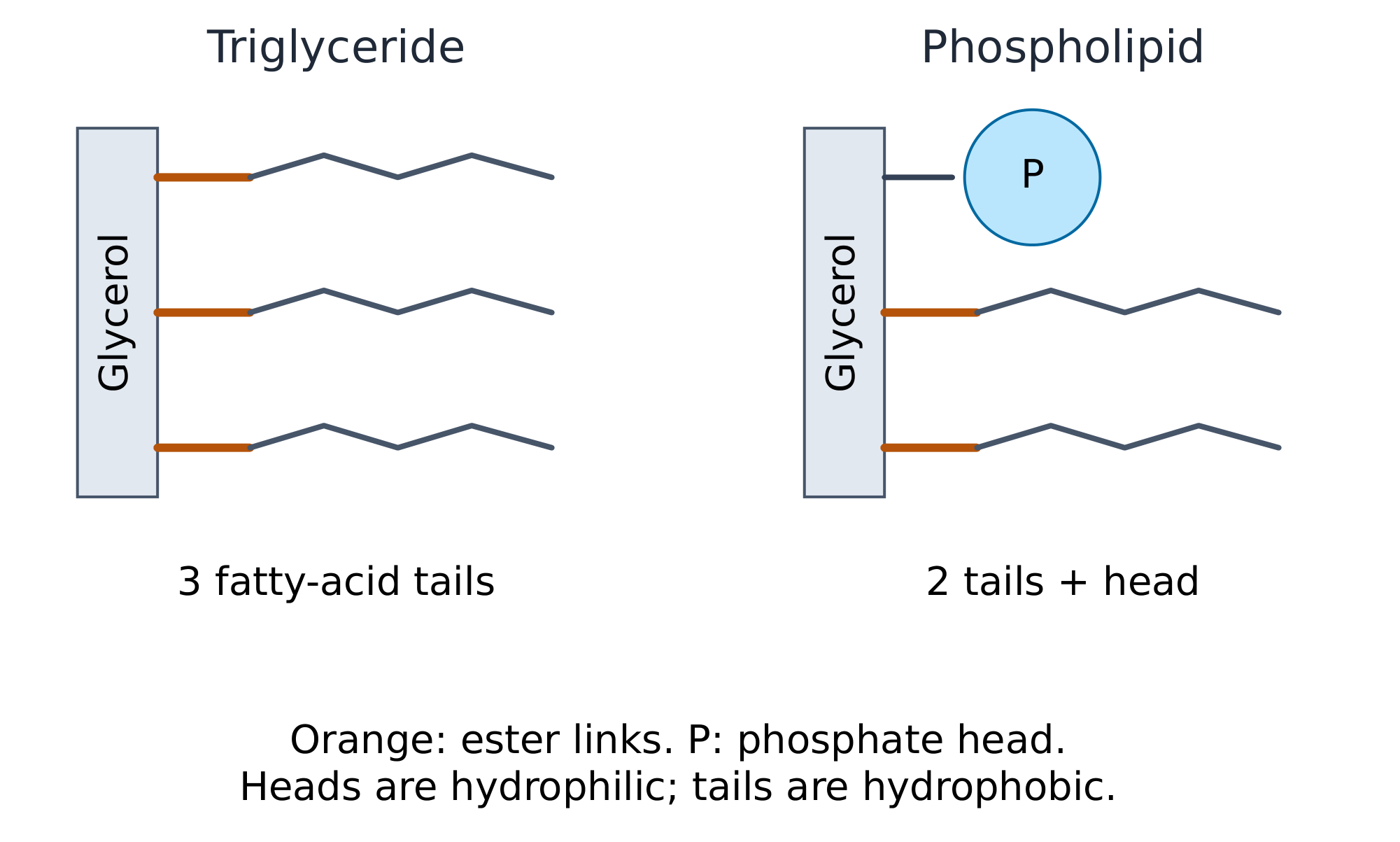
- A triglyceride consists of glycerol and three fatty acids connected by three ester links. In the simple esterification model, each link forms from a glycerol hydroxyl and a fatty-acid carboxyl group with one water released. Complete hydrolysis uses three waters and yields glycerol and three fatty acids.
- A typical glycerophospholipid has two fatty-acid tails and a phosphate-containing head group. It is not a three-tail triglyceride with an extra phosphate added. Much of a triglyceride is non-polar; the phospholipid has both a hydrophilic head and hydrophobic tails. These contrasting regions explain its behaviour in water.
Account for released water in mass calculations
- Use invented molar masses of 92 for glycerol, 256 for each of three identical fatty acids and 18 for water, all in grams per mole. Reactants total $92+3(256)=860$. Three ester links release three waters, so the triglyceride molar mass is $860-3(18)=806$ grams per mole.
- The products still total 860: triglyceride 806 plus water 54. Water has not vanished, and its mass is subtracted only once when finding the triglyceride. For two triglyceride molecules, six ester links form and six water molecules are released in this accounting model; do not apply the polymer rule “units minus one” to these unlike components.
Use the stated invented molar masses: glycerol 92, each of three fatty acids 256, and water 18, all in grams per mole. Find the triglyceride molar mass after three waters are released.
Dificuldade 2/5 · Moedas 140 + pequeno bônus na primeira conclusão hoje
92 + 3 × 256 − 3 × 18 = 806 grams per mole. The products comprise 806 triglyceride plus 54 water, conserving the original total of 860.
Explain how saturation affects packing
- A saturated fatty acid has no carbon–carbon double bond; monounsaturated has one and polyunsaturated has more than one. Cis double bonds introduce bends. For comparable chain lengths, these bends hinder close packing and generally lower melting point. A trans double bond has a different geometry, so not every double bond produces the same bend.
- Chain length, cis/trans geometry, mixture composition and temperature all matter. Many plant oils are liquid and many animal fats more solid at room temperature, but these are tendencies rather than universal rules. Identify the molecules and stated temperature instead of inferring physical state from plant or animal origin alone.
Compare equal energy and the mass actually carried
- With invented energy yields of 38 kJ per gram of lipid and 17 kJ per gram of dry carbohydrate, storing 380 kJ requires 10.0 g lipid or about 22.4 g dry carbohydrate. If this model assigns 3 g associated water per gram of carbohydrate, its hydrated mass is $4(380/17)=89.4$ g, to three significant figures.
- Triglycerides have high energy yield per mass and are stored with little associated water, supporting long-term stores. Adipose tissue also slows heat transfer from a warmer body to colder surroundings; insulation does not itself generate heat. Carbohydrate stores remain useful: accessibility, mobilization and physiology matter alongside energy density.
An invented carbohydrate store supplies 17 kJ per gram dry mass. It must store 190 kJ and carries 3 g water per gram dry mass. Find the total hydrated mass to three significant figures.
Dificuldade 2/5 · Moedas 140 + pequeno bônus na primeira conclusão hoje
Dry mass = 190/17 grams. Total mass is dry mass plus three times that mass of water: 4 × 190/17 = 44.7059… grams, or 44.7 g. Keep unrounded intermediate values; the supplied hydration ratio is a model assumption.
Orient a bilayer with water on both sides
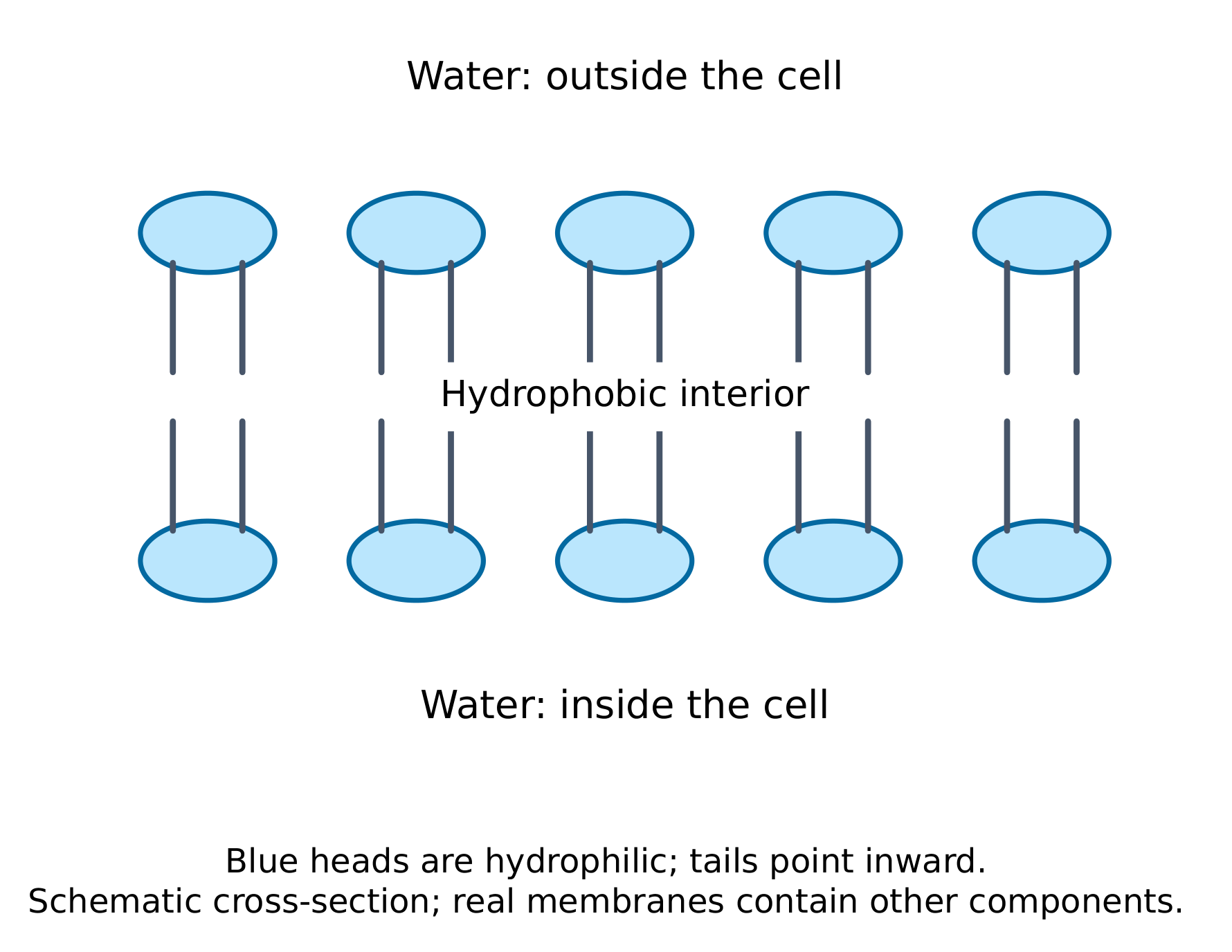
- A phospholipid is amphipathic: its head interacts with water while its largely non-polar tails associate away from water. A bilayer has heads facing the aqueous solution on both surfaces, and tails facing one another inside. Water exists both outside the cell and in its cytoplasm.
- The hydrophobic interior limits passage of many ions and polar substances; it is not absolutely impermeable to every molecule. Membrane proteins and other components modify the real membrane's properties. Bilayer formation follows molecular interactions under suitable conditions, rather than a molecule choosing where it wants to point.
Recognize steroid rings and specific responses
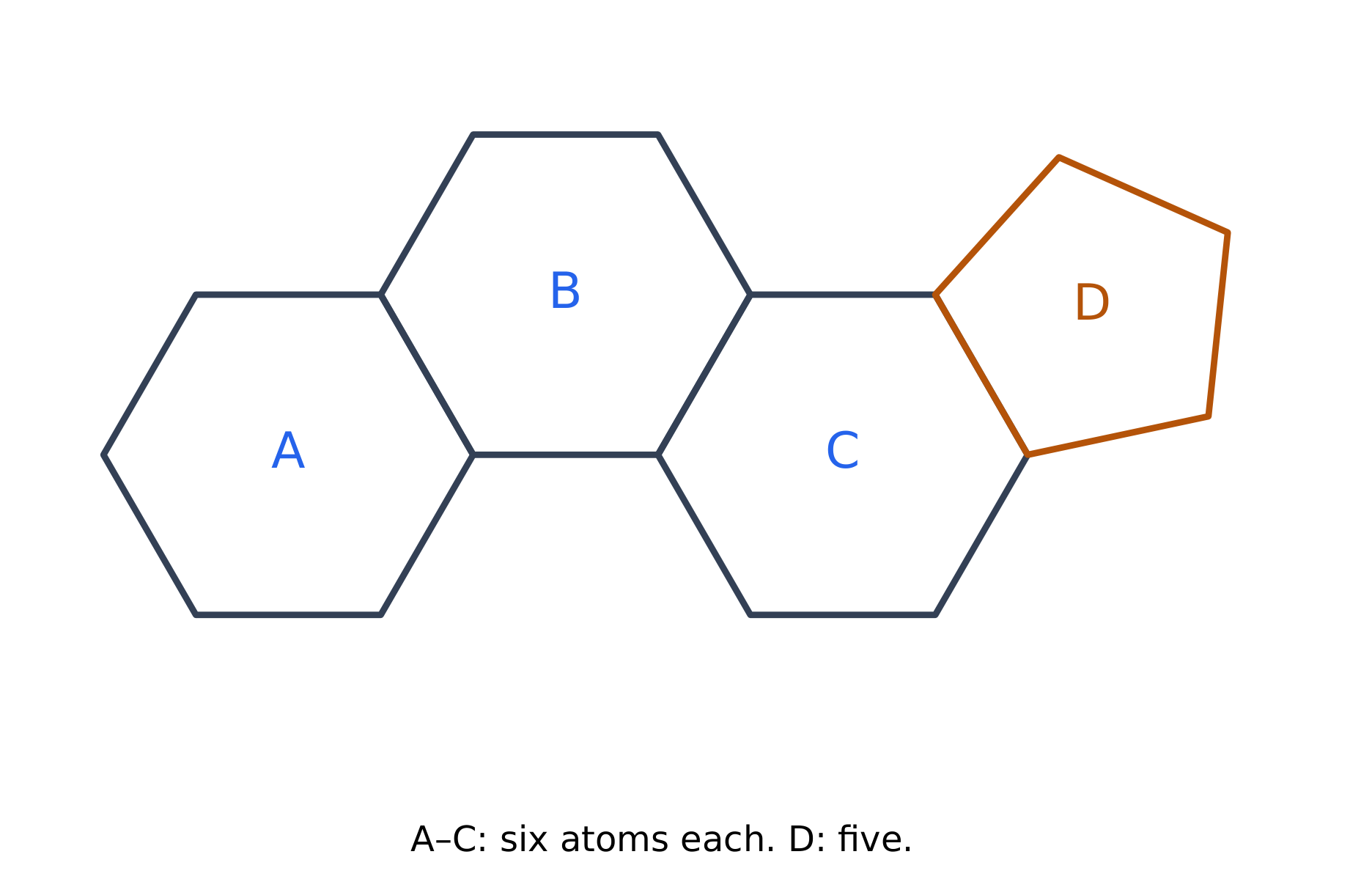
- Steroids share four fused carbon rings: three six-membered rings and one five-membered ring. Fused rings share atoms and bonds, rather than being four separate circles. Side groups and bond arrangements distinguish steroids such as oestradiol and testosterone; both can contain oxygen as well as carbon and hydrogen.
- Their overall lipid solubility permits passage through a phospholipid bilayer. This does not imply that a charged ion crosses equally easily or that every cell responds identically. A specific hormonal response also requires an appropriate receptor and cellular machinery. Passage through a barrier and recognition of a signal are different steps.
Build a structure-to-function explanation
- For an invented seed, explain an oil store through triglyceride structure, high energy yield per mass and little associated water. Explain its cellulose wall through straight beta-glucose chains and their hydrogen-bonded associations. Naming “lipid” or “carbohydrate” without the structural mechanism is incomplete.
- Check the comparison: a cell wall is not a phospholipid bilayer; denaturing a protein is not automatically hydrolysing its backbone; glucose polymerization is not triglyceride assembly. Use the bond type, molecular organization and environment to justify each function instead of assigning every molecule of one broad class the same role.
An invented seed stores oil and has cellulose-rich cell walls. Explain the different structures and their functions, and distinguish both from a phospholipid bilayer.
A structure–function explanation connects a named bond or arrangement to its physical interactions and biological consequence.
Draw the shared amino-acid framework
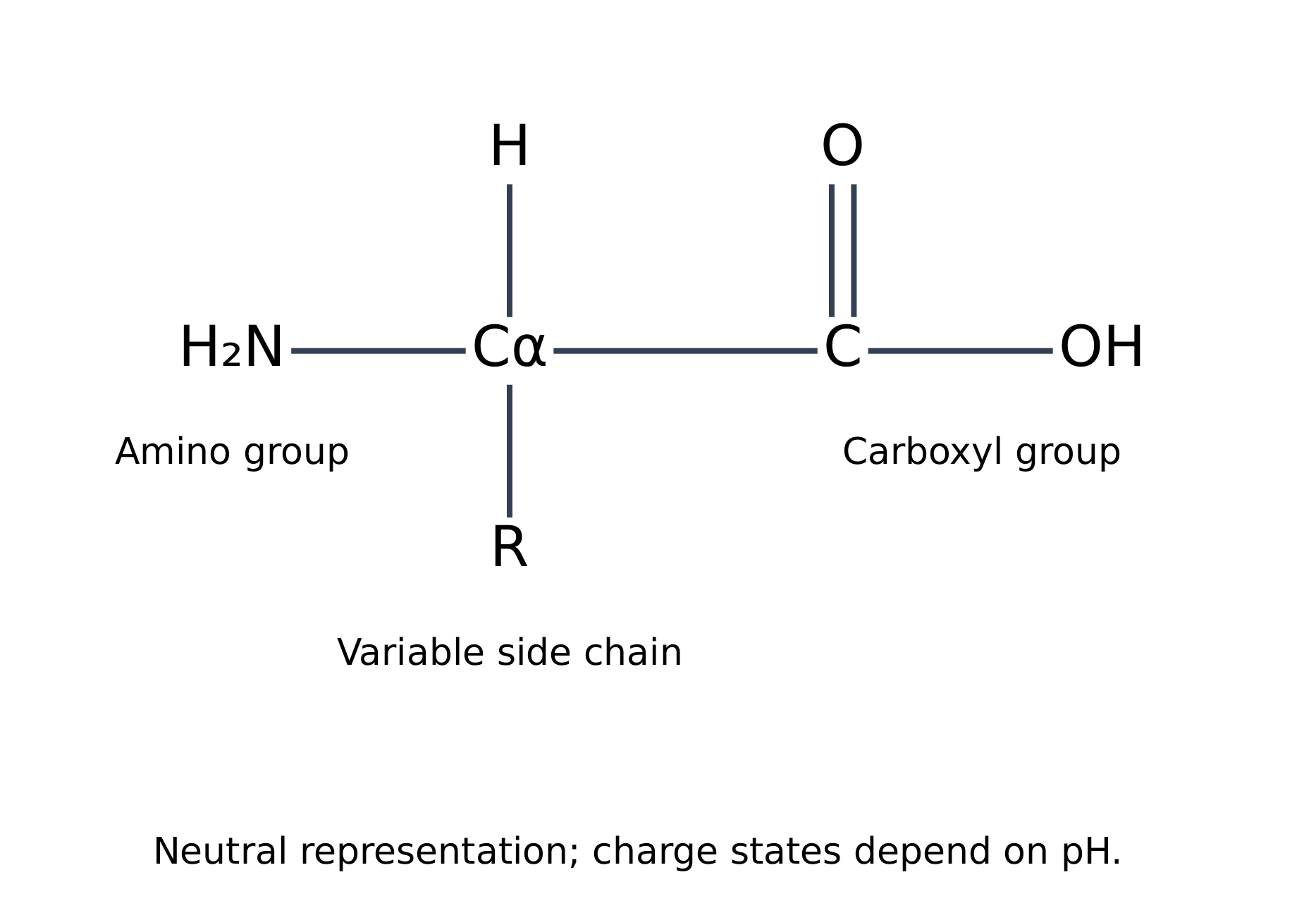
- An amino acid used in a protein has an alpha carbon attached to an amino group, a carboxyl group, H and a variable R-group. R means a side chain, not an element. In glycine, R is H; the alpha carbon then has two hydrogen attachments. Other side chains differ in size and chemistry.
- A neutral drawing shows an amino group and a carboxyl group with its carbonyl C=O and hydroxyl on the same carbon. In solution, groups can gain or lose hydrogen ions, changing charge with pH. Follow atoms and bonds rather than replacing the carboxyl carbon with an oxygen or putting every attachment inside R.
Identify the actual peptide linkage
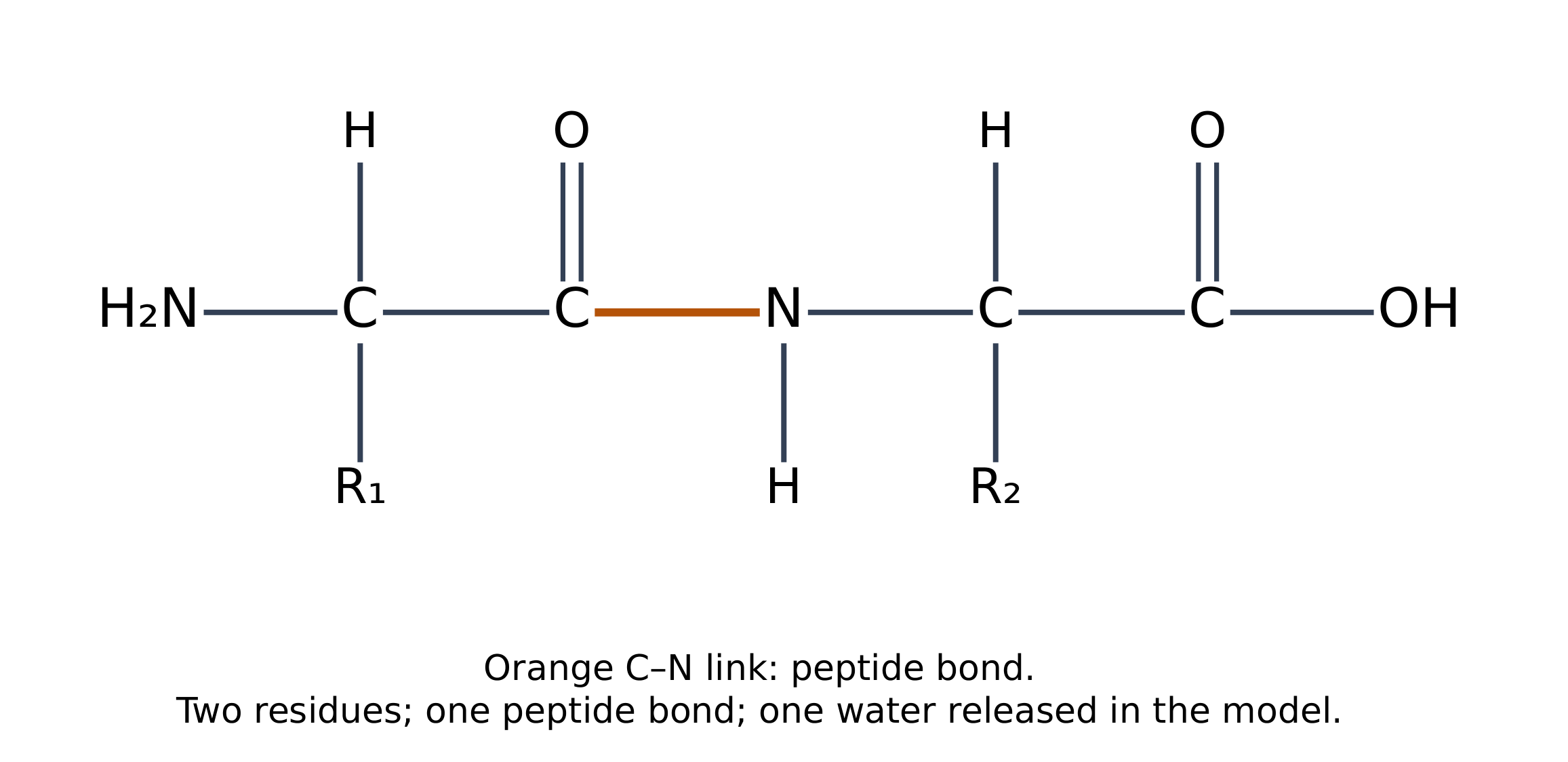
- In the simple condensation model, a carboxyl group from one amino acid and an amino group from another form a peptide C–N link. OH from the carboxyl group and H from the amino group account for the released water. A carbonyl remains beside the new link, and each R-group remains on its own alpha carbon.
- One linear 120-residue chain contains 119 peptide bonds. Two separate chains of 12 and 18 residues contain $11+17=28$; joining their ends adds one peptide bond to make 29. Holding chains together through other interactions does not add that backbone link. Real cellular synthesis uses ribosomes and activated substrates, beyond this accounting model.
Distinguish essential from unnecessary
- Digestion breaks dietary proteins into absorbable products, including amino acids used for new protein synthesis. Eating a muscle protein does not insert the intact protein into a matching muscle. Cells build their own proteins using amino-acid supplies and their own gene expression.
- An essential amino acid must be obtained from food because the body cannot synthesize enough. Non-essential means the body can synthesize it, not that it is unnecessary. Foods supply different amino-acid proportions. A varied vegan diet can supply essential amino acids; total protein mass alone does not establish an adequate supply of every required type.
Find the supply that limits complete chains
- In an invented model, each peptide requires two X residues and three Y residues; all other resources are abundant. With 50 X and 60 Y, X permits 25 copies but Y permits 20. Therefore only 20 complete copies form, leaving $50-2(20)=10$ X residues and no Y.
- Always compare the supplies divided by their own requirements, then take the smaller whole-number capacity. A large supply of X cannot replace missing Y in a specified sequence. Real synthesis also depends on other amino acids, energy, enzymes and regulation; this model treats those as non-limiting rather than proving they never matter.
In an invented model, each complete peptide requires 2 X residues and 3 Y residues. Supplies are 45 X and 72 Y, with everything else abundant. What is the maximum number of complete peptides?
Dificuldade 2/5 · Moedas 140 + pequeno bônus na primeira conclusão hoje
X allows floor(45/2) = 22 complete copies; Y allows 72/3 = 24. X limits production to 22, leaving 1 X and 6 Y. A fractional chain does not count as a complete copy.
Distinguish sequence from composition
- A primary amino-acid sequence has a specified order and direction. A–B–C and A–C–B have the same composition and length but different orders. With three permitted residue types, repetition allowed, a three-position sequence has $3^3=27$ possibilities. With 20 types and four positions, there are $20^4=160000$.
- The standard code specifies 20 common amino acids, not just 20 possible proteins. Different lengths and sequences permit enormous variety. Function still depends on suitable structure and conditions. Proteins include hormones and structural components as well as enzymes, while some catalytic RNA molecules are not proteins at all.
An invented sequence has four positions and three permitted residue types. Repetition is allowed. How many ordered sequences are possible?
Dificuldade 2/5 · Moedas 140 + pequeno bônus na primeira conclusão hoje
Each of four positions has three choices, so 3 × 3 × 3 × 3 = 3⁴ = 81. The order matters; identical composition does not establish identical primary sequence.
Separate unfolding from cutting a backbone
- Denaturation disrupts a protein's normal functional conformation and can cause loss of activity. Heat can disturb stabilizing interactions; changed pH can change group charges and their interactions. Ordinary denaturation need not hydrolyse peptide bonds, so sequence can remain while the working shape is lost.
- Cooking egg white causes unfolding and association into an altered network that ordinary cooling does not reverse. Some other proteins can refold under suitable conditions. Avoid both universal claims: not every denaturation is reversible, and not every protein permanently loses the ability to refold. Severe treatments can also cause damage beyond ordinary unfolding.
Which distinguishes ordinary denaturation from complete peptide-bond hydrolysis?
Dificuldade 1/5 · Moedas 100 + pequeno bônus na primeira conclusão hoje
Conformation, covalent backbone integrity and rate at a particular temperature are different observations. Test recovery under common assay conditions, and use product or structural evidence for stronger molecular claims.
Separate treatment from measurement conditions
- Invented equal enzyme samples are treated for five minutes, then all assayed at 25°C with the same pH, substrate concentration and measurement interval. Activities after 25°C, 45°C, 65°C and 5°C treatments are 100, 87, 20 and 98 units. The hottest treatment retains 20% of control activity, an 80% loss.
- Measuring all samples under the same final conditions tests persistent functional changes after treatment. A low rate measured while an enzyme is cold instead could reflect reversible slowing. Use independent repeats and an unheated control, and check evaporation, volumes and concentrations. Activity alone does not reveal the complete structure or identify exactly which interaction changed.
Equal enzyme samples are assayed under the same final conditions. The control gives 100 activity units and the previously heated sample gives 20. What percentage of the control activity has been lost?
Dificuldade 2/5 · Moedas 140 + pequeno bônus na primeira conclusão hoje
Loss = (100 − 20)/100 × 100 = 80%. Retained activity is 20%, which is a different requested quantity. These are activity percentages, not counts of broken peptide bonds.
Explain what the protein evidence permits
- Suppose an invented heated sample returns to the original assay conditions and retains 70% of the control activity. Report a 30% activity loss under that protocol. Do not conclude that 30% of every peptide bond broke or that 30% of every protein molecule unfolded: the activity measurement alone does not establish those molecular counts.
- A strong answer links the treatment, controlled assay, observed response and a qualified explanation. “Protein was destroyed” is too vague. Distinguish altered conformation, aggregation and hydrolysis; propose an additional structural or product analysis if the question asks which mechanism occurred.
Design a test of whether heating causes persistent loss of enzyme function after cooling. Explain what activity results alone can and cannot establish.
Comparable assays test persistent function, while molecular structure or products require additional evidence.
AHL: Put side chains in their chemical environment
- R-groups can be non-polar, polar without a net charge, or charged. Their positions influence packing, interactions and binding. A pH change can alter protonation and attractions between charged groups without changing the amino-acid sequence. A substitution's effect depends on its position and chemical difference, rather than every substitution abolishing function.
- A soluble globular protein often places many hydrophobic groups toward its core and hydrophilic groups toward water. A membrane-spanning surface instead presents hydrophobic groups toward lipid tails. A water-filled pore can have hydrophilic groups facing inward. Environment matters: “hydrophobic always means inside the protein” is not a universal rule.
AHL: Which side-chain arrangement is consistent with its environment?
Dificuldade 1/5 · Moedas 100 + pequeno bônus na primeira conclusão hoje
The surroundings determine which groups face water or lipid. The effect of a substitution depends on the position, chemical difference and function being measured.
AHL: Locate regular secondary-structure bonds
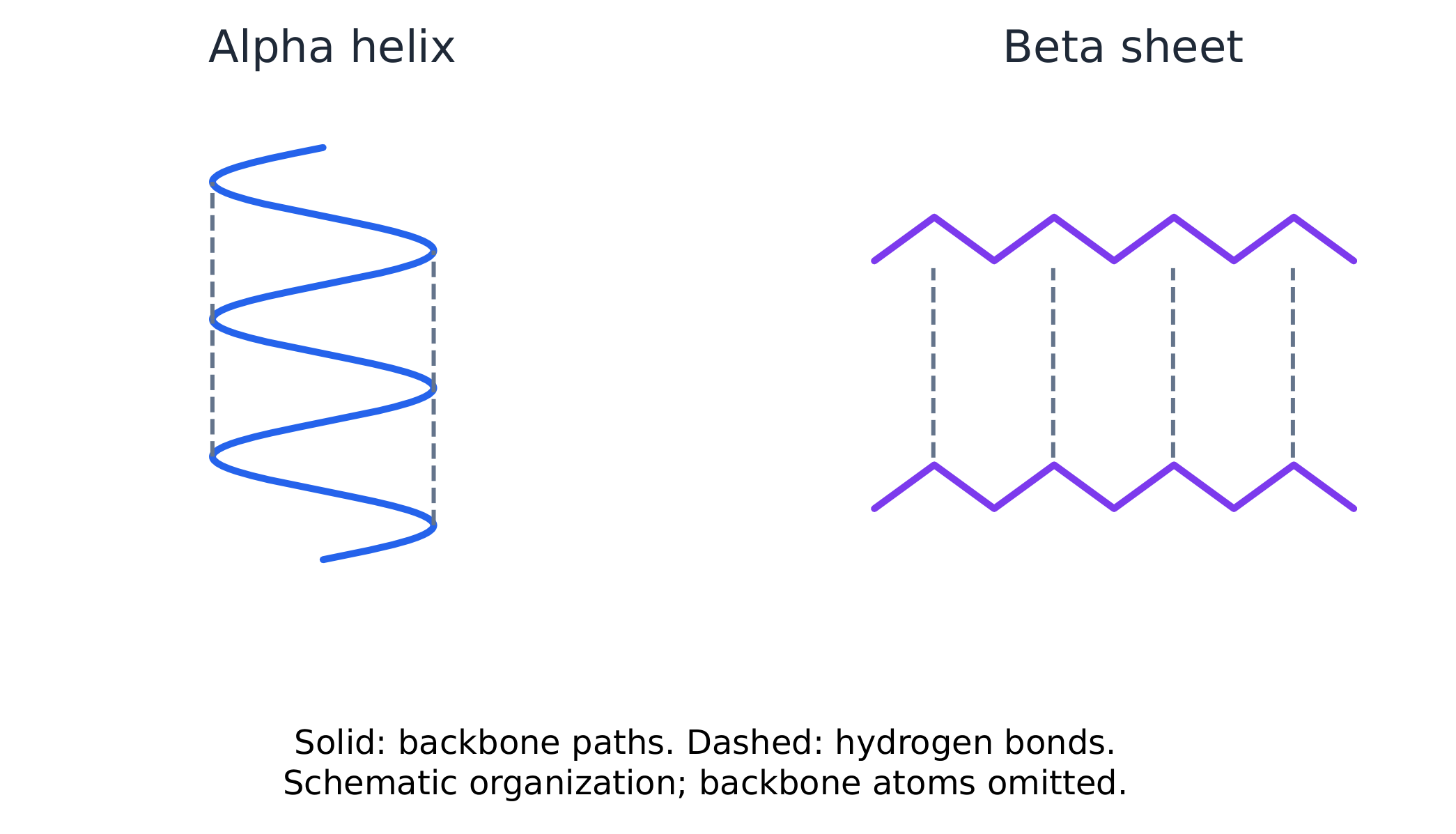
- An alpha helix coils a local segment of polypeptide backbone. A beta sheet contains extended strands, from different regions of a chain or different chains. Hydrogen bonds between suitable backbone carbonyl oxygens and amide hydrogens stabilize their regular arrangements.
- These stabilizing hydrogen bonds are different from the covalent peptide bonds connecting successive residues. They are not simply a row of R-group-to-R-group links. Side chains influence which arrangements are favoured, but the repeated pattern in this secondary-structure model concerns the backbone.
AHL: Explain the overall fold of one chain
- Tertiary structure is the overall three-dimensional arrangement of one polypeptide, including how helices, sheets and other regions pack. Hydrogen bonds, ionic interactions and hydrophobic interactions contribute. Disulfide bonds are covalent S–S cross-links between suitable cysteine side chains, rather than weak hydrogen bonds.
- A disulfide can connect regions of one chain or different chains; it is not a peptide bond. Proteins are dynamic, and conformational change can be part of function. Folding can require cellular assistance. A sequence constrains possible interactions but does not ensure the same functional structure in every solvent, temperature or pH.
AHL: Count chains separately from associated groups
- Quaternary structure describes the arrangement and association of two or more polypeptide chains. Each chain has its own sequence and conformation. A one-chain protein can have tertiary structure without quaternary structure; a non-protein component is not an extra polypeptide chain.
- In this classification, a conjugated protein contains an associated non-protein component needed for normal function, such as a prosthetic group. Non-conjugated does not mean one-chain, unfolded or lacking covalent cross-links. Shape, chain number and conjugation are separate features, so classify each from the evidence provided.
AHL: Use insulin to count discontinuous backbones
- Mature human insulin is a compact hormone with an A chain of 21 residues and a B chain of 30. Disulfide links stabilize its structure, including links between the chains. Its structure supports specific receptor binding. The RCSB insulin activity distinguishes mature chains from the precursor.
- Count peptide bonds in each chain: $(21-1)+(30-1)=49$, not 50. Side-chain disulfides do not supply the missing backbone bond. Mature insulin is the non-conjugated globular example here; zinc-associated storage assemblies are a different level of organization, rather than making each A–B pair a six-chain hormone.
AHL: Mature human insulin has separate chains of 21 and 30 residues, connected by side-chain disulfide links. How many peptide bonds do its two backbones contain in total?
Dificuldade 2/5 · Moedas 140 + pequeno bônus na primeira conclusão hoje
(21 − 1) + (30 − 1) = 49. Subtract one for each separate backbone; disulfide bonds are not additional peptide bonds.
AHL: Connect collagen fibres to tensile strength
- A collagen molecule contains three polypeptide chains wound into a triple helix. Glycine occurs at every third position in the triple-helical region and allows close packing. Associations and cross-links in fibrils help create structures that resist pulling, fitting roles in tendons, skin and supporting tissues. See the RCSB collagen account.
- This fibrous, non-conjugated comparison differs from compact insulin. A collagen triple helix is not an ordinary alpha helix simply renamed because there are three chains. Chemical modification of residues does not automatically mean a separate prosthetic group has been added. Explain the specific organization and the force it resists.
AHL: Relate haem groups to reversible oxygen binding
- Main adult human haemoglobin has two alpha and two beta globin chains, each with an iron-containing haem group. Each haem binds one oxygen molecule reversibly, so one fully occupied haemoglobin binds four oxygen molecules. Haemoglobin is globular and conjugated, with quaternary chain organization. See the RCSB haemoglobin account.
- Four globin chains plus four haem groups do not equal eight polypeptide chains. Oxygen atoms and oxygen molecules are also different counts. Structural methods such as X-ray crystallography and cryogenic electron microscopy support molecular models; a ribbon cartoon summarizes a model rather than being a light-microscope photograph or proof that a protein is flat.
AHL: Match each protein example to its organization and role.
Dificuldade 2/5 · Moedas 140 + pequeno bônus na primeira conclusão hoje
Count polypeptide chains separately from prosthetic groups. Shape, conjugation and chain number describe distinct structural features.