Seu plano de estudos · Continuar · Revisar →
要不 … 吧 (como seria se… / que tal…)
IntroduzidoSua posição salva fica neste navegador. Retomar não conclui a lição nem responde às perguntas.
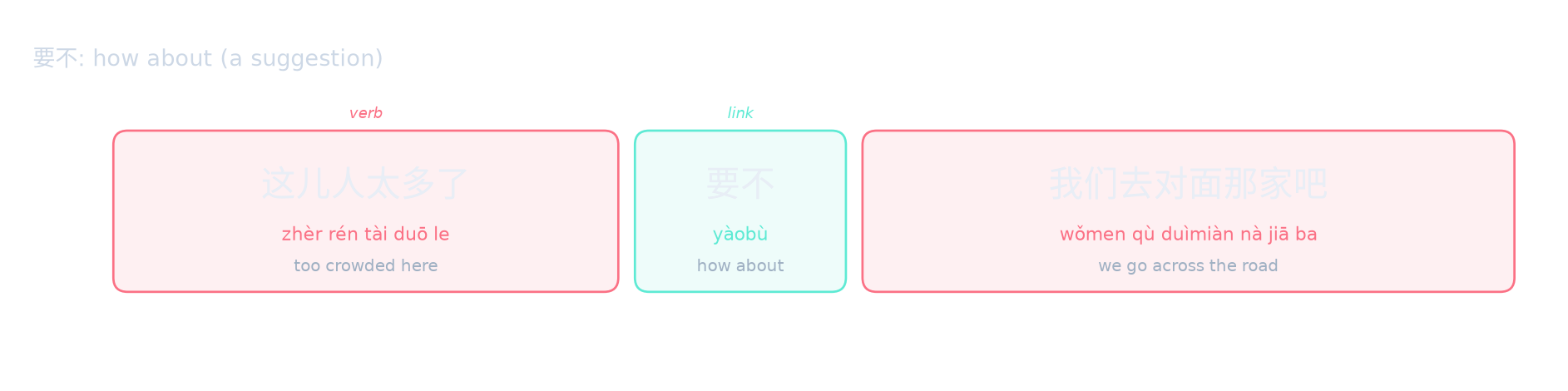
Too crowded here
- You and a friend walk into a café, and every table is taken.
- here这儿人太多(completed / change)了,want / will / need要not不we我们to go去opposite对面that那home; family家(suggestion)吧。 — "It's too crowded here; how about we go to the one across the road?"
- Goal: make a suggestion with want / will / need要not不…(suggestion)吧 ("how about …").
want / will / need要not不 + suggestion + (suggestion)吧
- want / will / need要not不 at the start of a clause offers an alternative: "how about …, or else …".
- (suggestion)吧 at the end keeps it a soft suggestion: want / will / need要not不tomorrow明天to say again再说(suggestion)吧 — "How about we talk about it tomorrow?"
how about要不we我们tomorrow明天then再talk about it说吧。
Suggest: “How about we take a taxi?” ____我们打车吧。
Dificuldade 1/5 · Moedas 100 + pequeno bônus na primeira conclusão hoje
要不 + suggestion + 吧.
After a problem
- afternoon下午maybe / possible可能to rain下雨,want / will / need要not不we我们(把: marks the object)把the picnic野餐to change改to / arrive到indoors室内(suggestion)吧。 — "It might rain this afternoon; how about moving the picnic indoors?"
- want / will / need要not不 often follows a reason why the original plan doesn't work.
how about要不we我们把the picnic野餐move to改到indoors室内吧。
Build: “It might rain; how about moving the picnic indoors?”
Dificuldade 3/5 · Moedas 200 + pequeno bônus na primeira conclusão hoje
Reason, then 要不 + suggestion.
want / will / need要not不 versus if it were not for要不是
- if it were not for要不是 = "if it weren't for": if it were not for要不是you你to remind提醒I / me我,I / me我then / just就to forget忘(completed / change)了 — "If you hadn't reminded me, I'd have forgotten."
- otherwise要不然 = "otherwise": fast; soon快to walk走,otherwise要不然then / just就to arrive late迟到(completed / change)了 ("Hurry up, or we’ll be late"). Different from the suggestion want / will / need要not不.
What does 要不是你帮我,我就完了 mean?
Dificuldade 1/5 · Moedas 100 + pequeno bônus na primeira conclusão hoje
要不是 means “if it weren't for”: it introduces a condition contrary to fact. 要不是你帮我,我就完了 “If you hadn't helped me, I'd have been done for.”
要不然 means “otherwise”.
Dificuldade 1/5 · Moedas 100 + pequeno bônus na primeira conclusão hoje
True. 要不然 (also 要不) means “otherwise”: 快走,要不然就迟到了 “Hurry up, otherwise we'll be late.”
want / will / need要not不 versus had better还是…(suggestion)吧
- had better还是…(suggestion)吧 recommends after weighing options: had better还是take坐the subway地铁(suggestion)吧 — "We’d better take the subway."
- want / will / need要not不…(suggestion)吧 tentatively offers a new idea: want / will / need要not不we我们take坐the subway地铁(suggestion)吧? — "How about we take the subway?"
we我们had better还是take坐the subway地铁吧。
Recap
- want / will / need要not不 + suggestion + (suggestion)吧 = how about …? (a soft new idea).
- if it were not for要不是 = if it weren't for; otherwise要不然 = otherwise.
Read the full reference: HSK 5 grammar — Conjunctions.
You and a friend walk into a café, and every table is taken. Close the examples. Say a Mandarin response, then write it in Chinese. Explain briefly in English what the lesson’s pattern adds. Compare with the model, then change one detail and try again.
This is supported productive practice. Compare meaning and structure; your answer need not copy the model. A partner or teacher must hear the spoken response to comment on pronunciation.